Showing posts with label Classics. Show all posts

Monday, January 10, 2022

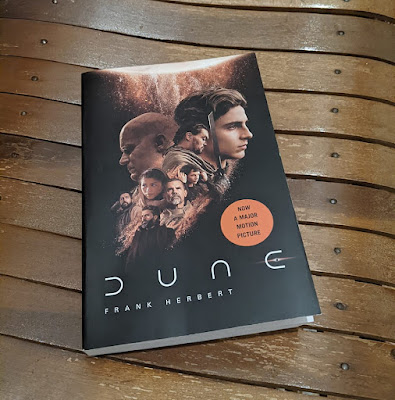
Dune by Frank Herbert


I think I'm going to feel silly saying anything at all about Dune by Frank Herbert after nearly a lifetime of hearing about it and wanting to read it; but, I've decided to go with a Q/A format. 

Warning: There may be some minor spoilers in this review. If you're planning to read Dune, soon, and don't want to take a chance of reading a spoiler, please skip down to the recommendation near the bottom of this post. 

What's Dune about?

The Emperor has instructed the Atreides family (the Duke, his concubine Jessica, and their son Paul) to leave their home planet and move to Arrakis, also known as Dune, where they'll be in charge of the spice trade. Spice is extremely valuable and it seems likely that the Baron Harkonnen, who was previously in charge of spice, will have set a few traps. 

Here's the Google description of the movies:

In the year 10191, a spice called melange is the most valuable substance known in the universe, and its only source is the desert planet Arrakis. A royal decree awards Arrakis to Duke Leto Atreides and ousts his bitter enemies, the Harkonnens. However, when the Harkonnens violently seize back their fiefdom, it is up to Paul [Kyle MacLachlan in 1984; Timothée Chalamet in 2021], Leto's son, to lead the Fremen, the natives of Arrakis, in a battle for control of the planet and its spice. Based on Frank Herbert's epic novel.

Have you seen the movie versions?

Yes, I saw the new Dune movie that only covers half of the book (almost to the page count) and then decided to watch the 1984 version, which I didn't see back in the 80s because I heard it was so awful. It definitely departed farther from the book than the new movie, which is both more accurate and a visual feast. But, in both cases the story kept us glued to the TV. 

Did the book meet your expectations?

Yes and no. It had more of a fantasy aspect than I was expecting, with the Bene Gesserit (the females often referred to as witches, of which Paul's mother, the Lady Jessica, is one) and their powers, then the rituals and rules of the Fremen (the desert people). I'm not big on fantasy but I like sci-fi and I was most interested in finding out the subtle details that can't be portrayed in a movie. So, I guess you could say I liked everything but the religious aspect, although I was fascinated by the way the author blended a bunch of religions and I definitely found myself thinking he either did some rocking fine research or simply had a huge knowledge base. 

Would you recommend Dune?

Absolutely. I know there are people who won't be able to tolerate it, for one reason or another (the somewhat confusing politics, the annoying made-up lingo), but I'm so glad to have finally read it! I felt like there was this Dune-shaped hole in my pop culture knowledge (there are a lot of other holes, unfortunately) and I found that it was an epic story with a huge depth and breadth that captured me in every form. Even as inaccurate and visually unappealing (often repellent) as the 1984 version of Dune was, the story still was compelling. 

What did you find surprising and special about Dune?

It was way ahead of its time in regard to ecological preservation. You don't get this from the movie (at least, not from the 1984 version) but the planet has at some point been ravaged and yet, in spite of being almost entirely desert, the indigenous people, the Fremen, are in the process of a plan to renew the planet that will take many, many generations. And, yet they know its value isn't in the harvesting of a single product. They also know how the spice is generated and have control over that, if need be. So, while I expected the political aspect because of what happens in the movies, I was most thrilled by the fact that it said a planet can be brought back from disaster if you have the patience and dedication. 

Did the book answer all your questions about the movies?

Yes, and then some. The one thing that I didn't get when I watched the movies was, "Why would Duke Leto take his family, his security team, and everyone else who ran their home and grounds to Arrakis if he knew spice was the most valuable thing in the universe?" Clearly Baron Harkonnen wouldn't willingly give up the planet's harvest. So, it seemed like kind of a set-up and I actually said that, as I was watching the first movie (the newer one). The book answers that question early on. Since a great deal of the book is internal and the newer movie is heavily visual, the movie does leave some questions lingering. But, there's much more to the book than either of the movies and everything was answered. 

Highly recommended - While I disliked the more fantasy-oriented aspects of Dune, it is such an amazingly detailed world and so incredibly plotted that I probably should have given it 5 stars just for the depth of detail. But, I took a point off for annoying made-up language. That's the thing I actually can't tolerate about fantasy, all the weird words and names and strange religiosity. I tend to have trouble remembering made-up language. I like sci-fi, though, and Dune is a blend of sci-fi and fantasy. So, while it will not become an all-time favorite classic for me, it was well worth the read and I still highly recommend it. At around 700 pages, it's a bit of a chunkster and surprisingly, I've come to enjoy sinking into a world for a longer time. I used to consider anything over 400 pages a chunkster and was a little terrified of those longer books. Not anymore. 

Because I like how and where the book ended, I don't plan to read any of the many sequels. However, this particular copy has an afterword by the author's son that made the continuation sound tempting. 

©2022 Nancy Horner. All rights reserved. If you are reading this post at a site other than Bookfoolery or its RSS feed, you are reading a stolen feed. Email bookfoolery@gmail.com for written permission to reproduce text or photos.

Tuesday, July 20, 2021

They Came Like Swallows by William Maxwell


They Came Like Swallows by William Maxwell is a fictional pandemic tale that takes place in 1918. I know not everyone can tolerate reading a pandemic novel during a pandemic but I routinely read about emerging diseases and wasn't horribly surprised by COVID-19, so I've had no problem reading both fiction and nonfiction about pandemics throughout the last year-and-a-half. 

In They Came Like Swallows, you view the changes in daily life, the annoyances, the rising fear, and tragic personal loss caused by the spread of Spanish Flu through the eyes of the two Morison children and one of their parents.

Stylistically, They Came Like Swallows reads a lot like a Persephone book. It was published in 1937, so that should come as no surprise. Both the writing and the storyline did surprise me in many ways, though. 

Viewing a pandemic through the eyes of a young child who overhears snippets of conversations, an older child who is frustrated by school closure and the inability to play with friends, a grieving adult, and others around them made for an unusual and well-rounded view of pandemic life through the lens of a single family. 

Highly recommended - There are so many parallels to what we've gone through, recently. There's even a man who complains about church closures. It was an eye-opening lesson in how things don't change. Heartbreaking but an exceptional read and there is, fortunately, a glimmer of hope at the end. 


©2021 Nancy Horner. All rights reserved. If you are reading this post at a site other than Bookfoolery or its RSS feed, you are reading a stolen feed. Email bookfoolery@gmail.com for written permission to reproduce text or photos.

Wednesday, July 14, 2021

Mini reviews: Summer by Edith Wharton, Remo: The Adventure Begins by Murphy and Sapir, and The Days of Abandonment by Elena Ferrante

I don't have a lot to say about any of these, so they get the mini treatment. 

I read Summer by Edith Wharton after Brittanie mentioned it in our online book group and I just happened to spot my copy as I was walking from one room to the next. Thanks, Brittanie!

Summer is kind of difficult to describe but it's about a girl named Charity who works in the library of her small town, lives with a man who took her away from the mountain people out of kindness, and yearns for a more exciting life. 

Brittanie mentioned that the book was considered scandalous at the time it was published but, of course, the mentions of women of ill repute and a neighbor who was forced to go to the Big City for an abortion are only referred to in a vague way. They're obvious and yet obscured by the writing style of the time period. 

Charity, herself, ends up getting into trouble and throughout the book you feel like shaking her. She's aware of the scandal of her friend's sister's pregnancy but naive enough to put her trust in the wrong man. 

I enjoyed Summer but felt like the ending was completely implausible. Still, I'd recommend it. Wharton's writing is stunning. I need to dig through my shelves and see if I can find the other book I know I have by her, The Glimpses of the Moon. I'm not sure if I have any other Whartons but I'll be keeping an eye out. 

Remo: The Adventure Begins by Murphy and Sapir is a companion novel to the 80s movie and I chose to read it after reading Hamnet. Because Hamnet was both melancholy and character-centric, I was in the mood for something plot-driven, pulp-fictiony, even a little stupid. 

Well, I got the stupid part. It actually takes a lot longer to get to the action scenes than I expected. The movie is better, although it's actually pretty bad, too, all "government out to get us so a shadowy organization must be created to kill dangerous people." The authors were imaginative but what they conjured up is ridiculous. 

As to Remo, he's a decent character and I particularly liked the strength of Major Fleming, who was played by Kate Mulgrew in the movie. I just wish the authors had managed to fit in more action. The movie does a good job of portraying the training of Remo Williams and his relationship to his Korean teacher. But, the book portrayal is actually a bit offensive. In hindsight, I doubt I'd have liked the movie as much if I knew early on that the role of the Korean teacher was played by a white guy. 

At any rate, unless you really are in the mood for something terrible, I do not recommend Remo: The Adventure Begins. Save yourself. Read something else. Anything. 

The Days of Abandonment by Elena Ferrante is a stand-alone novel by the author of the Neapolitan series (which I have not yet read). 

When the main character's husband abruptly announces that he's leaving her and walks out the door, she descends into madness and experiences the stages of grief before a tremendous climax leads to acceptance of her new life as a single parent. 

What a crazy novel. I gave it 3.5 stars for excellent craftsmanship and was particularly impressed with the way she built to the climax. I especially liked the scene in which her son is ill and so is the dog and it falls to her young daughter to try to bring down the fever of her big brother because Mom can't cope. I'm going to write a sentence about that favorite scene and the climax for posterity but make the text white so it won't be visible and ruin it for anyone (but you can highlight it if you'd like).

When the dog is poisoned, her son becomes violently ill, and the main character can neither get out of the apartment because of a difficult lock or call out for help because both her cellphone and home phone are non-functional, she finds her daughter putting wet pennies on her son's forehead to cool his fever. 

The biggest problem I had with The Days of Abandonment was that it was just too vulgar for my taste and I had trouble liking the heroine, even when she began to finally started to cope with life as a single mother, so I'm iffy on recommendation. And, yet, you can't help but notice the author's skill and it certainly made me look forward to the Neapolitan series even more. So I don't regret reading it (but it's going into the donation box). 


©2021 Nancy Horner. All rights reserved. If you are reading this post at a site other than Bookfoolery or its RSS feed, you are reading a stolen feed. Email bookfoolery@gmail.com for written permission to reproduce text or photos.

Monday, March 01, 2021

In Our Time by Ernest Hemingway


You're going to start thinking I read nothing but short stories, soon, after three collections in a row. This is the last one for a while, since I have screwed up and forgotten to read my daily short story for about a week. And, the collection I'm reading is a thick one that I'm not in love with. I may even ditch it and put it in the donation pile. 

In Our Time by Ernest Hemingway was Hemingway's first collection of short stories, published when he was still a fresh young thing at 25 years of age. It's a unique book. It starts with a vignette called "On the Quai in Smyrna" It's such a confusing bit of writing that I had to look it up online to see what on Earth was happening. And, it turns out that was a deliberate approach. 

From Spark Notes:

["On the Quai at Smyrna"] begins the collection by disorienting the reader. Ernest Hemingway makes this story by confusing by never establishing the setting or the characters. All he gives is a series of impressions and memories. This disorientation actually serves to orient the reader to the tone and flow of the stories to come. 

So, after looking that up I thought, "Great, I'm not going to understand a word of this book," but that did not turn out to be the case at all, although there were some stories that didn't make a lot of sense to me. The vast majority were his Nick Adams stories, which start with a young Nick accompanying his father to a childbirth and another with his father getting frustrated over the local Native Americans refusing to do a job for him. 

In the latter, the doctor wants the natives to hack up a tree that floated over to the Adams' property to prevent ending up with a rotting log on his shore. The doctor treats the local natives in exchange for odd jobs and thinks they're just trying to get out of doing work when one of the natives says he can chop it but there's a lumber company logo on the log and it's technically stealing, making the doctor rethink the job. Later, you follow Nick to war and around Europe and home, where he spends time in the woods. Not all of the stories are about Nick Adams but a good portion of them are and I thought they were surprisingly mature for such a young writer. 

In between the stories are more vignettes, often but not always war scenes. 

There's also a story about a jockey and his son and how the jockey becomes corrupt that I thought was pretty fabulous: "My Old Man". I marked a quote from that particular story and started to type it up before realizing that apparently I marked it because it had an offensive ethnic slur (used very casually) and that I probably flagged it to remind myself that there were numerous times I grimaced reading these stories because of similar words/racial slurs that were offensive. So, bear that in mind if you read it. 

Recommended but not a favorite - I am pretty much in awe of how skilled Hemingway's writing was at such an early age. But, while I appreciated the skill, I didn't love the stories. What I loved the most about In Our Time was the glimpse of Hemingway's early writing. It was particularly fascinating to find that everything Hemingway wrote was so very Hemingway from the beginning: bullfights, fishing, war, heaving drinking, frustrations with women. I've now read his first book and his last (unfinished novel) along with a few in the middle. Yep, Hemingway was just Hemingway, once and forever. 

©2021 Nancy Horner. All rights reserved. If you are reading this post at a site other than Bookfoolery or its RSS feed, you are reading a stolen feed. Email bookfoolery@gmail.com for written permission to reproduce text or photos.

Wednesday, October 02, 2019

The Size of the Truth by A. Smith, Raise High the Roof Beam, Carpenters by Salinger, Collage and Construction by H. Weiss

Well. This is a hodgepodge. I looked back over the list of books I've read and found that there are 4 I haven't reviewed. One is The Mueller Report, which I think I'll start quoting, next week (you should see the number of flags in that book). The rest are random and none are ARCs; all were purchased at some point, so there's no need to say much.

The Size of the Truth by Andrew Smith is a middle grade story about Sam, a boy who fell down a well when he was 4 years old and was so traumatized that he didn't speak for years. While he was in the well, he encountered a talking armadillo.

Now 11, Sam has been moved 2 grades ahead and is feeling traumatized all over again. Everyone is bigger, especially James, the boy Sam blames for his fall into the well. Sam's father wants him to go to the science and math magnet school and MIT but Sam wants to be a chef. Gym sucks and the teacher seems to hate him. Everyone is making him feel like he has no control over his life.

As the present-day story is told, the tale of Sam's time in the well with Bartleby, the talking armadillo, unfolds. Of course, the armadillo was all in his mind (or was it?) The Size of the Truth is a fun read and all the way through the book I was so convinced that the armadillo was real that I kept stopping myself to question how on earth it was that someone had managed to convince me a clearly-not-real character was, in fact, real and not a figment of the child's imagination.

I do recall having a bit of trouble with the fact that the 4-year-old knew so much, including how to swim. But, obviously Sam is a pretty sharp kid or he wouldn't have been bumped up 2 grades. I still had trouble swallowing his level of knowledge, although I shouldn't because I knew a little girl who was that far ahead of her age range at 5.

Recommended - Smart and entertaining with some terrific lessons. I particularly liked what Sam learned about James and how memories can be distorted.


Raise High the Roof Beam, Carpenters and Seymour, an Introduction by J. D. Salinger is a book of two novellas (I think), which I read during a weekend readathon. I posted a couple photos of the book to Instagram but chose not to do any updating at the blog because I figured it would be too time-consuming and the whole idea was to read as much as possible, after all. There's something very real about Salinger's writing and the moment I read that opening paragraph, I was hooked. I loved "Raise High the Roof Beam, Carpenters". I love the Glass family and it was nice to revisit them.

"Seymour, an Introduction" was a bit more philosophical, much like Franny and Zooey but without the nice stretches of description in which the family is just being human, so I didn't care for the second story as much. The great thing about Salinger was his straightforward descriptive ability and characterization. The awful thing was that he was too smart for his own good. I find his philosophical meanderings exhausting. But, it was great to go back in time and learn a bit about Seymour, his love of poetry, and how he and his friend kept getting in trouble for going off to talk poetry when they were in the military. In general, I kind of adore Salinger.

I definitely recommend Salinger, in general, and particularly loved "Raise High the Roof Beam Carpenters", of the two stories.


Collage and Construction by Harvey Weiss is an ugly old book that I bought in the library sale so long ago that I didn't even recall owning it. I came across the battered copy while I was going through books, trying to find some to donate. It's a children's book that describes the difference between collages and constructions, gives examples by the author and other artists (often with photos of museum pieces), and describes how to come up with a theme, the items needed to create them, and the actual process of creating or building.

I looked up Harvey Weiss, after I finished reading the book. He was an interesting man. He wrote quite a few how-to books and I wouldn't mind finding more of them to read but they were mostly published a long time ago, like this one (1970 is the copyright date). I also looked up some of the artists whose works were included and I'd like to read more and see more of one of those artists' works. I'm still not buying from Amazon but it's a book of one of the featured artists' work that I might break my boycott for . . . eventually.

At any rate, the book was fascinating and informative enough that I'd probably keep it if I didn't need to get rid of books and it didn't happen to be so grubby. Recommended, if you can find a copy.

©2019 Nancy Horner. All rights reserved. If you are reading this post at a site other than Bookfoolery or its RSS feed, you are reading a stolen feed. Email bookfoolery@gmail.com for written permission to reproduce text or photos.

Wednesday, April 17, 2019

The Awakening by Kate Chopin


There were strange, rare odors abroad -- a tangle of the sea smell and of weeds and damp, new-plowed earth, mingled with the heavy perfume of a field of white blossoms somewhere near. But the night sat lightly upon the sea and the land. There was no weight of darkness; there were no shadows. The white light of the moon had fallen upon the world like the mystery and the softness of sleep. 

~p. 35 of The Awakening

Edna Pontellier is spending a lazy summer in her family's cottage near the beach at Grand Isle in Louisiana. Her children are mostly watched by an unreliable servant (the term used to describe this woman is archaic and, according to the site where I looked it up, now considered offensive) while Edna spends the bulk of her time hanging out with Robert, a single man who is around her age, talking, taking walks or listening to music, wading into the ocean. She is learning how to swim but is not quite comfortable going far out into the water and has a frightening experience, at one point.

Meanwhile, Mr. Pontellier spends most of his time either at his club or ignoring everyone, especially his wife. He's disinterested in her until and unless she steps out of line.

"Sometimes I am tempted to think that Mrs. Pontellier is capricious," said Madame Lebrun, who was amusing herself immensely and feared that Edna's abrupt departure might put an end to the pleasure. 

"I know she is," assented Mr. Pontellier; "sometimes, not often."

~p. 37

Nobody is bothered by the fact that a married woman is publicly spending her time with a single man. The neighbors all know each other, both through the proximity of their vacation homes and socially, when they're back home in New Orleans. Edna's clearly a daydreamer and Robert is willing to listen to her flights of fancy. She's lightened by his presence.

When she and Robert stepped into Tonie's boat, with the red lateen sail, mostly spirit forms were prowling in the shadows and among the reeds, and upon the water were phantom ships, speeding to cover. 

~p. 51


But, then Robert abruptly decides to go and seek his fortune with some friends when a business opportunity in Mexico arises. After he leaves, Edna is lost. She is in love with Robert, feels penned in by her husband's demands for a certain type of behavior, restless, and probably depressed. When they return to New Orleans, Edna's longing grows more pronounced. A friend is receiving letters from Robert, but he isn't writing to Edna.

When Mr. Pontellier leaves town for an extended business trip, Edna purchases a small house next to her home and moves in. There, Robert eventually comes to visit her. But, when he makes it clear that he's not going to indulge in an affair or attempt to break up her marriage, Edna makes a fatal decision.

Recommended - I am utterly fascinated that, upon finally reading this classic I've heard was considered so scandalous upon its publication, I discovered it to be so mild. It seemed to me less a book about a woman who desired to have an affair and more a novel about a women whose husband was completely immune to her charms to the point of torturous indifference. She was clearly not just capricious and whimsical, although Edna certainly was a woman who danced to her own tune. I think The Awakening is really a story about a woman who is so choked by convention that it leaves her chronically depressed. Would Robert have been able to save her from herself, had he been willing? Hard to say. The ending both shocked me and was expected, though. I felt Edna's pain throughout the reading. Loved Chopin's prose. There were several of Kate Chopin's short stories included with the copy I read. At least one of those had a shocking twist ending, as well, and I closed the book wishing I'd read The Awakening with a buddy or a discussion group.

©2019 Nancy Horner. All rights reserved. If you are reading this post at a site other than Bookfoolery or its RSS feed, you are reading a stolen feed. Email bookfoolery@gmail.com for written permission to reproduce text or photos.

Wednesday, February 27, 2019

Franny and Zooey by J. D. Salinger


Franny and Zooey is one of those secondhand classics that I spent years collecting (seriously, you should see my classics shelves; they're great) which then spent years collecting dust. Now that I'm back to challenging myself to read a classic read per month, I'm happy to be diving back into those particular shelves.

Franny and Zooey contains two sections: one from Franny's point-of-view and one from Zooey's, Zooey being a nickname for Zachary. In the first section, Franny's boyfriend comes for a visit but during dinner Franny slowly goes to pieces and by the end of supper she has collapsed. In the second part of the book, Franny is home after suffering the nervous breakdown during dinner with her boyfriend. Pale and tearful, she spends her time alternately crying and sleeping on the couch while her mother tries to feed her chicken soup and her brother attempts to talk her into understanding the source of her distress in order to knock her back to her senses.

There were two particular things I got out of the reading of Franny and Zooey. The first was that it's definitely a product of its time, with long-winded, philosophical dialogue and a bit too much superfluous swearing. The swearing felt unnatural to me in a way I don't recall thinking the swearing in Catcher in the Rye came off, possibly because it was Holden thinking or saying all the swear words in Catcher but the people around Franny who used a rougher mode of speech when she was the one going to pieces. Most of the characters chain smoked in public and private, as well -- something that seems odd in today's mostly smoke-free environment. The fact that religion and/or philosophy was at the core of Franny's breakdown also felt like it was a very time-sensitive thing. Maybe I'm wrong about that. Salinger did seem to enjoy writing about breakdowns, didn't he?

The second thing I got out of the book was that, yes, I do believe Salinger was pretty impressive. If you can tolerate the idea behind the book, which is a bit odd (the cause of the breakdown) and put up with the long-windedness of the dialogue, it's actually kind of hard to put down. I have a 1980s copy and by that point it was in its 45th printing. 45th!!! That's any writer's sweetest dream.

I had to become accustomed to Salinger's style, I confess. At first, the dialogue just exhausted me. But, then I found myself sucked in, partly because the Glass family's history was slowly revealed and it became clear in that onion-peeling plottish way that everyone was deeply affected by the loss of the eldest Glass son, Seymour, who was the kindest of the children and apparently the most sensitive as he died by suicide. I had no problem whatsoever keeping the Glass children distinct in my mind because the characterization was so sharply drawn, even though only Franny, Zooey, and their mother actually appear in the book.

Highly recommended - I do like Salinger. I'm one of those people who fall on the love side of the love/hate polarization of Catcher in the Rye readers, so while there were things I found awkward about Franny and Zooey -- the basis for Franny's breakdown being so weird (although, in the end, it's implied that the book was more of a mechanism for expressing her grief -- at least, that's how I saw it) and all the uncomfortable swearing, for example -- I found the Glass family fascinating and I wanted to know what would happen. What caused Franny to fall apart? What was Zooey trying to accomplish as he talked her through her breakdown and brought up the book that started it all? The ending is fabulous. In just a few pages, after you've finally gotten the idea that Franny's obsession with the book may be connected to her trauma over the loss of Seymour, at least tangentially, Zooey does something that helps to moor her and you just want to give him a hug for doing something so wise and comforting.

Somewhere, I've also got a copy of Salinger's Nine Stories, which I recall being stories of the Glass family. I'll have to see if I'm right about that. If so, I'll seek out my copy because I'd definitely like to read more about the Glass family.

In case you're wondering, I took a raft of photos of Franny and Zooey with various backgrounds and chose the one with Izzy partly because it's a moody book and both the cat's face and the lighting in this particular frame look kind of moody, partly because I just like pictures of cats with books.

©2019 Nancy Horner. All rights reserved. If you are reading this post at a site other than Bookfoolery or its RSS feed, you are reading a stolen feed. Email bookfoolery@gmail.com for written permission to reproduce text or photos.

Tuesday, February 05, 2019

Howard's End by E. M. Forster


That evening Margaret took decisive action. The house was very quiet, and the fog -- we are in November now -- pressed against the windows like an excluded ghost. Frieda and Helen and all their luggages had gone. Tibby, who was not feeling well, lay stretched on a sofa by the fire. Margaret sat by him, thinking. Her mind darted from impulse to impulse, and finally marshalled them all in review. 

~p. 51

Howard's End by E. M. Forster is a book I've meant to get to for literally decades, as is the movie. So far, I haven't had any luck finding the movie on any of the streaming channels we have access to, but I'm happy to have finally read the book for my January classic selection.

Howard's End is a delightful classic about two single women who are into the arts, intellectual pursuits, and travel. When Helen visits acquaintances from their recent travels and then the two women (Helen and her sister, Margaret) cross paths with a struggling man whose umbrella Helen accidentally absconds with, a chain of events is set off and at the center of it all is a house called Howard's End.

Since I haven't seen the movie and Howard's End is not one of those classics that people bring up in conversation regularly, I had no idea quite what I was getting into. I knew I liked the only other book I've read by Forster but even the trailer to the movie (the Merchant and Ivory film starring Helena Bonham Carter as Helen and Emma Thompson as Margaret) didn't tell me much, although I thought it hinted at sinister happenings. So, I was pleasantly surprised that there was occasionally a slightly comedic touch to the dialogue.

I'm not going to get into the plot because I'm sure it's been written about all over the place, but my favorite scene is one in which Margaret (I don't recall if Helen was present) attends a gathering of women in which they do an intellectual exercise. The set-up is that a millionaire has died. Each person is assigned an identity and then has to argue what should be done with the deceased's million dollars from the perspective of the identity given to them. So, one woman might have to argue from the perspective of the millionaire's son, another from that of a neighbor, and so on. I not only loved the scene because it was entertaining and thought-provoking but also found myself wishing I happened to hang out with people who liked playing that sort of mind game. The women in the novel had a great time and laughed a lot. Doesn't it sound fun? I'm sure there are board games with similar concepts but we don't currently have any friends that enjoy game nights, as we used to.

Recommended - The only reason I'm not giving Howard's End my highest recommendation is that sometimes the language of turn-of-the-Twentieth-Century England lost me. There would be some bit of dialogue with sentences that I'd have to read and reread or just blow past because I couldn't entirely follow them, although I always at least got the gist of what they were saying. I just didn't always understand the detailed meaning because of their dialect. At any rate, I thoroughly enjoyed Howard's End and a few passages that I couldn't completely follow were not enough to ruin the story in any way. Howard's End was first published in 1910. My edition (shown on a Fiona-cat easel) was printed in 1985. Chances are good that I bought it at a library sale but it definitely has been lurking on the shelves for a very long time.


©2019 Nancy Horner. All rights reserved. If you are reading this post at a site other than Bookfoolery or its RSS feed, you are reading a stolen feed. Email bookfoolery@gmail.com for written permission to reproduce text or photos.

Tuesday, January 08, 2019

Everything I didn't review in 2018, Part 1

I did a pretty good job of keeping up with reviews in 2018, so there are just a handful that I didn't get to. I think only 1 was received from a publisher. At any rate, sometimes I missed one so I'm going to briefly review them and move on to 2019.

Don Quixote by Miguel de Cervantes (the Edith Grossman translation, as shown) took me months to read but it was worth every minute. The classic story of a man who goes crazy and believes himself to be a knight errant is both funny and horrifying.

This edition contains both books. In the first, Don Quixote begins his adventure with his friend Sancho Panza. He's at peak madness toward the beginning and misunderstandings often lead to terrible beatings. It's not funny when Don Quixote, Sancho, and their animals are beaten. Those scenes are often fairly cringy. But, I was determined to finish Don Quixote, this time around (I think it was my fourth attempt? Maybe my third.) so I plowed on through the beatings and the stories within a story, which I found a bit frustrating, especially at first because they were so jarring.

The second book was a bit milder and ends sadly but feels like a proper ending.

Et voila! Finally, I can say I've read Don Quixote. And, I loved it. It was definitely a 5-star read and I'm so happy I stuck it out, this time around. I highly recommend the Edith Grossman translation. I think it made a difference; it was very readable and the footnotes were informative.

I Survived the San Francisco Earthquake, 1906 by Lauren Tarshis is the story of a young boy who is poor and bullied. When the Great Earthquake hits, he must use his wits to survive. And, when he discovers the boys who bullied him are in similar dire straits, he tries to band together with them.

I don't remember much about this story but I do recall two things:

1. I was expecting something more of a drama in real life, based on actual events -- not just a fictionalized tale that takes place during the real life event. That was disappointing to me. But . . .
2. It turned out to be such a terrific story (very plotty -- a lot happens) that I enjoyed the book immensely.

However, since I really prefer to read actual stories from history, even if they must be fictionalized to fill them out, I decided this series is not for me. That's fine. I was just curious about them. I bought two of the "I Survived" books and haven't gotten to the second. After I read it I'll donate them both to either a teacher or a school library. I gave I Survived the San Francisco Earthquake, 1906 a rating of 4/5.

Sam Wu is Not Afraid of Ghosts by Katie and Kevin Tsang is another story about a boy who's bullied. In this case, he's an Asian American who doesn't feel like he fits in. And, he has massive angst issues. Sam Wu needs to conquer his fears and he's determined to do so.

OK, to be honest, that's all I remember. I have vague memories of scenes but the book didn't stick with me and that's why I didn't get around to reviewing it in the first place. I also didn't love the story. That doesn't mean I disliked it; I think it was more a matter of bad timing. Ever since I read it I've been thinking I need to give it a second chance. The reading came right on the heels of another book that was targeted at the same age range and which I found absolutely hilarious. You know how you can't help but compare two books that are both marketed as funny when you read them close together? That's what happened with Sam Wu is Not Afraid of Ghosts.

I may read it again, soon, just so to see if my feelings about it were colored by the proximity of the reading to that other book, although, you should see the TBR in my head (I haven't gathered my TBR stack because I still have Kiddo in the Guest Room, where I usually do my book organizing). It's huge!

I gave Sam Wu an above-average score of 3.5/5 so I enjoyed it in spite of thinking it lesser than the other humorous middle grade book I read just prior. Sam Wu was sent to me by Sterling Books for review, so again . . . if I can fit it into my massive TBR I'll give it a second go.

©2019 Nancy Horner. All rights reserved. If you are reading this post at a site other than Bookfoolery or its RSS feed, you are reading a stolen feed. Email bookfoolery@gmail.com for written permission to reproduce text or photos.


Wednesday, May 24, 2017

The Plague by Albert Camus


When leaving his surgery on the morning of April 16, Dr. Bernard Rieux felt something soft under his foot. It was a dead rat lying in the middle of the landing. On the spur of the moment he kicked it to one side and, without giving it a further thought, continued on his way downstairs. Only when he was stepping out into the street did it occur to him that a dead rat had no business to be on his landing  [...]

~p. 7


In Oran, a city on the coast of Algeria, the citizens are only mildly alarmed by the appearance of dying rats, at the beginning of The Plague. First, a trickle of rats emerging from their hidden homes is taken by Monsieur Michel, the concierge of Dr. Bernard Rieux's building, as a sign that an unhappy tenant or a hooligan is leaving them for him to clean up after. But, then the rats begin to appear throughout the town. They stagger and then die, the number of dead rats growing until they're piled in heaps and the city struggles to keep up with their disposal. Then, Michel falls ill and dies in agony and gradually, the disease spreads.

Dr. Rieux is among the first to suspect that Bubonic Plague is the culprit. But, even he has his doubts and both the city officials and the other doctors in town are hesitant to declare an emergency for fear of panicking the citizens. As the crisis grows, eventually the city officials concede to the facts and begin to organize, separating the sick from the healthy, taking over schools and apartment buildings when the hospital overflows, and finally closing the town's gates to keep the disease from spreading beyond the town's walls. While news from outside the town walls becomes difficult to come by, local reporting focuses on the number of casualties, the shortages of food and other necessities, and the need for volunteers to help with the disposal of bodies. Slowly, the disease peaks and tapers off, leaving the survivors shaken but ready to return to normal. But, their world will never be quite the same.

During the time I was reading The Plague, I didn't give a lot of thought to the theory that the story is considered by many to be an allegory for the invasion by Nazis in WWII (there's another possibility about its meaning that I don't recall). The story is so focused on the logistics of the city's efforts to combat the plague, the doctor's efforts and exhaustion, and the longing for loved ones from whom many are separated that I found it a little difficult to step back and look at the big picture until after I finished the book. Instead, I observed it from the micro view of the individual characters and how the plague impacted their lives: a doctor exhausting himself, a journalist from elsewhere who desperately wants to escape Oran and return to his wife, a man with a small life but lots of optimism who has decided to write a book but can't get beyond the first paragraph, a tenant who attempts suicide and ends up unexpectedly thriving during the plague. The characters are pretty fascinating.

And then, well after closing the book, I got it. First, a few rats appear from obscurity and nobody is particularly alarmed. [Nazis appear but everyone thinks they'll fade away.] Then, the rats' presence explodes and they become problematic, but still the officials hesitate to acknowledge the danger. The rats' disease invades the city. [The city is invaded by Nazis.] The plague hits and people begin to die. [War.] Time passes and the plague continues to kill at a relentless pace; people are exterminated by the disease. [Hitler's extermination of Jews.] A small band of stalwarts continue the fight. Some are killed off. [Perhaps the Resistance?] Eventually, the plague ends and people celebrate, but things are not the same as they were before the plague. Many have lost loved ones and friends.

That may not be the best analysis but I can see how one might view The Plague as an allegory, now, whereas I was caught up in the emotion and the logistics while I was reading the book.

Recommended - A brilliantly written but ponderous story in which you can practically feel the painfully slow passage of time as a plague stretches out for months on end, locking citizens away from the rest of the world and separating many from their loved ones. Is it an allegory for WWII? I don't know. I'm not sure what the consensus is, either, as I only briefly skimmed information about the book. But, I can see now why people view it as such. The Plague was my classic choice for the month of April and won't be my last by Camus. I'm pretty sure I have a copy of The Stranger around here, somewhere. I'll be keeping an eye out for it.

For posterity: There was an interesting philosophy in few words that I want to write down for the sake of my own memory (so I can take the flags out of the book): "Big fish eat little fish." Interesting way of expressing "liberal ideas, as his pet dictum on economic questions". I won't comment on how I feel about it; I just liked the expression.

Last thought: The book could be a bit gruesome, at times, but Camus kept the more graphic scenes to a minimum, so it's not too bad if you're faint of heart and prefer not to read about the gory details of a ghastly disease.


©2017 Nancy Horner. All rights reserved. If you are reading this post at a site other than Bookfoolery  or its RSS feed, you are reading a stolen feed. Email bookfoolery@gmail.com for written permission to reproduce text or photos.

Wednesday, January 11, 2017

Mini Reviews - The Orphan's Tale by Pam Jenoff, Appointment in Samarra by John O'Hara, Wild Pork and Watercress by Barry Crump

Since I have so many reviews remaining from 2016 and another 2 to hit in 2017, I'm going to go ahead and revert to the mini review format, for now. If there are any books that I believe require more depth in reviewing, I'll save them for separate posts. I'll post my December reads, later today.

The Orphan's Tale is my first read by Pam Jenoff, in spite of the fact that she writes about WWII. I don't know what took me so long to get to her books. The story is about two women. Noa was kicked out by her family after falling pregnant at 16, the father of her child a Nazi soldier. Separated from her own child, she has saved a baby found in a freezing train carriage. Astrid was forced to divorce her Nazi husband and leave her home because of her Jewish heritage.

Astrid grew up in a German circus and her family has disappeared. When a neighboring circus takes her in she is grateful but haunted by the loss of her family and perpetually in danger. After Noa shows up with the baby and is also given refuge, Astrid reluctantly teaches her to work on the flying trapeze. When they travel across Germany and Noa falls for the son of a mayor who works closely with the Nazis while Astrid's boyfriend refuses to stop breaking the rules, the dangers sharpen. Will Noa and Astrid be able to keep each other and the baby safe?

There was a lot that I loved about The Orphan's Tale. I liked the fact that I learned about a new facet of life during WWII. I liked the fact that it focused on specific issues that were problematic for women. And, I thought the ending was both heartbreaking and beautiful. There were a couple problems I had with the book, though. The main one was stylistic. The author used the passive voice and it took me ages just to learn to stop mentally rewriting sentences. So many had dones and had beens. The Orphan's Tale needed a dedicated editor to shift its prose away from the passive voice. The other problem was minor: I really don't like circus settings. I thought I would be okay with a circus setting and I did enjoy learning about what it was like within that kind of setting during WWII, but it still was not a setting I enjoyed and I occasionally found myself bored with the details of training someone to be an aerialist.

Recommended but not a favorite - I'm glad I read The Orphan's Tale and I will happily read more by Pam Jenoff but there were some minor frustrations. Definitely a unique setting for WWII and solid storytelling. Crucially, the ending felt perfect in a way few endings do.

Appointment in Samarra by John O'Hara - My classic choice for December, I knew Appointment in Samarra was not going to be a happy tale. I'd read about it a bit and the fable about death finding a merchant in Samarra makes it clear that the ending will not be a pleasant one. But, the writing is superb and I was quickly swept into the story.

Julian English finds one of the members of his club particularly annoying and thoughtlessly tosses his drink in the man's face. The next day, his wife Caroline talks Julian into going to apologize to Harry Reilly, the victim, but Harry is unwilling to see him. It then begins to become clear just how much damage Julian has done to his standing. Slowly, Julian begins to unravel, in the process throwing away everything he's worked for and ruining his closest relationships. What will happen to Julian and Caroline?

Well, the fable makes it pretty obvious but it's still just a bit shocking, in the end.

Highly recommended - Sad as it is, Appointment in Samarra is impressively written and when I look back at 2016's classic choices, I have a feeling it will be one of my favorites.

I ordered a copy of Wild Pork and Watercress by Barry Crump after watching the movie Hunt for the Wilderpeople and finding out that it was based on a book. I love watching a movie and comparing it to the book (better that way than reading the book first and being disappointed, actually) and they were definitely poles apart, although both are set in New Zealand - so, at least the book didn't suffer the fate of being Americanized.

Ricky Baker has been taken in by his Aunt Bella and Uncle Hec. At 12 years old, he's overweight and has spent much of his life being shuffled about. Aunt Bella is warm and loving, a great cook, and happy to step in as a surrogate mom. Uncle Hec is a curmudgeon and former inmate. When Aunt Bella dies suddenly, Hec is heartbroken and decides to head into the bush. But, Ricky will be sent back into foster care if Uncle Hec doesn't take him along. Reluctantly, Uncle Hec agrees to let Ricky come along.  They head into the bush to hide out till Ricky turns 16, when he'll be free of the social system.

That's the book version and they do, in fact, succeed in hiding out for about 2 years, sometimes while being pursued by authorities. Ricky and Uncle Hec make a single friend while on their adventures and Ricky becomes an expert hunter. Because the book is a survival story in which they hide out for literally years, it's quite different from the lighthearted comedy film. But, both are terrific in their own ways. The book is wonderful for being a survival story that ends mysteriously, the movie for its sense of humor. Both describe a building relationship with heart and they both have meaningful, yet extremely different, endings.

Highly recommended - I ordered my copy of Wild Pork and Watercress from Book Depository and it was shipped from Australia. Then, it became available on Amazon. Oh, well. It was worth the wait. I enjoy survival stories and it was fun mentally comparing the book with the movie, as I read. Wild Pork and Watercress has the feel of a YA because Ricky tells the story, although I'm not sure how it would be shelved in New Zealand.

©2017 Nancy Horner. All rights reserved. If you are reading this post at a site other than Bookfoolery  or its RSS feed, you are reading a stolen feed. Email bookfoolery@gmail.com for written permission to reproduce text or photos.

Saturday, August 13, 2016

Good-bye, Mr. Chips by James Hilton


My copy of Good-bye, Mr. Chips by James Hilton shows off its age with the hyphen in the word "good-bye". I just finally noticed this, today. The copy shown is an illustrated "Junior Deluxe Edition" printed by Little, Brown in 1962. Because it's technically novella length and it doesn't appear to have been watered down in any way, I'm certain the "junior" aspect is the addition of illustrations, rather than any editing to suit a younger crowd.

I saw the movie Goodbye, Mr. Chips (no hyphen in that title!) as a child and fell in love with its warmth. Like another book I recently got around to reading decades after seeing the movie version, The Prime of Miss Jean Brodie, the story stuck with me, but in a vague way. I knew it was about an elderly man who spent many years teaching and I remembered that he died in the end. Otherwise, the details were lost to time.

But, unlike The Prime of Miss Jean Brodie, I found the book every bit as satisfying as the memory of the movie. Miss Brodie's teaching style is one I've always wished I had access to, but as an individual, her character suffered from an inflated ego and damaged judgment. Mr. Chips, on the other hand, grew in my estimation. He begins the story as a young classics teacher who is only average in his teaching method and not particularly a standout in any other way. But, then he marries a bright, younger woman who is full of energy, enthusiasm, and unexpected wisdom. Her joy and kindness rub off on Mr. Chips during their brief marriage; and, because of her he becomes a favorite of the students. After retiring, he continues to stay involved in the lives of the children, inviting new students to his small home for tea and keeping track of them well into adulthood. He returns to teaching during the Second World War and steps aside when it ends.

Because it's novella length, Good-bye, Mr. Chips is not very detailed. He'll recall, for example, the time a young boy set a mouse loose in the choir loft but the reader is left to imagine what kind of chaos a mouse in a choir loft might have entailed because there's absolutely no description at all. The book is focused on the fact that he grew from a relatively boring teacher to one who was beloved, whose sense of humor was set free, who was changed immensely and made a better person by the touch of a single person's love, even though her presence in his life was short-lived. It's really a lovely story.

Highly recommended - Originally written and published in a magazine, Good-bye, Mr. Chips is a short and tightly written story that is gratifying and heartwarming. I'm glad I finally got around to reading it.


©2016 Nancy Horner. All rights reserved. If you are reading this post at a site other than Bookfoolery  or its RSS feed, you are reading a stolen feed. Email bookfoolery@gmail.com for written permission to reproduce text or photos.

Tuesday, April 19, 2016

The Bell Jar by Sylvia Plath


I chose The Bell Jar by Sylvia Plath as my classic for April because I've wanted to read it for years and I was so excited when I found my copy in a box that had not yet been unpacked from our move, 3 1/2 years ago. I couldn't wait to dive in.

The Bell Jar is Sylvia's fictionalized account of her own story, beginning with her month working for a magazine in New York City. Because I've read about this time period in Pain, Parties, Work by Elizabeth Winder, I was surprised to find that it felt like I'd already read the book. I didn't realize the nonfiction account I've already read covered the same time period fictionalized in The Bell Jar.

On the plus side, I did enjoy finally getting a glimpse of why everyone thought Sylvia so brilliant. Her prose definitely sparked with her own unique turn of phrase; she was clearly a talented writer. Somewhere around here, I have a volume of her poetry and I'm looking forward to that even more, now that I've gotten a glimpse of her writing.

On the negative side, The Bell Jar is truly, deeply disturbing. It's one thing to read about Sylvia Plath and the various theories about what exactly, during that fateful month, may have set her on the downward spiral that led to a suicide attempt and treatment that sounds more terrifying than the depression; it's another to read it through her eyes. It's not heavily fictionalized; it hovers very close to the actual events, including an attempted rape that she successfully fought off.

Recommended for the writing and to help understand depression but with a warning - I thought Sylvia Plath did an excellent job of actually showing the agony of depression and how it leads to irrational thoughts and behavior. The scene in which she tosses her clothing off the roof of the hotel is one that I think is particularly telling, as it shows her irrationality in a vivid, effective way.

Reading The Bell Jar, then, may help those who simply don't get depression to at least get a glimpse of its complexity, particularly those who consider the depressed and their attempts at suicide "selfish" or think people take their own lives specifically to get back at people who have caused them pain (a simplistic viewpoint that places blame on the victim without attempting to understand the emotions involved). However, I do think this book should come with a warning. It's so dark and despairing that it took two fairly light follow-up reads to get past the melancholy that it inflicted on me. Absolutely do not read The Bell Jar if you're already feeling blue.

©2016 Nancy Horner. All rights reserved. If you are reading this post at a site other than Bookfoolery  or its RSS feed, you are reading a stolen feed. Email bookfoolery@gmail.com for written permission to reproduce text or photos.

Tuesday, February 16, 2016

Cakes and Ale by W. Somerset Maugham


Hypocrisy is the most difficult and nerve-racking vice that any man can pursue; it needs an unceasing vigilance and a rare detachment of spirit. It cannot, like adultery or gluttony, be practised at spare moments; it is a whole-time job. 

~ p. 15

I stopped him. 'Edward,' I said. He looked startled. For a moment I could have sworn he did not know who I was. 'What avenging furies urge you with such hot haste through the rakish purlieus of Pimlico?' I asked.

~ p. 241

Cakes and Ale by W. Somerset Maugham is my third read by Maugham and my second classic read for 2016.

Told in first person, Cakes and Ale tells the story of how the narrator met now-famous and deceased author Ted Driffield when he was a boy and Driffield was married to a disreputable former barmaid, Rosie. Rosie was known for carrying on with just about anyone. The narrator, a writer himself, is asked by his friend Roy to share all he knows about Driffield to help fill some of the gaps in his knowledge about the author after the second Mrs. Driffield has asked Roy to write her husband's life story. But, neither Roy nor the second Mrs. Driffield want Roy to bother mentioning Rosie, the first Mrs. Driffield. So, the narrator recalls the truth of what he knows about Rosie.

Cakes and Ale jumps back and forth in time a bit, which can be a little confusing, and the ending is abrupt. But, I thought it was excellent. Rosie is a scandalous character but charming, as well. The narrator was entranced with her from his boyhood and, having spent a great deal of time with the Driffields over the years, understands her like no other living man. The book winks at the reality of how inaccurate a biography can be, based on the way an author chooses to portray his subject. By skipping past the years with Rosie, Roy has chosen to ignore the heart of how Driffield's characterization emerged. But, because the narrator of Cakes and Ale has secrets of his own, he doesn't go out of his way to correct Roy.

I noticed that the copyright page indicates that Cakes and Ale was originally entitled Skeletons in the Closet, a much more apt title because that's exactly what it's about -- the hidden events of both the author's and narrator's lives that are kept from view but which inform their lives.

In fact, I never could figure out quite where the title Cakes and Ale might have come from. Rosie is a former barmaid and Driffield liked to hang out at an unfashionable public house in his younger years, so I suppose that could be the origin of the "ale" in the title. But, the only time I recall reading anything about cakes was in the odd scene involving tea and cakes. There is one particular scene in which the narrator is persuaded to go to tea at the home of a woman whose influence can make or break an author. That scene took place after a crucial moment in the book (I don't want to give away the plot point) and the narrator had been working all day. He was extremely hungry but because he arrived late for tea, his hostess assumed aloud that he probably didn't want anything and the poor narrator sat there, hungry and thirsty, while she nibbled on the leftovers. That was a particularly irritating but telling scene, showing that many of the narrator's crowd thought it was perfectly fine using his friendship with Driffield for selfish purposes, so he was equally justified in sharing just enough to satisfy them.

Highly recommended - While I wouldn't call Cakes and Ale my favorite Maugham, it is nonetheless an excellent read that starts out slowly and gradually becomes more compelling. Rosie, in spite of her flaws, is a delightful character.


©2016 Nancy Horner. All rights reserved. If you are reading this post at a site other than Bookfoolery  or its RSS feed, you are reading a stolen feed. Email bookfoolery@gmail.com for written permission to reproduce text or photos.

Tuesday, January 26, 2016

Lolita by Vladimir Nabokov


Well, there's one more classic knocked off the miles-long To Read list. When I finished Lolita, I wrote about it on Facebook and was surprised to find that it's a book everyone wants to talk about. Cool, double the reason for sticking it out.

I confess, Lolita was both a fabulous read and a miserable one. I've always been impressed with Nabokov's precision. He was such a careful craftsman, very deliberate about choosing the perfect word and with such an outstanding vocabulary. He kept me hopping -- looking up vocabulary definitions and translations for all the French phrases. I can read a tiny bit of French but clearly not enough. I enjoyed the fact that I had a used copy of Lolita that someone had already written in. Normally, I don't write in books or dog-ear. It horrifies me if I accidentally bend a cover or dampen a page. So, it was delightfully freeing to realize that since someone had already written in my secondhand copy I could write definitions and translations inside the book, guilt-free.

I presume everyone knows what Lolita is about, but I'll write a brief synopsis. Humbert Humbert is a man who is sexually drawn to pre-pubescent girls, whom he calls "nymphets". He blames his attraction to young, underdeveloped girls on his tragic first love. But, at the same time, it's clear that Humbert's aware that he's not normal and when he attempts to suppress his desires or find a substitute he only succeeds in forcing himself into either violence or psychological breakdown. Humbert marries his landlord hoping to find a way to drug and fondle her daughter but when he's widowed, he is able to take young Dolores (or "Lo" or "Lolita") on a lengthy road trip, during which he justifies using her sexually on the fact that she already lost her virginity at camp. While Lolita clearly shows signs of being very unhappy, Humbert is so clouded by desire that he doesn't realize he is destroying her.

The most difficult thing about the reading of Lolita, I thought, was reading through the eyes of such a warped human being. No matter how low he sinks, he has some sort of explanation or defense. I think in the hands of anyone else, Lolita would have been awful but, oh, Nabokov. What a brilliant writer. I have to tell you it was such a relief to read the Afterword by the author, in which he talked about how the story came to him and then haunted him, the changes he made after writing a complete first draft and destroying it, the reaction of various publishers (one of whom said, "If I publish this, we'll both go to prison,") and the understanding of how deplorable his main character was. It was nice to know the author found his protagonist as creepy as readers do.

When I rated Lolita at Goodreads, I was torn between taking off points for the icky factor or rating it on its merits alone. In the end, I couldn't bear to give Lolita less than 5 stars because you have to admit that the reason Humbert is so appalling is that he's so believable. At one point, I wanted to take an interior picture of the book and realized that every single page had some nasty thought or quote by the protagonist. No wonder I had to take a break from it about halfway. Lolita is anything but easily palatable.

Highly recommended with a cringe - Challenging to read because of both its warped protagonist and the author's stellar vocabulary, but worth reading as a lesson in crafstmanship and certainly a book worth talking about.


©2016 Nancy Horner. All rights reserved. If you are reading this post at a site other than Bookfoolery  or its RSS feed, you are reading a stolen feed. Email bookfoolery@gmail.com for written permission to reproduce text or photos.

Wednesday, October 08, 2014

Catch-up #1: Of Mice and Men by Steinbeck, A Survival Guide for Life by Grylls, Tomorrow We Die by Grady

I had such a fantastic reading month in September that my sidebar has been taunting me for ages. Yes, true, I am under no obligation to write about every book I read (I do skip a book if I feel like there's nothing to say and the book in question is from my personal library). But, the whole point of blogging is to keep a record of what I've read and my thoughts about each of those books so I'm going to do some catch-up posts. The following were either recently purchased or on my home shelves. I absolutely loved and highly recommend all three.

Of Mice and Men by John Steinbeck - I just found out I'm not the only person in America who missed out on reading and discussing Of Mice and Men in school, yesterday! Whew! Good to know.

Short version of the storyline, lacking spoilers: Two friends travel around working odd jobs together. Lennie is intellectually challenged; George watches out for his friend. When they end up in trouble -- which invariably happens because Lennie has difficulty understanding boundaries and doesn't know his own strength -- George takes charge of their escape. When Lennie does something so horrific their lives are both put in danger, what will George do?

I love Steinbeck. For such a small book, Of Mice and Men certainly packs a wallop. Definitely one of my favorite reads of the year. I wish I'd read it in a group setting. When I closed the book, I was dying to discuss the moral dilemma.

I love Bear Grylls and have been thinking, "I need to read one of his books" for quite a while. So, when I indulged in some stress shopping in September I went in search of a book by Grylls. Any title would do -- and since I was looking at a discount website I took what was available.

A Survival Guide for Life by Bear Grylls is about achieving your goals, with focus on paying attention to what makes you happy, maintaining enthusiasm, dealing with adversity, working on strength of character -- really great advice. The author refers to the book as "self help" within its text. I'm not generally a fan of self-help because I've found the majority of such books are not particularly helpful or their effects are short-lived. However, I do love books on positive thinking and have several favorites that I periodically reread when I need an upper.

A Survival Guide for Life definitely falls into the "uppers worth rereading" category. Although much of Grylls' advice is common sense or already in practice here, there is still plenty to think about and his infectious can-do attitude just can't be beat. I haven't yet talked my youngest into reading the book because he's been reading business books recommended by his father while working on his second degree but I think there are aspects to A Survival Guide for Life that are particularly relevant to young people on the verge of entering the work force so I hope he'll find the time to read the book soon. In the meantime, I may even give it a second go. A Survival Guide for Life is definitely a book I plan to reread repeatedly. And, I would especially recommend it for those who need a little mental boost. It would also make a fabulous graduation gift. Bear Grylls is truly an inspiration.

I've already talked about Tomorrow We Die by Shawn Grady a bit, here, but without describing the storyline.

Jonathan Trestle is a paramedic working for a private ambulance service. When he's called to a cardiac arrest, he manages to revive the patient, an unkempt man who may have overdosed. Before the patient slips back into unconsciousness, he hands Jonathan a note and tells him to give it to Martin. Of course, Jonathan has no idea who Martin is.

There is so much going on in this book that I realize now why I didn't post a synopsis, before. First, there's the patient with the note. Jonathan tracks down the patient and goes in search of Martin. There's an old girlfriend Jonathan keeps running into; they have a lot of baggage but the mutual attraction is still there. His alcoholic dad is fading. Jonathan has flashbacks to his mother's death. And, when the ambulance company gets after Jonathan for not meeting the city's standard response time because there aren't enough ambulances to cover the quantity of calls coming in, he stumbles across a corporate cover-up that puts his life (and the lives of several other people) in danger.

I have a feeling there's more that I've forgotten but the bottom line is that Tomorrow We Die is action-packed, well paced and the pages absolutely flew. I loved this book. My only problem with it was that it could be a little too descriptive. But, that's something you just have to be prepared for when you're reading a book written by a paramedic. The things they see are not pretty. I'm currently reading Bringing Out the Dead by Joe Connelly (yet another novel written by a paramedic) and it is equally stomach-turning, at times, but I love this stuff. Tomorrow We Die was definitely the most exciting novel I've read by a paramedic, so far. We'll see how the next one goes.

©2014 Nancy Horner. All rights reserved. If you are reading this post at a site other than Bookfoolery  or its RSS feed, you are reading a stolen feed. Email bookfoolery@gmail.com for written permission to reproduce text or photos.

Wednesday, July 02, 2014

Time and Again by Jack Finney


Time and Again by Jack Finney
Copyright 1970
This edition: 2014 by Touchstone - Fiction/Time travel
Source: Simon & Schuster

I've been a Jack Finney fan for most of my adult life and have read absolutely everything I've managed to acquire by him. Time and Again is time travel classic I read quite a while ago and I've always meant to reread it but just haven't gotten around to doing so. When I was asked to review a reprint with a fresh, pretty cover, I jumped right on the bandwagon. I don't need a new copy but I figured it was a good excuse to reread the book.  

Brief synopsis:

Simon Morley is an artist at an advertising agency in New York.  He's not thrilled with his job or his life but he considers it comfortable and adequate. When he's approached about joining a government experiment, he's hesitant. Then, he hears the details. He will move into New York City's historic Dakota building -- a building that dates back to the late 19th century -- where he'll dress in clothing appropriate to the year 1882 and use self-hypnosis to transport himself to the past.

Simon has a lovely girlfriend who runs a failing antique store and there's a mysterious letter in her possession. Because of this mystery, Simon decides he wants to go back to the day the letter was mailed and observe as it's posted. Will Simon succeed at traveling to the past? What will he find there?

My thoughts:

I recall thinking the pacing in Time and Again was slow when I read it long ago and, yep, I was right.  There's a lot of detail. Finney himself admitted to becoming a little over-enthusiastic while doing his research. The net result is a book that is believable in its detail but a little bit slow off the block because Finney spent a great deal of time on set-up, explaining the government program and how it works before Simon finally manages to travel back in time.

It's not a spoiler to say that Simon succeeds.  The book wouldn't have been a time travel classic had its protagonist not managed to travel through time, after all.  But, there the questions begin. Can one travel through time without causing any damage to the present timeline? When Simon returns again and again, and discovers that he is not only more content in the past but also finds himself drawn to one of the women in the boardinghouse where he lives during his travels, what will happen?

Highly recommended - Still a favorite after all these years. While it takes awhile for the story to really crank up, once Simon begins to get involved in the past, his experiences become utterly fascinating. I felt transported back to 1882 and imagined myself traveling along with Simon, dressed in a wine-colored gown with a big, feathered hat. Time and Again is that kind of book.  I remembered less than I thought I recalled about the book but my memory was accurate to the general storyline so it was fun revisiting and living through the experience of Time and Again a second time. I absolutely love the way the story ends.

Side notes:  

  • One of the few things I remembered from the story was reading about the Dakota, a building that was so far out in the country when it was built that people said, "You might as well go to the Dakotas," it was so far away from the city. So, its name was actually a nickname based on that remark. The Dakota is on my wish-list of places to see on a future trip to New York City. 
  • Time and Again is illustrated with photographs and illustrations of New York City in the late 19th century (although not all are strictly from 1882), which adds to the fun. 


©2014 Nancy Horner. All rights reserved. If you are reading this post at a site other than Bookfoolery  or its RSS feed, you are reading a stolen feed. Email bookfoolery@gmail.com for written permission to reproduce text or photos.