Showing posts with label highly recommended. Show all posts

Thursday, March 31, 2022

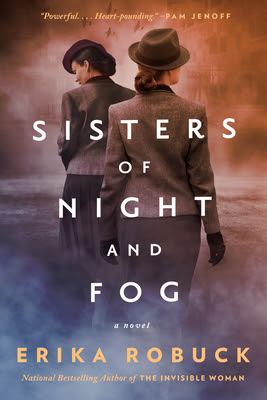
Sisters of Night and Fog by Erika Robuck


Violette is young, energetic, athletic, and smart. She is also half-British, half-French and staying with her aunt in France as the country is invaded during WWII. Quickly hustled away with her younger brother, she vows to return to France but her life is complicated. When she finally gets the chance to return with the Special Operations Executive, parachuting into France to help out with the Resistance, she is thrilled but knows that it means her child may grow up without a mother. 

Virginia is an American married to a Frenchman and living in France. When the country is invaded and then occupied, she could easily escape to Florida and sit out the war. But, she won't even entertain the idea. Philippe is everything to her. When Virginia and Philippe realize they can help with the Resistance by working to house soldiers who have been shot down or escaped from Germans, they are happy to have the chance to do their part.

Although they have very different lives, the two women cross paths when they're caught and imprisoned. But, will their fates be the same? 

If you hang around here much, you might recall that I took a writing workshop in August of last year and Erika Robuck was one of the guest speakers. She talked a little about Sisters of Night and Fog, at the time, although I don't think it had an official title, yet. The Invisible Woman (link leads to my review) was either about to be released or just had been and she talked about how she discovered the stories of Violette and Virginia during her research about Virginia Hall for The Invisible Woman

Although much of Sisters of Night and Fog has been fictionalized to fill in the gaps, their general storyline is based on the true stories of these remarkable women who risked their lives to fight the Nazis. 

I had trouble getting into the story, initially, but it was my problem, not an issue with the book. I wasn't in the mood to have my heart broken and a little piece of your heart is always shattered when you read about WWII. There was so much cruelty. But, there was a great deal of heroism, as well. and Sisters of Night and Fog is absolutely a story of women willing to lay down their lives in the service of others. 

Highly recommended - I can't say much more without giving away plot points and details that are best revealed slowly but while Sisters of Night and Fog is definitely heartbreaking, it is also uplifting and awe-inspiring to read about the courage of these two women and the people they worked with. I recommend reading it during a time when you're feeling like you can handle intrigue, tension, danger, and sadness. I was fighting depression hard this entire month (improving, now) so I kept picking the book up and setting it aside to read lighter fare but when I finally felt up to it, it was difficult to put down. 

I have a feeling Violette and Virginia will stick with me for a long time and I'd like to read more about them. Obviously meticulously researched and another beautifully written book by Erika Robuck, if a tiny bit overlong. Be aware that the book tells their stories from the beginning of the war to the end and their work was later in the war, so much of Sisters of Night and Fog feels like backstory if you're expecting to jump right into the action, as I was. Initially, I thought the book started too far back in time but I trusted the author's timing and it turned out that you really do need to understand where they came from.

My thanks to Berkley Books for the review copy!

©2022 Nancy Horner. All rights reserved. If you are reading this post at a site other than Bookfoolery or its RSS feed, you are reading a stolen feed. Email bookfoolery@gmail.com for written permission to reproduce text or photos.

Monday, February 21, 2022

The Founding Myth by Andrew L. Seidel

Jefferson also authored the Virginia Statue for Religious Freedom, upon which the First Amendment would be based. That law, along with the University of Virginia and the Declaration of Independence, were the only achievements he wanted inscribed on his gravestone. The statute guaranteed religious freedom by guaranteeing a secular government. In the statute, Jefferson skewered "the impious presumption of legislators and rulers, civil as well as ecclesiastical, who being themselves but fallible and uninspired men, have assumed dominion over the faith of others, setting up their own opinions and modes of thinking as the only true and infallible, and as such endeavoring to impose them on others."

~p. 36 of The Founding Myth

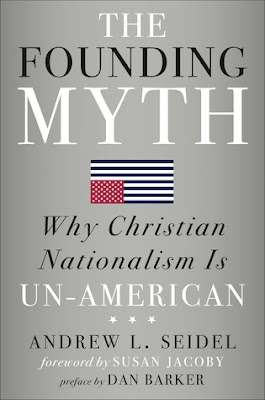
The Founding Myth: Why Christian Nationalism is Un-American by Andrew L. Seidel is about the separation of church and state, how and why the "founding fathers" of the United States chose to create this wall of separation, and what specifically they said about religion that indicated their personal beliefs. 

If you're a Christian, as I am, you'll struggle with certain opinions of the atheist author of The Founding Myth. He can be pretty strident when describing the negatives of religion. But, while he may get certain details wrong from our perspective, the bottom line is that the historical references and quotes lay out his assertion that the US was not founded as a Christian nation in a logical, detailed way. 

Seidel also asserts that the wall of separation between church and state makes both religious groups and the government stronger. I agree with him on that, but if the idea rubs you the wrong way, all the more reason to explore why he makes such a declaration. 

Highly recommended - I have always been a strong believer in the separation of church and state and the author of The Founding Myth does an excellent job of explaining why it exists and backing that up with historical references. As to his thoughts about Christianity, while there were some minor issues with some of his assertions about it, I like having my beliefs challenged and I can't deny that he makes a lot of excellent points about how Christianity has been used as a cudgel, whether to cause the submission of women or justify violence against enemies. Christianity has a terrible, bloody history, when you get right down to it. We see, in fact, the justification of gun ownership and use by Christians using a single, out-of-context Bible quote, even today. 

There are a lot more quotes I considered using for this review as this is my most marked-up book, so far in 2022. But, the book is so worth reading that I'd rather just encourage everyone to read it, instead. 

©2022 Nancy Horner. All rights reserved. If you are reading this post at a site other than Bookfoolery or its RSS feed, you are reading a stolen feed. Email bookfoolery@gmail.com for written permission to reproduce text or photos.
Tuesday, February 01, 2022

The Midnight Library by Matt Haig


I read The Midnight Library primarily because I needed an upper and Matt Haig's books are pretty much guaranteed to be uplifting in some way. Bingo. Definitely a book that gives you hope. 

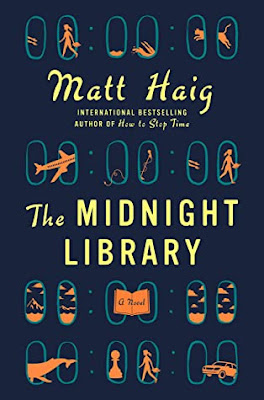
The heroine in The Midnight Library has problems that she can't see her way out of. Nora Seed's lost her parents, her brother seldom speaks to her, her cat has died, and she's just lost her job. She can't find any reason to go on and decides to end it all but instead finds herself in a library, where she's told that she's between life and death by the woman who actually used to be her school librarian and helped her get through another rough time in her life. In this library, Nora can choose to relive her life if she'd made different decisions, large or small. All of them exist parallel to each other (so, it's a metaverse book). If she finds a life she prefers, she can stay. But, even the smallest thing that doesn't feel right will send her right back to the library.

At first, Nora relives changes to the most obvious regrets in her life. But, eventually Nora finds out that she can try things that are a bit outlandish. However, she doesn't have forever because it's possible that back in her known world, the body she tried to kill may die. If the clock in the library hits midnight, it's all over. Will she be able to find her perfect life and keep living it? 

Highly recommended - The Midnight Library gets some pretty polarized reviews and I can see both sides but the bottom line, for me, was that I couldn't put it down and it makes a nice point about life being imperfect but worth living. It's schmaltzy, but I loved it. I gave it 5 stars. Having said that, the ending wasn't what I'd hoped for and I think Haig got the same theme across better in The Humans. But, his writing is clever and compelling and I can actually visualize myself rereading The Midnight Library in the future, when I need an upper again. 


©2022 Nancy Horner. All rights reserved. If you are reading this post at a site other than Bookfoolery or its RSS feed, you are reading a stolen feed. Email bookfoolery@gmail.com for written permission to reproduce text or photos.
Tuesday, January 25, 2022

Spy x Family #1 by Tatsuya Endo


My first manga! And, it was a good one, which I read thanks to the recommendation of a friendly librarian (who leads the online book group I joined during the pandemic). Yay for librarians!

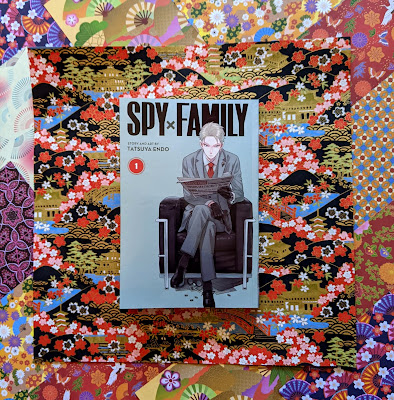
Spy x Family #1 is about a spy who is ordered to infiltrate a prestigious school. At first he thinks, "I just need a daughter" and goes about adopting a child and getting her accustomed to acting like he's her father. And, then, he finds out that both a mother and father are required for the interview to get his child accepted to admission in the school. So, he has to go out and find a wife. 

The joy of this story is in the silliness. The adopted daughter, it turns out, is a telepath. And, the wife is an assassin. This is, of course, entirely nuts. I loved every moment; I smiled pretty much all the way through the reading. And, it was definitely interesting learning how to read from back to front and right to left. 

Highly recommended - A very entertaining story. Spy x Family #1 is mostly set-up, but I can imagine I'm going to really continue enjoying this series if even the set-up is this amusing. I'm balancing six books at this moment (January does this to me — I want to read everything and I want to read it all now) but I keep looking longingly at Spy x Family #2. I can't wait to read it. 

©2022 Nancy Horner. All rights reserved. If you are reading this post at a site other than Bookfoolery or its RSS feed, you are reading a stolen feed. Email bookfoolery@gmail.com for written permission to reproduce text or photos.
Monday, January 10, 2022

Dune by Frank Herbert


I think I'm going to feel silly saying anything at all about Dune by Frank Herbert after nearly a lifetime of hearing about it and wanting to read it; but, I've decided to go with a Q/A format. 

Warning: There may be some minor spoilers in this review. If you're planning to read Dune, soon, and don't want to take a chance of reading a spoiler, please skip down to the recommendation near the bottom of this post. 

What's Dune about?

The Emperor has instructed the Atreides family (the Duke, his concubine Jessica, and their son Paul) to leave their home planet and move to Arrakis, also known as Dune, where they'll be in charge of the spice trade. Spice is extremely valuable and it seems likely that the Baron Harkonnen, who was previously in charge of spice, will have set a few traps. 

Here's the Google description of the movies:

In the year 10191, a spice called melange is the most valuable substance known in the universe, and its only source is the desert planet Arrakis. A royal decree awards Arrakis to Duke Leto Atreides and ousts his bitter enemies, the Harkonnens. However, when the Harkonnens violently seize back their fiefdom, it is up to Paul [Kyle MacLachlan in 1984; Timothée Chalamet in 2021], Leto's son, to lead the Fremen, the natives of Arrakis, in a battle for control of the planet and its spice. Based on Frank Herbert's epic novel.

Have you seen the movie versions?

Yes, I saw the new Dune movie that only covers half of the book (almost to the page count) and then decided to watch the 1984 version, which I didn't see back in the 80s because I heard it was so awful. It definitely departed farther from the book than the new movie, which is both more accurate and a visual feast. But, in both cases the story kept us glued to the TV. 

Did the book meet your expectations?

Yes and no. It had more of a fantasy aspect than I was expecting, with the Bene Gesserit (the females often referred to as witches, of which Paul's mother, the Lady Jessica, is one) and their powers, then the rituals and rules of the Fremen (the desert people). I'm not big on fantasy but I like sci-fi and I was most interested in finding out the subtle details that can't be portrayed in a movie. So, I guess you could say I liked everything but the religious aspect, although I was fascinated by the way the author blended a bunch of religions and I definitely found myself thinking he either did some rocking fine research or simply had a huge knowledge base. 

Would you recommend Dune?

Absolutely. I know there are people who won't be able to tolerate it, for one reason or another (the somewhat confusing politics, the annoying made-up lingo), but I'm so glad to have finally read it! I felt like there was this Dune-shaped hole in my pop culture knowledge (there are a lot of other holes, unfortunately) and I found that it was an epic story with a huge depth and breadth that captured me in every form. Even as inaccurate and visually unappealing (often repellent) as the 1984 version of Dune was, the story still was compelling. 

What did you find surprising and special about Dune?

It was way ahead of its time in regard to ecological preservation. You don't get this from the movie (at least, not from the 1984 version) but the planet has at some point been ravaged and yet, in spite of being almost entirely desert, the indigenous people, the Fremen, are in the process of a plan to renew the planet that will take many, many generations. And, yet they know its value isn't in the harvesting of a single product. They also know how the spice is generated and have control over that, if need be. So, while I expected the political aspect because of what happens in the movies, I was most thrilled by the fact that it said a planet can be brought back from disaster if you have the patience and dedication. 

Did the book answer all your questions about the movies?

Yes, and then some. The one thing that I didn't get when I watched the movies was, "Why would Duke Leto take his family, his security team, and everyone else who ran their home and grounds to Arrakis if he knew spice was the most valuable thing in the universe?" Clearly Baron Harkonnen wouldn't willingly give up the planet's harvest. So, it seemed like kind of a set-up and I actually said that, as I was watching the first movie (the newer one). The book answers that question early on. Since a great deal of the book is internal and the newer movie is heavily visual, the movie does leave some questions lingering. But, there's much more to the book than either of the movies and everything was answered. 

Highly recommended - While I disliked the more fantasy-oriented aspects of Dune, it is such an amazingly detailed world and so incredibly plotted that I probably should have given it 5 stars just for the depth of detail. But, I took a point off for annoying made-up language. That's the thing I actually can't tolerate about fantasy, all the weird words and names and strange religiosity. I tend to have trouble remembering made-up language. I like sci-fi, though, and Dune is a blend of sci-fi and fantasy. So, while it will not become an all-time favorite classic for me, it was well worth the read and I still highly recommend it. At around 700 pages, it's a bit of a chunkster and surprisingly, I've come to enjoy sinking into a world for a longer time. I used to consider anything over 400 pages a chunkster and was a little terrified of those longer books. Not anymore. 

Because I like how and where the book ended, I don't plan to read any of the many sequels. However, this particular copy has an afterword by the author's son that made the continuation sound tempting. 

©2022 Nancy Horner. All rights reserved. If you are reading this post at a site other than Bookfoolery or its RSS feed, you are reading a stolen feed. Email bookfoolery@gmail.com for written permission to reproduce text or photos.
Tuesday, December 21, 2021

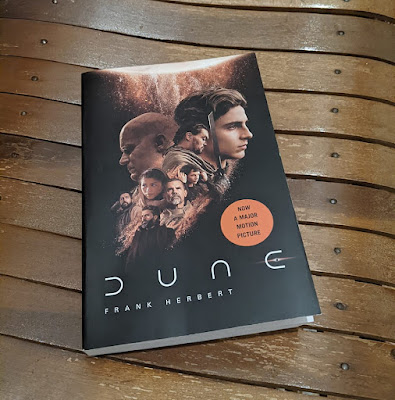
The Christmas Bookshop by Jenny Colgan


I love Jenny Colgan's writing, so I jumped at the chance to read The Christmas Bookshop during the holiday season. And, I was every bit as charmed and heart-warmed as I expected. 

Carmen has been working at a department store for years but it's been slowly going downhill. When it closes permanently, she's at loose ends and has no choice but to return to her parents' home. Her sister Sofia lives in a perfect house in Edinburgh with a perfect husband and they have lucrative jobs, both lawyers. Sofia is expecting her fourth child and when their mother asks Sofia if she can possibly find a job for Carmen, Sofia realizes that Carmen might be the person who can help a small bookstore owner, Mr. McCredie, at least get his business in enough shape to sell it as a going concern instead of an empty storefront. Mr. McCredie is more of a bibliophile hermit than a businessman and has frittered away his entire inheritance. He's about to lose everything. 

Carmen is not interested in living with her accomplished sister in her fancy house but a bookshop sounds like a decent place to earn a little money. What she finds is a disaster. The bookshop is dusty with mostly antiquarian books, no organization, and no hint at Christmas decor. Carmen's a little overwhelmed, at first, but then she gets to work cleaning, organizing, decorating and creating events to draw people in. While doing so, she meets two men who appeal to her. One is a famous author with perfect teeth and lots of money. The other studies and lectures about trees. 

Can Carmen draw in enough traffic and sell enough books to help Mr. McCredie's shop keep going? Or, will Christmas be the end of her job and the bookshop, entirely. And, what about those two guys? Will she let the wealthy man who writes inspirational books sweep her away? Or, will she find herself with a sudden interest in trees and man buns? 

Highly recommended - A lovely tale of friendship and love in snowy Edinburgh at Christmas, worth buying to save for next year if you're a Christmas book fan or downloading right now if you need a little upper. There's a lot of tension between sisters Sofia and Carmen so this book fit the "sisters who learn to get along" theme that I love (because I have a sister with whom I have little in common) but there's so much else I loved about this book. I loved taking an armchair visit to Edinburgh. Because she mentioned a lot of sights, I had fun looking things up on my phone. I loved visualizing the quirky little shop and seeing in my mind's eye what Carmen did to make it lovely and grab the interest of people passing by. I loved how Carmen interacted with her nieces and nephew, encouraging the one who was most like her, who was experiencing similar frustrations as a sister and student. And, I really want to see the giant tree that drew Oke, the dendrologist, to study in Edinburgh. I'm pretty sure I've read about that same tree elsewhere (it's about 2,000 years old) and I enjoyed reading about it again. I also adored the relationship between Carmen and Mr. McCredie, a wounded soul whose emotional and work life Carmen improved. 

In fact, I loved the world she built in Edinburgh so much that I really didn't want to leave it. But, The Christmas Bookshop has a perfect, lovely, satisfying ending so I closed it with a smile on my face and I may have shed a few tears. 

Many thanks to HarperCollins for the review copy! I will hang onto this one for a reread. I'm not big on reading seasonal books otherwise, but Christmas is a big YES. 


©2021 Nancy Horner. All rights reserved. If you are reading this post at a site other than Bookfoolery or its RSS feed, you are reading a stolen feed. Email bookfoolery@gmail.com for written permission to reproduce text or photos.
Monday, December 13, 2021

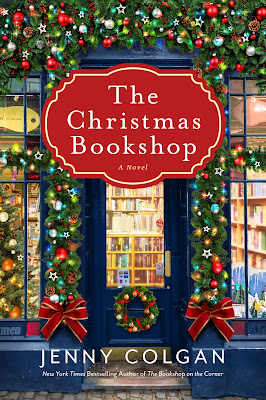
The Cat Who Saved Books by Sōsuke Natsukawa


In The Cat Who Saved Books by Sōsuke Natsukawa, Rintaro is a hikikomori, a reclusive teen who loves books and has an almost encyclopedic knowledge about them. His grandfather has just died, leaving him to run Natsuki Books on his own, but soon he'll have to leave the bookstore behind to live with a distant aunt. 

Rintaro stops going to school entirely after his grandfather's death. Why bother? He's going to leave, soon, and he doesn't have any friends. When an orange tabby named Tiger shows up and asks for his help saving books that are being destroyed, he follows. And, when the class rep — a cheerful girl named Sayo — arrives with his homework and becomes involved in the series of adventures into the labyrinth with Tiger, what will they discover? Can he and Sayo save the books from destruction?

Highly recommended - I had trouble putting down The Cat Who Saved Books and ended up with a bit of a late-night hangover from staying up to finish. I liked the way Sayo and another bookish schoolmate ignored Rintaro's introverted tendencies and spotted the depth of his knowledge and his heart. A lovely story of how books connect us and help us understand each other, translated from the Japanese. 

I won a copy of The Cat Who Saved Books from HarperCollins via Goodreads. Many thanks! 

This copy also includes a note on the cover illustration, which is quite interesting. 

©2021 Nancy Horner. All rights reserved. If you are reading this post at a site other than Bookfoolery or its RSS feed, you are reading a stolen feed. Email bookfoolery@gmail.com for written permission to reproduce text or photos.
Thursday, December 09, 2021

Red is My Heart by Antoine Laurain and Le Sonneur


First a note on the cover: I don't know if this is the final cover for the American edition of Red is My Heart but the one I have is so subtle that the words don't stand out (they're impressed rather than printed on the cover). In person, it has a nice look but this cover is what you see at Amazon. I chose this image over a photo of my copy so that it would stand out. 

Red is My Heart by Antoine Laurain and Le Sonneur (illustrator) is a sweet, sad, funny, and ultimately hopeful story about a man who is despondent after his girlfriend leaves him. It's heavily illustrated, so probably novella length.

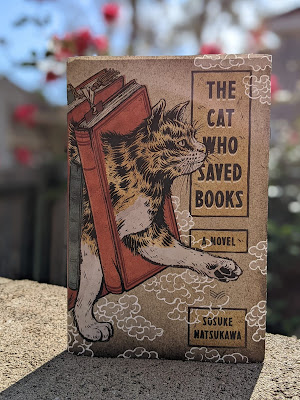
Each of the illustrations are in black and white with a touch of red. The red is usually distant in some way (but not always), and I presume it represents the loss of a piece of the protagonists heart or the distance, loneliness, and longing that he feels. But, maybe it's less a collaboration than a project written with the thought of Le Sonneur's art (which, you can see from this interior shot, the author describes as serving no purpose). I'd love to know how this book came about.


Highly recommended - I love Antoine Laurain's sense of humor. Red is My Heart is a simple story of a broken heart that appears to be on the mend in the end, but both Laurain's sly wit and the illustrations made Red is My Heart a super fun read that I will undoubtedly return to when I want to read something simple and visual. 

I jumped the gun a bit because I neglected to look at the publication date when I sat down to read Red is My Heart. The current release date is January 18, 2022. It can be pre-ordered. 

My thanks to Meryl Zegarek Public Relations and Gallic Books for the review copy! 

©2021 Nancy Horner. All rights reserved. If you are reading this post at a site other than Bookfoolery or its RSS feed, you are reading a stolen feed. Email bookfoolery@gmail.com for written permission to reproduce text or photos.

Wednesday, November 24, 2021

What We Talk About When We Talk About Love by Raymond Carver


I bought What We Talk About When We Talk About Love by Raymond Carver when a bunch of my fellow writing workshop participants gushed about Carver's short stories and how much they loved them, back in August. I've heard of Carver, of course, but I had not paid much attention to him because this was the first time I'd ever really encountered anyone who felt like Carver's a must-read. And, they all seemed to think he was a must-read. 

At any rate, I finally got around to reading What We Talk About When We Talk About Love and I have to tell you that it wasn't an immediate love story. At first, I was kind of perplexed. What was he trying to say? Why did his short stories leave so much to the imagination? Is this something I personally should strive for or is it just some rare skill that makes you want to talk to anyone you can find who's read the same stories? 

The further I got into the book, the more I began to love Raymond Carver. And, it's for exactly the same reasons that I was perplexed. He leaves so much to the reader's imagination that you get a bit of an enjoyable brain workout. For example, in the first story the contents of a man's house are outside on his lawn and driveway. The bedroom is set up as it was inside, with side tables and lamps in their proper places. The living room furniture is placed so that you can sit on the couch and look across to the TV. A young couple comes along and wonders aloud whether all these items are for sale. They could sure use some inexpensive furnishings to fill out their new home. Then, the owner comes outside, sits with them, and gives them his asking price for each item. The young woman has already planned to ask to pay less and he takes each of their offers with no argument. In fact, they sit around like they've known each other forever. And, that's it. That's the story.

So, you can see how much he leaves for the reader to think about. Why would someone empty the contents of his house and sell them cheaply? Has he lost his job? Is he about to lose his home? Has he gotten divorced and, knowing his ex is going to get the house and its contents, decided to sell everything cheaply for revenge? Is he dying, so no longer finds possessions important? So many questions and none of them are answered, of course, or you wouldn't have them in the first place. But, it's the missing information that makes Carver such an amazing read. That, and his minimalist writing style, which is punchy and clear and draws you in. 

Highly recommended - I'm going to be watching for more Carver when I give myself a break to buy books. I am utterly fascinated and besotted with his writing and the way it makes my mind churn. Someone at Goodreads put it much better, calling these "slice of life stories that go nowhere and end ambiguously." Jason Koivu is the name of that reviewer. Ah, he stated it perfectly and while he seems to agree that it makes no sense why such ambiguity is so compelling, you can't help but admire and enjoy them. Or, in Jason's words, "[. . . ] for some damn reason I loved them." Yeah, that. 


©2021 Nancy Horner. All rights reserved. If you are reading this post at a site other than Bookfoolery or its RSS feed, you are reading a stolen feed. Email bookfoolery@gmail.com for written permission to reproduce text or photos.
Monday, November 15, 2021

How to Astronaut by Terry Virts


How to Astronaut: Everything You Need to Know Before Leaving Earth by Terry Virts is exactly what the author describes in the subtitle. He talks about everything involved in becoming an astronaut, both now and when he was in training. Virts worked both on the space shuttle and the International Space Station (ISS). The space shuttle program ended some time ago, so that gives you a vague idea of the timing. 

Terry Virts began his career as a fighter pilot and then later moved on to the astronaut training program. So, he knew his physics and knew how to fly, had lived with intense pressure to perform with accuracy and lived with a certain amount of risk. But, danger as a fighter pilot and its intensity level of training paled by comparison to the training to become an astronaut. 

In How to Astronaut, Virts walks readers through the process of becoming an astronaut, from learning to speak Russian (now an absolute requirement because Americans and Russians work together and the ISS missions take off from Russia) to learning to handle weightlessness, to practicing space walks. He also talks about such everyday things as the food they eat, the clothes they wear, the experiments they perform, how they exercise and why a certain amount of daily exercise is crucial to an astronaut's health, how to use the bathroom in space, how they keep clean, and (yuck) how they clean the toilet. He describes disasters that have taken place and what happens when one does (for example, the loss of a supply ship that blew up and how it impacts astronauts on the ISS). There are a lot of interesting details that I found utterly fascinating. 

Updated 11/16/21

After yesterday's news about the Russian anti-satellite missile test and the resulting scramble to safety by the ISS crew members, it occurred to me that I needed to update my review of How to Astronaut because space debris and its dangers are discussed in the book. In fact, I think I can safely say I would have been concerned about Russian aggression but otherwise probably not blinked at the news if I hadn't read this book. But, space debris is a significant danger both to the International Space Station and future hopes for space travel. Terry Virts goes into some detail about how different countries have handled such tests, the preferred method being to only do them at such a height that the resulting debris will reenter the atmosphere and burn up harmlessly. Otherwise, it remains in orbit around the Earth perpetually and because of that, the ISS has to make maneuvers several times a year to avoid debris, which could not only damage the space station but kill everyone in it. 

I also neglected to mention how Virts goes into the realities of long-term space travel (radiation danger, in particular) and why travel to Mars is plausible but what would be involved in such a mission, including the supplies necessary, the need to find a way to protect astronauts from space radiation, how such a ship would need to be assembled, and the best way to fuel a long journey. On that same note, he goes into what it would take to do space travel along the lines of what we've seen in science fiction TV and movies and why it's unlikely we'll ever encounter other living beings outside of Earth — because of the sheer length of time it would take to get to the closest potentially habitable planet. Fascinating stuff. 

And, one last thing . . . Space Force. I was dubious about the concept of the Space Force, thinking it some weird thing that the last president came up with to look cool, until someone I know explained to me that the job of the Space Force is protecting our satellites and was formerly the mission of the US Air Force but merely separated into its own unit to focus on that particular mission. Yesterday's anti-satellite missile test shows why it's necessary. Having said that, I still think it is badly named and has been poorly described to the public and that's probably the main reason so many people have scrunched their faces up and wondered aloud at why it even exists. There was not yet a Space Force, at least in the early part of How to Astronaut, but the author hinted at the fact that it might be coming. I can't say whether or not the references to a potential space force have been updated because I don't have a final copy of How to Astronaut but I did find it of interest that he knew it might be coming. 

Highly recommended - Especially recommended for fans of all things outer space/NASA and nonfiction lovers. My husband has recently met a former astronaut so I had a lot of fun telling him what I'd learned about the process of becoming and being an astronaut and he's planning to read the book soon. My only problem with the book was that occasionally I got lost in the science and felt like I was drowning in acronyms. There are far too many acronyms!!! But, that just goes with the territory if you're an astronaut, apparently. 

The most interesting anecdote, in my opinion, was one about learning to deal with zero gravity. Back in his early training days, there was still a plane that went up and arced down in a parabola to cause a few minutes of weightlessness. You may have seen Howard Wolowitz, the astronaut character from The Big Bang Theory inside the padded plane when he was doing his training. That's exactly what Virts describes; however, this type of training is no longer done in the US and the reason why is what's most interesting to me. Virts says the US had been doing this for decades and it was affordable. But, then someone decided to privatize the zero gravity training and it became, in the process, dramatically more expensive. Instead of bringing back the old program, now canned, they eliminated it completely. So, if you want to get zero gravity training in the old plane-dropping-precipitously way, you have to go to another country. 

Having said that's my favorite anecdote (it's partly because I'm of the opinion that privatizing government work is generally, although not always, a bad thing — and I have a business degree so that's the kind of thing that really piques my interest), there are a lot of entertaining and fascinating stories in How to Astronaut and I'm glad I read this book. Terry Virts keeps it light-hearted and has a great sense of humor. 

I received an ARC from Workman Publishing in 2020 and it kept moving from one TBR pile to another till I finally decided its time had come. My thanks to Workman for the ARC! How to Astronaut was published in September of 2020, so it's readily available for purchase. 

©2021 Nancy Horner. All rights reserved. If you are reading this post at a site other than Bookfoolery or its RSS feed, you are reading a stolen feed. Email bookfoolery@gmail.com for written permission to reproduce text or photos.

Tuesday, November 09, 2021

The London House by Katherine Reay


In the prologue to The London House by Katherine Reay, it's the 1940s in Occupied France. A woman named Caro has gone to the House of Schiaparelli to give her Jewish friend money and encourage her to escape the country before it's too late. But, then a dangerous traitor shows up and grabs Caro. He's going to turn her over to the French police, the Milice, who are known to be even more brutal than the Germans. 

In present-day Boston, Caroline Payne (great niece of Caro in the prologue) is working when she gets a call from an old college friend, Mat. Now a college instructor working toward tenure, he has developed a side business that he hopes will get him onto tenure track, researching family histories and writing about how history sends ripples through families. He's in Caroline's building and wants to talk to her because her family came up while he was researching a German family whose Nazi ancestor was connected to the disappearance of Great Aunt Caro, whom Caroline is named after and has always been told died at the age of 7 from polio. 

Mat has a different story to tell and the documentation to prove it, a letter by a British dignitary who informed her great-grandparents that Caro ran off with her Nazi lover. Mat has already approached her father to tell him that the story will include her family but it's not meant to be incriminating; it's about how the pain of the past reverberates through the generations and how people move on with their lives after tragedy. Caroline's father has threatened him with a lawsuit. 

Caroline has a great deal of difficulty adjusting to the idea that her great aunt lived to adulthood. But, once she does, she decides to visit the family's ancestral home in London's Belgravia, where there are letters and diaries that can give her clues. She only has a limited amount of time to get the research done before Mat's article is submitted and she's also on a tight schedule to return to her job. 

Did Caroline's great aunt, her grandmother's twin sister, betray the family and her country? Or, is there more to Caro's story? Will Caroline be able to untangle the clues from the past that will lead her toward the truth?

Highly recommended - I loved The London House. The story is a very believable one because some things about WWII simply could not be known till recently and it makes sense that one may have had to know where to find clues — and couldn't necessarily find answers in any official sense. I loved the way Caroline slowly uncovered her great aunt's story, the Nazi lover's (in the process), and in so doing changed the direction of both her friend's article and her family's understanding of their history. Also, there is a touch of romance and it unfolded slowly and believably. 

My only problem with this book is an issue a lot of Americans probably won't have. The writing and dialogue by British characters doesn't contain any particular use of Britishisms and lacks a British cadence. So, everyone sounded American to me. I think that's an extremely minor issue because the story swept me up so thoroughly that I didn't really give the dialogue much thought. However, it did eventually jump out at me. I still highly recommend The London House, even if you've been to the UK a bazillion times. It's a good story and I found it nearly impossible to put down. 

My thanks to Harper Muse, Katherine Reay, and Laurel Ann of Austenprose for the review copy!

Interesting side note:

Goodreads has some additional description that I found interesting (I opted not to read the publisher's description but saw this when I went to rate the book):

A stand-alone split-time novel
Partially epistolary: the historical storyline is told through letters and journals

"Stand-alone split-time" is a new descriptor for me. I usually call the split-time books a "contemporary historical mix". Also, the fact that much of the book is told through letters and diary entries is crucial, so I'm glad I glimpsed that for the reminder. Now you know. If you're an epistolary fan, you'll undoubtedly enjoy the way this story is told. 

©2021 Nancy Horner. All rights reserved. If you are reading this post at a site other than Bookfoolery or its RSS feed, you are reading a stolen feed. Email bookfoolery@gmail.com for written permission to reproduce text or photos.

Monday, November 01, 2021

Unaccustomed Earth by Jhumpa Lahiri


The whole time I was reading this collection of short stories, I was wondering what took me so long to get to it. I've had an ARC (which came from a free cart at the library, not the publisher) since 2008 and have set it on my bedside TBR pile numerous times, but it always has ended up getting reshelved and saved for another day. I'm glad I finally read it as it is 5-star brilliant. I can still see the characters in my head and it's the kind of book in which the stories are so thorough that you need to let them sit and roll around in your head before moving on to the next. That's my favorite kind of story. I like stories that make me think, make me even wonder where the characters are, now, or what happened after. 


Some features of the stories in Unaccustomed Earth by Jhumpa Lahiri:


  • Main characters  who have Indian parents who have emigrated to the US.
  • MCs who have traveled regularly to visit grandparents in some part of India.
  • Challenges of standing out and how that discomfort feeds into the large communities of Indian immigrants (the way they stick together as a community) in the US and possibly the reason some return to India.
  • Mixed marriages (usually Indian/American and a Caucasian) and the things individuals in these marriages can't understand about each other. 
  • The pressure of parental expectations — specifically Indian parents, who tend to have driven children in fields like law, medicine, and engineering and expect their children to do the same or the pressure of keeping to tradition. 
  • Fathers who are distant and mothers who spend their time cooking elaborate Indian meals.
  • Frequently, the loss of a parent. 
  • Characters who stopped over in London before moving on to the US or end up there or another country, where they feel comfort in being absorbed by the multinational crowd. 


There are two sections of the book and the second part is told in 3 interconnected stories, each from a different point of view. The first is that of a boy whose family lived in the US, moved back to India, and has returned. Then, the viewpoint of a girl who had a crush on that boy, didn't forget him when he left, and is baffled when his family moves in with hers temporarily when they return to the US. The final story tells about how they meet in Italy when she is 37 and he's 40. 

Trigger warning for woman dying of cancer: The final section spends a little too much time on the mother with cancer. For some of us, this hits a little too close for comfort. I will not read this book again, partly because of that. 

Highly recommended - I can see why Lahiri is an award-winning author and I look forward to The Namesake and Interpreter of Maladies, both of which I have on my shelves. In spite of my warning about that last section, the stories are phenomenal, the characters well-rounded, their conversations and thoughts and concerns believable. I didn't think the stories always had strong endings, but I thought they were otherwise excellent. 

Having highly recommended the book, I will also add that I gave it a 4/5 at Goodreads for bumming me out, particularly in that final section. I like a bit more light at the end of the tunnel, so to speak. But, the writing style, the depth of detail in particular, is 5-star and that point off is merely about how the book made me feel. Rating books is always subjective, of course. The bottom line, though, is that Unaccustomed Earth is worth reading and a very impressive collection. 

Note: I thought this was my first by Lahiri but then I looked up her work because I couldn't remember the latter of the two titles still on my shelf and I was reminded that I read The Lowland by Lahiri in 2013. Link leads to my mini review, which notably says this:

I did, however, feel like The Lowland was written in what I'd call the Bummery Things Happen mode of literature. 

So, the feeling of being bummed by her writing persists. And, yet, it's so good that I will definitely read the other two books I own. Also, here's a cat with Unaccustomed Earth because I'm here to give you all the cat content. 


©2021 Nancy Horner. All rights reserved. If you are reading this post at a site other than Bookfoolery or its RSS feed, you are reading a stolen feed. Email bookfoolery@gmail.com for written permission to reproduce text or photos.

Monday, October 18, 2021

The Apothecary (The Apothecary #1) by Maile Meloy


The Apothecary by Maile Meloy is the first in a magical Young Adult series set in the 1950s. Janie Scott's family has moved from Los Angeles to London after her parents — both in the film industry — are accused of being Communists and feel obligated to leave the country. In London, Janie feels totally out of place but she's fascinated by Benjamin Burrows, the son of the local apothecary, an unusually defiant student who pointedly refuses to get under the table for atomic bomb drills. 

When the apothecary's shop is invaded and he disappears, Janie and Ben set out to find him and discover the apothecary's Pharmacopoeia, the book filled with magic potions that Russian spies were seeking when the apothecary disappeared. To find Ben's father, keep the Pharmacopoeia out of Russian hands, and prevent nuclear disaster, they will have to try some magical potions that do amazing things like turn people into birds. 

Highly recommended - Magic, adventure, and a touch of romance make The Apothecary a total delight. I'm kind of disappointed that I only have the first book in the series. The next two don't get quite the ratings the first does at Goodreads, but I enjoyed The Apothecary enough that I'd still like to read on. I just looked and my library system does have the second book, but not the third. I need to drop off donations, anyway, so I'm tempted to check it out in spite of my library check-out ban —  part of my book-buying ban. I haven't checked out a single book since the pandemic began so one can't hurt, right? Right?


©2021 Nancy Horner. All rights reserved. If you are reading this post at a site other than Bookfoolery or its RSS feed, you are reading a stolen feed. Email bookfoolery@gmail.com for written permission to reproduce text or photos.

Thursday, October 14, 2021

The Birds and Other Stories by Daphne du Maurier


Oh, Daphne. You sure could write. 

Near as I can tell, The Birds and Other Stories is my 9th read by Daphne du Maurier and it's my second deliberately spooky/atmospheric read for fall in 2021. I never did figure out how to sign up for this year's RIP Challenge, but that's OK. I've become so accustomed to reading at least one or two books that are spooky, witchy, atmospheric, or scary to usher in autumn that I do so by force of habit. I'm not in touch with Carl, who started the RIP and helped me form this habit, but I'm grateful that he started it as it helps to make those last hot, sticky days of summer feel like they pass a little more quickly. Our second cool front is finally on its way, this weekend! 

Back to Daphne. I've had The Birds and Other Stories on my TBR for a year or two but it didn't click for me till last week. I loved all but one of the stories. Unfortunately, the least enjoyable of them was the longest. It was more odd and mysterious than creepy or frightening. But, the rest were suspenseful, spooky, atmospheric. Du Maurier had a knack for building tension in the most unexpected ways. Summaries of the stories follow with my thoughts below in italics:

The Birds - The most well-known story, thanks to Alfred Hitchcock, is different from what I know of the movie (I've only seen bits and pieces). A farm hand, injured in the war and only able to perform the easier chores, is shocked when he hears a tapping at his window one night and is attacked by birds, then discovers that his children have left their windows open and are being attacked, as well. The next day, he realizes the birds are hovering offshore, waiting to attack when the tide comes in. So, he rushes his children home and boards up all of the windows. The family hunkers down during the evening attack while the farm hand worries about supplies. How will they survive if this continues? They have barely any food left and there seems to be no end in sight to the attacks. 

I can see why this story is a classic that has given plenty of people a fear of birds. Absolutely kept me on the edge of my seat. 

Monte Verita - When the beautiful wife of the narrator's friend disappears into a strange mountain complex, he's determined to wait for her to emerge. But, she'll only communicate with him in writing and she says she's never coming back to him.

This is the longest story that asks, "Will the man ever figure out how to get his wife to emerge?" and "Do the people inside this complex stay forever young, as the nearby villagers have told him?" A strange story that I didn't particularly enjoy. 

The Apple Tree - When a man's wife dies and he notices that one of his apple trees looks like her, he wants it cut down. But, his gardener is determined to keep the tree alive as it's blossoming for the first time. Each time a piece of the tree enters the house, something goes wrong. Is the tree out to get him? 

One of my favorites. I will never think about apple trees in quite the same way. 

The Little Photographer - A Marquise on holiday with her children and nanny is captivated by the local man who runs a photography business. Bored with her life, she begins meeting him during siesta time on a cliff where he likes to take photos. But, what will happen when her husband decides to come to the seaside a little earlier than expected? 

Trouble, that's what. Good story. The tension is in the fact that they could be caught at any time, but then something shocking happens. 

Kiss Me Again Stranger - When a mechanic goes to see a movie, he falls for the usherette and they take a walk together. A few strange moments intersect with a news article, the next day, and he becomes aware of the danger he was in. 

Another story with a good shock factor. It doesn't feel entirely creepy till the end; you just get the sense that something is off. 

The Old Man - The narrator has been advised to stay away from "the old man" who lives near the lake. Did he kill his children?

The surprise twist ending totally caught me off-guard. Not my favorite. In fact, I'd totally forgotten what this one was about and had to flip through the book. 

Highly recommended - The second book of short stories I've read by du Maurier (Don't Look Now is the other; link leads to a mini review). Of the two, The Birds is better in my humble opinion. Only one story fell totally flat for me and the last story felt like it had a bit of a cheap twist. 4 of the 6 were exceptional. And, as I said in my mini review of Don't Look Now, Daphne du Maurier's books are always worth reading because her writing is stellar.

This is my favorite cover of The Birds. My copy looks like the one at the top of the post. 


©2021 Nancy Horner. All rights reserved. If you are reading this post at a site other than Bookfoolery or its RSS feed, you are reading a stolen feed. Email bookfoolery@gmail.com for written permission to reproduce text or photos.

Wednesday, October 06, 2021

September Moon by John Moore


September Moon by John Moore is a book I ordered secondhand from Across the Pond for a buddy read hosted by @the_unhurried_reader of Instagram in 2019. Unfortunately, it didn't arrive till October of that year and the buddy read was by then over, having finished at the end of September. I've been eager to read it during a September ever since, but I must have been too booked up in 2020. 

September Moon tells the story of the harvest of hops in England's Hertfordshire. During the month, itinerant workers — some Welsh, many traveling Romany, one an older man who has been harvesting all his life — arrive to do the harvesting. This is not a fast-placed, tightly plotted book, but at the same time there's no waste of words and the writing is lovely enough to suit anyone who enjoys literature. Instead, what you get is a farmer with chest pains; his son who had a fling with a "gipsy" girl [I'm going to continue with the spelling and usage of the word "gipsy" for convenience and to match the book, although I know Romany is the proper term] and tries to resume their affair but finds that her personality has changed; the Gipsy King who is challenged by the other tough-guy gipsy; the farmer and would-be inventor who is not a natural to farming, frequently loses money on crops and attempted inventions, and tends to drink off his profits at the local pub; and, his half-French daughter who has returned from London and whom the villagers suspect left in the first place because she got in trouble with a boy. There's also the threat of a spreading fungus ruining the crops. 

Published in 1957, September Moon is a total comfort read. The tension is ever-present and there are plenty of questions to keep the pages turning, but in the end nothing awful happens. Literally nothing. All the fighting and drama and knives flashing by moonlight, the one farmer's illness and the other's threatened loss of his farm. Well, there's bloodshed and danger, but no tragedy and the plot twists are comfortable rather than nerve-racking. I think it'll be great going into the book in future Septembers knowing that it's that kind of read, taut enough to make the pages fly but pleasant enough to read when you're stressed out and just want to find something enjoyably tense in which nobody dies. 

Highly recommended but apparently out of print - I checked to see if there are any newer copies available and it looks like the only available options are secondhand. Abe Books has quite a few but the first one to pop up is in a shop in Melbourne, Australia, so perhaps it was never published in the U.S. At any rate, if you're ever looking for something that is enjoyable to read and not in the mood for anything horrible to happen, September Moon is perfect. If I didn't happen to still be on that book-buying ban (I am determined to make it to the end of the year without buying another single book, in spite of having broken my ban a time or two), I would see if I could find some other secondhand books by Moore. But, I won't. Maybe next year. 


©2021 Nancy Horner. All rights reserved. If you are reading this post at a site other than Bookfoolery or its RSS feed, you are reading a stolen feed. Email bookfoolery@gmail.com for written permission to reproduce text or photos.

Monday, October 04, 2021

The Boatman by Billy O'Callaghan


Even without Mei in the room, her presence blocked out the space the way sand fills an hourglass, turning everything slow. That's how I wanted it to be, and that at least was what I'd have, but I knew from before, from having already lost her once, such ghosts tormented as much as consoled. We'd taken an important step in reconnecting and had sworn we wouldn't let that flag, so that it would be different this time, better even if still a long way from ideal, but keeping our promise meant condemning ourselves to a famished life, to the scraps that could nourish only the most fragile of hearts. 

~from "Ruins", p. 44 of The Boatman

I chose an excerpt from the story "Ruins" in The Boatman by Billy O'Callaghan at random because when I was reading I was so immersed that it never occurred to me to get up and look for flags to mark favorite passages. Instead, I read them over and over for their sheer beauty. But, this is what you most need to know about The Boatman: it is carefully, meticulously crafted, rhythmic and melancholy and absolutely stunning.


A few of the stories:

"The Border Fox" - A young man goes over the border into Northern Ireland with a group, to make a delivery. A tense story of subterfuge, violence, and budding romance. 

"The Boatman" - Two men walk to a graveyard to dig the grave of the boatman's daughter, who died very quickly after becoming ill. "She was only young," her uncle keeps repeating. A heartrending tale of grief and the physical labor that becomes a part of the grieving process. 

"Beginish" - A young couple, madly in love and still newlyweds, work hard at two jobs each to save money for a proper holiday. When they decide to stay close to home and camp out on an abandoned island, the man from whom they rent a boat is friendly though mildly concerned. But, neither he nor the young couple expect the tragedy they're about to encounter. 

"Love is Strange" - A teenager is compelled to help an elderly neighbor who regularly struggles up the hill to her home with her purchases. A few years later, he goes out with a neighbor girl and they talk about the old woman. 


I realize, after writing about these 4 stories, that all of them are favorites from the dozen in the book. But, I can't think of any story in The Boatman that I disliked. "Beginish" was the one story in the collection that I could imagine expanded to novel length and perhaps even turned into a movie. It's tragic, as are many of the stories. But, I was so swept away by the incredible beauty of O'Callaghan's writing that for once I thought more about the sound, rhythm and uniqueness of his wording than about the direction each story took. Having said that, all are compelling and at least two had an "edge of your seat" feel. 

Speaking of tragedy . . . if you've hung around here for a while, you know I generally rate anything tragic that lacks a glimpse of hope lower than I do those that give you some sense of light at the end of the tunnel. I gave The Boatman 5 stars, which just goes to show that truly amazing writing will win out, even if a story is gut-wrenching. That surprised me, actually. 

Highly recommended - This one's going on the good shelves and I will definitely return to it for future rereading. 

Important note: I posted about this book on Instagram, yesterday, and one of the photos I posted was of the book posed with a record album (vinyl, that is) and music box that my mother brought home from Ireland, way back when I was a tiny tyke. I listened to the album as a child and remembered the tune to the title song but none of the words. After I posted, I found the title cut on YouTube to listen to and hoo boy, it could be considered extremely offensive in some quarters. It's about a man going off to join the IRA. Since I don't mean to take sides in any way, that post will come down. I was really shocked. It has such a jaunty tune that I had no idea what it was about. In fact, the words "where the helmets glisten in the sun" was one of those phrases that my little-kid brain turned into something else, although there is no such thing as a "Hal man" that glistens in the sun . . . and I didn't remember what my mind had turned it to till I heard the song for the first time in decades. Apologies to any Irish citizens who may have seen that post and found it offensive. 


©2021 Nancy Horner. All rights reserved. If you are reading this post at a site other than Bookfoolery or its RSS feed, you are reading a stolen feed. Email bookfoolery@gmail.com for written permission to reproduce text or photos.

Tuesday, September 28, 2021

The Lighthouse Witches by C. J. Cooke


The Lighthouse Witches by C. J. Cooke tells three interconnected stories. In 1998 Liv, a single mother of three, takes an art commission to paint a mural inside a 100-year-old lighthouse on an island in Scotland. Since her husband died, life has been rough and she's barely been able to support her family. But, this job should keep her going for a while. 

The lighthouse has a hole that leads to a cave where people accused of witchcraft were tortured in the 17th century; and, superstition on the island runs deep. When a child knocks at her door, has Liv found a wildling? Wildlings are supernatural beings that take the place of children, allegedly due to a curse by the witches who were executed in 1662, and they have been accused of causing the deaths of entire families for centuries. 

In 2021, Luna receives a startling call. Back in 1998, her mother Liv and both of her sisters, Clover and Sapphire (Saffy), went missing. Now, Clover has reappeared and Luna is her only known relative. But, when Luna travels to Scotland from her home in Coventry, she is stunned to find that her little sister is the same age she was when she disappeared, rather than a 30-year-old woman. And, she has a mark on her leg that is known to be the mark of the wildling. Is Clover really her sister or a strange being that took her place? Is Luna in danger? 

There's also a third storyline that intertwines, but it's a lesser part of the story. In 1998, Saffy has found the grimoire (a book of magic spells, although it reads like a diary) of a man from 1662. Since there's little to do on the island and not a lot of reading material but Saffy is an avid reader, she reads the grimoire. It describes the accusations of witchcraft that took place on the island and the confessions and deaths of the women accused. 

Highly recommended - Creepy, atmospheric, fascinating, sometimes a little scary, well-written and very meaningful. I didn't find The Lighthouse Witches extremely scary but there were some violent and disturbing scenes so I was also a bit surprised not to have any nightmares at all while I was reading it. In the end, the really great thing about the book is that it has a very satisfying ending (in my humble opinion) and an exceptional theme, really an indictment of cruel misogyny, the author's point being that the world needs to stop persecuting women for simply existing. I loved the depth of meaning and will be watching for more by this author, for sure. 

I did have one issue with the book. The grimoire excerpts read like a contemporary diary to me. In fact, it took me a long time to figure out that that particular storyline took place in 1662 as it lacked a date label, although Saffy may have mentioned it being from that time period. I considered that a minor issue as she did a fantastic job of interconnecting the stories and eventually the time period does become clear, even if the language feels off. 

My thanks to Berkley Books for the review copy! 

As you can see, I was finally able to take an outdoor photo after a long, hot, wet summer. It's warmed back up but we cooled off for 3 or 4 whole days! Wow, was that fun. 

©2021 Nancy Horner. All rights reserved. If you are reading this post at a site other than Bookfoolery or its RSS feed, you are reading a stolen feed. Email bookfoolery@gmail.com for written permission to reproduce text or photos.

Thursday, September 09, 2021

The Matchmaker's Lonely Heart by Nancy Campbell Allen


First things first. Does that cover rock, or what? I love it. 

The Matchmaker's Lonely Heart by Nancy Campbell Allen is a historical romantic mystery. Since Amelie's parents died, she has lived and then worked with her Aunt Sally as a matchmaker and columnist for The Marriage Gazette. She would love to find romance, herself, but for now she's satisfied with living in a building owned by Aunt Sally (near her beloved cousins, Eva and Charlotte) and being an independent woman. 

Michael Baker is a detective working for Scotland Yard. His partner and brother-in-law has recently been killed in the line of duty, leaving his sister widowed with a baby. Michael is convinced that he could never marry and risk leaving a widow, as well. 

Amelie and Michael first meet when the detective begins investigating a man by the name of Radcliffe, whom he suspects of murdering his wife. Amelie is watching Radcliffe and a dinner guest she set up with him from outside a restaurant, just to make sure they're getting along okay. She is surprised to find that the anonymous man for whom she arranged this meeting is a man from her book club whom she knows to be a recent widower. When Michael spots her and brings her in for questioning, she offers to bring the detective to her book club and introduce him as a family friend to aid his investigation. And, then she gets a little too involved in the investigation, becoming the love interest of Radcliffe for the sake of trying to get information out of him. 

Is Radcliffe the gentleman solicitor that he appears to be or a murderer? Has Michael put Amelie in terrible danger? What will happen when Amelie and Michael find that they are attracted to each other? 

Highly recommended - What an immensely entertaining read. Although there's a murder mystery wrapped up in this historical romance, the tone is light-hearted. Amelie is naive and Michael just a little bit jaded but she's such a charming innocent that he can't help but find himself drawn to her. 

There were a couple things that irritated me (the time period is never specifically mentioned) or felt off (anachronisms to the time or place), but they were not enough to knock this book down from the 5 stars I felt it deserved. I mentally placed the story around 1890 and then eventually the Arts and Crafts movement is mentioned and I thought, "Aha! At the very least, I'm close." I've only recently read up on the Arts and Crafts movement after finding out a stained glass window I bought from a salvage store hails from that time period. If you follow me on either Facebook or Instagram, you'll see a corner of the stained glass in the background of the image I posted of this book and that's why. 

Nancy Campbell Allen is new to me but I'll be keeping an eye out for more of her books. My thanks to Shadow Mountain for the review copy!


©2021 Nancy Horner. All rights reserved. If you are reading this post at a site other than Bookfoolery or its RSS feed, you are reading a stolen feed. Email bookfoolery@gmail.com for written permission to reproduce text or photos.

Thursday, August 19, 2021

The Invisible Woman by Erika Robuck


The Invisible Woman by Erika Robuck is a fictionalized account of Virginia Hall's work in occupied France during about the final 6 months before the invasion of Normandy during WWII. Virginia Hall was an American socialite who helped build and support the French Resistance. 

During the time this portion of Virginia's story takes place, she's dealing with her own personal trauma and also post-traumatic stress after her Resistance network was betrayed and most of the people she worked with fighting the Nazis were arrested, possibly killed, although she's uncertain of what's become of her friends. After spending some time in the UK, she is back in France, rebuilding a Resistance network, calling for supply drops to support her recruits and the local Maquis living in a nearby forest, and helping to hold them back from sabotage efforts until she gets the signal that D-Day is coming, so that they can do the most damage to bridges and rail possible without time for reprisals. 

I recently read about half of A Woman of No Importance by Sonia Purnell, which is a biography of Virginia Hall, and I confess I was a little thrown at the beginning of The Invisible Woman because I hadn't come anywhere close to the dates in which this particular part of Hall's time in France took place. So, at first I thought the author had fictionalized a great deal. Then, I realized it was me that was off. It's been a couple of months since I set A Woman of No Importance aside so I was discombobulated, date-wise. But, once I realized the dates were off in my head, I found the story gripping and captivating. Virginia Hall was an incredibly heroic woman and I believe Erika Robuck did an amazing job of bringing her to life. 

Highly recommended - An engrossing story of heroism, danger, and the horrors of war. The only problem I had with The Invisible Woman was that I had difficulty keeping the characters straight because there were so many of them. It didn't occur to me to pull out my copy of A Woman of No Importance, which has photographs of many of the key characters, who were real. There is a lot of information to digest because of the complexity of working as a spy in an occupied nation during war but the author presents it well and I found the story fascinating and ultimately satisfying. 

Side note: I got to hear a little about Erika's writing process, yesterday, when she was a guest author in the online writing workshop I'm taking, this month, and I think it's of interest that she chose to write the novel in 3rd person because Virginia kept her story close and was such a private woman that Erika felt like she needed to keep a bit of distance. She believed Virginia Hall's personal preference probably would have been not to have her story told at all so it was necessary not to crawl into her head and tell her story in 1st person. I think that was a wise choice. 

Also, wow, I loved hearing about Erika's writing process. She is incredibly disciplined and I loved how she described the way the characters who need their story told come to her in an almost mystical way. It sounds like she has two more WWII stories under contract, one to be released in the spring of 2022. You can bet I will be putting them on my wish list as soon as I'm able. 

©2021 Nancy Horner. All rights reserved. If you are reading this post at a site other than Bookfoolery or its RSS feed, you are reading a stolen feed. Email bookfoolery@gmail.com for written permission to reproduce text or photos.

Monday, July 26, 2021

Regretting You by Colleen Hoover


I've been seeing a lot of [mostly gushy] reviews of Colleen Hoover's books since I joined Instagram, a couple years ago. So many of my IG friends swear by her!  So I had to give one of her books a try. 

There are two interconnected storylines in Regretting You, the connection being family. 34-year-old Morgan married the wrong guy but she's happily married and close to her 17-year-old daughter Clara, the center of her universe, although she's starting to think it's time to go back and finish her education. The man she felt more in tune with as a teenager but didn't end up ever even dating is back in her life, father to her sister's baby boy and planning to marry the mother of his child. Morgan doesn't want to live a life of regrets so she's trying very hard to tolerate this complication. 

Clara is a sweet teenager and a good student with a devoted best friend but there's one boy who acts like he'll be poisoned if he gets too near her. When she stops her car to ask him if he wants a ride on a very hot day and he asks her to help move something, she discovers that he's actually a pretty nice guy. But, why has he been avoiding her at school if he's so friendly when they're alone?

When tragedy strikes and a betrayal comes to light, Morgan and Clara find themselves at odds and turning to the men who are willing to be there for them. 

Highly recommended - I love the "married the wrong guy" trope because it's always so fascinating. How can the couple who belong together get along while fighting back feelings? Is there a way they can end up together without everyone getting hurt in the process? Well, in this case, the complications are a little different than just learning to get along as friends. But, I think if I share any part of the tragedy/betrayal plot points it'll ruin the book for anyone who is interested, so I won't. 

What I will say is that Regretting You is believably emotional and I particularly liked the way Clara's feelings were portrayed as her life is pretty much spinning out of control. My only problem with the book was that the men were too perfect and, in fact, a bit too similar. And, the grief was hard. I've had a loss like Clara's when I was fairly young and it brought back the memories so it was a teary read for me. 

I have a copy of Verity on my reader so that will be the next Colleen Hoover book I read. I'm glad my Instagram friends brought this author to my attention!


©2021 Nancy Horner. All rights reserved. If you are reading this post at a site other than Bookfoolery or its RSS feed, you are reading a stolen feed. Email bookfoolery@gmail.com for written permission to reproduce text or photos.