Showing posts with label historical fiction. Show all posts

Friday, April 11, 2025

The Eights by Joanna Miller


Beatrice, Dora, Otto, and Marianne are among the first women allowed to attend Oxford University to obtain a degree, in 1920. Other women have attended but not been allowed to receive degrees and there is still plenty of prejudice against their presence at the university. Their rooms are in the eighth corridor of their building and as they get to know each other, they're quickly labeled "The Eights" because of their lodgings. 

As a tight friendship develops, the women dive into their studies, and learn the strict rules that are meant to keep them from interacting too much with the men of Oxford, secrets are revealed, challenges faced, and yes, there is a little bit of romance and heartbreak. They are slightly older than most matriculating students because they did their part during WWI and each is aware that there are far more women than men of their age living in Great Britain due to the war's deadly annihilation of young men. 

When I started reading The Eights, I had a little difficulty keeping the characters straight in my head because it takes a little time to get to know them. I set the book aside for a few days and then located a notebook in which I wrote mini-bios of each of the women, which helped me separate them in my mind until their personalities became clear. And, then I enjoyed the reading so much that I took my time and just immersed myself in their world. 

I absolutely loved the friendships, the atmosphere, the challenges each faced as individuals and as women dealing with misogyny, and the historical context (what's genuine and not is described in the author's afterword). Included are a glossary, a map, and a bibliography. 

Highly recommended - Definitely one of my favorite reads, so far in 2025. The release date is just a few days away, April 15. An excellent piece of historical fiction based on real-life events, great for fans of historical fiction that's immersive, a great learning experience, and features strong friendships, excellent writing (sometimes I'd stop to reread sentences; I loved the author's unique turn of phrase) with a satisfying ending. I did a lot of googling of buildings to get a good look at the scenery and feel like I've just returned from Oxford, England. I can't wait to see what Joanna Miller writes next. 

I received a copy of The Eights from the publisher, Penguin Random House (thank you!), in exchange for an unbiased review and it's the first review book that I've requested in almost 2 years. Wow, did I choose well! 

©2025 Nancy Horner. All rights reserved. If you are reading this post at a site other than Bookfoolery or its RSS feed, you are reading a stolen feed. Email bookfoolery@gmail.com for written permission to reproduce text or photos. 


Thursday, March 31, 2022

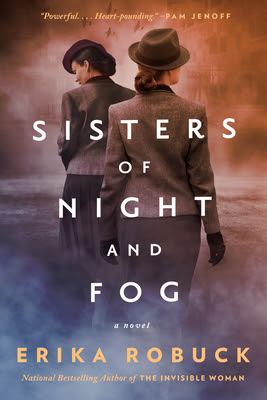
Sisters of Night and Fog by Erika Robuck


Violette is young, energetic, athletic, and smart. She is also half-British, half-French and staying with her aunt in France as the country is invaded during WWII. Quickly hustled away with her younger brother, she vows to return to France but her life is complicated. When she finally gets the chance to return with the Special Operations Executive, parachuting into France to help out with the Resistance, she is thrilled but knows that it means her child may grow up without a mother. 

Virginia is an American married to a Frenchman and living in France. When the country is invaded and then occupied, she could easily escape to Florida and sit out the war. But, she won't even entertain the idea. Philippe is everything to her. When Virginia and Philippe realize they can help with the Resistance by working to house soldiers who have been shot down or escaped from Germans, they are happy to have the chance to do their part.

Although they have very different lives, the two women cross paths when they're caught and imprisoned. But, will their fates be the same? 

If you hang around here much, you might recall that I took a writing workshop in August of last year and Erika Robuck was one of the guest speakers. She talked a little about Sisters of Night and Fog, at the time, although I don't think it had an official title, yet. The Invisible Woman (link leads to my review) was either about to be released or just had been and she talked about how she discovered the stories of Violette and Virginia during her research about Virginia Hall for The Invisible Woman

Although much of Sisters of Night and Fog has been fictionalized to fill in the gaps, their general storyline is based on the true stories of these remarkable women who risked their lives to fight the Nazis. 

I had trouble getting into the story, initially, but it was my problem, not an issue with the book. I wasn't in the mood to have my heart broken and a little piece of your heart is always shattered when you read about WWII. There was so much cruelty. But, there was a great deal of heroism, as well. and Sisters of Night and Fog is absolutely a story of women willing to lay down their lives in the service of others. 

Highly recommended - I can't say much more without giving away plot points and details that are best revealed slowly but while Sisters of Night and Fog is definitely heartbreaking, it is also uplifting and awe-inspiring to read about the courage of these two women and the people they worked with. I recommend reading it during a time when you're feeling like you can handle intrigue, tension, danger, and sadness. I was fighting depression hard this entire month (improving, now) so I kept picking the book up and setting it aside to read lighter fare but when I finally felt up to it, it was difficult to put down. 

I have a feeling Violette and Virginia will stick with me for a long time and I'd like to read more about them. Obviously meticulously researched and another beautifully written book by Erika Robuck, if a tiny bit overlong. Be aware that the book tells their stories from the beginning of the war to the end and their work was later in the war, so much of Sisters of Night and Fog feels like backstory if you're expecting to jump right into the action, as I was. Initially, I thought the book started too far back in time but I trusted the author's timing and it turned out that you really do need to understand where they came from.

My thanks to Berkley Books for the review copy!

©2022 Nancy Horner. All rights reserved. If you are reading this post at a site other than Bookfoolery or its RSS feed, you are reading a stolen feed. Email bookfoolery@gmail.com for written permission to reproduce text or photos.
Monday, November 29, 2021

Lost Love's Return by Alfred Nicols


This will just be a quickie review because I don't like to say much about books that I didn't love. Lost Love's Return by Alfred Nicols is a book I bought after a friend begged me to read it (the author is a friend of her family) and then she chose it for our F2F book group's selection. I didn't go to the meeting and have only actually been once since before the pandemic but I read it so I could share my thoughts with her. 

Lost Love's Return is about an American soldier named Peter who is injured during WWI. He and a British nurse, Elizabeth, fall in love. But, when he's shipped out without time to tell her he has to leave or give her his address and he realizes he doesn't know how to get in touch with her at all — doesn't even actually know the name of the hospital where she works — they completely lose touch and he ends up in a loveless marriage back home, an ocean away from her. 

Decades pass before he's able to track her down with the help of his son. What will Peter find when he finally reunites with the love of his life?

Neither recommended or not recommended - OK, so my personal opinion is that Lost Love's Return brings nothing new to the table. There is no new insight about WWI and the love story is both predictable and one that's been done, before. Having said that, there was a point that I found myself enjoying the story and it has high ratings at Goodreads. So, I wouldn't tell anyone not to read it. There's a sweetness to the romantic storyline; it's just nothing new or special, in my humble opinion. Also, I was a little frustrated by the fact that all of the men who were main characters were tall, strong, blond, and handsome but most of the women were either unattractive or highly self-critical, except for Elizabeth. And, the men kept getting women pregnant. It was just a little trite in that way and felt like a total guy book, to me. I also thought there were a few problems with the British English but that's not necessarily something that will jump out at everyone. I opted not to rate the book at Goodreads but now that I've had time to let it marinate, I'd say it's . . . average? Not horrible, not great, just OK. 

©2021 Nancy Horner. All rights reserved. If you are reading this post at a site other than Bookfoolery or its RSS feed, you are reading a stolen feed. Email bookfoolery@gmail.com for written permission to reproduce text or photos.

Thursday, November 11, 2021

Every Word Unsaid by Kimberly Duffy


In Every Word Unsaid by Kimberly Duffy, we meet Augusta "Gussie" Travers. Gussie is an adventuress, writer, and photographer using Kodak's newfangled portable camera. It's 1897 and her family is the social climbing variety, her father a banker who has managed to marry off one of his daughters into New York's high society; a second daughter will marry soon. Gussie's readers know her only as "Miss Adventuress" and the family worries about damage to their reputations if her traveling is exposed. 

As the book opens, Gussie is in Deadwood, South Dakota with a paid companion but she knows she will need to return home, soon. She just has one last place to photograph. After things get a little complicated and Gussie arrives home barely in time for an important event, everything goes downhill and the family decides Gussie must go stay with her aunt in Chicago till the fervor dies down. They hope everyone's memories will be short. But, Gussie is not interested in being stuck with a stodgy aunt in a town everyone's familiar with. She wants to go somewhere exotic. 

With a guarantee that her adventures will continue to be published, Gussie sneaks away to India. There, her childhood friends Gabriel (aka "Specs") and Catherine live. Specs is a doctor and his sister Catherine has been recently widowed. They're happy to see Gussie but there's one small problem: there's an ongoing outbreak of bubonic plague in the area. And, then, a second problem arrives when Gussie realizes she is in love with Specs. 

Will Gussie and her friends be able to stay safe from the plague? When Gussie also finds herself falling in love with India, will she be able to convince herself that it's possible to both settle down and still have an adventurous life? Or, will everything be halted by the arrival of her Uncle James, who has been tasked with chasing her down and bringing her back to Chicago?

Recommended - While I thought Every Word Unsaid was a bit overlong (it could have been trimmed by at least 50 pages, in my humble opinion), I liked Gussie from the first page. She's headstrong in a good way, a very likable character, and I liked the secondary characters, as well. I also found the author's vivid descriptions of India enchanting; she made me want to jump on a plane. It was clear the author has spent some time in India; she didn't just look it up on the Internet. One note: the conflict in the book is mostly internal. Gussie has been told she's not good enough since her family started climbing the social ladder and she rejected their wishes to be a compliant daughter in search of a wealthy husband. Her experiences in India force her to confront herself and her dreams and question whether it's time for a major change. But, it's also a nice, clean novel of romance and friendship and an examination of social constructs and how they impact individuals, particularly women. 

Bethany House is a Christian publisher, so there is some mention of God and Jesus. I didn't find it preachy, although there is an uptick in talk of Christianity and God's will for various characters that some might consider a little heavy-handed in the last 100 pages. I'm a Christian, so talk of faith and God's will, etc., doesn't bother me, although I did find it interesting that there were only a few vague references to God till that last quarter of the book. If that kind of thing bugs you, I think it's worth overlooking; the writing really swept me away and judging from the author's note, she did her research. I really loved the learning experience; I spent a lot of time looking up various sites, types of carriages, etc., on my phone, and there's more I want to look up that I put off while reading. I love that!

My thanks to Bethany House and Laurel Ann of Austenprose for the review copy! 


©2021 Nancy Horner. All rights reserved. If you are reading this post at a site other than Bookfoolery or its RSS feed, you are reading a stolen feed. Email bookfoolery@gmail.com for written permission to reproduce text or photos.

Wednesday, August 25, 2021

The Merchant and the Rogue by Sarah M. Eden (The Dread Penny Society #3)


London, 1865. Brogan Donnelly has been summoned by the leader of The Dread Penny Society, a group of writers who support their good deeds by writing penny dreadfuls. The Dread Master has a secretive job for Brogan. He must pretend to leave The Dread Penny Society so that he can go undercover to figure out what's going on between a local printer, who is a Russian immigrant, and the Russian Ambassador. To serve this purpose, he gets a job helping out in the print shop of the Russian immigrant, which is mostly run by daughter Vera Sorokina while her father solicits printing orders and fulfills them. 

Unexpectedly finding himself drawn to Vera, Brogan (now going by the name "Ganor O'Donnell") is dismayed to find that Vera and her father are not fans of people who write, in spite of stocking penny dreadfuls in their shop. And, he's even more horrified to realize that he is falling for her under false pretenses. 

When the problem with the ambassador becomes more complicated and he realizes it may be tied to another issue (spoiler, sorry), Brogan must come up with a plan to save the neighborhood, find the culprits, and redeem himself in the eyes of the woman he loves. 

This is the second book I've read from The Dread Penny Society series; I missed the first. As in the previous title, The Gentleman and the Thief, there are chapters from two separate penny dreadfuls interspersed within the pages of the main storyline. One is about a natural history museum from which display animals are being stolen. The other is about a candy shop proprietor who finds herself in an unexpected battle with a very dangerous man who hints of another world with the yucky smell and strange sounds that appear when he's near. 

Recommended - When I read The Gentleman and the Thief, I mentioned that it stood alone just fine and I enjoyed the penny dreadful stories interspersed throughout the book. The same is true of The Merchant and the Rogue; I like the concept a lot. I had to work at transitioning from one story to another a little harder than normal because I'm going through a particularly bad bout of insomnia but shifting gears between main storyline and penny dreadful chapters was definitely worth the effort. If the "story within a story" trope bugs you, this series is not for you. But, if you're fine with it and even enjoy the concept, as I do, Sarah Eden's writing is marvelous and captivating, romantic and complex enough to satisfy those who prefer a slightly meatier story. 

I did have one minor issue with this particular installment. I never did understand why it was necessary for Brogan to pretend to leave The Dread Penny Society and keep his work secret from them. But, it was not something that ruined the experience for me. 

My thanks to Shadow Mountain for the review copy!

©2021 Nancy Horner. All rights reserved. If you are reading this post at a site other than Bookfoolery or its RSS feed, you are reading a stolen feed. Email bookfoolery@gmail.com for written permission to reproduce text or photos.

Thursday, August 19, 2021

The Invisible Woman by Erika Robuck


The Invisible Woman by Erika Robuck is a fictionalized account of Virginia Hall's work in occupied France during about the final 6 months before the invasion of Normandy during WWII. Virginia Hall was an American socialite who helped build and support the French Resistance. 

During the time this portion of Virginia's story takes place, she's dealing with her own personal trauma and also post-traumatic stress after her Resistance network was betrayed and most of the people she worked with fighting the Nazis were arrested, possibly killed, although she's uncertain of what's become of her friends. After spending some time in the UK, she is back in France, rebuilding a Resistance network, calling for supply drops to support her recruits and the local Maquis living in a nearby forest, and helping to hold them back from sabotage efforts until she gets the signal that D-Day is coming, so that they can do the most damage to bridges and rail possible without time for reprisals. 

I recently read about half of A Woman of No Importance by Sonia Purnell, which is a biography of Virginia Hall, and I confess I was a little thrown at the beginning of The Invisible Woman because I hadn't come anywhere close to the dates in which this particular part of Hall's time in France took place. So, at first I thought the author had fictionalized a great deal. Then, I realized it was me that was off. It's been a couple of months since I set A Woman of No Importance aside so I was discombobulated, date-wise. But, once I realized the dates were off in my head, I found the story gripping and captivating. Virginia Hall was an incredibly heroic woman and I believe Erika Robuck did an amazing job of bringing her to life. 

Highly recommended - An engrossing story of heroism, danger, and the horrors of war. The only problem I had with The Invisible Woman was that I had difficulty keeping the characters straight because there were so many of them. It didn't occur to me to pull out my copy of A Woman of No Importance, which has photographs of many of the key characters, who were real. There is a lot of information to digest because of the complexity of working as a spy in an occupied nation during war but the author presents it well and I found the story fascinating and ultimately satisfying. 

Side note: I got to hear a little about Erika's writing process, yesterday, when she was a guest author in the online writing workshop I'm taking, this month, and I think it's of interest that she chose to write the novel in 3rd person because Virginia kept her story close and was such a private woman that Erika felt like she needed to keep a bit of distance. She believed Virginia Hall's personal preference probably would have been not to have her story told at all so it was necessary not to crawl into her head and tell her story in 1st person. I think that was a wise choice. 

Also, wow, I loved hearing about Erika's writing process. She is incredibly disciplined and I loved how she described the way the characters who need their story told come to her in an almost mystical way. It sounds like she has two more WWII stories under contract, one to be released in the spring of 2022. You can bet I will be putting them on my wish list as soon as I'm able. 

©2021 Nancy Horner. All rights reserved. If you are reading this post at a site other than Bookfoolery or its RSS feed, you are reading a stolen feed. Email bookfoolery@gmail.com for written permission to reproduce text or photos.

Wednesday, July 28, 2021

The Wartime Sisters by Lynda Cohen Loigman


In The Wartime Sisters by Lynda Cohen Loigman, the author explores a difficult relationship between two sisters and the challenges of being a woman. It's really a sister book, in my humble opinion, not a WWII book, although the Armory in Springfield, Massachusetts makes an interesting historical setting and its role in WWII appears to have been important. 

I'm not usually a fan of sister books because they tend to be gushy friendship stories. The Wartime Sisters is different and I like that because I prefer the conflict. Ruth and Millie are opposites in many ways. Ruth, the elder of the two, is envious of her pretty younger sister. She's very intelligent, good with numbers, but plain and narrow. Millie has curly red hair and is gorgeous and curvy but not the sharpest knife in the drawer. From an early age, their mother shows a clear preference for Millie, expecting her to marry well and making it far too clear to Ruth that her mother has neither a particular interest in her nor any great expectations for marriage. Being snubbed by one's own mother has harsh effects; Ruth becomes bitter and resentful.

Millie doesn't understand her sister's antipathy. She's blind to the fact that male attention is immediately shifted from Ruth to Millie when she's around and doesn't encourage men to act the way they do. She even tries to talk up her sister when marriageable men are around. 

Eventually, both sisters marry and WWII arrives. Ruth is living at the Armory in Springfield when her sister says her husband has enlisted, gone missing, and then writes that "he's gone". Feeling guilty over something she did after their parents' accident, a few years back, Ruth invites Millie and her son to move in with her family. But, the old resentment is still there and they skirt around each other. Will Ruth and Millie ever learn to get along? Will Millie be able to pull herself out of poverty and make a life for herself and her son, Michael? What secrets are the sisters keeping from each other?

Recommended - While I picked up The Wartime Sisters because of the word "wartime" in the title, not the "sisters" aspect, I really enjoyed The Wartime Sisters for the fact that it felt more realistic to me than most sister books and I didn't mind the fact that the war is merely a backdrop, apart from the details of the Armory. I also liked the fact that the family is Jewish so you got a little bit of the father speaking what I assume is Yiddish, the holidays and food that are important and Judaism. I loved that peek into the Jewish culture. 

©2021 Nancy Horner. All rights reserved. If you are reading this post at a site other than Bookfoolery or its RSS feed, you are reading a stolen feed. Email bookfoolery@gmail.com for written permission to reproduce text or photos.

Thursday, July 22, 2021

Where the Crawdads Sing by Delia Owens


When I heard Where the Crawdads Sing was our July selection for F2F group, I actually said, "Ugh," aloud. I did not want to read this book. The sheer volume of hype had turned me off and the few reviews I read didn't make it sound appealing to me. I strongly considered skipping this book group selection. After all, I'm on a book-buying ban and planned only to buy those I'm most interested in for book group. 

What changed my mind? I looked up the book and it was reasonably priced. At that moment, I didn't want to go hunt down a copy at the library so I just hit the button and voilá, it appeared in my mailbox. I miss having bookstores nearby but can't deny that modern book ordering can be kinda cool. I read it immediately (in June) because I had been planning to read Gone With the Wind in July since the beginning of the year. 

At first, I was sure my "Ugh," was going to be accurate. I spent the first 60 pages hating the book because I was so angry at every character who abandoned the main character, Kya, aka the Marsh Girl. And, as I mentioned in yesterday's review of Gone With the Wind (and many others), I'm not a fan of dialogue written in vernacular unless its use is very limited. At one point, I mentioned the fact that I just wasn't sure I was going to be able to finish. Thank goodness a friend on Instagram informed me that it improves. 

I'm not sure when I got to the point that I couldn't bear to put Where the Crawdads Sing down but I was up a tad late on the night I finished and totally gripped. I was angry, skeptical, teary, happy briefly, then teary again. What an emotional ride. 

Recommended - While there were things I disliked about Where the Crawdads Sing and things that I found implausible (to the point that I was visualizing the author sitting with pen and paper, plotting), I loved the naturalist aspect of the book and eventually the book became impossible to put down. I had to know what was going to happen to Kya, especially whether or not she would ever end up with the love of her life. The murder mystery was not nearly as interesting to me and I'm not actually sure how I feel about the ending. 

Unfortunately, I did not feel up to driving the 30 miles to book group so I can't speak to what others in my F2F group thought, darn it. I was really looking forward to this meeting because I think there's lots to talk about in Where the Crawdads Sing. So, I'd recommend it as a discussion book, even not knowing how the discussion went. 

©2021 Nancy Horner. All rights reserved. If you are reading this post at a site other than Bookfoolery or its RSS feed, you are reading a stolen feed. Email bookfoolery@gmail.com for written permission to reproduce text or photos.

Wednesday, July 21, 2021

Gone With the Wind by Margaret Mitchell


What is there to say about Gone With the Wind that hasn't already been said? I've been thinking about this a lot. Since it took me a full two weeks to read, my posts about it at Instagram were just updates about where I was in the story and that seems like a good place to start. 

Here are the updates I wrote throughout the reading of Gone With the Wind:


  • 5 days into my reading, the Yankees are coming, Prissy don't know nothin' 'bout birthin' babies, and Scarlett is frankly pissed that Melanie survived childbirth. 
  • As God is her witness, Scarlett will never be hungry again, or so she says. Not sure if that's really working out for her. I'm so involved that last night I found myself thinking, "Damn Yankees!" I was angry with them for stealing food and valuables, shredding the furniture, and causing everyone but Scarlett, her son, and Melanie's baby to hightail it to the swamp with whatever they could carry. Also, Melanie is tough under that sweet exterior.
  • I passed the halfway point in Gone With the Wind two days ago but yesterday I was so glum I didn't feel like reading at all. I declared that it was Intermission and went to bed early. Back to reading, tonight. Scarlett is wearing her mama's green velvet curtains and I keep thinking of Carol Burnett's hilarious skit in a dress made of curtains with the curtain rod still in them. 
  • Getting there, slowly but surely. There's a lot more that's not in the movie, the farther you get into the novel. I'm enjoying the newness and depth of these added details but I'm also starting to get fidgety, wanting to finish. The funniest/weirdest thing about my Gone With the Wind experience? While I'm reading, the movie theme song is almost always playing in my head. Strange but true. 
  • Rhett and Scarlett are not getting along. Rhett thinks Scarlett has abominable taste in home decorations and Scarlett doesn't care because it's so fun to have money and flaunt it. I hope to finish by tomorrow but might go to bed early and ruin my plan. 
  • FINISHED!! I hope to rewatch the movie soon. I read somewhere that what's most amazing about Gone With the Wind is the fact that Margaret Mitchell managed to make people care about such an unlikable heroine. Scarlett is cunning and courageous, though, in addition to her negative qualities. And Rhett, Melly, Ashley . . . so many fascinating characters. I will remember this book fondly forever. 


Highly recommended: a new favorite - Reading this saga was not just fun, it was an experience. I gave Gone With the Wind five stars. Captivating, informative about the way Southerners thought and behaved and the history of the Civil War and Reconstruction, absolutely addictive reading. 

I can see why Gone With the Wind is considered problematic, now, and why it's also The Great American Novel. Like most other novels with vernacular dialogue, I sometimes became frustrated because those bits were so difficult to read. But, It was simply one of the most engrossing reads of my life so I can't take off even a fraction of a point. 

It took me two days but I did manage to watch the entire movie version of Gone With the Wind across Saturday and Sunday evenings. It's been ages since I've seen it and it was a different experience viewing the film after reading the book. Instead of just sitting back and enjoying it, I was analyzing the differences between book and movie, like the fact that Scarlett's first two children don't exist at all in the movie. 

Obviously, a lot of material had to be cut out of the book to make even a 3-hour film but I was surprised at how faithful the movie is to the book. Instead of cutting out too many important scenes, what David O. Selznick did was boil down many of the plot points to a single scene. So, instead of having Scarlett's long drive to Tara past burned-out mansions, as in the book, the movie shows a single ruined mansion, Twelve Oaks. This nicely ties back to the barbecue at Twelve Oaks where Scarlett surrounded herself with her beaux to try to make Ashley jealous enough to ditch Melanie. Spoiler: It didn't work. 

I like the way the movie ends on a high note, with Scarlett determined to win Rhett back. Even as a child, I was fine with that ending because I remember just believing Scarlett would succeed. I went ahead and got them back together mentally and I was satisfied. 

Back to the book:  I keep using the word "experience" to describe the reading of Gone With the Wind because it truly was. There's so much to the book. Scarlett is both heroic and hideously selfish. Rhett is a rogue but he also has a heart and adores children. Melanie is weakened by childbirth permanently but she's tough as nails when strength of spirit is required. Ashley is so much nerdier than I realized and a terrible businessman. The war is described with some detail but made palatable by the fact that it's told through the eyes of the people of Atlanta as they become aware of what's happening or through Scarlett's eyes as she ends up nursing soldiers against her will. Seriously, what an amazing read. 

Have you read Gone With the Wind? I'd love to hear your thoughts!


©2021 Nancy Horner. All rights reserved. If you are reading this post at a site other than Bookfoolery or its RSS feed, you are reading a stolen feed. Email bookfoolery@gmail.com for written permission to reproduce text or photos.

Tuesday, July 13, 2021

Hamnet by Maggie O'Farrell


Hamnet by Maggie O'Farrell is about the death of Shakespeare's only son, mostly told through the eyes of his wife Agnes (a form of Anne) and the child. But, it's not just about Hamnet. The story alternates between Hamnet's final day and how Agnes and William Shakespeare met, fell in love, and married and theorizes about how Hamnet's death may have influenced Shakespeare's writing of Hamlet

In Hamnet, Maggie O'Farrell has imagined an Agnes with a finely-tuned sixth sense and a skill for healing with herbs. Shakespeare himself has a lesser role. He is the love interest, the abused child, the unhappy young man, the absentee father. He has a desk where he writes feverishly when he can, but he's stuck working a job in which he's not suited, for a good portion of the book. When he finally is able to do what he chooses, he's mostly out of the picture. 

I love Maggie O'Farrell's writing. Hamnet is melancholy of tone and the child's death is heartbreaking but the story is skillfully crafted and ends, fortunately, on an uplifting note. 

I bought my copy of Hamnet because it was my F2F book group's June selection but it just happened to be the one book I most regretted not ordering before the end of the year and the beginning of my book-buying ban. So I was pleased to have an excuse to buy it! Unfortunately, the book group discussion was not great. Nobody seemed to understand what the author was trying to portray and I don't think anyone else had read O'Farrell before. There is an author's note, at least in the copy I have, so I was surprised that the other group members didn't understand that it's fiction based on the real-life characters but with some alterations from the commonly-known or assumed story, based on her research, along with the magical touch of her own imagination. 

Highly recommended - A story of family dynamics, unique personalities, finding love, discovering your passion, and how very difficult it is to break through grief. While Hamnet is a work of fiction, I suspect it is very well researched. O'Farrell makes you feel, smell, and hear the time in which the book takes place. Marvelously done. 

Hamnet was my third read by O'Farrell and I'm so impressed with her that I've started an O'Farrell section on my shelves, although I don't know what I did with the first book, Instructions for a Heatwave. I may have passed that one on. I enjoyed it but it didn't blow me away like the last two O'Farrells I've read, the other being I Am, I Am, I Am. Click on the titles if you're interested in reading the other reviews. 


©2021 Nancy Horner. All rights reserved. If you are reading this post at a site other than Bookfoolery or its RSS feed, you are reading a stolen feed. Email bookfoolery@gmail.com for written permission to reproduce text or photos.

Wednesday, April 07, 2021

Band of Sisters by Lauren Willig


Band of Sisters by Lauren Willig is a fictionalized account of real-life events in which a group of Smith College graduates traveled to France during WWI to help the citizens who had been bombed out of their homes and were starving, lacking medical care, and often living in cellars of damaged buildings or barns. 

Kate Moran, a former scholarship girl from Brooklyn, is working a job she doesn't really like when her wealthy best friend from college, Emmeline Van Alden asks her to join the Smith College Relief Unit after another member dropped out. They will be going to France to help displaced and starving citizens, mostly women and children. Kate agrees for the change of pace but after being stung by the words of Emmie's cousin, many years back, she isn't sure she is interested in resuming her friendship with Emmie. 

Along with 15 other Smith grads, Kate and Emmie travel across the Atlantic Ocean and arrive in Paris to find that the proprietor of the place they planned to stay doesn't have enough rooms and some of their supplies have either gone missing or are stuck with nobody available to fetch them. Only a few of the women can drive and there are many complications but eventually they make it to a bombed-out village and set up to help the citizens get back on their feet. They are not far from the front line, relatively speaking, but they're able to set up their own lodgings and a store and provide for the villagers' medical needs and slowly branch out to aid those in the surrounding area. But, will the war stay far enough away from them or will the Germans break through and endanger the women and everything they've accomplished? 

Recommended - Excellent WWI fiction based on real events. Because the author stuck closely to the real-life events, much of Band of Sisters is about the friendships and backbiting, the difficulties acquiring supplies and dealing with automobile disasters, the dangers that single women face driving around the countryside, the touches of romance, and how the women overcome obstacles big and small. It's slow of pace in the first half to three-quarters but I was actually quite gripped by the everyday challenges the women faced and imagining how I would handle them if I'd been among them, wondering whether I would stick it out or run wailing back to the US in defeat. In the latter part of the book, it becomes fairly nail-biting and I particularly loved that bit. 

I really appreciated the fact (made clear in the author's note) that she fictionalized the characters but chose to use actual events within her work of fiction rather than making things up. As a result of that choice, there's an everyday feel to most of the book but I prefer accuracy of events, even if that means a book is a bit less action-packed. Even before I read the author's note, the Smithies' challenges seemed very realistic to me. Read Band of Sisters when you're in the mood to dip your toes into a unique view of WWI history and don't mind a quieter, slower-paced read (at least till near the end). 

I received a review copy of Band of Sisters from HarperCollins (many thanks!) in exchange for an honest review and have posed my copy on a news periodical from 1919. It's not in great shape and the pages have to be turned carefully or they'll crumble. The photos are amazing, though. I chose the spread above because the Smith women encountered ruins everywhere they went, although the photo above was taken in Belgium. Here's another photo that shows a Red Cross relief worker from Great Britain. The Red Cross is mentioned but as I recall the women worked with either the American or French Red Cross. You should be able to click on both images to enlarge them. 


©2021 Nancy Horner. All rights reserved. If you are reading this post at a site other than Bookfoolery or its RSS feed, you are reading a stolen feed. Email bookfoolery@gmail.com for written permission to reproduce text or photos.

Thursday, March 11, 2021

The Widow of Pale Harbor by Hester Fox


1846. Sophronia Carver was widowed 4 years ago. The townfolk of Pale Harbor think she's a witch and a murderer so she's exiled herself with only two servants and a part-time helper in her sprawling Maine home, Castle Carver. When bodies begin turning up, Sophy is blamed. But someone is dropping strange clues and threats on her doorstep, clues that only a person who knows literature can unravel. 

Gabriel Stone's wife was deep into transcendentalism before her death and Gabriel feels obligated to become the man she wanted him to be. So he has taken a job as a minister in Pale Harbor, even though he knows little about the philosophy and is ill prepared to guide others. 

When Sophronia and Gabriel meet, she is hesitant to let her guard down after an abusive marriage but he is smitten. When the small town has more than its share of bodies showing up and the threats against Sophy continue, will Gabriel be able to help figure out who is tormenting Sophy and killing the locals?

Meh - I don't know . . . I probably don't recommend this but I finished it so I'd say it depends on whether or not you like romance. After reading The Witch of Willow Hall by Hester Fox, I was hoping for another good Gothic read but The Widow of Pale Harbor was really a romance, first and foremost, and the mystery was a bit weak so it was slightly disappointing. I guessed who was guilty early on and the witch thing was a bit of a tease. Still, I liked The Witch of Willow Hall so much that I'll give the author another chance. 

A friend sent me this copy of The Widow of Pale Harbor and we discussed it after I finished. We felt about the same. Her opinion: "The cover was the best thing about the book." I do love that cover. 

©2021 Nancy Horner. All rights reserved. If you are reading this post at a site other than Bookfoolery or its RSS feed, you are reading a stolen feed. Email bookfoolery@gmail.com for written permission to reproduce text or photos.

Tuesday, December 01, 2020

A Castaway in Cornwall by Julie Klassen


I made the cover image really big because I love this cover. I felt transported to the time and place of A Castaway in Cornwall every time I looked at that cover. 

In A Castaway in Cornwall by Julie Klassen, Laura is living with her Uncle Matthew, his wife, and her daughter, Eseld in Cornwall. The year is 1813 and England is at war with France. Orphaned as an adolescent, Laura longs to visit the isle of Jersey to see her parents' graves. She feels as if she was cast aside by them when they went to tend to her sick aunt. 

Near Laura's home is a dangerous reef that is notorious for causing shipwrecks and Laura has a habit of salvaging items she finds on the rocky shore, cleaning them, searching for the loved ones of those who died in a shipwreck, and returning the items if she can. But, there are dangerous men who will do anything to acquire the cargo of a wrecked ship.

When the Kittiwake is wrecked and Laura finds a man nearly drowned on the beach, one of those dangerous wreckers threatens to kill him but Laura protects him and nurses him back to health. Alexander, the survivor, claims to have been returning to his home in Jersey. But, he is keeping secrets from the people who help him. Where is Alexander really from? Is he a dangerous escaped prisoner? When Laura finds herself falling for him, is she making a mistake? Will he end up leaving for his home, never to return? 

There's a lot that I'm leaving out because I think it's best to let this one unfold and I don't want to spoil any of the surprises. I enjoyed how it played out and I was happy with the ending, although a few too many people found romance in a fairly short timespan and that felt a little over-the-top, at least to me. 

Recommended - I should mention that last week was such a stressful week that I had a terrible time reading and didn't even read at all for 3 days in a row (shocking!) so my reading of A Castaway in Cornwall was likely colored by my inability to focus. So, please take my thoughts as atypical. I enjoyed A Castaway in Cornwall but since I was struggling to read, I never felt truly sucked in by the story and normally would have stopped to read something quick and easy then returned to it. But, I was scheduled for a tour so I didn't feel like I had the time to do what I normally do when I'm having difficulty focusing. Probably because of that, the story felt like it was too descriptive and drawn out. I have enjoyed Julie Klassen's books immensely, in the past, and the ratings of A Castaway in Cornwall are very high at Goodreads; it probably would have been a pretty quick read and more enjoyable at any other time. I did like the main characters and was rooting for them. 

Many thanks to Bethany House for the review copy and Laurel Ann for the opportunity to tour this book! 

©2020 Nancy Horner. All rights reserved. If you are reading this post at a site other than Bookfoolery or its RSS feed, you are reading a stolen feed. Email bookfoolery@gmail.com for written permission to reproduce text or photos.

Tuesday, November 24, 2020

The Gentleman and the Thief by Sarah M. Eden


The Gentleman and the Thief by Sarah M. Eden is a Victoria romance, the story of a man who is a gentleman by ancestry but supports himself by writing penny dreadful stories (Society must not find out!) and a music teacher who has been stealing back former possessions since her father was bankrupted and they lost everything. 

Hollis Darby's father gambled away everything but he still has principles. As a member of the Dread Penny Society, he is tasked with wooing various well-pocketed members of society into donating to their cause, rescuing waifs from the street and giving them a new home and life. They're also seeking a thief, the "Phantom Fox", whom they think to be one of the street children. 

Ana Newport's fall from society is more recent and painful as her father did nothing wrong beyond choosing a business partner who was dishonest. After the loss of his company, their house was emptied of all possessions and he has retreated to a single room, where he sits in the window. Ana teaches music but she has also become a skilled thief, although she only steals items of little but sentimental value. Will Ana get caught? 

Hollis has been besotted with Ana since the moment he first laid eyes on her but she seems hesitant to become involved with anyone. When Hollis's brother needs a music tutor for his daughter, Hollis jumps at the chance to ask her for help. It can't hurt that she will need a ride to and from the house. 

Hollis is also worried about his brother. He's hanging out with the wrong people and possibly gambling, the very thing that caused the loss of the family fortune. And, Ana Newport's father has noticed strange happenings at the home across the street. Are they connected? Hollis suspects that the notorious Four-Finger Mike is running a gambling den near Ana's home. Will Hollis and his friends find a way to infiltrate the house and stop Hollis's brother from ruining the family all over again? 

Interspersed throughout the book are installments of two immensely entertaining penny dreadful stories, one the story of a ghost school where young ghosts learn how not to accidentally fall through the floor, how to haunt properly, and other important ghostly skills. The other seems to parallel the main story without being a carbon copy, the tale of a man who has discovered that things are mysteriously disappearing from his ancestral home. The latter has a surprise twist that I never could have guessed in a million years. 

Highly recommended - Adventurous, captivating, clean romance and so immensely entertaining that I dashed off immediately to add the first book to my wish list. The Gentleman and the Thief is the second installment in a series but it stands alone, although hints are dropped and a few small things left open-ended, clearly to lead into a third book. I have got to chase down a copy of the first in the Dread Penny Society series: The Lady and the Highwayman.

Many thanks to Shadow Mountain for the review copy!


©2020 Nancy Horner. All rights reserved. If you are reading this post at a site other than Bookfoolery or its RSS feed, you are reading a stolen feed. Email bookfoolery@gmail.com for written permission to reproduce text or photos.

Wednesday, October 28, 2020

The Wreck by Meg Keneally

I read about The Wreck by Meg Keneally on Marg of Adventures of an Intrepid Reader's Instagram feed (Instagram is becoming a major influence for me, in recent months). The cover caught my eye, at first, because we visited a spot on the Australian coast where a shipwreck took place. It was not the same location as that in which the wreck of the story takes place and the circumstances in The Wreck are fictional but I liked the idea of reading about someone who was the lone survivor of a shipwreck and how she survived. 

As it turns out, much of the book is about what happens before the main character even goes aboard a ship. Sarah McCaffrey's family has fallen on hard times since machines made the spinning and weaving her parents did for a living in Manchester, England obsolete. Then, tragedy strikes when her entire family attends a peaceful protest. 

Angered by the senseless murders they've witnessed and the starvation they've both experienced and observed, Sarah and her brother move to London, where they join rebels who plan to participate in a dangerous plot. 

****Possible spoiler warning: Please skip down to the recommendation line if you're concerned about the potential for learning a bit too much about this book before reading. ****

When plot is foiled, Sarah has no choice but to run. She hides out on the ship of a sympathizer and then ends up traveling to Sydney, Australia. But, near the end of her journey, the ship crashes into the rocks of a cliff outside Sydney Harbour. 

Alone again, now in Sydney and living under a new name, Sarah is fortunately taken in by a wealthy woman and given work. But, when the truth of her past comes out, what will happen? Will she be hanged as a traitor or protected by those who have helped her in the past?

****Spoiler warning ends****

Highly recommended - It took me a little while to get into The Wreck because the beginning part was not quite what I expected, but it was a fascinating piece of history (the peaceful rebellion that ended up in a slaughter) and once I adjusted to this important background I couldn't put The Wreck down. I started it one night and then spent hours reading on the patio and finished it the next day. I liked Sarah and cared about what would happen to her. Her life is harsh but she's a survivor. 

The author talks about the various pieces of history that she drew from and her inspiration in notes at the end of the book, which I appreciated because till then I didn't know what was factual and which parts were Sarah's fictional story alone. In the end, The Wreck was not only a fabulous read but a learning experience — my favorite kind of historical fiction. I will be looking for more books by Meg Keneally. 

©2020 Nancy Horner. All rights reserved. If you are reading this post at a site other than Bookfoolery or its RSS feed, you are reading a stolen feed. Email bookfoolery@gmail.com for written permission to reproduce text or photos.

Wednesday, October 07, 2020

Girl in the Blue Coat by Monica Hesse


I bought and read Girl in the Blue Coat by Monica Hesse after finding out there was going to be a "buddy read" (really, a small group discussion) on Instagram. I ordered the book, signed up for the group, and dived right in. It's apparently classified as Young Adult but it didn't have the feel of a YA. It was much like any other WWII book I've read, with plenty of tension although lacking any harrowing scenes like torture. 

It's 1943 in Amsterdam and Hanneke Baker rides her bike around town delivering goods bought on the black market. She's doing it as part of her day job and she knows there's some danger but so far she has had few problems beyond the occasional attention from German soldiers — not for what she's doing but because she's a young lady. 

On one of her deliveries, she's asked to help find a missing girl, Mirjam, who was staying in a hidden room at a widow's home. The widow has lost her entire family, misses her young companion, and is worried about what's become of her. Hanneke is hesitant but reluctantly agrees. Then, she begins to look into Mirjam's life for clues and it's there that she comes across something unexpected, the brother of the man she loved and intended to marry. He knows the young woman Hanneke wants to talk to and invites her to a dinner party, where she can ask her questions. 

At home, Hanneke's parents are unemployed and one is disabled. So, Hanneke is the sole income earner in her household and it's this that she thinks about at the dinner party.  When no food appears and the "dinner" turns out to be something else entirely, a meeting of one little faction of the Resistance, Hanneke is not interested in helping out. How can she? She is responsible for her parents and they would be helpless without her. Even staying out past curfew makes them crazy with worry. 

The main questions are always whether or not Hanneke will be able to locate Mirjam, what became of her after she left the widow's house, why did she leave, will Hanneke join this Resistance group, can Hanneke trust the Resistance members or are they hiding something from her, and will Hanneke's new Jewish friends be able to survive the war or continue working at the local detention center and nursery, from which they know people are regularly being deported to concentration camps. It's a little harrowing, at times, but only a few scenes are particularly frightening.

Recommended but not a favorite - I love WWII books, enjoyed Girl in the Blue Coat, and gave it 4/5 stars but it's not a favorite WWII read because it felt more like a mystery than a WWII book, in a way. And, yet, it becomes more interesting as the story progresses. It was particularly fascinating to be in the head of someone with Hanneke's dilemma about her parents and just how much danger she could or should put herself in. I often wondered what I would do in her situation. I don't think one can really know till the circumstances exist in real life.

There are a few unexpected twists and the ending is definitely surprising (what became of Mirjam). It leaves you with a question that I can't mention because it's a spoiler but I didn't feel like it was one that annoyed me. It's simply unknowable. 

I especially enjoyed being part of a small group discussion. I felt like I got a lot more out of the book by reading other readers' thoughts, just as in an F2F discussion group. The only problem I had with this particular type of group is that sometimes it's easy to fall behind. At least in this case, the discussion moved quickly. While you're reading a discussion question, answering it, reading other replies, and then formulating your own thoughts to those replies, it can feel like you have to race to keep up with the conversation. But, I enjoyed it so much that I plan to keep my eyes peeled for more buddy reads, especially while my F2F group isn't meeting (in person or otherwise). 


©2020 Nancy Horner. All rights reserved. If you are reading this post at a site other than Bookfoolery or its RSS feed, you are reading a stolen feed. Email bookfoolery@gmail.com for written permission to reproduce text or photos.

Thursday, June 25, 2020

The Jane Austen Society by Natalie Jenner


The Jane Austen Society takes place in Chawton, England, Jane Austen's final home. The great estate inherited by Jane Austen's brother, Edward Knight, is a shadow of its former self, the tenant income having dwindled. There are two remaining relatives. One is dying; the other is agoraphobic and unmarried. There will be no more Knights to carry on the legacy. The Austen-related memorabilia at a separate estate has already been auctioned off and a Sotheby's employee is eager to get his hands on more.

During and a little after WWII, we get to know a few Jane Austen-obsessed people who live in the village of Chawton (and one American actress) in The Jane Austen Society. Each of the main characters has developed a love of Austen's writing, mostly due to the influence of a friend or relative. When they realize they have Jane Austen in common (and not merely because of the nearby estate that her brother inherited), they come up with a plan to create a society for the sake of preserving a little of the history remaining in Chawton. Will they succeed? Or will a spiteful, dying man ruin the legacy and send the last Knight relative out to fend for herself?

There's much more to The Jane Austen Society than the attempt to preserve the house. They don't even actually become a society till nearly halfway through the book. In the first 125 pages or so, you get to know the individuals and the trauma they've each had to endure: a housemaid at the Knight estate, a teacher, a doctor, a farmhand, and an actress. Each has found escape and solace in the worlds created by Austen; each has favorite novels and passages.

The Jane Austen Society is a very character-driven novel. While I'm not normally big on character-driven novels unless a lot happens and it does take a long time before the storyline really cranks up, after all of the characters have been very thoroughly introduced, I really enjoyed every minute of the reading and loved the denouement.

Recommended - Slow of character development, by the time The Jane Austen Society really gets going, you're completely invested in the lives of the characters, their potential to fall in love, and their possible upcoming battle with a distant heir. I would especially highly recommend The Jane Austen Society to devoted fans of her work. I haven't read all 6 of her novels, just 4 of them. I loved all of the novels I finished. One that I attempted to read fell flat for me and I'm hoping to read the last one, Northanger Abbey, soon. So, there were times that two of the characters would be conversing about various scenes and I either didn't recall them in such detail or hadn't read them, yet, but the characters mostly stuck to discussion about Emma, Persuasion, and Pride and Prejudice, with an occasional dash into Mansfield House (the one I abandoned) so I followed most of it just fine.

My thanks to St. Martin's Press and Laurel Ann for the review copy!


©2020 Nancy Horner. All rights reserved. If you are reading this post at a site other than Bookfoolery or its RSS feed, you are reading a stolen feed. Email bookfoolery@gmail.com for written permission to reproduce text or photos.

Wednesday, May 27, 2020

The Paris Hours by Alex George


Jean-Paul loved his wife most when she was singing. It was the ravishing vigor with which she performed that laid siege to his heart. Music coursed through her, a joyous river. It illuminated her from within, filling her with the light of a thousand suns. When there was a tune on her lips, his wife was always the most beautiful person in the room. 

~p. 98 of The Paris Hours

In The Paris Hours by Alex George an Armenian genocide survivor, a struggling artist, Marcel Proust's maid, and a journalist all converge in the same location on a night in 1927. Who are they and how did they all end up in the same place? What will be revealed when an important notebook is sold, its secrets bound to cause damage?

Oh, my. There is so much to say about The Paris Hours. First and foremost, I think it would make an excellent discussion book and I've already told the host of my book club that we need to discuss it, some time. We read A Good American back when it came out in paperback and that discussion was quite a lively one, so she is definitely interested (but I have to wait for it to come out in paperback because that's one of the group rules). It's the kind of book you want to reread once you've been through it a first time, so I'm already looking forward to that eventuality.

But, back to the story. The main storyline takes place within a single day in 1927. But, as each character's story unfolds, the reader is taken back in time to fill in the gaps. How did an Armenian survive the genocide and end up working as a puppeteer in Paris? What is in the notebook that belongs to Marcel Proust's former maid and how did she end up with it? What will happen to the artist when his time to pay a debt to a notorious loan shark runs out? And, how does the journalist help tie these people together?

Because so many American artists, writers, and musicians lived the ex-pat life in Paris during the 1920s, there are appearances by Ernest Hemingway, Gertrude Stein, Josephine Baker, and the owner of Shakespeare and Company, Sylvia Beach, among others. But, they're background characters who give color to the time period in Paris rather than main characters. I think that may be part of the reason I felt like they were more believable than a lot of real-life historical characters fictionalized in novels, but it also is undoubtedly down to the skill of the author.

The only thing I disliked about this book? I found the ending a bit abrupt. But, only briefly. After I'd let it roll around in my head for a time, I realized that if the author had taken that final scene one step further it would have entered entirely different territory as what's about to happen in the end is both an ending and a beginning, if that makes sense. Well, just read it and you'll see.

Highly recommended - Exquisite writing in a beautifully drawn tale that brings four seemingly disparate lives together for an evening of drama and tragedy followed by hope. Personal opinion: The Paris Hours is a five-star read. I chose the quote above at random because I didn't mark anything while I was reading (too engrossed to look for the flags) and it was just serendipity that it happened to be a quote about music. There is always music in Alex George's books and he has a particular talent for describing it, probably because he's a musician and music lover, himself. I couldn't help but smile when I randomly opened the book to that paragraph.


©2020 Nancy Horner. All rights reserved. If you are reading this post at a site other than Bookfoolery or its RSS feed, you are reading a stolen feed. Email bookfoolery@gmail.com for written permission to reproduce text or photos.

Tuesday, May 26, 2020

The Prisoner's Wife by Maggie Brookes


In The Prisoner's Wife, Izabela is a Czechoslovakian farm girl and Bill is a British prisoner of war. It's 1944 as the story opens. Bill is one of a half dozen prisoners brought to help with work on the farm where Izzy lives and works with her mother and younger brother and it's love at first sight when Bill and Izabela's eyes meet. Izzy finds ways to get closer to Bill and starts learning English so she can communicate with him better. And, then they secretly marry, deciding to run away with the hope that they can meet up with the partisans and join the resistance against the Nazis.

Thinking the Russians are coming soon and Izzy will be safer dressed as a boy, Bill cuts her hair and she dresses in her older brother's clothing. But, when they're caught and sent to a prison camp for soldiers, every moment is fraught with danger. How will Izzy keep her secret from the Nazis? If she's caught, she will undoubtedly be thought a spy and shot.

Based loosely on a true story, in The Prisoner's Wife, Maggie Brookes has created a harrowing tale of love, danger, and the horrors of war, a story in which a woman's identity is kept secret with the help of courageous men willing to risk their own lives to keep her alive.

Highly recommended - I don't use the word "harrowing" lightly. I found The Prisoner's Wife a difficult and exhausting read because the vast majority of it is about the couple's time in a prison camp, a work camp, and then taking a "long walk" to keep the prisoners from joining up with the Russians when they close in on the prison camp. It was gripping but nerve-wracking enough that I had to occasionally take breaks, walk away and do something like step outside to feel the breeze or paint or just goof online, and then I'd return to the book. I don't know why I found this particular story so much harder to read than other WWII stories. I've been reading them all my life, after all. Maybe it was because I cared about the couple and so desperately wanted them to survive. At any rate, after the long march I felt frostbitten and hungry and sad for the lives lost, in awe of the danger people are willing to face to help each other and a little sad at the interplay of good and evil, a thing that never changes. A moving tale that I'll be thinking about for a long time.

One side note: The story is told using alternating viewpoints. One chapter will be told in 3rd person (Bill's viewpoint but not his voice) and the next in 1st (from Izzy's viewpoint). I did find that a little bit jarring but it was never what I would call problematic. The shifts just interrupted the flow a bit. I presume the purpose was to tell both sides of the love story, male and female, and in that way I do believe it was effective.

My thanks to Berkley Books for the review copy!


©2020 Nancy Horner. All rights reserved. If you are reading this post at a site other than Bookfoolery or its RSS feed, you are reading a stolen feed. Email bookfoolery@gmail.com for written permission to reproduce text or photos.

Wednesday, March 18, 2020

And They Called It Camelot by Stephanie Marie Thornton


First, a clarification before I review this book: I said And They Called It Camelot is a fictional biography about John and Jackie Kennedy, a couple days ago. That's not entirely accurate. As you can see from the words on the cover, it says And They Called It Camelot is a novel of Jacqueline Bouvier Kennedy Onassis. Most of the book, however, does cover her years with JFK. There's a little bit before she started dating him and then it focuses on what it was like to date a Kennedy with the presidency in his sights, deal with things like his back injuries and her miscarriages, and become a very young First Lady with two small children. Jackie's story is told in four parts and the fourth part is the shortest, skipping ahead, little by little, to the final chapter in 1977.

So, what did I think of this story? I liked the learning experience. I knew JFK was known for having multiple affairs. I knew Jackie had at least one miscarriage while she was First Lady and I think I was aware she'd had a couple of others. I didn't know the details, though — how often JFK left his wife for months, hanging out in Europe with other women; how many miscarriages Jackie had and how far along she was. These things were much more severe than I realized. It was also interesting getting a glimpse into events like the election and why people thought it unlikely JFK would win; learning about what was important to Jackie as First Lady and how her past job keeping an upscale home informed the way she remodeled the White House; reading about her life after the loss of her husband to an assassin. I learned a lot! That's what I loved best about the book. It's also a very smooth read.

The only things I didn't like about the book were more about preference and personal viewpoint than anything else. I'm increasingly finding that I have a great deal of difficulty suspending disbelief when it comes to fictional biographies. I'll skid to a halt thinking, "Would he or she really have thought this way?" or wondering if the dialogue is anywhere near reality. I still can enjoy a book with those questions running through my head, but I'm leaning toward reading more biographies that include primary source documents within the text, in the future. I know not every biography is 100% accurate because there's always a little bit of the author's or historian's viewpoint involved and some things can only be guessed at, but I'm finding I prefer to actually see the words of the people I'm reading about. Also, this book made me kind of hate JFK. I've long known of his affairs but seeing it through Jackie's eyes was immensely painful.

Recommended to a specific audience - I enjoyed And They Called It Camelot especially for the learning experience and particularly recommend it to anyone who has a fascination for Jackie Kennedy Onassis and/or those who enjoy historical fiction or historical biographies. While I'm back on a buying ban, And They Called It Camelot piqued my interest enough that I'd probably hop online and order some books about the Kennedys and the Sixties (always a favorite time period to read about, anyway) if I wasn't avoiding purchases.

Fun side effect of reading this book: There are quite a few descriptions of Jackie's outfits, events they attended, people they knew, the interior of the White House, etc. I spent a lot of time looking up photographs of those things. It always adds a little dimension when photos of the subject matter are readily available.

My thanks to Berkley Books for the review copy of And They Called It Camelot!

©2020 Nancy Horner. All rights reserved. If you are reading this post at a site other than Bookfoolery or its RSS feed, you are reading a stolen feed. Email bookfoolery@gmail.com for written permission to reproduce text or photos.