Showing posts with label e-book. Show all posts

Tuesday, March 01, 2022

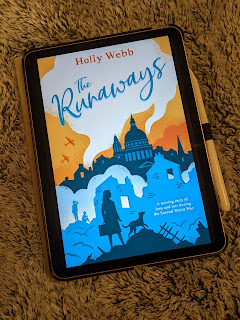
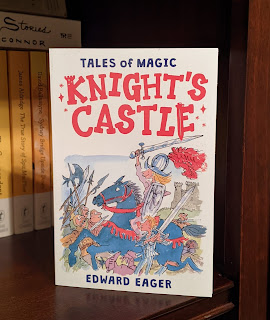
The Runaways by Holly Webb and Knight's Castle by Edward Eager

Both of these books are middle grade and (surprise!) I read an e-book! You know how often that happens. 

The Runaways by Holly Webb is a WWII story about a young London girl whose mother refuses to evacuate her to the countryside when war is coming. She is a widow and wants to keep her remaining family (two children, one of whom is a teenager) close and needs help running her shop. 

Molly is already upset about her friends leaving when she finds out her mum is going to have the dog and cat put to sleep in preparation for possible bombing. So she packs up, takes the animals, and runs away. 

The cat gets out of her basket and runs back home (which naturally gave the cat lover in me anxiety) but Molly continues on with the dog and eventually comes across two children who are also runaways but from an abusive home. The three travel together until they find a place to settle. But, even that may not end up well. 

Recommended - I thought The Runaways was a very good story, although the writing was occasionally a bit awkward. The occasional awkward sentence, though, certainly wasn't enough to stop the momentum. I felt like you really got a feel for the hunger, the dirt, the grief, and the general horror of war in The Runaways and I'll be watching for more by Holly Webb. 


Knight's Castle by Edward Eager is an older book, the second in the "Tales of Magic" series, copyrighted in 1956. It sat on my wish list for many months (because of last year's book-buying ban) after I read that it was the childhood favorite of an author I admire. 

After I added the book to my wish list, I threw away the interview in which Knight's Castle was mentioned, so I have no idea who recommended it but she said she'd been waiting for it to have it's time in the sun as she thought it was better than Harry Potter. While I'm not a huge fan of Harry Potter, I tend to disagree, but I still enjoyed Knight's Castle.

Knight's Castle is the story of a boy who has a collection of toy soldiers that have been passed down through his family. The oldest one is in terrible shape but when the boy closes his hand around it and makes a wish, he's transported back in time and the way he's positioned the toy soldiers around a play castle is how they are when he materializes in this magical world and the toys become human. 

There's a whole backstory with the boy, his sister, and two cousins. The boy and his sister end up at their cousins' house because something's wrong with their father and he must urgently go to the hospital.The boy is originally transported through time when he makes his wish and then the other children eventually begin to travel back in time with him. But, his wish can't come true until he proves himself worthy. And, he's running out of time.

Recommended - While I wouldn't call Knight's Castle a favorite, I enjoyed it enough to wish I had the entire series to read. I always enjoy time travel and there's a silliness to the book that tickled me. When the soldier's talk, it's like they're trying to speak as if they live in the Middle Ages but they don't quite know how, so it's a bit gibberish and quite funny. I can definitely see how this story would have left an impression on a child. 

©2022 Nancy Horner. All rights reserved. If you are reading this post at a site other than Bookfoolery or its RSS feed, you are reading a stolen feed. Email bookfoolery@gmail.com for written permission to reproduce text or photos.

Tuesday, February 15, 2022

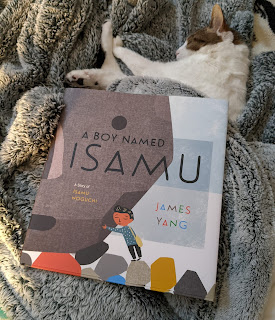
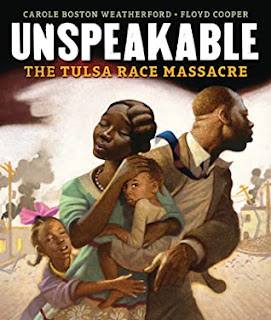
A Boy Named Isamu by James Yang and Unspeakable: The Tulsa Race Massacre by Carole Boston Weatherford and Floyd Cooper

Both of the following are children's picture books. Full disclosure: James Yang, author of A Boy Named Isamu, is a high school friend. While these are both 5-star reads, I have very little to say about either, so this will be just a couple of slap-dash, quickie reviews. 

A Boy Named Isamu by James Yang is a story that imagines artist Isamu Noguchi as a boy, on a single day when he goes to the market with his mother and drifts away. It shows his boundless curiosity and sense of wonder as he notices the shapes and textures that will inform his art. 

The illustrations are fabulous. I'm a fan of James's art but I think he really knocked it out of the park in A Boy Named Isamu. And, I loved the way he portrayed how an artist sees and thinks. There's a nice bio of Isamu Noguchi in the back of the book. 

Highly recommended - I loved A Boy Named Isamu so much that I read it, recorded it in my reading calendar, and then read it again. As I said elsewhere . . . forget the grandkids, this one's for me. But, I'm sure the grandchildren would appreciate it, as well. 


Unspeakable: The Tulsa Race Massacre by Carole Boston Weatherford and Floyd Cooper (illustrator) is a book I bought after seeing it on a list of books that some politician or conservative group wants banned. I was curious why on earth anyone would want to ban a children's picture book, especially about such an important topic. 

Brief note: My husband and I grew up in Oklahoma and neither of us ever heard of this particular historical event, although Hubby says his friend told a story of his grandfather hiding a Black man in the 1920s and he's pretty sure it was during what has elsewhere been called the "Tulsa Race Riot" (a name which, this author notes, places blame on the victims). 

Unspeakable tells the true story of the Tulsa Race Massacre  and places the blame squarely where it belongs, on the people of that time period who murdered, looted, and burned a prosperous black community to the ground. It's well written, appears well researched, and the illustrations are marvelous. It ends with a photo of the burned remains of Tulsa's Greenwood district. As an Oklahoman who didn't hear about this violent travesty until a few years ago, I'm glad to see it talked about. 

Highly recommended - The hardback was sold out everywhere when I looked this book up, so I bought the e-book and the electronic version is perfect. There were no issues at all with the images. This story was suppressed for far too long and I can't imagine why anyone would desire to ban it other than a continued desire to suppress the truth. It's told in a very positive way and the illustrations are just stunning. 

©2022 Nancy Horner. All rights reserved. If you are reading this post at a site other than Bookfoolery or its RSS feed, you are reading a stolen feed. Email bookfoolery@gmail.com for written permission to reproduce text or photos.

Monday, November 29, 2021

Lost Love's Return by Alfred Nicols


This will just be a quickie review because I don't like to say much about books that I didn't love. Lost Love's Return by Alfred Nicols is a book I bought after a friend begged me to read it (the author is a friend of her family) and then she chose it for our F2F book group's selection. I didn't go to the meeting and have only actually been once since before the pandemic but I read it so I could share my thoughts with her. 

Lost Love's Return is about an American soldier named Peter who is injured during WWI. He and a British nurse, Elizabeth, fall in love. But, when he's shipped out without time to tell her he has to leave or give her his address and he realizes he doesn't know how to get in touch with her at all — doesn't even actually know the name of the hospital where she works — they completely lose touch and he ends up in a loveless marriage back home, an ocean away from her. 

Decades pass before he's able to track her down with the help of his son. What will Peter find when he finally reunites with the love of his life?

Neither recommended or not recommended - OK, so my personal opinion is that Lost Love's Return brings nothing new to the table. There is no new insight about WWI and the love story is both predictable and one that's been done, before. Having said that, there was a point that I found myself enjoying the story and it has high ratings at Goodreads. So, I wouldn't tell anyone not to read it. There's a sweetness to the romantic storyline; it's just nothing new or special, in my humble opinion. Also, I was a little frustrated by the fact that all of the men who were main characters were tall, strong, blond, and handsome but most of the women were either unattractive or highly self-critical, except for Elizabeth. And, the men kept getting women pregnant. It was just a little trite in that way and felt like a total guy book, to me. I also thought there were a few problems with the British English but that's not necessarily something that will jump out at everyone. I opted not to rate the book at Goodreads but now that I've had time to let it marinate, I'd say it's . . . average? Not horrible, not great, just OK. 

©2021 Nancy Horner. All rights reserved. If you are reading this post at a site other than Bookfoolery or its RSS feed, you are reading a stolen feed. Email bookfoolery@gmail.com for written permission to reproduce text or photos.

Wednesday, November 18, 2020

The Day the World Came to Town by Jim Defede


I read The Day the World Came to Town: 9/11 in Gander, Newfoundland by Jim Defede as an e-book, which means I shocked myself because not long before I'd read Mexican Gothic electronically, as well. You know how I abhor e-books, right? Two in a row? Gasp! That's not likely to happen again, soon, although I am trying to read at least one per month. We'll see how that works out.

The Day the World Came to Town is the story of what happened when American airspace closed after the twin towers were hit, why Gander was chosen as the place to land a large number of planes, how the landing was handled and locals coordinated the effort to care for their huge influx of visitors, and what became of the various planeloads of people in the short and long run, along with a few of their stories. 

The Day the World Came to Town is not particularly well written but I liked it for the stories of kindness and the sense of community, including the way the "Newfies" embraced their guests and went out of their way to provide for their individual needs (like Kosher food for a small group when someone realized they were Orthodox Jews and noticed they weren't eating at all). For a few days, nobody cared about status, country of origin, skin color, etc. It made me want to move to Newfoundland, to be honest. What lovely people and so generous. 

The hard part of the reading was the losses described; and, if you were around on 9/11, it really takes you back to the memories and the emotion. I got teary a lot. 

Recommended - The Day the World Came to Town is slightly dated because it was written soon after 9/11 but it's still a good read. I chose to read it specifically because I'd heard it was an uplifting story and we were on the verge of the presidential election, as I was reading. I needed the escape and it didn't need to be perfect to fit the bill. 


©2020 Nancy Horner. All rights reserved. If you are reading this post at a site other than Bookfoolery or its RSS feed, you are reading a stolen feed. Email bookfoolery@gmail.com for written permission to reproduce text or photos.

Wednesday, November 11, 2020

Mexican Gothic by Silvia Moreno-Garcia


Mexican Gothic by Silvia Moreno-Garcia has been on my wish list for a while and I've read seemingly a gazillion reviews of it, so I was really excited when the e-book went on sale at a reasonable price. I may be terrible about getting around to reading e-books but desperation is very motivating and I really truly wanted to read it. 

Noémi is a party girl who lives in Mexico City in a sprawling, modern home, with her wealthy father. When she receives a rambling, incoherent note from the cousin who used to live with them, her father says she must go find out what's wrong with Catalina. Noémi doesn't really want to go but she knows it's the right thing to do. 

She's met at the train station by Catalina's husband and taken on a long drive up into the mountains to their remote home. This is where the "gothic" bit comes in. The home is an old mansion in poor repair and Catalina lives with her husband's family, including the patriarch of the family, a cousin, and the cousin's mother. There's mold on the walls and the family has bizarre rules that they expect Noémi to abide by (no talking during meals, no smoking, no bothering her cousin unless they feel she's okay to receive visitors). Catalina appears to be sick but maybe more in spirit than in health; her personality is entirely different from the carefree, happy soul of pre-marriage. But, Noémi isn't sure what's wrong and she's determined to get to the bottom of it. 

There's much more to the story, of course, including a growing attraction to cousin Francis and weird dreams that may be caused by the house, itself.

Recommended but not a favorite - Although I never fell massively in love with the plot, I liked about the first 2/3 of Mexican Gothic for the atmosphere, the creepy people, the weird dreams, and the questions that all this strangeness brought up. Why did Catalina's personality change? What was in the potion she had Noémi fetch from town? Was Catalina's husband just imprisoning her so he could keep her money or was there more to the story? What was up with the patriarch of the family and his need for silence? What was the reason for the murder in the family, years ago? What happened to all the other people who died near the house or in the family's long-closed silver mine?

See, I told you there was more to the story. Around the 2/3 mark, Mexican Gothic got a bit too weird for me and I considered giving up. Instead, I flipped to the end of the book and read a few pages to see if it looked like the book was worth sticking out. The ending looked promising so I continued, but I confess I pushed myself to read faster. The reason for all the strange happenings was just a little too bizarre for my taste. I did find the ending satisfying, though, so I have no regrets. And, I loved Noémi. She's a great, strong female character who was devoted to Catalina enough to refuse to leave, even when things became seriously weird and even dangerous. I also liked Francis and was rooting for Catalina, Francis, and Noémi to escape. 

My friend Brittanie started reading Mexican Gothic a few days after I did so we got to discuss it, which always adds to the reading experience. So glad I've been able to occasionally find people to discuss books with; I am missing my F2F group but the hole they fill in my life has been kept nicely plugged by discussion with other online friends and I so appreciate that. 


©2020 Nancy Horner. All rights reserved. If you are reading this post at a site other than Bookfoolery or its RSS feed, you are reading a stolen feed. Email bookfoolery@gmail.com for written permission to reproduce text or photos.

Wednesday, October 14, 2020

I Am Not Your Perfect Mexican Daughter by Erika L. Sánchez

I Am Not Your Perfect Mexican Daughter by Erika L. Sánchez is a young adult novel about the daughter of immigrants who has experienced trauma, feels like the lesser child in her family, and doesn't understand why her parents behave the way they do. 

Olga was the good daughter but now she's dead and her sister Julia feels like her life is spinning out of control. Her mother is overprotective and won't let her have any privacy. Her father is mostly silent. Everyone has been crushed by Olga's death. When Julia finds some unexpected possessions in her sister's room, Julia is determined to uncover Olga's secrets.

Grief, controlling parents, LGBTQ, racism, sexism, depression and anxiety, xenophobia, and teenage romance — there's a lot going on in this book. I didn't care for Julia's crudeness but I Am Not Your Perfect Mexican Daughter had the ring of truth. And, even though she's a hot mess, Julia still managed to show her sense of humor. 

Recommended - I've had an e-copy of I Am Not Your Perfect Mexican Daughter for several years (yes — gasp! — I read an e-book!) A friend chose it as a discussion book when I was in a Facebook discussion group but I was unable to fit it in, at the time. And, I do think it would have been a terrific group read. It's an emotional story, especially if you've experienced and can relate to Julia's grief. In fact, I think it would be a perfect book for a mother-daughter discussion group because it's the kind of book that will open up opportunities with a teenager to allow her to discuss her frustrations. 

I gave it ⭐⭐⭐⭐. 

©2020 Nancy Horner. All rights reserved. If you are reading this post at a site other than Bookfoolery or its RSS feed, you are reading a stolen feed. Email bookfoolery@gmail.com for written permission to reproduce text or photos.

Thursday, January 30, 2020

Mini reviews - Under the Jaguar Sun by Italo Calvino, Virus on Orbis 1: The Softwire by P. J. Haarsma, and If Cats Disappeared from the World by Genki Kawamura

I'm going to keep writing mini reviews where appropriate, although I'm closing in on catching up on reviews, finally! It's only taken me nearly a month. That's what you get for taking time off, I guess.

Under the Jaguar Sun by Italo Calvino was my first finished book in 2020. A slim read, it contains three short stories, each based on one of the senses. It was meant to contain stories about all of the senses, plus a frame, but not completed before the author died. Under the Jaguar Sun is my first completed Calvino. Oddly, I was loving If on a Winter's Night a Traveler when I was in the midst of it, a couple years back (and I get what he means by a "frame" from that). I'm guessing I had some ARC commitments that got in the way, at the time.

The first of the stories is about the sense of taste and it's a story in which a couple travels around Mexico, trying new dishes, seeing new sights. At some point, the wife begins to wonder aloud what happened to the hearts of those who were sacrificed. The implication is that she knows and is both appalled and intrigued.

Calvino strikes me as a real writer's writer. Such deft use of language! Because there are only three stories about the senses, the book is far from complete. It's still well worth the read, though.

Recommended - Sometimes lovely, occasionally revolting, often humorous, always skillful. Under the Jaguar Sun made me want to read more Calvino.

I downloaded Virus on Orbis 1: The Softwire for free and then heard Nathan Fillion recommended the series and downloaded a couple more. That was ages ago and what finally got me to read an actual e-book (an e-book!!! — if you read my blog regularly, you know I have a problem with them) was a middle-of-the-night wake-up and not wanting to disturb the spouse or get out of bed to go to the reading chair. It was a cold morning.

JT has a special talent. He can talk to the computer on the ship that's taking children to Orbis 1, a settlement on rings near a black hole. The adults are gone, killed by a problem with the pods that were intended to keep them from aging while the ship traveled to its destination, and the computer has raised and trained the children. Only JT can speak to Mother (the computer) without using a keypad.

When the children arrive at Orbis 1, they're distributed amongst the creatures (much like in the Star Wars café, there's quite a variety of aliens) to be used as labor. JT and his sister end up together, but JT is quickly identified as a "softwire" who can talk to and even enter a computer using only his mind. With problems frequently plaguing the Orbis 1 computer system, JT is blamed. But, JT knows there's something inside the computer. And, he must solve the problem quickly because his life is in danger as long as he's being blamed.

Neither recommended or not recommended - I might have abandoned this book (a middle reader, I presume) if not for Fillion's recommendation and the fact that I really wanted to know how JT would solve the problem with the computer. There's just a bit too much world building, if that makes sense. It's so far out there that I felt a little exhausted by it. But, the final third to half of the book is full of pulse-pounding action and that was enough to make me think, "Hmm, I will definitely read on." I probably won't get around to the second in the series until another dark, cold night in which I don't want to turn the light on, but I will definitely read on.

If Cats Disappeared from the World was my choice for #JanuaryinJapan (or is it #JapaninJanuary?) and, of course, the word "cat" in the title gave it first priority. The Japanese do love their cats, as do I.

The plot of If Cats Disappeared from the World felt a little familiar to me. A Japanese man with a cat finds out he's dying. What will happen? But, in this case, when the protagonist finds out that he's dying, he makes a deal with the devil. Each day, he can choose to have something removed from the world. Once the item is taken away, he gets a single day more of life. But, is there a line in the sand? If so, what is the hero unwilling to let the world do without?

Recommended but not a favorite - I thought the storyline was a little simplistic and predictable, a little schmaltzy, but I enjoyed it anyway. I think I might have liked it a little bit better if the hero had been rounded out a little better and if he'd had to consider a variety of items to possibly remove and choose from them. Instead, as I recall, he chooses the first thing that disappears from the world but then the devil makes the choice, after that. And, each of those choices becomes more difficult as they have some meaning to the hero.

Of these three books, none were favorites but I'd have to choose Under the Jaguar Sun as the best written and the one book whose author I most want to read again.


©2020 Nancy Horner. All rights reserved. If you are reading this post at a site other than Bookfoolery or its RSS feed, you are reading a stolen feed. Email bookfoolery@gmail.com for written permission to reproduce text or photos.

Sunday, March 25, 2018

Minis: Al Franken, Giant of the Senate by Franken and The Hate U Give by Angie Thomas

I've decided I'm going to do several sets of mini reviews to get myself caught up (again) since a good portion of the books I have left to review are from my personal stacks. Any books from publishers will get separate, full reviews.

I ordered Al Franken, Giant of the Senate because I figured it would be a funny book about life in the Senate and I've liked Al for as long as I can remember. Boy, was I surprised. Al Franken, Giant of the Senate is more than I could have imagined. It's funny, yes, but it's also educational. Rather than just describing his senate years, Franken goes back to his early life and explains how and why he became a liberal, a satirist (he prefers "satirist" over "comedian"), a Harvard grad, and a senator, his difficult entry into politics, and the challenges he faced specifically because of his background in show business.

The only things I really knew about Franken as a senator (as opposed to Franken the satirist) before reading Al Franken, Giant of the Senate, were the facts that he's a Democrat and that he asked by far the best questions of any senator when he vetted people for cabinet seats in the current administration. I'd paid little attention to him, otherwise, but I was definitely impressed at the precision of what he asked and the clear knowledge and/or research behind his questions. And, it turns out there's good reason for his amazing questioning skills: Al Franken did his research.

By the time I read Al Franken, Giant of the Senate, Franken had already been forced out of the Senate by female senators who ganged up on him without granting him the investigation he was willing to go through and deserved. So, it was particularly interesting to read about the ways he had to defend himself in the past, the challenge of trying to get the Democratic party to endorse him, the vetting he submitted to in order to make sure that nothing like what ended his career in the Senate would happen, and the sacrifices of Franken and his family to do a job that he felt driven to do because of his passion to help others. I never believed he got a fair shake, in the end, and I'm doubly convinced after reading his story; but, I do believe I understand why he gave up so easily. Al Franken was one of those rare politicians who was in it for his constituents, not to make himself piles of money. An excellent book, highly recommended. I'd like to go back and read some of his older books, when I have the time.

The Hate U Give by Angie Thomas is a book I read with an online book group. Seemingly everyone else on the planet has read and reviewed the book, so I feel like I'm a little late to the ballgame and I liked it perhaps a bit less than most, but it's a powerful story that I'm very glad I read.

16-year-old Starr lives in an impoverished neighborhood but attends a school in an upscale part of town, so she's learned to shift between the two worlds. On her home turf, she speaks the dialect of those around her; in school, she softens her language to match that of her fellow students. Putting on a different front at school takes effort, but it becomes even harder to hide her true feelings and self after an old friend is killed by a police officer when the officer mistakes the handle of a hairbrush for a gun. Starr is in the car when he's shot and sees him die.

Shocked by her experience, Starr does everything she can to see justice served but is stunned to find that nobody takes her seriously. Is there anything Starr can do to change the outcome and prevent more of the same, or will Starr's childhood friend always be known as just another drug-dealing black guy who made the wrong move, even though he did nothing wrong?

I thought The Hate U Give was excellent, powerful, important, and necessary. I only had one real problem with it and that was the vernacular. I did try to look up some of the words and expressions that I didn't know but was unable to find all of them. In general, I tend to really dislike books that are written in dialect. But, it was crucial to Starr's character to show the two sides of her. So, I looked up what I could and guessed at other words. Fortunately, I was eventually able to ask around and find out the meaning of the words I was unable to locate definitions for online. But, not knowing while I read frustrated me and that's why I gave the book 4 stars. Still . . . an emotional read that is truly of the moment. The Hate U Give shines a light on a uniquely American problem.

I read The Hate U Give electronically, so it won't appear on my stack of February reads when I get around to posting my Month in Review (running late on that, clearly). It was a good one to read for discussion because of both the difficulty I had with the lingo and the fact that the people in my discussion group had a lot of unique insight to contribute. I really appreciated reading other viewpoints. Recommended.


©2018 Nancy Horner. All rights reserved. If you are reading this post at a site other than Bookfoolery or its RSS feed, you are reading a stolen feed. Email bookfoolery@gmail.com for written permission to reproduce text or photos.

Thursday, February 16, 2017

We Should All Be Feminists by Chimamanda Ngozi Adichie


After yesterday's rambling post, you deserve a nice, short one. And, that should be easy enough as We Should All Be Feminists is a very quick read - the first for my personal Feminist Reading Challenge in 2017.

Written originally as a speech, We Should All Be Feminists is a mix of Adichie's personal experiences and observation. I don't think I can beat the description at Goodreads, so I'm going to share a paragraph of that and then tell you my own thoughts:

With humor and levity, here Adichie offers readers a unique definition of feminism for the twenty-first century—one rooted in inclusion and awareness. She shines a light not only on blatant discrimination, but also the more insidious, institutional behaviors that marginalize women around the world, in order to help readers of all walks of life better understand the often masked realities of sexual politics. Throughout, she draws extensively on her own experiences—in the U.S., in her native Nigeria, and abroad—offering an artfully nuanced explanation of why the gender divide is harmful for women and men, alike.

I found We Should All Be Feminists incisive and revealing, particularly for her unique view as an African woman who has spent a lot of time in America. I especially enjoyed reading about the differences between life as a woman in Africa and in the United States. Having said that, a lot of what she had to say was familiar. Where I may have read similar thoughts, I can't say. I've only read a few books about feminism or by feminist authors. I didn't mind the repetition at all because her perspective is a unique one and who knows? It may be the only book about feminism some people read. If so, it's a good choice because of its brevity and clarity.

Highly recommended - Especially recommended if you're looking for a very quick read about feminism and why treatment of women as equals is healthier for all concerned.

Surprise! Because the book was short and I was in a hurry (January was well under way when I decided to challenge myself to read feminist works, whether fiction or nonfiction), I opted to buy and read the book in electronic form! I know, shocking. Well, it's shocking to those who know about my aversion to e-books.

I asked for suggestions of feminist titles at Facebook and when I went back to collect the titles, I couldn't find the post. I'm going to look again because sometimes things disappear from Facebook and then reappear, presumably due to those annoying algorithms. I know I didn't delete it. But, I figure it doesn't hurt to ask for more suggestions, so please let me know if there are any feminist titles you highly recommend. I broke my book-buying ban to order a couple that were recommended on Twitter. I figure that's legit, buying books for my personal reading challenge, right? Right.


©2017 Nancy Horner. All rights reserved. If you are reading this post at a site other than Bookfoolery  or its RSS feed, you are reading a stolen feed. Email bookfoolery@gmail.com for written permission to reproduce text or photos.

Saturday, February 28, 2015

Even if the Sky Falls Down by Susan Jackson Bybee, a DNF, and an Internet-Free Month


I'm getting ready to go on a month-long break from the Internet, but I can't bear to leave without first talking about Susan Jackson Bybee's book, Even if the Sky Falls Down. I knew Susan as just "Bybee" at her blog, formerly called Naked Without Books but recently changed to Blue-Hearted Bookworm, for years before I finally got to know her as Susan at Facebook. And, I watched from the sidelines as she wrote during National Novel Writing Month. But, wow . . . I didn't expect her to edit and publish a book within just a few months! I had no idea what she was writing, much less that it would turn out to be one of the best stories I've read so far in 2015.

From Goodreads:

Thirty-something American Lily Thompson is enjoying her life as an English teacher in a private kindergarten in Seoul, South Korea. When she breaks her ankle and loses her job, her handsome recruiter finds her a new position in the Korean countryside, teaching English to elders at a senior center. Lily is unsure how she'll relate to students at the other end of the age spectrum, but things are not quite what they seem. Charged with documenting the memories of an eclectic range of elderly people sends Lily on a journey revealing unique insight into both Korea's troubled social history and her own life.

You have got to read this book. Even if the Sky Falls Down (link leads to Amazon) is currently available in e-book and it's so good I hope someone will "discover" Susan and publish it in paper form, someday.

I love the way Lily's faced with not one but several changes and conflicts in the book. Can she cope with the change from teaching young children to giving lessons to the elderly? How will she deal with the ghost of her past who has returned to haunt her? Will she ever learn to speak Korean?

As the elderly people at the senior center begin to dictate their stories and Lily gets to know them, you see the marvelous transition of Lily from a young (30-something) woman running away from her past to a woman who is happy and secure in her present. But, what I most love about Even if the Sky Falls Down are the personal histories dictated by the elderly people, which are interspersed within the present-tense story of Lily. They are so believable that I found myself wondering how on earth Susan came up with all those stories. Did she actually interview people? Are they similar to stories she's heard while living and working in Korea? Did she pick some historian's brain? It doesn't matter. What matters is that the book has that unusual ring of truth that makes a book really stand out.

Highly recommended, and not just because I like Susan (although I do). Unlike a lot of self-published books, Even if the Sky Falls Down is almost completely devoid of errors; it's about the cleanest text I've ever seen in a self-pub. I'm impressed and I can't wait to see what Susan comes up with next.

And, now a DNF:

Married to Sin: Hideous family secrets, redemption was dictated by Darlene Collier (whom I'll refer to as the "author") and written by Meredith McGee, who has also written a book about James Meredith that I hope to read soon (James Meredith was the first black man to attend the University of Mississippi). I met Meredith McGee at the meeting of a local writers group that I attended, last week, and she gave me a copy of Married to Sin after I mentioned the fact that I'm a book blogger.

I thought Married to Sin started off quite well. There's an authenticity to the voice of Darlene Collier that comes through very nicely and I found her family history fascinating. One of her ancestors bought a large chunk of land in Mississippi after slavery ended and the family is still earning income off that land. But, Darlene's mother died quite young and after her hard-working grandfather died from injuries received in a tragic accident, she and her siblings were left with a father who drifted in and out of their lives, seldom working, and a grandmother who was diabetic, hid food from the children, and stayed in a chair all day. The children eventually were sent to a home for many years, then lived with relatives for a short stretch, and Darlene was still very young when she married.

Here is where I began to have trouble with the story. The author was (and is) married to a serial abuser but she never attempted to leave him, sticking around in spite of hardship. I would admire her for her tenacity if I didn't know she's a classic abuse victim, always letting the man back into her life no matter what horrors he has inflicted upon her. There were other people in the family who caused trouble and one of them raped her daughter for years before he was finally caught in the act. This was the point at which I closed the book: when the man who raped her daughter begged Darlene not to send him to prison and she dropped the charges. I've read about abuse in the past and I can understand falling prey to an abuser and having difficulty getting away, but letting your daughter's rapist off the hook? That, I cannot respect. I couldn't bear to read any farther. I made it 83 pages, which is close to halfway, but was tempted to give up sooner. Lots of errors in this one, another self-pub.

Last but not least - break time!

I'm taking off the entire month of March from the internet -- not just the blog, but social media, as well. I'll only be checking e-mail. This is a last-minute decision, although you already know I've been thinking about taking an extended break for some time if you're a regular reader at Bookfoolery. I started out my writing year well in January but lost the thread in February, so I feel like it's necessary to get myself back into a routine. But, I also just like to step away, now and then, and we're moving into the best part of the year, when it's still cool enough to do outdoor work and the pollen hasn't begun to peak. Hopefully, ditching distraction will allow me to enjoy the best time of year more fully, as well.

I hope you all have a fabulous month. Happy reading!


©2015 Nancy Horner. All rights reserved. If you are reading this post at a site other than Bookfoolery  or its RSS feed, you are reading a stolen feed. Email bookfoolery@gmail.com for written permission to reproduce text or photos.

Wednesday, April 16, 2014

50 Children by Steven Pressman, The Accidental Caregiver by Gregor Collins and Children's Wartime Diaries, ed. by Laurel Holliday

I've decided to combine 50 Children and The Accidental Caregiver with Children's Wartime Diaries in one post because they have WWII as an element in common. 50 Children: One Ordinary American Couple's Extraordinary Rescue Mission into the Heart of Nazi Germany by Steven Pressman is about the rescue of 50 Jewish children from Vienna, Austria after the Anschluss (the peaceful but harrowing occupation of Austria by Nazis).  The Accidental Caregiver is a memoir about an actor who became one of several caregivers to an elderly Jewish woman who escaped Vienna, also after the Anschluss.  So, they have escape from the Nazis in common. The third book is mostly about children who were not so fortunate. Although they have the war in common, they're entirely different books.  I just thought it was very cool when I realized Maria Altmann, the elderly woman, was also a Viennese Jew, after reading 50 Children and then it occurred to me that this would be a perfect time to mention Children's Wartime Diaries. I love it when there's an unexpected tie between reads.

50 Children (an ARC received from HarperCollins) is one of the best-written and most surprisingly gripping books set during WWII that I've read in a while. 

Gil and Eleanor Kraus were living a fairly quiet life in Philadelphia, Gil as a lawyer involved in charitable organizations, his wife a socialite who adored their two children. When Gil was approached by the head of a Philadelphia Jewish organization with the request to head up an effort to rescue 50 children from Nazi Germany, he said "yes" without even giving it any thought. Eleanor was heavily involved as she had to persuade a number of people to divulge deeply personal information necessary for the affidavits needed to prove that there were people able and willing to care for the children when they arrived in the U.S.  

After the Anschluss, it became clear that children in Austria were at even greater risk so the origin changed but not the mission. 

Gil, being a lawyer, realized that the only way the rescue could possibly occur during a time when immigration was strictly limited would be to stick to the letter of the law. Consequently, there's a great deal about the red tape, the detailed paperwork and the people Eleanor and Gil Kraus had to deal with. So, I was a bit surprised that I never found 50 Children dull.  Instead, I really found it quite gripping and beautiful but a little sad -- sad because not every child who applied for a spot could be taken, sad because the heads of other Jewish organizations who had failed to do similar were envious enough to speak out against them, sad because you can't read about those left behind without knowing the fate of the majority. 

But, how beautiful the stories of the children themselves, told toward the end of the book, about how much fun they had during their summer together at a camp building and how lovely the reflections of the rescued children, now grown, still living.  And, how amazing that 3 Jewish adults (they were accompanied by a pediatrician, who actually fell in love in Berlin . . . that's a great story, as well) were willing to risk their own lives, going into Nazi-occupied nations to interview children and parents, dealing with paperwork and interviews to obtain visas, and then accompanying the children from Vienna to Berlin and onward to the U.S.

There is a photograph at the head of each chapter and my favorite is a photo of Gil Kraus reading to 4 of the children, with the following quote:

While the number 50 is but a small drop among the hundreds of thousands of lives yet to be saved, still in all each life is worth a world unto itself.  ~ Gil Kraus

Highly recommended - I get a little soppy just thinking about this book. It is a heroic tale, brilliantly researched and told in compelling narrative that makes the story feel quite tense, even though you clearly go into the reading knowing the outcome. 

The Accidental Caregiver: How I Met, Loved, and Lost Legendary Holocaust Refugee Maria Altmann by Gregor Collins is not merely about an escape from Austria, although Maria Altmann's escape story is told. Rather, it's about how Gregor, an actor, became one of Maria Altmann's caregivers, his time working with her, and his journey abroad after her death. 

When I was updating my progress reading The Accidental Caregiver -- a rare e-book purchase whose reading took me a few days because my iPad is crashing frequently -- I glanced across a few of the reviews at Goodreads and found that some people considered the author egotistical. I didn't feel that way at all, although there are moments that Maria humorously whips her head to the side to indicate that she wants to see Gregor's handsome profile.  Even when those moments happen, they're about Maria rather than the author.  At least, that's how I saw it.  

Maria Altmann was in her 90s when Gregor Collins became one of her caregivers.  She was quite a feisty, vigorous woman but during the 3 years Gregor worked for her she went into a sharp decline and passed away. The author had dated a number of shallow women who confused him; he wasn't even sure what he was looking for in a woman.  But he fell in love immediately with Maria's fearless, happy-go-lucky, sometimes raunchy and definitely life-affirming ways.  Sometimes Maria could be a bit shocking but it's the fact that Gregor and Maria both felt an immediate rapport that makes the book such a joy.  

Highly Recommended - I loved The Accidental Caregiver enough that I deliberately dragged out the reading a bit (aided by regular iPad crashes) and found both author and subject charming in their own ways. There are some misused words but I loved the light writing style and, no, I didn't feel like the author was uncomfortably self-centered. I gave it a 4.5/5 at Goodreads -- not much taken off for minor editing problems. The Accidental Caregiver is, after all, a memoir so it's not just about Maria Altmann but about the author's feelings about her as the author cared for her and then (briefly) his couch-surfing journey around Europe.  Loved it and wish I had the chance to know Maria. The book is currently being made into a film, which I hope will be widely released so I'll have the opportunity to see it.


Children's Wartime Diaries: Secret Writings from the Holocaust and WWII, ed. by Laurel Holliday, is a book I've meant to mention and which ties in to the other two books pretty well.  It's a set of diaries (some complete, others partial) written by children during the Holocaust.  I have the full versions of some of them on my shelves. 

I read Children's Wartime Diaries a couple months ago.  The surprising thing about the writings in Children's Wartime Diaries is that most of them (with only a couple exceptions) are every bit as well-written as Anne Frank's diary.  Some are even more jaw-dropping. Such skilled writing from children so young!  Many of the children died, their writings retrieved later by a friend or relative, so it's a heartbreaking read and the cruelty they experienced is . . . well, it leaves me speechless just to think about what some of them endured. Two diaries written by British youngsters lend a little levity to the book (those two are both on my shelves in complete form) although they do eventually begin to feel the full impact of war on their own home turf. 

Again, highly recommended - Surprisingly mature writing in most cases but definitely a rough read because of the horrors experienced by the children who wrote the entries in this book. I cried a lot while reading Children's Wartime Diaries but at the same time I was mesmerized by some of the writing. There were only a couple excerpts that were simplistic enough to feel as if they matched the age of the writers. If you were captivated by Anne Frank's diary, you really must try to find a copy of Children's Wartime Diaries.  I bought my copy secondhand and I'm pretty sure it's no longer in print, but there were plenty available. Prepare to have your heart broken if you do chase down a copy.


©2014 Nancy Horner. All rights reserved. If you are reading this post at a site other than Bookfoolery  or its RSS feed, you are reading a stolen feed. Email bookfoolery@gmail.com for written permission to reproduce text or photos.

Tuesday, February 25, 2014

A few minis - The Rosie Project by Graeme Simsion, The Returned by Jason Mott, Redshirts by John Scalzi

A few minis, today, to help me catch up on recent reads (so many!) that have tossed me into backlog hell.  
The Rosie Project is a book I read in electronic form because I saw  so many effusive tweets and reviews that when it became available for $1.99 I figured fine, I can do without the paper for the sake of reading it sooner.  I really do hate e-books.

Don Tillman is a professor of genetics with Asperger's, brilliant in his field but socially inept. When he decides it's time to find a wife, he goes about the process in the same meticulous way he does everything else.  Don finds, however, that even the women who pass his stringent written test don't meet his criteria for one reason or another but Rosie, a completely unacceptable woman sent by his best friend, attracts him in spite of her unsuitability. 

When Don finds out Rosie wants to know who her father is, he uses his research techniques and knowledge to help Rosie narrow down the candidates, mostly as an unconscious excuse to spend more time with her. But, the more time he spends with Rosie, the more he realizes that it is he who must adapt to Rosie's needs, rather than the other way around.

Don is very much like Sheldon Cooper from The Big Bang Theory. His inability to understand human interaction and his need for strict order make for some hilarious situations. I absolutely loved this wacky  romance and highly recommend The Rosie Project to anyone looking for an upbeat, smart, funny read. Highly recommended.

The Returned by Jason Mott is a book I'm pretty sure I read about in Entertainment Weekly. When dead people inexplicably begin turning up all over the world, they are at first returned to their homes if there are survivors willing to take them in. But, as the number of Returned grows, people begin to panic.  Are they really the people that died or something else entirely? Why are they coming back to life, if they're real?  Should they be allowed to continue living when the sheer number of Returned threatens to decimate the food supply and overwhelm the planet's resources?  The living people who have not died are referred to as the True Living.

It took me a while before I realized that The Returned was not a science fiction novel that was going to explain away the return of the dead but a "What if?" that asks what would happen if the people we lost were able to come back, for a time.  That changed the way I viewed the novel but since it was based on a dream the author had about his mother after her death and I had that same kind of dream not once but several times after my father died, I found the book gripping and then touching.  It makes you think long and hard about what might happen if you really could speak to your loved ones and interact with them, again, if only for a few months or a year.  

I would have preferred that The Returned was sci-fi because it was the curiosity about what was causing the Returned that made it such a page-turner, at first, and yet I really did appreciate the book for what it was, once I figured out where the author was taking the story. The Returned is in many ways reminiscent of "Miracle Day", the fourth season of Torchwood, although in "Miracle Day" people cease dying rather than returning from the dead.  Of course, Torchwood is sci-fi and an explanation (although not an entirely logical one) is eventually given at the end of the "Miracle Day" series but there were similarities in the way people reacted -- with fear more than hope, separating the Returned from the True Living, considering the eradication of those whom many think should return to being dead. It's fascinating to theorize about how people might really react.

Recommended. Not at all what I expected.  Still, I enjoyed the book even after realizing it was something entirely different from what I thought it was going to be.

I think I already mentioned the fact that I have a library due-date to thank for the nudge to pick up Redshirts by John Scalzi.  

Redshirts is a story that begins on with a prologue in which several crew members on the space ship Intrepid are killed by Borgovian Land Worms on an away mission. In the first chapter, an entirely different group of new crew members meet up as they wait to board the Intrepid. It doesn't take long into their service on-board the Intrepid before Ensign Andy Dahl realizes something strange is going on. When Chief Science Officer Q'eeng shows up seeking away team crewmen, his coworkers disappear for coffee or to do inventory. Dahl's not stupid; he can see that they're ducking out.  But, why?  

Then, Dahl begins to notice certain trends regarding the deaths of underlings and he's given a warning by an elusive crewman who promptly disappears.  Why are so many new crew members dying during missions?  Who is the hairy man who gave Dahl a warning and why is he so difficult to locate?  Can Dahl survive as a new crew member who can't always duck his duty on away teams?  

Eventually, Dahl figures out what's going on and I'm not sure whether or not it's a spoiler but I'm not going to share his conclusions or what happens, just in case doing so might ruin the reading for someone. I like going into a book as clueless as possible, myself.  Suffice it to say, there is a very crazy reason for the deaths of the eponymous Redshirts (whom any Star Trek fan will have noted as the most likely crew members to die on an away team).  

John Scalzi never fails to entertain and Redshirts is a delight.  Subtitled "A Novel with Three Codas", I think the storyline could have stopped right before the codas and I would have been perfectly satisfied.  I didn't like the first coda at all; it was a jarring switch from the main storyline to the viewpoint of . . . oh, maybe that's a spoiler, but anyway . . . while I think the codas could have been dropped entirely, in the end I liked where Scalzi took the story.  

Highly recommended, especially to Star Trek and sci-fi fans.  There were quite a few grammatical errors in Redshirts, which surprised me because I used to read Scalzi's blog, Whatever, and he's such a sharp writer that I hesitate to blame the errors (mixed tenses in particular) on the author. Eh, whatever. It's a crazy-fun ride.  

©2014 Nancy Horner. All rights reserved. If you are reading this post at a site other than Bookfoolery  or its RSS feed, you are reading a stolen feed. Email bookfoolery@gmail.com for written permission to reproduce text or photos.

Wednesday, October 17, 2012

Three minis - Wait Till Helen Comes, The Man Who Never Was, and Ned Kelly & the City of the Bees by Hahn, Montagu and Keneally

I'm pairing up these three books for mini reviews because none of them are advance readers.  In fact, they're all pretty old.

Wait Till Helen Comes: A Ghost Story by Mary Downing Hahn (originally published in 1986) is a book I purchased during a recent sale of Hahn's e-books for $1.99.  I've never read any of the author's creepy children's books, although I've desired to for a long time and decided reading a ghost story would be a great way to sneak in a little bit of RIP-like reading (I never did sign up for the challenge).

12-year-old Molly's family moves to a new house near a cemetery and her artist parents expect her and her brother Michael to bear responsibility for their 5-year-old stepsister, Heather.  Michael is a budding naturalist who disappears in search of specimens, leaving Molly to deal with a stepsister who wants to have nothing to do with her.  When a ghost named Helen appears and tries to lure Heather to her death (to keep Helen company in the afterlife), Molly's growing concerns are dismissed as irrational fears until disaster strikes.

Unfortunately, the Library Journal review at Amazon contains spoilers.  I thought that wouldn't be a problem but I was wrong.  The suspense simply wasn't there because I knew what was going to happen.  Still, I enjoy a good ghost story and was in the mood for something extremely light so I don't regret reading Wait Till Helen Comes.  The biggest problem I had with the story involved annoyance with the parents.  They were extraordinarily selfish, expecting a 12-year-old girl and 10-year-old boy to watch out for their little sister almost all day, every day.  Heather is a typical stepchild who feels like her father's affections have been stolen from her and she frequently slipped away from Molly.  Unsurprisingly, Molly didn't always bother attempting to keep an eye on her little stepsister. While I found the lack of parental involvement frustrating (although, I suppose, it's not that uncommon in books directed at children of that age), I enjoyed the story, in general and would recommend it.

I've already mentioned The Man Who Never Was by Ewen Montagu, but you must know the story behind this find.  I was in our former town to pay some bills and decided to take a trip to the library's perpetual sale corner because it had been a frustrating day and I always enjoy going to the Bookmark, even if I only end up wandering around and buying nothing. 

The Man Who Never Was caught my eye because it had that "old book" look that I adore.  I have a little row of old hardbacks in my bedroom.  Most of them are titles I'll read; a couple are just cool to look at.  I liked the looks of the cover and was a little stunned when I opened the book to find that it was about Operation Mincemeat - something I've desired to read more about, since I read the fictional tale about it: Operation Heartbreak by Duff Cooper (which apparently led to the request for Montagu to write about the facts of the operation for public clarification).  

For a whopping 25 cents, I came home with the true story of Operation Mincemeat, written by the man who came up with the idea.  It's only about 150 pages long and some people consider it dry.  For my part, I appreciated the "just the facts" approach and found it rather exciting.  Because Ewen Montagu proposed the idea, he describes the challenges of the mission: finding an appropriate body and getting permission to use it, where to place it in the water so that wind and tide would deposit the body in the right place, how to dress it and what documents to include with the body to make the fake documents meant to mislead the Germans appear real, and what they found out about the success of the mission after V-E Day.  It was a fantastic read, lots of photos were included and I read it in a single sitting.  Highly recommended to those interested in WWII in general or Operation Mincemeat, specifically.  My copy was published by J. P. Lippincott Company in 1954.  Near as I can tell, that publisher no longer exists.

Ned Kelly & the City of the Bees by Thomas Keneally caught my eye because of the name "Ned Kelly".  I've read very little about the Australian outlaw, but I desire to read more.  However, apart from a clever reference to the outlaw, the story is unrelated; this Ned Kelly is entirely fictional.  

Told as if the story happened to him when the narrator was a young boy, Ned reflects on the appendicitis that landed him in the hospital.  After receiving a shot to put him to sleep for surgery, he sees a bee on the window above his head.  The bee talks to him, shrinks him down to bee size and he and another miniaturized child (Nancy Clancy, who appears to be the same age as Ned but is actually 120 years old) go to live in a bee hive for the summer.

Ned Kelly & the City of the Bees is a wildly creative story, beautifully written, which nicely imparts plenty of interesting information about bees.  It would make an excellent book to read to children who are patient enough to sit still through chapter books read by parents or for children old enough to read chapter books on their own (Amazon says, "ages 9 and up" but mine would have read it at 7 or 8).  Highly recommended. I'm a little disappointed to find that Ned Kelly & the City of the Bees is Thomas Keneally's only children's book, but he's written a large number of fiction and nonfiction books and I've yet to read Schindler's List, so I have plenty of other Keneally books to look into.  My copy was published by David R. Godine in 1995.  I thought the storytelling was excellent, enough to look into the publishing company's other offerings.  I checked out David R. Godine's informational page and was also impressed with their goal to produce quality books (acid free, some hardbacks still bound by cloth) of eclectic variety.  I'll be spending some time reading about this publisher's titles.


©2012 Nancy Horner. All rights reserved. If you are reading this post at a site other than Bookfoolery and Babble or its RSS feed, you are reading a stolen feed. Email bookfoolery@gmail.com for written permission to reproduce text or photos.


Tuesday, January 10, 2012

Hal Spacejock by Simon Haynes

I've known about Hal Spacejock for a long time (Simon Haynes is one of my Nano friends) and tried to acquire a copy of the book; but, even mighty Amazon couldn't get me a paper copy of Hal Spacejock from Down Under when I first sought it out. I could have acquired a PDF download but I don't like sitting at the computer to read for any great length of time.

A few weeks ago, Hal Spacejock showed up as a free Kindle download -- this time in the pretty e-book form. And, now I have an iPad with a Kindle app, so I had that sucker loaded in nothing flat.

Hal Spacejock is a slap-stick outer space tale about a Firefly-like cargo spaceship called the Black Gull (not in the greatest shape; used for interplanetary transport). Hal Spacejock is the name of the pilot. Hal is out of work and out of money. Then, someone offers him a job he can't refuse. Described as a quick transport job, it is in fact a job that nobody else will take because the planet where he is supposed to pick up robot parts is currently a no-fly zone. The military is doing target practice and anyone who shows up will become a target.

Hal's new employer sends a robot by the name of Clunk to help with the piloting. Clunk is to be reconditioned upon their arrival because he's not in the greatest shape, either. As it turns out, Hal is a pretty bad pilot and Clunk has better manners than Hal, as well as piloting skills. And, there are many complications.

I'm not going to go into any great detail, but it takes a surprising amount of time for Hal to even get off the planet. Once that occurs, Hal and Clunk go through a string of adventures that make you think Hal is one of those Too Stupid to Live characters. Light-hearted and plot-heavy, Hal Spacejock is a book to read when you're in a mood for a fun read and willing to shut off your skepticism.

Normally, I don't read reviews before writing my own, but I did glance through the Amazon reviews and found that a lot of people found Hal unlikable. But, I think he warmed up as the book progressed. I knew Hal Spacejock is just the first in a series; it didn't bother me that he was more than a little rough around the edges. And, I liked Clunk so much that I paid slightly less attention to Hal and more to his friendly, mostly-competent, nearly-human robot and his spaceship's computer, which had vague hints of Douglas Adams.

Recommended for sci-fi lovers in the mood for a little crazy, action-packed fun. Be patient with Hal. It takes him some time to soften up but he improves toward the end. I'll be downloading the next book in the series, soon.


©2012 Nancy Horner. All rights reserved. If you are reading this post at a site other than Bookfoolery and Babble or its RSS feed, you are reading a stolen feed. Email bookfoolery@gmail.com for written permission to reproduce text or photos.
Wednesday, December 14, 2011

Mrs. Claus Explains It All by Claus and Wenzel - Review and link to e-book promotion

Sourcebooks sent out some promotional material about this gorgeous picture e-book, this morning, and I asked to review it before passing on any links. Mrs. Claus Explains It All by Elspeth Claus is an enhanced e-book that gives children the option of choosing to have Mrs. Claus read to them. A little note on each page shows a child's question ("How old are you and Santa?", "What are Santa's workshops like?"), each of which is read by a child's voice, and Mrs. Claus' cheerfully replies. The answers are shown in text that's placed so that the illustrations are large and clear.

It's really the illustrations that make Mrs. Claus Explains it All enjoyable, in my humble opinion, although there is nothing better than a book that reads itself when you hit the road with small children. We used to carry loads of books on tape for the kids, when we traveled. I found the text a little flat and dull when just reading it without Mrs. Claus narrating, but the narration gives it a special spark and the illustrations are beautiful. I can easily imagine a small child paging through the e-book over and over, again. Of course, on an iPad you can zoom in to admire the details of the illustrations. I love beautiful artwork, so I found myself zooming in, quite a bit.

Definitely recommended, especially if you're looking for a holiday book with narration to help keep your child occupied while traveling or when the adults are busy fussing around in the kitchen during the holidays. There's a link to sample pages, below, so you can peek inside and listen to the voices to see if you like the book, before purchasing.

View sample pages from Mrs. Claus Explains It All, here.

Mrs. Claus Explains It All is available for only $4.99 now at:

Apple's iBookstore

NOOK Bookstore

Platforms: iPad, iPhone, iPodTouch, NOOK Tablet, NOOK Color, NOOK app for iPad


©2011 Nancy Horner. All rights reserved. If you are reading this post at a site other than Bookfoolery and Babble or its RSS feed, you are reading a stolen feed. Email bookfoolery@gmail.com for written permission to reproduce text or photos.

Friday, March 25, 2011

Cutting for Stone by Abraham Verghese and a book group report

Cutting for Stone by Abraham Verghese
Copyright 2009
Vintage - General Fiction
Read in e-book form, which had no page numbers (but Amazon says the paperback has over 600 pages)

Cutting for Stone is an epic tale, but I've written a paragraph, deleted, written, deleted. I'm stuck. I think I'm going to have to go with Ye Olde Faithful interview format. Today, the cats are not available due to nap time, so I'm going to be interviewed by the color Green.

Green: Hello! I am ubiquitous. I am life. What's up with you?

Bookfool: Hello, Green. Yes, I see you everywhere outside my window. You and Yellow are making me sneeze. So, the book . . .

G: Yes, the book. Why did you read Cutting for Stone?

BF: I read it to discuss with my book group.

G: Would you have read it, otherwise?

BF: Nope. For some reason, I deliberately avoided Cutting for Stone for over a year. I read the description at Amazon, saw a million reviews online, looked at the cover (I really hated the hardback cover) and was totally turned off. Our Fearless F2F Group Leader talked me into reading it so that I could participate instead of sitting there, looking like I was watching a tennis match (I adore the way people get excited and talk right over each other, in that group).

G: What's the book about?

BF: That is the hard part to describe. It's about twin brothers born to a nun and a surgeon at a hospital where both work, in Ethiopia. The mother dies, the father immediately runs away, and two of the other doctors raise the boys, Marion and Shiva, as their own. Both boys, raised on the hospital compound, choose to become doctors, but with different specialties. Eventually, a rift develops between the twins and, thanks to political upheaval, one of them is forced to flee the country, where he goes through an entirely new experience as an immigrant. I thought it was about relationships, life, love, politics. Ethiopia is almost a character in and of itself. There is so much that happens and that would be spoilery that it would be best not to go into too much detail.

G: But, the author has something different to say.

BF: Yes, if you watch the video of Verghese at Amazon, you'll see he says Cutting for Stone is about how geography shapes your destiny (and more; I recommend the video -- he doesn't give anything away).

G: What did you like best about this book?

BF: There's a lot to love. I loved the characterization, the writing is beautiful, the details about Ethiopia are fascinating and it's really a story you can sink your teeth into -- meaty and very absorbing. I did the, "One more chapter, just one more chapter, okay one more," thing and wrecked myself thoroughly, one night. I didn't personally think there were any wasted words. Also, I adored the character Ghosh (one of the doctors who raised the boys) and his relationship with Hema was really a charming, tender love story.

G: What did your fellow book group members think about "wasted words" and the medical aspect?

BF: They agreed, for the most part, that the book was not overdone (as some critics have said) and absolutely everyone liked the book. But one or two people found the medical scenes a little Too Much Information, at times, and one person skimmed them without feeling like she missed out on anything important. There are a lot of medical scenes; medicine is integral to the lives of many of the characters. I found those scenes/descriptions a little gruesome, at times, but fascinating.

G: Was there anything you disliked about the book?

BF: I wanted to reach in and shake a couple characters and there was one time I said, "Oh, no!" out loud. So, no. I think you could say I became very involved and cared enough to want to give people who did bad things a kick in the shins and to wish I could stop Marion from disaster, at least once. But, apart from that, I guess the only thing I disliked was probably some of the medical bits that were so vivid I can't get them out of my head. I am way the heck too squeamish to have ever become a medical practitioner.

G: One of the reasons you avoided the book was . . .

BF: . . . the fact that everyone kept saying, "It's by a doctor!!" I've read a lot of medical thrillers and physicians who write have a tendency to write arrogant protagonists who mention (in dialogue or internally) their opinion that doctors are intellectually superior to other humans. There is one author in particular that I gave up reading because his protagonists did that in every single book. Physicians are superior to all the CEOs, lawyers, engineers, linguists, inventors . . . really? I just can't swallow that.

G: And, did you find this to be true of the author in Cutting for Stone?

BF: Absolutely not. In fact, there were so many physicians in the book that you got a broad viewpoint of different opinions about doctoring. Some were constantly questioning their ability to handle this or that, to make the right diagnosis or keep from doing damage to someone already in distress. One or two may have been a little arrogant. But, most were humble people who simply loved their chosen profession.

G: Do you recommend the book? If so, to whom would you specifically direct your recommendation?

BF: Never let it be said the color Green has no grasp of grammar. Yes, I highly recommend the book to anyone who loves a good story. Chunkster fans? You'll love it. Chunkster haters? I think you'll find it's such an engrossing read that you will not mind the thickness. Squeamish people? Well, I'm squeamish and I survived but if medical detail makes you heave . . . I guess you might want to skip. I'd advise you to skim, though, instead. I really think Cutting for Stone is that wonderful. I'm still thinking about the characters.

G: Any other thoughts?

BF: I really dislike Yellow. I can't say why.

G: That's very colorist of you. You realize I'm half Yellow.

BF: Oh, I'm so sorry. I just meant on walls, you know like eggshell is yucky compared to bright --

G: You might want to stop while you're behind.

BF: Thank you for interviewing me. You may now return to the plants and photosynthesize to your little heart's content.

G: You're welcome, but I don't have a heart because I'm actually just something your mind thinks it sees, just as the sky is not really blue and--

BF: THE END

Book group report: We had fun!! I took a bottle of hard cider, for which the host gave me a lovely etched crystal glass in which to pour. I came home relaxed and happy! Nobody argued about this particular book, so it was really a much tamer meeting than usual. I just adore this group and had a great time.

Fiona Friday will appear, later today!

©2011 Nancy Horner. All rights reserved. If you are reading this post at a site other than Bookfoolery and Babble or its RSS feed, you are reading a stolen feed. Email bookfoolery@gmail.com for written permission to reproduce text or photos.