Showing posts with label both highly recommended. Show all posts

Tuesday, February 15, 2022

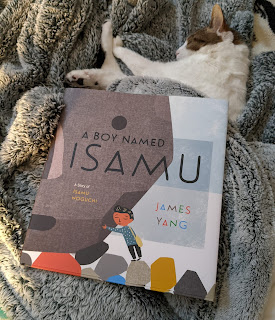
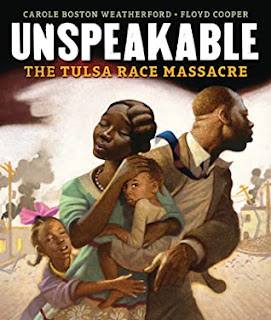
A Boy Named Isamu by James Yang and Unspeakable: The Tulsa Race Massacre by Carole Boston Weatherford and Floyd Cooper

Both of the following are children's picture books. Full disclosure: James Yang, author of A Boy Named Isamu, is a high school friend. While these are both 5-star reads, I have very little to say about either, so this will be just a couple of slap-dash, quickie reviews. 

A Boy Named Isamu by James Yang is a story that imagines artist Isamu Noguchi as a boy, on a single day when he goes to the market with his mother and drifts away. It shows his boundless curiosity and sense of wonder as he notices the shapes and textures that will inform his art. 

The illustrations are fabulous. I'm a fan of James's art but I think he really knocked it out of the park in A Boy Named Isamu. And, I loved the way he portrayed how an artist sees and thinks. There's a nice bio of Isamu Noguchi in the back of the book. 

Highly recommended - I loved A Boy Named Isamu so much that I read it, recorded it in my reading calendar, and then read it again. As I said elsewhere . . . forget the grandkids, this one's for me. But, I'm sure the grandchildren would appreciate it, as well. 


Unspeakable: The Tulsa Race Massacre by Carole Boston Weatherford and Floyd Cooper (illustrator) is a book I bought after seeing it on a list of books that some politician or conservative group wants banned. I was curious why on earth anyone would want to ban a children's picture book, especially about such an important topic. 

Brief note: My husband and I grew up in Oklahoma and neither of us ever heard of this particular historical event, although Hubby says his friend told a story of his grandfather hiding a Black man in the 1920s and he's pretty sure it was during what has elsewhere been called the "Tulsa Race Riot" (a name which, this author notes, places blame on the victims). 

Unspeakable tells the true story of the Tulsa Race Massacre  and places the blame squarely where it belongs, on the people of that time period who murdered, looted, and burned a prosperous black community to the ground. It's well written, appears well researched, and the illustrations are marvelous. It ends with a photo of the burned remains of Tulsa's Greenwood district. As an Oklahoman who didn't hear about this violent travesty until a few years ago, I'm glad to see it talked about. 

Highly recommended - The hardback was sold out everywhere when I looked this book up, so I bought the e-book and the electronic version is perfect. There were no issues at all with the images. This story was suppressed for far too long and I can't imagine why anyone would desire to ban it other than a continued desire to suppress the truth. It's told in a very positive way and the illustrations are just stunning. 

©2022 Nancy Horner. All rights reserved. If you are reading this post at a site other than Bookfoolery or its RSS feed, you are reading a stolen feed. Email bookfoolery@gmail.com for written permission to reproduce text or photos.

Wednesday, February 02, 2022

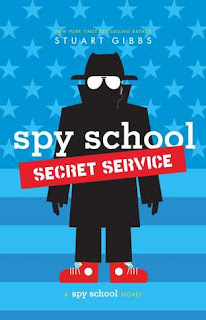
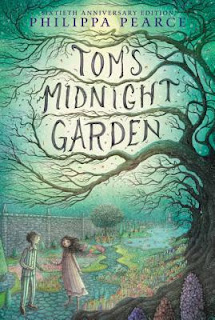
Spy School Secret Service by Stuart Gibbs and Tom's Midnight Garden by Philippa Pearce

I don't know the order of the Spy School books by Stuart Gibbs but Spy School Secret Service is my 4th read and maybe the 5th or 6th book? Each of the books refers back to the others, on occasion, but I've found that skipping a title here or there is no big deal. 

In Spy School Secret Service, 13-year-old Ben Ripley is sent on an undercover mission to the White House. Chatter about a possible attempt on the president's life has been overheard and even the Secret Service is suspect. SPYDER, the evil spy agency whose plans Ben has thwarted in the past, is involved and they are very good at infiltrating government agencies. 

Ben's cover doesn't work out well, at first, so he has to be careful and clever to find a way to uncover the plot. But, when an actual attempt is made on the president's life, Ben is accused of the crime. Will Ben be able to find a way to stop SPYDER and get himself out of trouble? 

Highly recommended - I absolutely love this series. Every book is equally funny and there are always plenty of exciting action scenes. I think I only have one Spy School book left on my TBR pile and I'm going to read it soon. This is a series I'll hang onto to reread. They're so entertaining that it doesn't matter one bit what age range they're meant for. They're absolutely delightful. 

Tom's Midnight Garden by Philippa Pearce is a British children's classic (you can probably see that it says "Sixtieth Anniversary Edition" on the cover, although it's a bit small). I'd never heard of it till I read a review of it but I immediately put it on my wish list and it's one that I bought during my break from what seems to be becoming my permanent book-buying ban. 

Tom's brother has the measles and to try to prevent Tom from getting them as well, he's hustled off to his childless aunt and uncle's home, a flat in a large house that's been divided. Tom is disappointed because he was looking forward to spending the school holidays playing in the garden with his brother. But, when the grandfather clock downstairs strikes 13, Tom is curious and he can't sleep, anyway, so he goes to peer out the back door, where he's been told there's a small parking area and a garbage bin but little else. 

When Tom opens the door, instead he finds a large walled garden with plenty of room to explore and trees to climb. He finds that he's invisible to most of the people in the garden but there's a little girl who can see and speak to him. She thinks he's a ghost but that doesn't faze her; they become playmates. Each night, Tom sneaks out the door to the garden and plays in another time. Where and when does this garden exist? Is Tom's playmate the ghost of someone who used to live in the house? 

Highly recommended - I can see why this book is a classic. It's beautifully written, mysterious, and absolutely sweeps you away to a magical time when nature was an endless playground. I loved every minute and was happy that the book ended exactly as I hoped it would. 

I also found it quite interesting how a child's dangerous illness was handled in an earlier time (guessing his aunt and uncle had already had the illness?). Tom's Midnight Garden was published in 1958, undoubtedly pre-vaccine. His brother is ill for weeks, which fits my own experience as my vaccination didn't "take" and I was one of the rare children of my era who had the measles after being vaccinated. 

Another book I'll hang onto for a potential reread and hopefully one that I can share with my grandchildren, someday. 

©2022 Nancy Horner. All rights reserved. If you are reading this post at a site other than Bookfoolery or its RSS feed, you are reading a stolen feed. Email bookfoolery@gmail.com for written permission to reproduce text or photos.

Friday, January 21, 2022

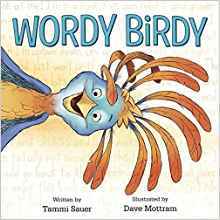
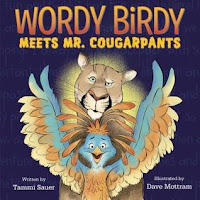
Wordy Birdy and Wordy Birdy Meets Mr. Cougarpants by Tammi Sauer and Dave Mottram

Just a couple quickies. I bought these two books shortly after seeing a review of one of them and thinking, "Oh, how cute!" But, I likely wouldn't have bought them if the author, Tammi Sauer, didn't happen to be a favorite children's book author. Good decision. 

The eponymous bird in Wordy Birdy by Tammi Sauer and Dave Mottram (illustrator) is just what she sounds like, a bird who can't stop talking. But, she's not a good listener and doesn't particularly pay a lot of attention to her surroundings. So, when she sees a danger sign, she just admires it and keeps going, ignoring the message. Her friends try to stop her but she doesn't listen to them, either. And, then a second warning sign . . . same thing. When she arrives at the point of danger, her friends are there to help her escape. Wordy Birdy will be paying more attention, from now on. 

A sweet, funny, charming story with vibrant, expressive illustrations and a nice lesson in friendship and paying attention to one's surroundings. I loved it. 

In Wordy Birdy Meets Mr. Cougarpants by the same author and illustrator, Wordy Birdy and her friends have gone camping. She talks so much that nobody can get to sleep. But, then a hungry cougar shows up at their campsite and she drives him out of the camp with her chattiness, saving herself and her friends. 

There's one fantastic line in this book and it's the cougar saying, "Did she just call me Mr. Cougarpants?" Ohmygosh, the expression on the cougar's face is a hoot!

Both highly recommended - I loved both of these books but my personal favorite is Wordy Birdy Meets Mr. Cougarpants because of that moment when the cougar is stunned and the sheer hilarity of a bird talking a predator away from the camp because he just wanted a nice peaceful meal. So, so cute. Also, I hate to say it but Wordy Birdy reminded me of myself as a child. I got told to please be quiet a lot. 

These are picture books for younger ones, with few words. My only issue with them is that I never have liked reading picture books that have word balloons to small children because I always felt obligated to point at whoever is speaking. I prefer dialogue to be described within text saying who is saying what. But, that's a personal preference and it's really not a big deal. The stories win out. 

©2022 Nancy Horner. All rights reserved. If you are reading this post at a site other than Bookfoolery or its RSS feed, you are reading a stolen feed. Email bookfoolery@gmail.com for written permission to reproduce text or photos.

Monday, November 01, 2021

Throwback #2 and #3 - The Chaos Loop and Out of Time by Peter Lerangis

These two reviews describe the second and third in the Throwback middle-grade trilogy by Peter Lerangis. I've reviewed the first book, here:

Throwback by Peter Lerangis

In Throwback #2: The Chaos Loop, Corey finds out he had a great uncle who died just before the end of WWII and that his maternal grandmother and grandfather met after her escape from Europe to South America. Corey's best friend Leila's family was also affected by the Holocaust. When Corey decides to try to help facilitate the failed attempt on Hitler's life (a bombing attempt that failed because of timing), Leila agrees to go with him. 

Reminder: Corey is a "Throwback", a rare time traveler who can cause changes in history. Leila can time travel and so can Corey's grandfather, but neither of them are Throwbacks. In The Chaos Loop, Corey's grandfather can no longer time travel because it can change your DNA if you travel too much and he was starting to sense changes in his body. 

Corey ends up going back to three separate time periods. He sees Hitler during his days as a struggling artist and homeless man in Austria, as the Fuhrer well into WWII, and, right before the war ends, Corey meets his great uncle. Will Corey be able to change time and save millions of lives? Will he be able to continue traveling through time without it turning him into some kind of strange creature? 

Highly recommended - I thought the first Throwback book was only so-so, although I enjoyed the adventurousness of it. But, The Chaos Loop was full of action-packed tension and I finished it within a couple days. In each of the books, I learned something new about history but I especially enjoyed learning about the bombing attempt on Hitler's life. I knew it happened but have never read any of the details, before. 

Warning: There are spoilers for The Chaos Loop in the third book's description, so skip down to the recommendation line on the third book's review if you want to avoid knowing what happens in The Chaos Loop but want to read my general thoughts about Throwback #3: Out of Time. 

Second warning!!! - Skip down to the recommendation line and don't read the review of Throwback #3: Out of Time if you don't want any spoilers for The Chaos Loop!

In Throwback #3: Out of Time, the worst possible thing has happened. Corey has suddenly turned into a wolf-like creature and his actions during previous time travel have messed things up in the present. Now, his grandmother never met his grandfather, his mother doesn't exist but his dad has a son by the woman he married instead, and his paternal grandfather is married to someone else. Corey shouldn't even exist! But, he does, as a mangy animal who can talk, and Leila oddly remembers him. Normally, when someone changes time, the people who exist in the new timeline are unaware that things were ever different. But, Leila is somehow able to always remember the other threads of time. 

Corey and Leila go looking for help from his grandfather and he doesn't remember a Corey at all, just a grandson named Gregory. But, he has some ideas and another time traveler has offered her help. After they figure out the only way that it's even remotely possible to change Corey back is to restore the timeline, Corey and Leila go back to WWII and also to the 19th century to talk to Frederick Law Olmsted, the landscape architect who designed Central Park. 

Will Corey and Leila be able to figure out how to restore time? Or is Corey stuck in the body of an ailing wolf-like animal for the rest of his life . . . which might not be long. 

Highly recommended - Wow, what a wild ride. Out of Time is a rollercoaster that kept me on the edge of my seat. I read it in a single evening, which is very unusual for me. I just couldn't bear to put it down. I had to find out what was going to happen! And, I have to say, it was one of the best finales of any trilogy I've ever read, satisfying yet surprising in some ways. I loved it and would recommend this whole series to any adventure-loving child or grown-up. 

Worth mentioning: The first book, which I didn't like as much, did get lower ratings. So, my opinion is a common one. But, I bought the entire trilogy based on the ratings of the latter two and the fact that time travel is totally my jam. I'm so glad I trusted my instincts on this purchase. 

©2021 Nancy Horner. All rights reserved. If you are reading this post at a site other than Bookfoolery or its RSS feed, you are reading a stolen feed. Email bookfoolery@gmail.com for written permission to reproduce text or photos.

Tuesday, January 28, 2020

Listen to the Wind and The Spirit of Fire by Susanne Dunlap


I've opted to combine these two books into a single review because they're the first and second in a series and this will be my last review of books read in 2019. Woot-woot!

Listen to the Wind is Book I in The Orphans of Tolosa, a historical fiction series that takes place in the 13th century in an area that's in flux, part of it being taken over by the French, part Spanish, part I don't know what. Where one's allegiance falls can mean life or death at any time.

Azelaïs and Azemar are orphans who look out for each other during the dangerous Inquisition that's taking place during this time period. There's a small but powerful group that considers themselves the only real Christians and everyone else is a heretic. Anyone can pretty much be branded a heretic at any time. When the two children and the other orphans with them must split up to avoid capture, Azelaïs and Azemar vow to meet in a nearby town. Years pass and they don't make it to the town because they're too busy surviving and learning, but neither forgets.

I don't want to give too much away, but Azelaïs (the female of the two) ends up with a nearly-blind monk, working as his eyes and pretending to be a boy. The monk teaches her about herbs, among other things, until something happens and she must run. Then, an entirely new life begins and eventually she is forced to do something to protect the woman who has taken her in from a life she doesn't want to lead.

Azemar is male and he goes on a very different path, at first learning about the workings of a winery from the field and then from a different angle. And, soooo much happens. No matter where they go or what they do, there is danger at every turn. Listen to the Wind was a 5-star read for me and I loved it so much that I got online to look for the follow-up book, immediately. At the time, it hadn't been released and I posted a mournful comment on Facebook. Susanne Dunlap replied that the second book, The Spirit of Fire, was due to be released in a week, so I pre-ordered it and got to it as soon as I could.

The Spirit of Fire, the second in The Orphans of Tolosa series, is every bit as fabulous as the first book about Azelaïs and Azemar.

Because the ending of the first book folds right into the beginning of the second, I feel like saying almost anything at all would spoil the story but it's adventurous, educational, heartbreaking, and hopeful. I felt utterly transported, so the horror of what happened at Montsegur (this being the focal point of the book, based on actual events in the 13th century) is painfully vivid. But the lovely ending is doubly satisfying after what the two main characters survive and witness.

Both highly recommended - Listen to the Wind is an action-packed, plot-driven tale of how two children survive and grow, find help, learn important skills, and fight danger while trying to figure out how to reunite in the dangerous Middle Ages. The Spirit of Fire takes the hero and heroine on a journey together . . . but then they're separated and . . . well, anyway, I did say I don't want to say too much. Suffice it to say that these two books are so incredible that I can hardly stand the thought that anyone might miss out on them. If you're a fan of well-researched, informative, adventurous historical fiction, these two books are absolutely not to be missed.

The third in The Orphans of Tolosa series is going to be a prequel. When I first heard that, I thought, "Oh, bummer, I'd like to see what happens to Azelaïs and Azemar. And, then I sat back, pondered, and came to the conclusion that The Spirit of Fire was actually a perfect ending for them and a prequel will nicely fill in the blanks about how the two orphans came to be abandoned and became friends.


©2020 Nancy Horner. All rights reserved. If you are reading this post at a site other than Bookfoolery or its RSS feed, you are reading a stolen feed. Email bookfoolery@gmail.com for written permission to reproduce text or photos.

Wednesday, October 31, 2018

Two Graphic Novels: Hey, Kiddo by Jarrett Krosoczka and To Kill a Mockingbird by Fred Fordham

Hey, Kiddo: How I Lost My Mother, Found My Father, and Dealt with Family Addiction by Jarrett J. Krosoczka is a graphic memoir about the author and illustrator's life. The book begins by telling about Krosoczka's mother and her family, how his mother became pregnant and was rejected by the father of her child and how baby Jarrett ended up spending most of his time living with his grandparents while his mother flitted in and out of his life, writing to him but seldom showing up.

Krosoczka's life was interesting for the colorful language of his grandparents, his mother's method of encouraging his art from afar, and how he handled the challenges of not knowing who his father was and what his mother was up to. Eventually, he learned the truth: his mother was an addict who came and went from home to the street to jail or halfway houses. Because she occasionally wrote to him and showed up when she was able, Krosoczka knew his mother loved him but he always missed having her in his life when she was away.

Highly recommended - I don't feel like I'm doing an adequate job of describing Hey, Kiddo, so I'll just skip to the bottom line. This is a highly readable graphic novel that gives you a distinct sense of what it's like to grow up not really knowing either parent and how erratic the life of an addict is. It also tells about the author's artistic journey, how his talented mother and his caring grandparents encouraged his art, and what he learned from art instructors that influenced him, as well as his stylistic choices. It's a touching, deeply meaningful story about coming through an unusual and sometimes difficult childhood and the destructiveness of addiction to the addict and everyone around her. I found this was one of the clearest graphic novels I've ever read. Usually, authors rely a little too heavily on the artwork to do the explaining but there's plenty of text and I didn't find the art confusing as I often do.


To Kill a Mockingbird by Harper Lee, illustrated and adapted by Fred Fordham is a graphic adaptation of the classic novel by Harper Lee. You can tell what you're getting into by the prominence of Harper Lee's name on the cover and the words "illustrated and adapted". Sure enough, Fred Fordham -- the illustrator who adapted the novel -- almost exclusively used words directly pulled from the novel. He only altered them when necessary for clarity (I couldn't tell when that occurred: I just know it because the author said so).

I've only read To Kill a Mockingbird once, but it's one of those books that sticks with you because it's so brilliant and meaningful. Still, there were times I didn't understand what was going on in a particular frame or set of frames. But, in general, when I couldn't figure out what was happening it was quickly clarified, so a handful of frames that perplexed me was never enough to cause a problem. Also, the farther you get into this particular graphic novel, the better it becomes.

Highly recommended - An excellent adaptation of a classic novel into graphic novel form. The characters are clearly identifiable and there were only a few instances in which I couldn't tell exactly what was happening but the confusion didn't last long. I particularly appreciated the use of Harper Lee's actual wording. I didn't know it was hers till the author's note but I presumed so because of the language, which is pretty distinctive and a little old-fashioned.

Additional notes:

Hey, Kiddo has a particular colored palatte that was a deliberate choice and a little unusual -- not full color but limited to about 4 colors. The finished copy of To Kill a Mockingbird appears to be full color. I have an ARC that's black and white but I looked online and found a video at Amazon of the author and he talks about using watercolor washes and shows himself coloring in some of the images. It looks beautiful and I think maybe the final, colored version will make some of those frames that I had trouble with make sense. In at least one case, there was a series of frames that were so dark that they were almost entirely black. Colored, I would imagine the characters stand out better, even though the reason they were dark was because they took place at night. At any rate, the graphic novelization of To Kill a Mockingbird would probably make a super gift for those who claim it as their favorite book. In my case, it made sense of at least one scene that I had trouble understanding when I read the book, years ago, so it's also great for anyone who loves the language but may have been slightly baffled by a scene or two.

©2018 Nancy Horner. All rights reserved. If you are reading this post at a site other than Bookfoolery or its RSS feed, you are reading a stolen feed. Email bookfoolery@gmail.com for written permission to reproduce text or photos.

Sunday, March 25, 2018

The Brontë Sisters by Catherine Reef and a reread of The Woman Next Door by Yewande Omotoso

There were two books that helped break my February book slump: Our Native Bees and The Brontë Sisters. It was at my worst moment, when I could absolutely not bear to read another word of anything with a bookmark in it, that I decided to just let something call to me. I'd been glancing at The Brontë Sisters for days, by that point. It's an ARC that I got at my former library, back in the days when I'd occasionally drop by and find that they'd set out a cart full of ARCs for anyone to take, free of charge. I happened across my copy while doing a book purge and set it at the top of a bedside stack, thinking eventually I would get to it.

Then, I let it call out to me. The Brontë Sisters: The Brief Lives of Charlotte, Emily, and Anne, is a children's biography of the sisters, but I can't say what age it's geared toward, although I think a middle schooler could easily handle it. The Brontë Sisters is also certainly comprehensive enough for an adult to enjoy -- a read that can be quickly gobbled up in an afternoon but not one that's lacking in any way because it's geared to a younger crowd. The Brontë Sisters includes a nice range of photos of documents, paintings, and other memorabilia.

I am not, in fact, really a Brontë fan. I liked Jane Eyre but detested Wuthering Heights. And, that's the limit of my exposure to the Brontës. But, Catherine Reef describes the lives of the Brontës and the events that were occurring during the writing of each book, including the plots of the books, in a manner that intrigued me enough that I would have immediately picked up a Brontë book to read, had I not already written a list of books that I needed to read in the coming month. It's likely I'll return to the book to read whatever section happens to be about each title, when I eventually do read more Brontë works. Reef definitely gave me an appreciation of the stories that I lacked while I read the two. Recommended for readers who are intrigued with the tragic Brontë family and/or their books.

Add caption
The Woman Next Door by Yewande Omotoso is a reread and I've already reviewed it (click on the title, above, to hop to my review) but I think it's worth mentioning the reread because it was quite a different experience. The first time I read The Woman Next Door, I did so because I wanted to read something set in South Africa before going on vacation there. The second time, I read it because I recommended it for discussion with my F2F book group.

What made the second reading different was the fact that this time I'd already been to South Africa. The Woman Next Door is set in a fictional neighborhood called Katterijn in Cape Town. It's about two elderly women who hate each other: one black, one white. But, there are some subtleties of characterization that you miss if you aren't familiar with Cape Town. I found that the book was even more enjoyable when I read it knowing the history of those areas.

Marion, the white woman who is racist but not self-aware, lived in District 6 for a short time, early in her life, for example. I had no idea what the significance of District 6 was, of course, having never been there when I first read it. But, while we were in Cape Town, we went on a tour that included the District 6 museum. District 6 was a part of Cape Town that was known for its diversity. A community that had attracted people from a large variety of races, backgrounds, and religions, the people of District 6 lived in blissful harmony till the Apartheid government kicked everyone out and plowed it down (unity being something that collided with the concept of control by minority, which is facilitated by division).

The area was an island unto itself. It wasn't necessary to go into Cape Town proper to buy groceries, go to school, or join in on activities. So, had Marion stayed in District 6, she undoubtedly would have grown up appreciating diversity. But, her parents were Jewish and escaped the Holocaust (this is more implied than stated), gave up their religion when they fled, and moved out of District 6 as quickly as they could. When Marion finally realizes how racist she is, it appears to startle her to think back on the fact that she was once a resident of the same neighborhood that spawned anti-Apartheid activists such as Nelson Mandela.

As to the discussion . . . it was fabulous. It's worth noting that I'm in a group in which the average age is probably about 20 years above mine (and I'm no spring chicken). A story about two elderly women, aged 88 and 82, with richly developed characterization was very much appreciated in that group. Only one of the women present disliked The Woman Next Door and she said her problem was the bitchiness of the characters. Well, there's no denying they're not pleasant people. But, there was purpose to their sharp tongues (they were wounded souls) and a meaning to their slow arrival at the realization that they were more alike than they could have imagined.

It's also notable that one of the group members observed the negative reviews at Goodreads appear to mostly have been written by younger women. Maybe it takes a bit of hard living and long years to truly appreciate the depth of meaning in The Woman Next Door. But, it definitely was a hit in my book group.

©2018 Nancy Horner. All rights reserved. If you are reading this post at a site other than Bookfoolery or its RSS feed, you are reading a stolen feed. Email bookfoolery@gmail.com for written permission to reproduce text or photos.