Showing posts with label Mexico. Show all posts

Thursday, February 17, 2022

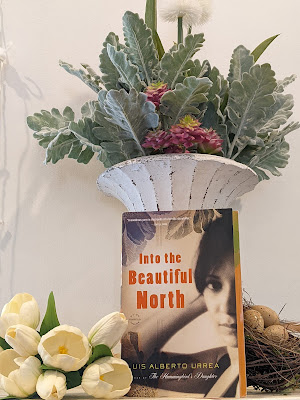
Into the Beautiful North by Luis Alberto Urrea


In Into the Beautiful North by Luis Alberto Urrea, Nayeli's village in Mexico, Tres Camarones, has been invaded by dangerous drugs runners/bandidos but almost all of the men have gone to the United States to find work. Her father has been gone for years without sending money or even a postcard. When Nayeli realizes there is nobody around to save them, she's inspired by the movie, The Magnificent Seven. She and her friends will go to America to bring home her own Magnificent Seven to drive the bandidos away. 

Highly recommended - A marvelous read that treats the "illegal" characters like the humans they are, with joys and sorrows like the rest of us. Nayeli is an especially strong character but a believable one, as are her friends, flaws and all. I was expecting the usual, harrowing border crossing adventure and there's plenty of that. What I didn't expect was the humor. Mexicans complaining that they need a wall on their Southern border. Border Patrolmen who put illegals on the bus back to Tijuana and, after asking, "Will you cross over again?" and being told yes, say "See you next week!" Just an all-around fabulous read, respectful, surprising, and hilarious. 

I don't own any other books by Luis Alberto Urrea, unfortunately, but now I want to read his entire backlist. I love his sense of humor. 


©2022 Nancy Horner. All rights reserved. If you are reading this post at a site other than Bookfoolery or its RSS feed, you are reading a stolen feed. Email bookfoolery@gmail.com for written permission to reproduce text or photos.

Wednesday, November 11, 2020

Mexican Gothic by Silvia Moreno-Garcia


Mexican Gothic by Silvia Moreno-Garcia has been on my wish list for a while and I've read seemingly a gazillion reviews of it, so I was really excited when the e-book went on sale at a reasonable price. I may be terrible about getting around to reading e-books but desperation is very motivating and I really truly wanted to read it. 

Noémi is a party girl who lives in Mexico City in a sprawling, modern home, with her wealthy father. When she receives a rambling, incoherent note from the cousin who used to live with them, her father says she must go find out what's wrong with Catalina. Noémi doesn't really want to go but she knows it's the right thing to do. 

She's met at the train station by Catalina's husband and taken on a long drive up into the mountains to their remote home. This is where the "gothic" bit comes in. The home is an old mansion in poor repair and Catalina lives with her husband's family, including the patriarch of the family, a cousin, and the cousin's mother. There's mold on the walls and the family has bizarre rules that they expect Noémi to abide by (no talking during meals, no smoking, no bothering her cousin unless they feel she's okay to receive visitors). Catalina appears to be sick but maybe more in spirit than in health; her personality is entirely different from the carefree, happy soul of pre-marriage. But, Noémi isn't sure what's wrong and she's determined to get to the bottom of it. 

There's much more to the story, of course, including a growing attraction to cousin Francis and weird dreams that may be caused by the house, itself.

Recommended but not a favorite - Although I never fell massively in love with the plot, I liked about the first 2/3 of Mexican Gothic for the atmosphere, the creepy people, the weird dreams, and the questions that all this strangeness brought up. Why did Catalina's personality change? What was in the potion she had Noémi fetch from town? Was Catalina's husband just imprisoning her so he could keep her money or was there more to the story? What was up with the patriarch of the family and his need for silence? What was the reason for the murder in the family, years ago? What happened to all the other people who died near the house or in the family's long-closed silver mine?

See, I told you there was more to the story. Around the 2/3 mark, Mexican Gothic got a bit too weird for me and I considered giving up. Instead, I flipped to the end of the book and read a few pages to see if it looked like the book was worth sticking out. The ending looked promising so I continued, but I confess I pushed myself to read faster. The reason for all the strange happenings was just a little too bizarre for my taste. I did find the ending satisfying, though, so I have no regrets. And, I loved Noémi. She's a great, strong female character who was devoted to Catalina enough to refuse to leave, even when things became seriously weird and even dangerous. I also liked Francis and was rooting for Catalina, Francis, and Noémi to escape. 

My friend Brittanie started reading Mexican Gothic a few days after I did so we got to discuss it, which always adds to the reading experience. So glad I've been able to occasionally find people to discuss books with; I am missing my F2F group but the hole they fill in my life has been kept nicely plugged by discussion with other online friends and I so appreciate that. 


©2020 Nancy Horner. All rights reserved. If you are reading this post at a site other than Bookfoolery or its RSS feed, you are reading a stolen feed. Email bookfoolery@gmail.com for written permission to reproduce text or photos.

Tuesday, March 19, 2019

Beast Rider by Tony Johnston and M. E. Fontanot de Rhoads


Beast Rider by Tony Johnston and Maria Elena Fontanot de Rhoads is the story of a boy's journey from Mexico to the United States. I jumped at the chance to review it when I saw the advertisement on Shelf Awareness. I've read a few tales of people escaping hardship by immigrating but most have been about immigration to Europe, not the United States, so I was excited to read a story that happens closer to home (fictional).

Manuel's brother Toño rode the train (illegally, as in climbing on top of the train and alternately walking and riding) to the United States from their home in Oaxaca, Mexico, a few years ago. They know he survived the journey because he occasionally calls home. Manuel misses Toño, his family lives an impoverished farming life, and he is curious about life in El Norte. So he decides to also make the journey. He will begin the dangerous trip by running to jump onto the train locally known as "The Beast". Even climbing aboard is dangerous, not to mention riding on top of train cars without handholds. People have been known to fall off or miss while jumping aboard and lose limbs or die. But, Manuel is determined.

My initial thought, as I began reading, was that Manuel's journey would be an event that took a few weeks or a few months, at most, even though the cover description says he's "robbed, arrested, beaten, and left for dead." But, it actually takes him about two years because he has to keep stopping to recover. Along the way, terrible things happen but there are good people who care for him, help him recover, feed, and clothe him, as well. It's an emotional journey and I often got choked up, especially when reading about the kindness of strangers.

Highly recommended - The storytelling style is unique and I had to adjust to it, but once I became accustomed to Johnston's voice, I found the story compelling and eye-opening. It took a while, though. When I was about 1/3 of the way into the book and realized that Toño was an illegal immigrant and that Manuel planned to enter the U.S. illegally, as well, I thought, "Well, this isn't going to be a book that's helpful." I figured it was the wrong viewpoint and people who are prone to thinking of Mexican immigrants in a negative light would just shake their heads and say, "See! Just as I suspected." But, besides illuminating the good and evil in people one might encounter in real life, Beast Rider actually places you in the midst of the incredibly terrifying and life-threatening process that is illegal immigration from Mexico and shows you just how much people are willing to go through to seek out a better life.

Quite a few Spanish words or phrases are used and there is a 6-page glossary to refer to. Beast Rider is for ages 12 and up.

This next part may be considered a spoiler, so I'll type it in white and you can highlight it to read if you're not worried about potential spoilers. I won't give away the ending, but I will say I thought it felt right and it was what I hoped for.

Manuel eventually does make it into the United States, but because he's illegal he can't get a decent job and neither can his brother; they just scrape by. They live better than they did in Oaxaca, from the standpoint of living space. But, without legal documentation, there's really no way to move up in the world and they live in fear of being caught and sent back. As you're reading about Manuel's daily life in Los Angeles, it becomes clear that his family may have been poor but they were happy and they had a loving support system. In other words, while their life was one of hardship in Oaxaca, it was really a better life. As such, you could definitely look at the book as one that supports legal immigration. I'd like to see something similar that digs into what it's like being surrounded by gangs, threatened and extorted, having loved ones killed, like many of the current immigrants coming from Honduras -- one in which going back is likely a death sentence. But, as a way to learn about why the journey is so dangerous (and, thus, so many large groups have been forming to fend off that danger), Beast Rider is definitely illuminating. 

I received an Advance Reader's Copy of Beast Rider for review from Abrams Books. Many thanks!


©2019 Nancy Horner. All rights reserved. If you are reading this post at a site other than Bookfoolery or its RSS feed, you are reading a stolen feed. Email bookfoolery@gmail.com for written permission to reproduce text or photos.

Thursday, March 17, 2016

Books 1 and 2 for #Weirdathon - Other Voices, Other Rooms by Truman Capote and Like Water for Chocolate by Laura Esquivel

Blogger and my ISP are both behaving fitfully, this morning, so I'm going to try to keep this short for sanity's sake.

I'm calling Other Voices, Other Rooms by Truman Capote my first read for #Weirdathon, even though it originally hit my stacks because it was my book group's March selection and I had no idea (because I've only read Capote's sweet Christmas story) just how wacky a Capote book could be. The group's selection was just lucky timing.

Joel has been living in New Orleans with an aunt, following the death of his mother. When his father's second wife writes a letter saying they'll be happy to take him in, Joel is sent to a decaying and isolated mansion. Before he even arrives, Joel is disappointed to find that nobody has been dispatched to meet him, although he was told he would be met near the town where his father lives, so he has to figure out how to get to the house on his own. And, when he makes it to the house, he's confused. Where is his father? Why won't anyone answer any of his questions? Was that a ghost he saw in the window?

Surrounded by eccentric characters and bored out of his mind, Joel seeks friendship while trying to figure out what on earth has happened to his father.

A couple of our group members brought some helpful information to share. Other Voices, Other Rooms can be a little surreal, at times, and it has more of a snapshot feel than the sense of a well-defined plot, but there were some very strong themes. The book is partly about Capote's own loneliness and longing for a father, but there are several other themes that were not quite as obvious to me. I mostly got the sense of longing for love out of it.

Bizarre characters and beautiful language were the two aspects of this book that made me love it. I often felt like I didn't understand what was happening during a scene but then understood it as it was ending. A lot of what I didn't grasp was nicely explained by people in my group so the discussion was excellent. It's a book worth talking about and I loved its oddities.

Like Water for Chocolate by Laura Esquivel is a book that seemingly everyone has read but me. I already owned a copy, purchased in a library sale years ago, so I was happy when not one but several people suggested Like Water for Chocolate when I asked for weird book suggestions.

Tita is in love with Pedro and expecting him to ask for her hand in marriage when her mother informs her that she is never to marry. Instead, Tita will be forced to follow tradition, caring for her mother for the rest of her life. Seeking to be near his beloved, Pedro marries her sister, Rosaura. Tita has learned how to cook from the elderly Nacha, and will eventually take over the cooking duties. But, when Tita's tears over her lost love are mixed into the batter of Rosaura and Pedro's wedding cake, the start of their marriage is ruined. Will Tita and Pedro ever be able to marry or are they doomed to love each other from a distance?

Holy Toledo, there is some serious weirdness going on in Like Water for Chocolate. No wonder so many people recommended it! There's strange magic in Tita's cooking and sexual energy that vibrates between Pedro and Tita, inflaming or repelling those around them via the food. Each chapter begins with a recipe and one of the quirks of this book is the way the author will interrupt her own story with a continuation of the recipe. The storyline bounces around a little, sometimes stepping backward in time so that a deceased character is suddenly alive. I found myself jolted by the changes in time but loved the uniqueness of this strange love story and its crazy ending.

Both highly recommended - I really enjoyed the eccentricities of the characters and the storytelling in both Other Voices, Other Rooms and Like Water for Chocolate. If you're filing away ideas for future #Weirdathon events and you haven't read these titles, definitely add them to your list. They are completely nuts.

©2016 Nancy Horner. All rights reserved. If you are reading this post at a site other than Bookfoolery  or its RSS feed, you are reading a stolen feed. Email bookfoolery@gmail.com for written permission to reproduce text or photos.