Showing posts with label art history. Show all posts

Wednesday, January 26, 2022

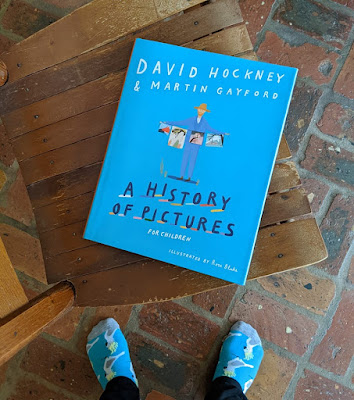
A History of Pictures for Children by Hockney and Gayford and The Collage Ideas Book by Alannah Moore

Both of these books are about art, one focusing on history and technique, the other a book of ideas and examples; one for children, one geared to adults but I wouldn't keep it away from the kiddos. 


I've been a fan of David Hockney's art since I saw "Mr. and Mrs. Clark and Percy" at the Tate Gallery in London when I was 17.  I loved it so much that I bought one of those little art cards of the painting in the museum shop and started paying attention to the artist. Of course, back then we didn't have the Internet so I only got glimpses of his work on occasion for many years, but I've always been drawn back to his work. 

So, when I saw that there was an art history book by Hockney, I grabbed it. It didn't matter to me that it's for children since my art education was pretty much cut off after elementary school and everything else I know has been learned in classes and workshops (mostly online — meaning, I don't know a lot). What I hoped for was a general overview of art with some of Hockney's work represented to show the various principles or techniques. And, that is exactly what you get in A History of Pictures for Children. It's written as a discussion between the artist and art critic Martin Gayford. It's not an in-depth look at art through the ages but a glimpse of art across time and how it has changed since our ancestors drew the first pictures in caves. It's also about some concepts artists try to portray, like shadow and light and styles like realism vs. cubism. Bonus: "Mr. and Mrs. Clark and Percy" is one of the Hockney paintings in the book, yay. It's still a personal favorite. 

Unsurprisingly, a lot of the concepts are shown via Hockney's own works and his descriptions of how and why he chose to create a particular work of art. Not a problem for this fangirl. A good introduction to some basics with a glossary and extensive references. 

Highly recommended - Remember, this is a children's book so it doesn't go into great depth. But, if you're a Hockney fan and/or just want yourself or your child to learn some basics about art history, this book is an entertaining read and informative but breezy, nothing taxing. I loved it. And, I did learn a few new things. A History of Pictures for Children is illustrated by Rose Blake. 
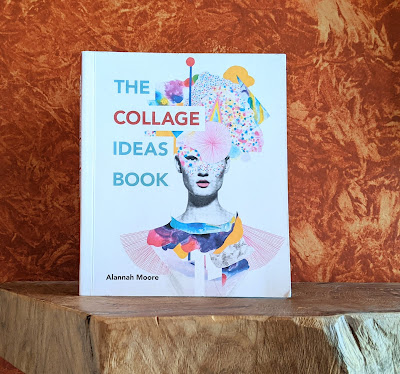


The Collage Ideas Book by Alannah Moore is a book in which an artist's work is shown on each spread with a concept that was used in the artist's work. For example, "Embellish with stitching," "Create a fantastical world," or "Be brave with color". 

OK, details. This book is very small, about 5 1/4" x 4 1/2" (this is a ballpark figure based on the proportions of the index card I plopped on top of it; I did not take measurements). It needs to be the size of a more normal book, as in 8 1/2" x 11" because the details are very, very hard to see. In some cases, several works of art by an artist are shown and the smaller images are only about 1" or 1.5" tall and similar in width. I had to pull out a magnifying glass and even then I felt like I wasn't getting a good view of the artworks. That's the bad. 

The good is everything else. I loved seeing the diversity of collage art in The Collage Ideas Book and I figure I will be looking up a lot of these artists online, so perhaps I'll be a able to enlarge their artworks and see them better in that way. Also, there are so many great methods to spark ideas. 

Highly recommended - Small as it is, The Collage Ideas Book is inspiring and, in fact, I did test that idea to look up artists online and it worked well. I looked up the cover artist, Niky Roehreke. Wow, what an explosion of color! I love her work. At any rate, the bottom line is that I'll definitely be referring back to this book repeatedly, so it was worth the money as a reference book. I guess one just has to put up with the size and enjoy the inspiration. 


©2022 Nancy Horner. All rights reserved. If you are reading this post at a site other than Bookfoolery or its RSS feed, you are reading a stolen feed. Email bookfoolery@gmail.com for written permission to reproduce text or photos.

Friday, June 02, 2017

The Legion of Regrettable Supervillains by Jon Morris


They say you should dress for the job you want, not the job you have. If the intergalactic Dr. Voodoo is following that advice, it's difficult to say what job he's aiming for. Clad in tuxedo and tails, he seems more prepared for a career as a maitre d' or a cartoon mayor than as the servant of an ever-living goddess of evil. 

[...]

When Lilith's planet -- also called Lilith -- is destroyed in a battle with Wonder Man, Dr. Voodoo searches for a new seat of the empire. But the queen of evil considers Earth her rightful domain. Harried and henpecked, Voodoo has no choice but to comply. 

Dr. Voodoo and his allies disappeared from Wonder Man's ongoing narrative, though the hero's saga continued for a few more issues. Perhaps Voodoo was marshaling his anthozoons when he should have been recharging his frigitrons for another attack on Earth's peaceful cosmoplanes.

~p. 60

I'll have to take an interior shot of The Legion of Regrettable Supervillains by Jon Morris (page down . . . it'll be here, by the time I post this review) because a view of one spread gives you a pretty good idea of what you're in for when you open the book.

With a sly sense of humor, author Jon Morris describes various villains, which hero was the villain's enemy, where and when the character appeared and what happened to him (some of them appear and then simply fade away, some are quickly dispatched, some bumble around practically asking to be exterminated).

The Legion of Regrettable Supervillains, published by Quirk Books, is the follow-up to The League of Regrettable Superheroes, which I have not read but am now totally dying to read. A friend read The League of Regrettable Superheroes and went straight to her library to request Supervillains when I posted it in my stack of arrivals. She had to exercise patience because it had not yet been released. But, it has now! And, you'll want to grab a copy if you're a fan of old comic books.

Beginning with The Golden Age, from 1938-1949, The Legion of Regrettable Supervillains describes a time period, progressing forward, and then goes into details about various villains. Occasionally, there will be a spread with interior shots from one of the comic books (they're readable, thank goodness), and sometimes a spread will contain brief blurbs about 5 or 6 supervillains who bore similarities to those who are described in greater detail. The result is a book that gives you a good sense of the historical perspective in which the books were written (so many Hitler-like villains in the years before and after WWII) as well as a broad look at a variety of villains, some of whom were clearly more regrettable than others.

Interior shot! Hopefully, you'll be able to enlarge it for a better view.


Highly recommended - Comic fans, in particular, will enjoy this book but I'm not exactly what you could call a comic fangirl and I thought the book was a total delight. I read it slowly, maybe 10 villains per night, and found it immensely entertaining. It's the kind of book you can't shut up about. While I was reading, I'd read excerpts to my husband or tell him some funny little factoid about a supervillain, read one of the humorous side notes written by the author (on the supervillain Colossus: "Earth shirt size XXXXXXXXXXXXXXXXL"). Loads of fun and would make a great gift as it is one freaking gorgeous book.

©2017 Nancy Horner. All rights reserved. If you are reading this post at a site other than Bookfoolery  or its RSS feed, you are reading a stolen feed. Email bookfoolery@gmail.com for written permission to reproduce text or photos.

Sunday, March 03, 2013

The Art Forger by B. A. Shapiro


The Art Forger by B. A. Shapiro is the story of a disgraced artist, Claire, with a skill for forgery. Claire is offered a chance to redeem herself. If she forges a work of art, reputable Boston gallery owner Aiden Markel will give her a new chance by holding a showing of her paintings.  


This was one of those cases of, "Already reading it; might as well finish," I'm afraid. I don't know why I pushed my way through The Art Forger.  It is actually the second book I've read that focused on artists and both bored me to the point that I probably should have abandoned them. The details were not that interesting to me. At the heart of The Art Forger is a mystery based on a theft that occurred in real life. I found the mystery -- or, at least, the heroine's conclusions -- a stretch. While I'm not a fan of mysteries, I have to agree with a Goodreads reviewer who said The Art Forger was not predictable and yet not surprising. 

I also found Claire's romantic interests completely baffling. First, she's involved with an emotionally unstable man who uses her and then disappears from her life without looking back but happily takes credit for something she's done (nicely revealed in flashbacks, I thought), then she gets involved with the gallery owner, even after pondering the fact that there's no real basis for a relationship. Say what? 

And, man, that would have to be one prodigiously talented and prolific artist, if the heroine were genuine. I know there are such people in all forms of creative work but it was hard to accept the level of talent of the fictional Claire Roth and even more difficult to buy into her conclusions when it came to the mystery. It all seemed too easy, in other words, although there were certainly plenty of challenges for the heroine. 

On the plus side, I did think the artistic detail in The Art Forger was believable. I know next to nothing about painting and while I found reading about the process rather dull, at the same I was impressed with the author's research. I also enjoyed learning about the Isabella Stewart Gardner Museum and its history. 


Recommended to mystery readers, people who like reading about Boston and art history lovers , but not a personal favorite.  

It's been several weeks since I finished reading The Art Forger, so I've simply transferred my review from Goodreads to the blog with some minor alterations.  I don't know why I didn't think to do that, before.  I gave The Art Forger a 3/5 rating at Goodreads.

You should read Carrie's review of The Art Forger at Care's Online Book Club .  It's much better than mine.  I've been so short of time, lately, that I think I'm a little more negative with books that aren't a perfect fit, right now.  Anyhow, I appreciated Carrie's reminder of the scene around p. 100 that takes place in The Oak Room in Boston -- pretty much the only familiar location to me and a place that holds pleasant memories as Carrie and I met up with Simon Van Booy for coffee in The Oak Room and had a terrific time.  

©2013 Nancy Horner. All rights reserved. If you are reading this post at a site other than Bookfoolery  or its RSS feed, you are reading a stolen feed. Email bookfoolery@gmail.com for written permission to reproduce text or photos.