Showing posts with label poetry. Show all posts

Tuesday, February 22, 2022

A few minis - Slightly Foxed #71, Letters of Note: War by Shaun Usher, The Arrow Book of Funny Poems by Eleanor Clymer

Again, a few I don't have much to say about. 
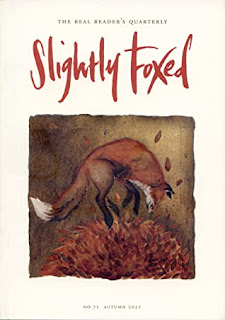
Slightly Foxed Reader's Quarterly #71: August 2021
is my first Slightly Foxed journal. I had not heard of it till a friend mentioned it at Instagram, and I confess that I bought a one-year subscription for myself as a Christmas gift for no other reason than I knew nobody else would buy it if I asked. And, then it never did get put under the tree so it felt like a bit of a post-Christmas bonus.  

For those who are unfamiliar with Slightly Foxed, it's a quarterly journal with essays about books, usually a particular book that is either tied to the author's memories in some way or was found during research, etc. The bottom line is that the authors of essays in Slightly Foxed tend to wax poetic about a particular book or several books and it is one delightfully dangerous little collection of writings. Yes, yes, I want nearly all of them after reading about how wonderful, memorable, controversial, or charming the books are. Of course, I'm on a book-buying ban so it's not happening. But, wow, if I was just building a library I would want to start a collection of Slightly Foxed books. 

Recommended if you're not afraid that reading eloquently-written essays about books will destroy your budget. And, even then I recommend it, just hold onto your hat and maybe freeze your credit card till you get over it. 
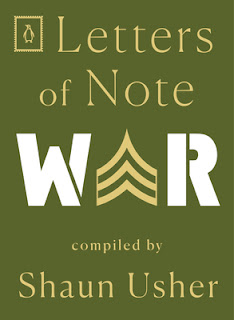
Letters of Note: War compiled by Shaun Usher is a book of letters either written during a war or about war. I was curious about it because I have a passion for reading about war, both as it's experienced by those who are in the military and the folks left back home. 

To be honest, I didn't read the description so I was quite surprised by the sheer variety. There is, for example, a letter written by a Roman soldier at Hadrian's Wall, asking someone to "send beer". I was certainly not expecting the letters to go back that far! There are also plenty of letters written home from wars closer to our time period, including one from the mother of a soldier killed in Vietnam, a letter from Evelyn Waugh telling a story about soldiers making a hash of tree removal during WWII, and a letter from Martha Gellhorn to Eleanor Roosevelt written as Martha was heading to Spain to fight the rise of fascism. 

Of all of these letters, by far the most moving was the one from a mother whose son died in Vietnam. I absolutely sobbed when I read that one. Some were funny, like Evelyn Waugh's story about the trees, some a little difficult to read because the language of the writer's time was a bit different. Martha Gellhorn's was my favorite for sheer readability and that's a positive because I just happen to have a book of selected letters written by Gellhorn. At any rate, compact as this book is, it was a fascinating read. 

Recommended to those who are interested in primary source material from various wars. There is a series of "Letters of Note" books and the Letters of Note website is still extant. I haven't spent any time there but it looks like a good way to waste an afternoon. 

The Arrow Book of Funny Poems compiled by Eleanor Clymer is a Scholastic book from my childhood with silly rhyming poetry. I chose to read it to see if it held up to my memories (as a child, I nearly beat the book to death, I read it so many times) after an Instagram friend reread a poetry favorite from her youth. I'd just spotted the book on one of my shelves, shortly before I saw her post. 

Answer: Yes, it holds up. It's just as silly as it ever was and I like the goofiness. While it's probably still best read as a child, I enjoyed it. A couple favorites:

The Optimist (Anonymous author)

The Optimist fell ten stories,
And at each window bar,
He shouted to the folks inside, 
"Doing all right, so far!"


The Ostrich is a Silly Bird by Mary E. Wilkens Freeman

The Ostrich is a silly bird, 
With scarcely any mind,
He often runs so very fast, 
He leaves himself behind.

And when he gets there, has to stand
And hang about till night,
Without a blessed thing to do
Until he comes in sight 


I'd recommend this book for children but I think you'd be hard pressed to find a copy, anywhere. Still, if you ever happen across it, it's loads of fun and especially suited for giggly kids who like humor. 

©2022 Nancy Horner. All rights reserved. If you are reading this post at a site other than Bookfoolery or its RSS feed, you are reading a stolen feed. Email bookfoolery@gmail.com for written permission to reproduce text or photos.

Wednesday, September 30, 2020

Finna by Nate Marshall


fin-na /ˈfinə/ contraction: (1) going to; intending to. rooted in African American Vernacular English. (2) eye dialect spelling of "fixing to." (3) Black possibility; Black futurity; Blackness as tomorrow.

dispatch from the 6th circle
Crawfordsville, IN

I count the Confederate flags
around town, a surprise considering the geography.
what earnest confusion, honest mistake it takes
to fly a rebel flag in the North. this makes the most
sense: us turning against us, the cannibal instinct, the
vote against self. self-hate is something i've known.
hear the way my voice lilts too many 
ways, my vocabularies wrestle themselves, scrap
amongst the street in between my teeth. watch my mouth slang
& stutter into eloquence. watch my mouth whistle
this simple Dixie.

~p. 86

If you hang around my blog much, you might remember that I accidentally bought the wrong book entitled Finna. I mean . . . you wouldn't think there'd be two by that name, would you? Here's a link to the other Finna, by Nino Cipri.

Finna by Nate Marshall is the book I intended to buy, a book of poetry from which I read an excerpt online somewhere (Instagram, maybe?) that I absolutely loved. Although I didn't buy it specifically because of the fact that the author is Black, that's a definite side benefit because I am trying to buy more books by people of color to amplify their voices. 

You can see the author is both serious about racism and playful. I enjoyed his ability to stab the heart with irony.

Highly recommended - An outstanding poetry collection. Sharp, insightful, descriptive of both pain and anger but with humor. I love this collection of poetry about blackness and claiming one's name, place, and people. I gave it 5 stars and am so glad I bought a copy so I can return to it. 

©2020 Nancy Horner. All rights reserved. If you are reading this post at a site other than Bookfoolery or its RSS feed, you are reading a stolen feed. Email bookfoolery@gmail.com for written permission to reproduce text or photos.

Tuesday, July 16, 2019

Mini reviews - If I Die in a Combat Zone by Tim O'Brien, Extreme Ownership by Willink and Babin, and Cat Poems by a variety of poets

Hard to believe, but I'm caught up on reviewing books I've read that were sent by publishers, so I have a couple days to write about the books I've read from my own shelves or borrowed. Then, hopefully I will have finished another ARC by the time I'm done catching up on personal reads.

After I read The Things They Carried by Tim O'Brien, I put a number of his books on my wish list at Paperback Swap and managed to acquire 2 or 3 of them before relinquishing my membership. If I Die In a Combat Zone, Box Me Up and Ship Me Home was one of them. I acquired every title I could get my mitts on without bothering to even read what they were about; that's how impressed I was with The Things They Carried.

If I Die in a Combat Zone is O'Brien's memoir. I didn't realize that till I opened the book and started reading. I read it specifically for Memorial Day. It was my little way to keep those who died for our country in my head and heart over the holiday weekend.

O'Brien tells about his life and his plans prior to being drafted, how he waffled about whether to show up for duty or run to another country and made actual plans to escape but then decided to report, his experiences with training and throughout his year in Vietnam, how he managed to go from dangerous jungle duty to a clerical job toward the end of his deployment, and his return home.

I had mixed feelings about If I Die in a Combat Zone. It's every bit as beautifully written as The Things They Carried, but the feeling I got from it was deeply sad and painfully honest. He was witness to some horrible atrocities, watched people die because of stupid decisions by his superiors with inflated egos, and lived with the knowledge that at any minute he could be amongst the maimed or dead. The only real light in the proverbial tunnel of O'Brien's war seemed to be the friendship he had with another man who was well-educated in literature. But, even then, the two of them occasionally got in trouble for having the nerve to sit around talking about poetry. It was a dark experience, overall, and it's hard to read. When he got that clerical job and then climbed on the plane and returned to Minnesota, I felt utterly relieved to have his combat days in the past. I love O'Brien's writing, though, and I still gave it 4 stars. Recommended but will rip out a piece of your heart.
Contains graphic violence.

Extreme Ownership: How U.S. Navy Seals Lead and Win by Jocko Willink and Leif Babin is a business book but because it's written by two Navy SEALs, it can be surprisingly gripping as they relate tales of their experiences in training and on deployment in Iraq. My husband has read Extreme Ownership at least twice and wanted me to read it but I'm not exactly sure why. I opened it up when he handed it to me and was surprised at the intensity. It begins with a story of a SEAL mission in which a potential terrorist ran from the building they'd surrounded. Willink pursued him and then realized, when he captured the man, that he had chased the man down without informing anyone where he was going. He had to make a critical decision about how to handle the prisoner and return without getting them both killed. He then applied that decision-making process to a particular business problem. It was fascinating and I was hooked.

The theme of the book, "extreme ownership" is about taking responsibility when things go wrong, the idea being that solid leadership and well-coordinated teamwork are the best ways to solve problems in business, but it's important for leaders to take responsibility when something goes wrong in order to lead well. "There are no bad teams, just bad leaders," is one of the quotes I highlighted after reading what I considered one of the most fascinating illustrations of leadership in the book. I don't recall which author told this story, but one of the men described a particular part of SEAL training in which the soldiers were divided into teams. Each team carried a heavy boat and raced it. He described how one team was consistently winning and another repeatedly came in last or next to last. The leader of the losing team thought he'd just ended up with a bad bunch of teammates. But, then the leaders were told to switch boats and the team that had been coming in last won. The team that had previously won still did well. I would have loved to see an actual film of the leaders of those teams in action.

Highly recommended - I've tried to apply the leadership principles to marriage by explaining to my husband how it benefits him to listen to my housekeeping leadership. Unfortunately, it's not working. I hope the principles do better for him at work than they have for me at home. I'd like to know what Jocko and Leif have to say about stubborn men who just don't get why socks need to be placed in the laundry right-side-out.


Cat Poems does not list an editor but it's an anthology of poems about cats, obviously. I got a copy of Cat Poems for Mother's Day from Kiddo and his fiancée.

The problem with an anthology about a particular chosen subject is that editors don't always go into the selection with the people who appreciate that subject in mind. I read a book of poems for and about children, a few years ago, in which some of them were actually quite dark — about the loss of a child or the horror of abuse, for example. They covered all the bases but it wasn't always pleasant. The same is true of Cat Poems. Some of them are funny or sweet, about the things a cat lover adores. Others are frankly awful, either because they're negative about cats, cruel, or sad.

My favorite was a poem by Muriel Spark, "Bluebell Among the Sables." The poem is about a visit from a friend wearing expensive sables. Muriel was bored by her social obligation to entertain the friend. Then, Bluebell began to attack the tails of the sables on the woman's coat and it diverted her. It's a cute story but short enough to relate through poetry. It was those poems in which the cat is recognized and appreciated that I obviously liked best, being a cat lover.  No surprise there. I'm iffy about recommending Cat Poems because I found some of the poetry downright upsetting, but I will definitely reread my favorites.

©2019 Nancy Horner. All rights reserved. If you are reading this post at a site other than Bookfoolery or its RSS feed, you are reading a stolen feed. Email bookfoolery@gmail.com for written permission to reproduce text or photos.

Wednesday, May 08, 2019

On Democracy by E. B. White, ed. by Martha White


Treason is too narrowly interpreted to suit us. Our courts call it treason when a restaurant-keeper helps a German flier to escape, but nobody calls it treason when a congressman helps a touchy issue to escape "until after the elections are over." We hang a man for the first kind of treason; we reelect a man for the second. 

[...] It is not only treacherous to help the enemy by postponing questions which involve the lives of all of us but it is the greatest insult which can be offered to the electorate of a democracy. When you hear it announced that such-and-such an issue cannot be raised now because it is "political dynamite," the implication is that you yourself are mixed up in a cheap trick perpetrated by one section of the people on another section.

~from pp. 39-40 "Treason, Defined"(originally published in 1942) in Advance Reader Copy of On Democracy by E. B. White

One of my all-time favorite pieces of writing in the world is by E. B. White, a tribute to Pullman cars (railroad sleeping cars) in a book of essays published some time in the 1940s. It's a lovely, moving, brilliant piece of writing. So, I figured White probably had some wise and wonderful things to say about democracy and jumped at the chance to read and review On Democracy, a book of his essays and a handful of rhyme-heavy poetry.

I was correct. There's plenty of wisdom in On Democracy. But, it is also an excellent showcase for White's wit and humor and a reminder that America has survived similar attempts to attack truth and the rule of law to what we're currently experiencing, although I confess that I didn't find the fact that such attacks eventually failed all that soothing because we now have so many huge issues to address. Among them: potential human extinction being ignored and/or suppressed by an entire administration, massive voter suppression, newly-created poll taxes, refusal to address a foreign attack on our voting system (machines that can be easily compromised and which contain no paper backup are being bought by states at an alarming rate), and a political party that talks big about transparency whilst going out of its way to hide absolutely everything that may or may not say something untoward has been done by them while declaring investigations (which they themselves recently drove into the ground with at least 7 investigations that proved absolutely nothing bad about the same exact issue) pointless and partisan. These are huge challenges.

With the fate of humanity on the line the stakes, it can be said, are much higher. Still, it's heartening to know that there have been times in the past when newspapers were being heavily bought out by a single purchaser who pushed his political slant on the reportage, corruption has run rampant, and executives in government have attempted to hide documents important to the public.

A few quotes from the book:

Fascism is openly against people-in-general, in favor of people-in-particular. Nationalism, although in theory not dedicated to such an idea, actually works against people-in-general because of its preoccupation with people-in-particular. 

~p. 45, "Definition of Fascism," published 1943


When you think with longing of the place where you were born, remember that the sun leaves it daily to go somewhere else. When you think with love of America, think of the impurity of its bloodlines and of how no American ever won a prize in a dog show. 

[...] 

Save the world by respecting thy neighbor's rights under law and insisting that he respect yours (under the same law).

~pp. 60-61, "Instructions to the Delegate," published 1946


There's not much news to report. Roger and Evelyn had a baby girl a couple of weeks ago, and Roger is supporting it by working for a magazine called Holiday, a travel publication based on the perfectly sound idea that everybody in the United States would like to be somewhere else. 

~p. 80, Herald Tribune ("Hollywood Ten" letters), published 1948


Misinformation, even when it is not deliberate, is at the bottom of much human misery. 

~p. 95, "The Thud of Ideas," published 1950


Some of the published news was distorted, but distortion is inherent in partisan journalism, the same as it is in political rallies. I have yet to see a piece of writing, political or nonpolitical, that doesn't have a slant. All writing slants the way a writer leans, and no man is born perpendicular, although many men are born upright. The beauty of the American free press is that the slants and the twists and the distortions come from so many directions, and the special interests are so numerous, the reader must sift and sort and check and countercheck in order to find out what the score is.

~p. 121, "Bedfellows," published 1956

[Editorial insert: In our modern world of brief sound bites, I'd be willing to hazard a guess that less than a quarter of the American population takes the time to "sift and sort and check and countercheck" as readers of the 1950s may have done, hence the creation of the term "echo chamber."]


The Herald Tribune headed the story, "PRESIDENT SAYS PRAYER IS PART OF DEMOCRACY." The implication in such a pronouncement, emanating from the seat of government, is that religious faith is a condition, or even a precondition, of the democratic life. This is just wrong. A President should pray whenever and wherever he feels like it (most Presidents have prayed hard and long, and some of them in desperation and in agony), but I don't think a President should advertise prayer. That is a different thing. Democracy, if I understand it at all, is a society in which the unbeliever feels undisturbed and at home. If there were only a half a dozen unbelievers in America, their well-being would be a test of our democracy, their tranquility would be its proof.

~p. 124, "Bedfellows," published 1956


Highly recommended - While not exactly what I expected (heavier on the wit and humor than I anticipated), E. B. White was a brilliant writer whose thoughts on democracy were at once light-hearted and serious, penetrating and cogent. I was fascinated by the fact that White was hell-bent against the formation of what was then known as the "United Nations Organization" because he feared a world government would trample on the rights of individual nations to create and execute their own laws.

The essays/poetry span a significant time period, from 1928-1976, so there's a lot of ebb and flow from war to peace and back, through presidencies left and right, in and out of corruption, through arrests for speech we would now consider protected and threats to the press and university professors, and spanning other challenges to democracy. I recommend it to anyone interested in solid writing, politics, essays, history, and/or the topic of democracy in tumultuous times. Apparently, there have not been very many stretches without some form of upheaval. It does give one hope but also serves as a reminder that in order to maintain genuine hope, the requirement for action on the part of the populace is axiomatic.

My thanks to HarperCollins for the review copy.

©2019 Nancy Horner. All rights reserved. If you are reading this post at a site other than Bookfoolery or its RSS feed, you are reading a stolen feed. Email bookfoolery@gmail.com for written permission to reproduce text or photos.

Friday, November 17, 2017

Iowa: Poems by Lucas Hunt + a Fiona Friday pic


I haven't read any poetry in quite some time so I was super excited to get a copy of Iowa by Lucas Hunt. I've read two other volumes of poetry by the author and enjoyed them both.

Iowa is just what it sounds like: poetry set in the state of Iowa, where the author grew up. Because I grew up in the Plains, there is a lot of subject matter I totally relate to in Iowa. Here's a great example:

Hawks
They take the air like words in blue display,
planes of rain that pass with outspread wings
and ride round the sky in sure, slow turns
to hunt hypnotic, float and dive--
birds witness wider fields,
their eyes survey a storm and pass
through light that changes everything in space.
~p. 19

The author has a lovely way of bringing the experiences of growing up in Iowa to life, whether he's talking about riding a bike down a dusty road or lying in a corn field with a girlfriend, the type of beer can you're most likely to see by the road, the experience of working on a farm. It's all very reminiscent of home to someone who grew up in similar territory. I got a particular buzz out of any poem with wind and wheat, my two favorite things about Oklahoma. Seriously, I love wheat fields.

Here's another excerpt (not the full poem):


Rusty and dusty on blacktop pavement
American flags in yards
train trestles piled by the tracks
country on the radio
deer sausage
chills in the bed of our Chevrolet.

~from "Wheatland Car Wash", p. 65


Highly recommended - A wonderful, transportive volume of poetry full of slice-of-life Americana in verse. You'll especially love this book if you appreciate the Plains or you're from Iowa, but there's something for every poetry lover in Iowa.

And, it's Friday but I didn't take any great photos of the cats, this week, so Fiona Friday is a cheat -- one of the photoshopped pictures of my girls that were done by people in my online cat group, this one of a conga line by Lauren Boutz. I can't look at this without smiling.


©2017 Nancy Horner. All rights reserved. If you are reading this post at a site other than Bookfoolery or its RSS feed, you are reading a stolen feed. Email bookfoolery@gmail.com for written permission to reproduce text or photos.

Friday, April 24, 2015

Three for National Poetry Month - On the Bus with Rosa Parks by Rita Dove, House of Light by Mary Oliver and Where Robot Mice, etc. by Ray Bradbury

My subject line is out of order specifically because I didn't want Where Robot Mice and Robot Men Run Round in Robot Towns by Ray Bradbury to get priority placement. It's that bad. At Goodreads, I described it as "hackneyed, uninspiring, egotistical,  often clearly envious of others." It's not unusual for a poet to use another poet for inspiration but there's often an unsettling undertone of envy or current of braggadocio when he refers to literature.

Having said that, there were a few random poems that I got something out of, if only conceptually. The poem about a man reflecting on the childhood games he played with his friends while looking at the landscape in which their young imaginations soared is one anyone reflecting on a lost childhood can appreciate in spirit. But it turned a little angry in the end when he noted that there were no children outdoors because they were all watching TV (and he even got in a little dig on Walter Cronkite -- funny, from our perspective, as most people now look back fondly on the days when there was a newscaster they could trust). What would he think of children now, with their iPhones, video games, home computers and TVs?

Another poem I liked was about a drunken uncle that the family was happy to bury but who then came back to haunt them till the author, a young boy, shouted at the ghost to go away. Humorous, yet definitely one of those poems that came off as egotistical. If he's in the poem, you can bet his part is inflated. 

There were some similar themes to Bradbury's prose work. Lots of mentions of dandelions, dandelion wine, science, the future. Honestly, he should have stuck with prose and just hidden this collection away. It's amazing that anyone was willing to publish it, even given Bradbury's name power. Where Robot Mice and Robot Men Run Round in Robot Towns was published in 1970 and went through several printings, though. Mental shrug, verbal reject. Not recommended.

On the Bus with Rosa Parks by Rita Dove is more typical of a volume of poetry, at least to this reader, in that I found poems I loved, poems that perplexed me, poems that made me think. It's a nice mix. 


One of my favorite poems is "Homework." I can't duplicate the way the poem is laid out on the page perfectly but here's an excerpt:

"The Negro and his song
are inseparable.
If his music is primitive
and if it has much that
is sensuous, this is simply
a part of giving
pleasure, a quality
appealing strongly
to the Negro's 
entire being. Indeed,
his love of rhythms
and melody, his
childish faith
in dreams . . . "

Shit,
he'll take Science, most
Exacting Art.
In school when the teacher
makes him lead
the class in song,
he'll cough straight through.
Better
columns of figures, the thing
dissected to the bone.
Better
the clear and incurious drip
of fluid from pipet
to reassuring beaker.

~from "Homework", pp. 20-21 of On the Bus with Rosa Parks

Such a nice way to show how humans have a tendency to diminish each other, to narrow our viewpoint of each other by categories like race or sex or income. Some other favorites are "Maple Valley Branch Library, 1967," which any booklover will appreciate and "Dawn Revisited," about the glory of rising in the morning, which ends:

To hell with wisdom. They're all wrong:
I'll never be through with my life.

I also love "Ghost Walk," about a haunted castle. And, of course, the title poem. 

Recommended - a lovely little collection about life in general, some of the poetry more specifically about being African American. There are several poems like "Homework" that would be especially fitting for Black History Month. I'll be looking for more poetry by Rita Dove, a Pulitzer-winning, highly feted former Poet Laureate of the United States.

I snatched up House of Light, in spite of the fact that I'd just ordered a volume of Mary Oliver's poetry, for the usual reason: to get a taste of her writing without a huge time investment. I figured I can then go back and spend more time really immersing myself in her poetry, later.

I've been pondering Mary Oliver for a while. Her poetry has been highly recommended whenever I've asked for recommendations, but I honestly knew nothing at all about her. Best to just dive in with poets, I've found. And, what I discovered is that she is a nature lover, like myself. It took some time to adjust to her poetry, which is often a little startling and graphic; but, in the end I found myself absolutely loving the sensation of drowning in the beauty. Just before I picked up House of Light, I read a line from "The Summer Day" quoted in Find the Good by Heather Lende:

Tell me, what is it you plan to do 
with your one wild and precious life?

What a wonderful line to think about, frame, put to work in your everyday world. And, "Summer Day" is in House of Light, so I was thrilled to see it in context. Another favorite excerpt is in "The Ponds," as Oliver observes that life is imperfect, physically and otherwise:

Still, what I want in my life
is to be willing 
to be dazzled--
to cast aside the weight of facts

and maybe even
to float a little
above this difficult world.
I want to believe I am looking

into the white fire of a great mystery.
I want to believe that the imperfections are nothing--
that the light is everything--that it is more than the sum
of each flawed blossom rising and fading. And I do.

~ from "The Ponds", pp. 58-59 of House of Light 

Isn't that beautiful? I'm so glad I bought a nice-sized volume of Mary Oliver's poetry. I'm going to enjoy it, I'm sure.

Recommended - Sometimes harsh, sometimes beautiful, with special focus on nature. I think Les of Prairie Horizons was the first to recommend Mary Oliver to me, although I'm not entirely certain. Thanks, Les!

©2015 Nancy Horner. All rights reserved. If you are reading this post at a site other than Bookfoolery  or its RSS feed, you are reading a stolen feed. Email bookfoolery@gmail.com for written permission to reproduce text or photos.

Wednesday, August 13, 2014

Minis - My Custom Van by Michael Ian Black, Atlas (poems) by Katrina Vandenberg, Rescue by Anita Shreve

This is quite a varied set of books. None of them were sent to me for review. One was a gift, one purchased and I won My Custom Van in a Twitter giveaway.

I had no idea who Michael Ian Black even was, when I won My Custom Van -- I just quickly looked him up and thought, "Yeah, I could stand a laugh," and signed up for the drawing. 

Five years passed before I got around to reading My Custom Van and I have mixed feelings about it, but I knew I was going to at least like it when I read the "Foreword by Abraham Lincoln." Essays include "One Day, I'm Going to Open a Scented Candle Shoppe,"which reads like a short story with a surprise twist ending and, "Hey, David Sedaris -- Why Don't You Just Go Ahead and Suck It?", an essay that is surprisingly complimentary to its subject. "Taco Party" reads like a story written by a high school kid trying to show off his coolness by peppering the description of his upcoming party with foul language. My favorite line: "You can't f***ing swim in guacamole!"  

Like a lot of comedians, he can end up in bad language, sex-laden, yucky territory and that makes it easier for me to foist upon the son who asked for it in 2009. It just feels like it's meant for the younger crowd. I did, however, accidentally laugh a few times, so . . . Recommended for those who don't mind off-color humor.

Atlas (Poems) by Katrina Vandenberg was a Christmas gift from my wonderful blog buddy Chris and reading about how to read poetry must have helped because the first time I picked it up, I couldn't get into it. The second time, I absolutely loved it. 

Vandenberg was in a long-term relationship with a man who contracted AIDS through a blood transfusion during the days before blood was screened for HIV. He was a hemophiliac. She was a Fulbright fellow in the Netherlands. These two major events -- the loss of a partner to AIDS and time spent in Netherlands -- informed her poetry with images of blood and tulips. 

There were a few poems that made little question marks hang over my head, but for the most part I found Vandenberg's poetry lucid and raw, about love, pain and beauty. I had to look up at least one Dutch painting she mentioned (always fun to have an excuse to go a-googling) and appreciated the learning experience. I will definitely be watching for more by Vandenberg. Recommended to poetry lovers. 

Rescue by Anita Shreve was, like the two books above, a book that I happened across while working on organizing my personal library. I had just finished reading The Paramedics within a week of finding Rescue and it seemed a fitting follow-up, a contemporary fiction read about a paramedic, the love of his life, and the daughter he fears he may lose to her mother's addiction.

When Peter pulled Sheila from the wreckage of a car, he could smell the alcohol, so he knew it was crazy (and, definitely unethical) to get involved with her. But, there was something about her that drew him back, again and again, till they ended up married with a baby. 

In the present day, his daughter Rowan is floundering. She's always been happy and well-adjusted but now she's acting out. The knowledge that her mother was an alcoholic leads her to numb her own fears by drinking heavily, herself. Can Peter reach Rowan before it's too late?

I read a few reviews of Rescue because I was curious what people thought about the paramedic action scenes. The book is Peter's story, about how he loved and lost his wife and has carefully raised his daughter but then realizes he is losing her, too. Because Peter is the hero, there are quite a few scenes from his working life. I loved that. Having just read a history of early EMS, I enjoyed reading updated scenes to see how things have changed. But, many readers had a problem with the abundant use of rescue scenes. They were in it for the usual Shreve fare and found his work uninteresting. My only problem with Rescue was the fact that I thought there were a few too many life-threatening accidents involving his family and Sheila was an unlikable character. Otherwise, I found the book entertaining.

Recommended if you like reading EMS action scenes with a touch of family angst. Atypical for Shreve but well-researched. I didn't like Sheila but I did admire Peter as a human, if not his choice in women, and I cared about Rowan. 

©2014 Nancy Horner. All rights reserved. If you are reading this post at a site other than Bookfoolery  or its RSS feed, you are reading a stolen feed. Email bookfoolery@gmail.com for written permission to reproduce text or photos.

Wednesday, April 30, 2014

Poetry for Young People: African American Poetry, ed. by A. Rampersad and M. Blout, illus. by K. Barbour


Poetry for Young People: African American Poetry, ed. by Arnold Rampersad and Marcellus Blount, Illustrated by Karen Barbour
Copyright 2012 
Sterling Children's Books - Poetry
Source: Sterling

Brief synopsis:

An anthology of African American poetry from as early as the 18th century, including both well-known poets and some not as widely read. Includes an introduction describing the evolution of African American poetry, intros to each poem, and vocabulary that explains the usage of some of the words in the context shown. Children's picture book sized, 48 pp.

My thoughts:

I was totally excited to see an anthology of African American Poetry in the envelope Sterling sent me because I enjoy passing on children's books to schools and my youngest son's girlfriend is currently teaching in the Mississippi Delta, where the children are mostly African American and resources are appallingly limited. They can use any book but I think this one will be especially meaningful to the children.

Poetry for Young People: African American Poetry is worth buying for the introduction alone, as it is truly eye-opening. Editor Arnold Rampersad (from Princeton University) beautifully describes the history of African American poetry, its influences (poverty, slavery and racism as well as everyday life), its writers and how some were able to write as early as the years of slavery, even though teaching a slave to read was against the law. I loved the learning experience as well as the poetry itself.  I had no idea, for example, that a volume of poetry by an African American (Poems on Various Subjects, Religious and Moral by Phillis Wheatley) was published as early as 1773.

The editors have done a fabulous job of selecting poetry and placing it in chronological order, earliest to most recent. The illustrations are bold and colorful but I must admit I didn't love them. They remind me a little of both Eric Carle and primitive art but they're a little flat for my taste, yet definitely well-suited to the individual poems. "Apollo", shown below, is one of my favorite poems. This is not my favorite spread for illustration but the one I liked best didn't turn out -- the battery died on my camera and I had to use a lower-quality camera. Will try to replace the image and update later; there are definitely better examples of the illustrations.


The intro to "Apollo":

[Elizabeth Alexander] is a professor at Yale University in New Haven, Connecticut. She is also a graduate of Yale, Boston University, and the University of Pennsylvania, where she earned a doctorate in literature. An acclaimed writer, she was chosen by President Obama to read one of her poems at his inauguration in 2009. Her poem "Apollo" takes us back to July 20, 1969, when men landed on the moon for the first time. The U.S. spacecraft Eagle touched down with Apollo 11 astronauts Neil Armstrong and Edwin "Buzz" Aldrin, Jr.  Eager to watch the event on television, an African American family traveling by car stops at a roadside restaurant frequented by white customers. For a moment, the drama on the screen seems to put racial tension in its proper perspective.

And, the poem (in case you can't view it by enlarging):

Apollo 

by Elizabeth Alexander

We pull off
to a road shack
in Massachusetts
to watch men walk

on the moon. We did
the same thing 
for three two one
blast off, and now

we watch the same men
bounce in and out
of craters. I want 
a Coke and a hamburger.

Because the men
are walking on the moon
which is now irrefutably 
not green, not cheese,

not a shiny dime floating
in a cold blue,
the way I'd thought,
the road shack people don't

notice we are a black
family not from there,
the way it mostly goes.
This talking through

static, bounces in space-
boots, tethered
to cords is much
stranger, stranger

even than we are.

Highly recommended - A fabulous anthology with an exceptionally informative introduction, a great selection of poetry, terrific intros to each poem and some vocabulary words.  My only quibbles with Poetry for Young People: African American Poetry are minor. I thought a couple of the definitions were good descriptions of the author's meaning without strictly defining in a dictionary sense. The fact that they weren't dictionary definitions bothered me a tiny bit but that choice is arguably correct because usage trumps definition in poetry. While he illustrations are not a style I like all that well, I do love the eye-popping color. Another great book for teaching, I think it would be especially wonderful to use as a reference during Black History Month because, being an anthology, it goes beyond talking about the better-known poets. I've heard some complaints from youngsters about having to study the same African Americans over and over, again, during their years of schooling. Variety is a very fine thing.


©2014 Nancy Horner. All rights reserved. If you are reading this post at a site other than Bookfoolery  or its RSS feed, you are reading a stolen feed. Email bookfoolery@gmail.com for written permission to reproduce text or photos.

Poetry for Young Children: Robert Frost, ed. by Gary D. Schmidt

Brief note:

A few days after my computer problem was allegedly fixed, I am still having difficulty with sluggishness and occasionally getting suspicious pop-up messages asking me if I want to add files with strange names.  So, unfortunately, this isn't probably going to be the productive week I hoped it would but I want to review the poetry books I've read before April ends.

I adore April for National Poetry Month, an excellent reminder to read more poetry. Poetry is a form of writing I don't indulge in as much I should.  


Poetry for Young People: Robert Frost, ed. by Gary D. Schmidt, illus. by Henri Sorensen
Copyright 2014 (reprint, originally published in 1994)
Sterling Children's Books - Poetry
Source - Sterling 

Brief synopsis;

A collection of poetry by Robert Frost with an introduction describing his life and poetry as well as intros to each individual poem. Children's picture book sized, 48 pp.

From the cover flap:

Meet Robert Frost -- one of the best-loved American poets. The winner of four Pulitzer Prizes, he is most known for his ability to capture the beauty of nature and his surroundings in  evocative, yet uncomplicated language.

My thoughts:

When I was contacted by a Sterling rep about the Poetry for Young Children series, I replied saying I'd be happy to review any they wanted to send without specifying any particular author or book. So, the two books I received were selected by the publicist.  When I opened the envelope, I was excited to see Robert Frost's collection. I'm a nature lover and I like what I've read of Frost but haven't read enough. You don't have to be a youngster to enjoy the added benefit of an introduction describing Frost and the brief intros to each poem.

Intro to "After Apple-Picking":

Apple picking can be slow work. Each apple must be picked by hand, while you  hold yourself secure on the ladder with your legs. Any apple that falls or is dropped will bruise and then rot, spoiling any other apples that are stored with it. In this poem, the weather is starting to turn wintry -- there is already ice on the water trough -- and Frost is looking forward to a long winter's sleep.

The poetry in Poetry for Young Children: Robert Frost is divided by seasons and beautifully illustrated with watercolor paintings that are topical, not just generic images of nature.


I read Poetry for Young Children: Robert Frost on the patio with a light breeze blowing, birds and bumblebees flitting around then slowing in the gathering darkness -- definitely the best way to read Frost. Occasionally, I read a poem aloud (quietly, because it was the weekend and the closest neighbors were outside, as well) and I listened to the actor Robert Lansing reading "Birches" (which is included in this collection) on YouTube. Although my intent was to locate a video of Robert Frost reading his own poetry and I failed at the time, I've since discovered there are a few; I must have chosen the wrong search terms.

Highly recommended - I love everything about this book: the selections, the illustrations, general introduction and intros to each poem. Great for teaching a unit about Robert Frost, to give to a poetry-loving child, to supplement your own education if you feel it's lacking or to read aloud to younger ones you want to acquaint with poetry.

©2014 Nancy Horner. All rights reserved. If you are reading this post at a site other than Bookfoolery  or its RSS feed, you are reading a stolen feed. Email bookfoolery@gmail.com for written permission to reproduce text or photos.

Tuesday, April 29, 2014

Ode to Childhood: Poetry to Celebrate the Child, ed. by Lucy Gray


Ode to Childhood: Poetry to Celebrate the Child, ed. by Lucy Gray
Copyright 2014 
Batsford - Poetry (anthology)
Source: Sterling Children's Books

Brief synopsis
. . . a celebration of children, of childhood, and in many ways, of being a parent. [Ode to Childhood] covers some of the best poetry ever written about the charms and beauty of children, as well as the magical time of childhood. The poems range from the humour of childish talk and wonderment and the formation of childhood memories through to the pain of losing a child, and the profound love that a child can bring.
Featuring much loved poets such as Wordsworth, Betjeman, Blake and E E Cummings.
~ quoted from the cover

My thoughts:

When I first picked up Ode to Childhood, I had it in my head that it might be the kind of book you buy for a new parent, but then I got to, "A Child Ill" (that's "ILL") by John Betjeman, which begins, "Oh, little body, do not die," and I chucked that idea out the window.

I think, perhaps, I was also in the wrong mood when I first opened Ode to Childhood. I set the book aside and waited a bit, letting my mind-set change and reading from Inside Poetry Out, a book about how to read poetry, understand and enjoy it. Wow, has that book been helpful! On the second reading of Ode to Childhood, I found myself absolutely falling in love with this little anthology, picturing the little hands and tousled heads, the joyful moments of discovery. And, I got every bit as much out of the poems that are about the fear a child might die, the horror of being the victim of bullying, etc.

The illustrations are absolutely wonderful - bold, blocky, colorful illustrations that are nicely consistent, throughout.


Ode to Childhood is the kind of poetry book that you keep to read over and over and over, again, when you want to be reminded of what it was like to feel the bliss of childhood as you explored with your fat little hands and wobbly legs, to remember when your little ones were around and how much light they brought into your world (if you're a parent) or just to read for pleasure.


Highly recommended - I smiled almost all the way through this book; I absolutely love Ode to Childhood.  The poetry is nicely varied, covering a broad perspective of childhood's joys and fears (more heavily focused on the positive side) and with absolutely beautiful illustrations. It's truly a little gem.  My only caution is that it's not a book I'd wrap up and give to a poetry-loving new parent, if only because they might not appreciate being reminded that bad things happen to children while they're still counting fingers and toes. Then again, a new parent probably won't get around to reading it for a long time!

Most of the poetry in Ode to Childhood was new to me, although I did recognize some.  A couple of the poems are a little tricky to read because of their age but after reading some of Inside Poetry Out, which advises you to read a poem twice silently and then again aloud, I found myself relaxing into the poetry and actually realized the oldest poems were quite clear when read aloud or even imagining someone reading them aloud. Amazing what a difference that makes.

©2014 Nancy Horner. All rights reserved. If you are reading this post at a site other than Bookfoolery  or its RSS feed, you are reading a stolen feed. Email bookfoolery@gmail.com for written permission to reproduce text or photos.

Thursday, November 29, 2012

Mini reviews - The Four Seasons, The Faithful Gardener, The Best Christmas Pageant Ever & The Cat Who Came Back for Christmas

I need to knock out reviews even faster and all four of the following books are from my personal library.  There's really not all that much I have to say about them, so it makes sense to keep them brief. Mini time!


The Four Seasons: Japanese Haiku Second Series is just what it sounds and looks like - a slim volume of carefully-selected and translated Haiku poetry.  There's a nice little 2-page "Note on Japanese Haiku" which talks about the poetic form and describes the known masters whose poetry are most frequently quoted in the book.  At 61 pages, The Four Seasons is the kind of book that you can gobble down in 30 minutes, if you so desire.  But, I prefer to read poetry slowly and let it roll around in my head.

The Four Seasons was published in 1958 by Peter Pauper Press.  My copy is definitely showing it's age, but it's the kind of book you want to hold onto to reread.  Some of the haiku verses are funny, some sad, some thoughtful.  It's a nice selection.  This is one of my favorites:


I particularly love Haiku that makes me smile.  If you love Haiku and can find a copy, this is a great little book.

The Faithful Gardener by Clarissa Pinkola Estes is another quick read, only 81 pages long, published by HarperCollins in 1995.  When I finished the book and set it down, I remember thinking it was going to be hard to describe but I'll do my best.  The author says The Faithful Gardener is a book of stories within stories, much like Russian Matryoshka dolls and, yes, it is definitely that.  But, the basic framework is the tale of her family's storytelling tradition and her education in storytelling at the knees of her family members blended with their terrifying history and how they emigrated to start a new life.

An uncle was among one of the people who were closest to the author and who helped teach her the importance of stories to understanding life.  Many of the author's family members were killed by the Nazis; her uncle was among those who survived and fled to the U.S.

At one point, the U.S. Government takes over some of the family's land by eminent domain, which sends Uncle into despair because the taking of everything he owned was the beginning of horror at the hands of the Nazis.  What Pinkola Estes' uncle does to restore the land and his soul is deeply moving.  Highly recommended to lovers of stories (which pretty much covers everyone reading this, right?) and those who are interested in WWII.

I bought The Four Seasons and The Faithful Gardener at the Mississippi College Library's awesome book sale, a few weeks ago.  My check was written out to "M C Library" but I wrote the "c" smaller than the "M" and "L", so it looks like I made the check out to "McLibrary".  Haha.  There's a concept.

I have almost nothing to say about The Best Christmas Pageant Ever by Barbara Robinson, a reread and another short one, originally published in 1972 (and there's a movie, but I haven't seen it).  My copy was published by HarperCollins. You've probably read it.  If you haven't, you should.  The Best Christmas Pageant Ever is one of the cutest Christmas stories I've ever read.  A family of wild children takes over all the major roles in an annual church Christmas pageant when one of the children hears that doughnuts are served at church.  The Best Christmas Pageant Ever is a riot, but at the same time it manages to be sweet and touching without landing in "totally sappy" territory.  I love it and will continue to reread it at Christmas, when the mood strikes me.  Also, I discovered I cannot spell "pageant" without really focusing.

Last, but not least, is a book that looks Christmasy but really isn't:

The Cat Who Came Back for Christmas by Julia Romp was an impulse purchase.  I tell myself I'm not impulsive when it comes to books (I don't pre-order and almost never go running out to buy a book on its release date) but I lie to myself.  Sam's Wholesale Club is my downfall.  I should never walk down the book aisles.

More suitably titled "A Friend Like Ben" in Great Britain, The Cat Who Came Back for Christmas is as much about the author's experience raising an autistic child as it is about how the cat, Ben (nicknamed "Baboo"), broke through young George's shell and helped him learn to socialize.  It is also about the cat's disappearance, although that happens toward the end of the book.  When author Julia Romp and her son George went to Egypt with a friend on their very first vacation ever, the cat disappeared.  The author details her search and how George regressed during the cat's absence.  Fortunately, as the title indicates, The Cat Who Came Back for Christmas does have a happy ending.

I love cat stories, of course, so I really enjoyed The Cat Who Came Back for Christmas, but do be aware that it's more of a memoir than a Christmas story.  If you're an animal lover, you won't care.  I definitely recommend the book, although it's not one I'll hang onto for a reread.  I would happily frame that kitten cover, though.  That is not actually Ben on the cover, incidentally. If you google an image search of the author, you'll get to see the real Ben.  The Cat Who Came Back for Christmas was published in the U.K. in 2010 but was just released in the US in October of 2012, published by Plume, an imprint of Penguin.

Woot!  4 down!  Are we having fun, or what?

©2012 Nancy Horner. All rights reserved. If you are reading this post at a site other than Bookfoolery and Babble or its RSS feed, you are reading a stolen feed. Email bookfoolery@gmail.com for written permission to reproduce text or photos.

Monday, April 30, 2012

Quick! A poem before it's too late and the Earth explodes and all that; from Light on the Concrete by Lucas Hunt


Okay, maybe the Earth will not blow up into a million-squillion tiny particles because I did, in fact, confuse Tuesday with the last day of April. I can pretend it's still April if I want to. In fact, I can change the post date and it will magically become April. Ha! At any rate, my point is that April was National Poetry Month (and still is, in my messed-up mind).

And, I think Light on the Concrete by Lucas Hunt is worth talking about:

And, not just because it's a lovely shade of lavender, which I can really get behind.

There are so many wonderful poems that I would happily just repeat 90% of the book if I had space, but I don't even have room to share my favorite, "Our Communication", which is written in six parts. So, a couple short examples of Lucas Hunt's lovely poetry.

No Greater Love

I still worship you sweet whisperer of secret longing,
still dance to hypnotic movements of your voice
and dream of the new valentines that lay before us.

Delicate one, your features entrance me in a bouquet
of desires that will not quit, there is something
that transpires between us now, the unknown expanse

Traversed by touch, odd yet familiar truths bordering
on consciousness, oh dear, let's forget everything
and swing from the stars tonight, I want to be with you.

--p. 29, Light on the Concrete

Tell me you wouldn't like someone to feel that way about you.

And, another, because it fits our bookish world and sounds like the perfect dream, a place to write.

Studio by the Harbor

Having left the sanctuary of house and found no cottage,
ventures resume in studio by the harbor
On a couch before fireplace, to report on manuscripts
via email, stories from the world.

Here the epics rage on wings of covers yet to be bound,
sagas continue, heroes have their party,
Characters roam, wars transpire yet remain, as sadly,
inevitably, ballads come to a close.

Yet in this den-like dream of home beats a poet's heart,
who sleeps to read the morning news
And journals about being, still, love is astonishment
while letters issue out this cozy pen--
Life, like some literary art, comes of figures cast
apart that long to be together again.

--p. 54

You can buy Light on the Concrete through that giant, online shopping galaxy that everyone knows about (but which I prefer not to link to; it starts with "A") or directly from Lucas Hunt's website. I reviewed Lives by Lucas Hunt in October of 2011 and liked some of the poetry but didn't love the volume, as a whole. I love Light on the Concrete. I can't wait to see what Mr. Hunt comes up with, next.

My copy of Light on the Concrete was sent directly by the author, but that in no way influences how I feel about its contents. I can tell you, however, that the author is charming and I'd like to meet him over coffee, someday.

©2012 Nancy Horner. All rights reserved. If you are reading this post at a site other than Bookfoolery and Babble or its RSS feed, you are reading a stolen feed. Email bookfoolery@gmail.com for written permission to reproduce text or photos.