Showing posts with label Children's Books. Show all posts

Tuesday, February 22, 2022

A few minis - Slightly Foxed #71, Letters of Note: War by Shaun Usher, The Arrow Book of Funny Poems by Eleanor Clymer

Again, a few I don't have much to say about. 
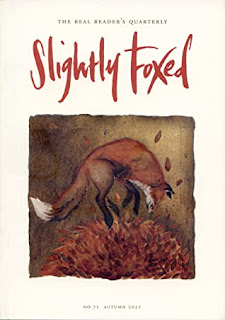
Slightly Foxed Reader's Quarterly #71: August 2021
is my first Slightly Foxed journal. I had not heard of it till a friend mentioned it at Instagram, and I confess that I bought a one-year subscription for myself as a Christmas gift for no other reason than I knew nobody else would buy it if I asked. And, then it never did get put under the tree so it felt like a bit of a post-Christmas bonus.  

For those who are unfamiliar with Slightly Foxed, it's a quarterly journal with essays about books, usually a particular book that is either tied to the author's memories in some way or was found during research, etc. The bottom line is that the authors of essays in Slightly Foxed tend to wax poetic about a particular book or several books and it is one delightfully dangerous little collection of writings. Yes, yes, I want nearly all of them after reading about how wonderful, memorable, controversial, or charming the books are. Of course, I'm on a book-buying ban so it's not happening. But, wow, if I was just building a library I would want to start a collection of Slightly Foxed books. 

Recommended if you're not afraid that reading eloquently-written essays about books will destroy your budget. And, even then I recommend it, just hold onto your hat and maybe freeze your credit card till you get over it. 
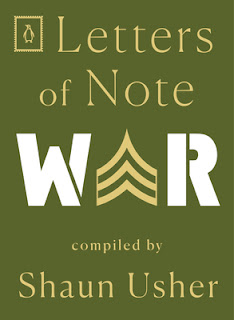
Letters of Note: War compiled by Shaun Usher is a book of letters either written during a war or about war. I was curious about it because I have a passion for reading about war, both as it's experienced by those who are in the military and the folks left back home. 

To be honest, I didn't read the description so I was quite surprised by the sheer variety. There is, for example, a letter written by a Roman soldier at Hadrian's Wall, asking someone to "send beer". I was certainly not expecting the letters to go back that far! There are also plenty of letters written home from wars closer to our time period, including one from the mother of a soldier killed in Vietnam, a letter from Evelyn Waugh telling a story about soldiers making a hash of tree removal during WWII, and a letter from Martha Gellhorn to Eleanor Roosevelt written as Martha was heading to Spain to fight the rise of fascism. 

Of all of these letters, by far the most moving was the one from a mother whose son died in Vietnam. I absolutely sobbed when I read that one. Some were funny, like Evelyn Waugh's story about the trees, some a little difficult to read because the language of the writer's time was a bit different. Martha Gellhorn's was my favorite for sheer readability and that's a positive because I just happen to have a book of selected letters written by Gellhorn. At any rate, compact as this book is, it was a fascinating read. 

Recommended to those who are interested in primary source material from various wars. There is a series of "Letters of Note" books and the Letters of Note website is still extant. I haven't spent any time there but it looks like a good way to waste an afternoon. 

The Arrow Book of Funny Poems compiled by Eleanor Clymer is a Scholastic book from my childhood with silly rhyming poetry. I chose to read it to see if it held up to my memories (as a child, I nearly beat the book to death, I read it so many times) after an Instagram friend reread a poetry favorite from her youth. I'd just spotted the book on one of my shelves, shortly before I saw her post. 

Answer: Yes, it holds up. It's just as silly as it ever was and I like the goofiness. While it's probably still best read as a child, I enjoyed it. A couple favorites:

The Optimist (Anonymous author)

The Optimist fell ten stories,
And at each window bar,
He shouted to the folks inside, 
"Doing all right, so far!"


The Ostrich is a Silly Bird by Mary E. Wilkens Freeman

The Ostrich is a silly bird, 
With scarcely any mind,
He often runs so very fast, 
He leaves himself behind.

And when he gets there, has to stand
And hang about till night,
Without a blessed thing to do
Until he comes in sight 


I'd recommend this book for children but I think you'd be hard pressed to find a copy, anywhere. Still, if you ever happen across it, it's loads of fun and especially suited for giggly kids who like humor. 

©2022 Nancy Horner. All rights reserved. If you are reading this post at a site other than Bookfoolery or its RSS feed, you are reading a stolen feed. Email bookfoolery@gmail.com for written permission to reproduce text or photos.

Tuesday, February 15, 2022

A Boy Named Isamu by James Yang and Unspeakable: The Tulsa Race Massacre by Carole Boston Weatherford and Floyd Cooper

Both of the following are children's picture books. Full disclosure: James Yang, author of A Boy Named Isamu, is a high school friend. While these are both 5-star reads, I have very little to say about either, so this will be just a couple of slap-dash, quickie reviews. 

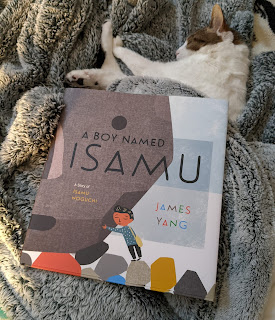
A Boy Named Isamu by James Yang is a story that imagines artist Isamu Noguchi as a boy, on a single day when he goes to the market with his mother and drifts away. It shows his boundless curiosity and sense of wonder as he notices the shapes and textures that will inform his art. 

The illustrations are fabulous. I'm a fan of James's art but I think he really knocked it out of the park in A Boy Named Isamu. And, I loved the way he portrayed how an artist sees and thinks. There's a nice bio of Isamu Noguchi in the back of the book. 

Highly recommended - I loved A Boy Named Isamu so much that I read it, recorded it in my reading calendar, and then read it again. As I said elsewhere . . . forget the grandkids, this one's for me. But, I'm sure the grandchildren would appreciate it, as well. 


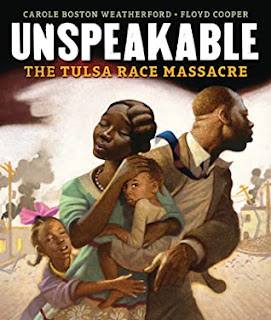
Unspeakable: The Tulsa Race Massacre by Carole Boston Weatherford and Floyd Cooper (illustrator) is a book I bought after seeing it on a list of books that some politician or conservative group wants banned. I was curious why on earth anyone would want to ban a children's picture book, especially about such an important topic. 

Brief note: My husband and I grew up in Oklahoma and neither of us ever heard of this particular historical event, although Hubby says his friend told a story of his grandfather hiding a Black man in the 1920s and he's pretty sure it was during what has elsewhere been called the "Tulsa Race Riot" (a name which, this author notes, places blame on the victims). 

Unspeakable tells the true story of the Tulsa Race Massacre  and places the blame squarely where it belongs, on the people of that time period who murdered, looted, and burned a prosperous black community to the ground. It's well written, appears well researched, and the illustrations are marvelous. It ends with a photo of the burned remains of Tulsa's Greenwood district. As an Oklahoman who didn't hear about this violent travesty until a few years ago, I'm glad to see it talked about. 

Highly recommended - The hardback was sold out everywhere when I looked this book up, so I bought the e-book and the electronic version is perfect. There were no issues at all with the images. This story was suppressed for far too long and I can't imagine why anyone would desire to ban it other than a continued desire to suppress the truth. It's told in a very positive way and the illustrations are just stunning. 

©2022 Nancy Horner. All rights reserved. If you are reading this post at a site other than Bookfoolery or its RSS feed, you are reading a stolen feed. Email bookfoolery@gmail.com for written permission to reproduce text or photos.
Friday, January 21, 2022

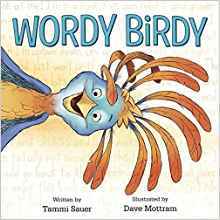
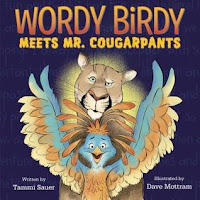
Wordy Birdy and Wordy Birdy Meets Mr. Cougarpants by Tammi Sauer and Dave Mottram

Just a couple quickies. I bought these two books shortly after seeing a review of one of them and thinking, "Oh, how cute!" But, I likely wouldn't have bought them if the author, Tammi Sauer, didn't happen to be a favorite children's book author. Good decision. 

The eponymous bird in Wordy Birdy by Tammi Sauer and Dave Mottram (illustrator) is just what she sounds like, a bird who can't stop talking. But, she's not a good listener and doesn't particularly pay a lot of attention to her surroundings. So, when she sees a danger sign, she just admires it and keeps going, ignoring the message. Her friends try to stop her but she doesn't listen to them, either. And, then a second warning sign . . . same thing. When she arrives at the point of danger, her friends are there to help her escape. Wordy Birdy will be paying more attention, from now on. 

A sweet, funny, charming story with vibrant, expressive illustrations and a nice lesson in friendship and paying attention to one's surroundings. I loved it. 

In Wordy Birdy Meets Mr. Cougarpants by the same author and illustrator, Wordy Birdy and her friends have gone camping. She talks so much that nobody can get to sleep. But, then a hungry cougar shows up at their campsite and she drives him out of the camp with her chattiness, saving herself and her friends. 

There's one fantastic line in this book and it's the cougar saying, "Did she just call me Mr. Cougarpants?" Ohmygosh, the expression on the cougar's face is a hoot!

Both highly recommended - I loved both of these books but my personal favorite is Wordy Birdy Meets Mr. Cougarpants because of that moment when the cougar is stunned and the sheer hilarity of a bird talking a predator away from the camp because he just wanted a nice peaceful meal. So, so cute. Also, I hate to say it but Wordy Birdy reminded me of myself as a child. I got told to please be quiet a lot

These are picture books for younger ones, with few words. My only issue with them is that I never have liked reading picture books that have word balloons to small children because I always felt obligated to point at whoever is speaking. I prefer dialogue to be described within text saying who is saying what. But, that's a personal preference and it's really not a big deal. The stories win out. 

©2022 Nancy Horner. All rights reserved. If you are reading this post at a site other than Bookfoolery or its RSS feed, you are reading a stolen feed. Email bookfoolery@gmail.com for written permission to reproduce text or photos.
Wednesday, November 17, 2021

Walrus Song by Janet Lawler and Timothy Basil Ering


Where is Walrus? 
On a floe. 
Hop flops. He plops. 
Where did he go?

Walrus Song by Janet Lawler and Timothy Basil Ering (illustrator) is a gorgeous children's rhyming picture book about walruses that I'm absolutely in love with. 

Some of the things children will learn about in Walrus Song:


  • Herding/socializing behavior
  • How big a walrus is and about the fat layer that keeps them warm and stores energy
  • What walruses eat and how they hunt for food
  • How they play with birds(!)
  • The growth of tusks and how they're used to lift a walrus from the water and chip ice to make space to dive
  • How they use their flippers to walk and fight
  • The sounds they make
  • Mothers and babies: how often walruses give birth and how long they stay with mother
  • The danger of global warming to walruses


All of this is told in simple, rhyming text. But, there's also an explainer section at the end of the book that goes into greater detail about what various lines mean. For example, the line saying Walrus is "on a floe" describes the meaning of the word floe (an ice sheet). And, a line describing the way a walrus swims, "Twirling, whirling, flippers swirling," is further described in the explainer section in this way:

"A walrus swims by wiggling its whole body and stroking with its back flippers. It steers with its front flippers."

I took an interior shot to show you just how gorgeous the illustrations are (you should be able to click on the image to enlarge):


Highly recommended - I've read and reviewed a lot of children's books and I'm sure some of the animal books I've read (along with a single book I remember from my childhood) have had walruses in them along with other animals. But, Walrus Song is the first book I've read that's totally dedicated to walruses. I enjoyed learning about them and I think little ones will appreciate the gentle rhythmic text while they're still small enough to sit on laps, then will enjoy learning more about walruses as they grow. Walruses need love, too! Walrus Song would also be a great book for libraries and classrooms, since it has some nice added details in addition to the lovely story showing a walrus throughout its day. 

My thanks to Candlewick Press for the review copy! 

©2021 Nancy Horner. All rights reserved. If you are reading this post at a site other than Bookfoolery or its RSS feed, you are reading a stolen feed. Email bookfoolery@gmail.com for written permission to reproduce text or photos.
Wednesday, September 29, 2021

Gobbolino the Witch's Cat by Ursula Moray Williams


I bought Gobbolino the Witch's Cat by Ursula Moray Williams when someone I follow on Instagram gushed about it. Gobbolino the Witch's Cat is about a kitten with just a touch of magical ability, thanks to the fact that he was born to the cat of a witch who lives in a mountain cave. But, he has no interest in growing up to be a witch's cat. His heart's desire is to be a beloved house cat with a family, a nice bowl of cream, and a place to nap by the fire. 

I can't actually remember if Gobbolino sets out on his own or not. However it happens, he ends up in a creek, swimming toward a dangerous water wheel and barely saved by some children. The children take him home and it appears that he's found the place he dreamed of until sparks come from his whiskers and the adults realize he's a witch's cat. Nobody wants a witch's cat, so he's kicked out. 

This pattern repeats with Gobbolino finding a home in an orphanage, with a troupe of puppeteers, and various other places. But, each time someone figures out that he's a witch's cat and he's turned out over and over again until, finally, he ends up finding his sister — a cat who never had any doubts at all that she would find a witch of her own. The witch threatens to throw him down the mountain because he's useless as a witch's cat, but Gobbolino is able to get away. Unfortunately, he ends up right back in the creek and now, thanks to the witch, he can no longer swim. Will Gobbolino ever find a home with people who love him and a place by the fire?

Recommended but not a favorite - As evidenced by the fact that my copy is an anniversary edition, Gobbolino the Witch's Cat, published in 1942, is apparently a classic . . . presumably in the UK. I'm pretty sure I bought it from Book Depository, although it was last year so I'm not positive about that. And, I can see why it's a classic. I would have loved it as a child. As an adult, though, it fell a little flat for me. I found the "found a home, kicked out, found a home, kicked out" repetition a bit exhausting. As a youngster, though, I probably would have enjoyed it for the way Gobbolino's story comes full circle and he does, indeed, find a happy home. It's a lovely story and one I'll save for my grandchildren to read. It's just a little too simplistic, even for this middle grade-book-loving reader. 

©2021 Nancy Horner. All rights reserved. If you are reading this post at a site other than Bookfoolery or its RSS feed, you are reading a stolen feed. Email bookfoolery@gmail.com for written permission to reproduce text or photos.
Tuesday, September 14, 2021

Ungifted by Gordon Korman (Ungifted #1)


Ungifted by Gordon Korman is the story of a middle school troublemaker who goes a bit too far. When Donovan causes an accident that will cost the school district a great deal of money in repairs and then is accidentally sent to the Academy of Scholastic Distinction (a school for the gifted), he decides the school is an excellent place to hide from the superintendent, who knows what Donovan looks like. 

When it turns out that Donovan's averageness is a bonus to the robotics team and the school in general, everyone wants him to stay. But they know he doesn't belong; he's definitely not gifted. Will Donovan be able to remain at the school long enough to help the Academy's robotics team win the annual robotics competition?

Shifting between a number of different viewpoints, the reader gets to see what it's like to be an average guy who likes pranks and ends up in a school for the gifted, how a couple of his teachers view him, and life as a very gifted person through the eyes of some of his classmates. 

Highly recommended - I love Gordon Korman's books and Ungifted is a new favorite. I've read the follow-up book, Supergifted, out of order (I got it as an ARC, a few years ago). It stood alone fine but I've wanted to read Ungifted since then and I was not disappointed. Korman is a gifted writer. I love his blend of smart, wacky, and humorous storytelling. 

Click here to read my review of Supergifted

©2021 Nancy Horner. All rights reserved. If you are reading this post at a site other than Bookfoolery or its RSS feed, you are reading a stolen feed. Email bookfoolery@gmail.com for written permission to reproduce text or photos.

Wednesday, September 08, 2021

Mini Reviews - Once Upon a Goat by Richards and Barclay, Pastoralia by G. Saunders, The Long and Living Shadow by D. Winston

I don't feel like any of these require a lengthy review, so here we go again with the mini reviews.  Pardon my mostly-absent week. I spent the entire Labor Day weekend cleaning out my breakfast nook, which I'd turned into a very messy art studio. It had gone well beyond acceptably disordered, so I've moved everything out and now we're just pondering how to bring everything back but make the room orderly. We want to find a storage solution for all the paint, brushes, etc. that is attractive but it may take some time to find. At any rate, I needed a day to recover after spending the weekend hauling canvases, bottles, brushes, and boxes of paint to another room. 

Onward. 

Once Upon a Goat by Dan Richards and Eric Barclay is an adorable picture book in which a king and queen long for a family. When they ask their fairy godmother for a child, the king makes the mistake of saying, "Any kid will do." 

And, a kid is exactly what they get, a baby goat. At first they're horrified and even decide to cast the kid out of the castle after he causes too much chaos and eats the royal roses. But, then it begins to rain heavily and they feel bad about sending the poor little guy out on such a rough night. After bringing him back inside, he slowly becomes part of the family. And, then their fairy godmother returns and sees her mistake. 

Out in the countryside, the fairy godmother peeks around a tree and, sure enough, there's the baby the king and queen asked for — living with a mother and father goat. She intends to switch them but the king and queen have become so attached to their kid that they come up with an alternative solution. Hint: it means the castle is never tidy. 

Recommended - While the storyline in Once Upon a Goat is predictable to an adult, it's super cute and I can imagine it tickling small children. I love the illustrations, love the kindness of the king and queen and their willingness to tolerate a messy castle because they adore their little goat, much like parents who put up with the messes that come with having small children. 

Pastoralia by George Saunders is a book of short stories with one novella. As in many of his collections, there's a "theme park going downhill" story, the novella of the title name, "Pastoralia", and it was my favorite. A man and woman are living in cave, each with his and her own Separate Area into which they retreat at night. They're not related, not attracted to each other. They're supposed to just grunt all day, skin and cook their daily goat, pretend to eat bugs and paint wall art. With fewer visitors coming, they fear they'll lose their jobs soon and occasionally their daily goat doesn't show up in their slot so they must eat crackers, instead. 

Meh - Saunders' theme park stories are wildly creative and absurd. I tend to love them, even the ones that get a bit . . . violent (his earlier work, especially). But, the rest of the stories in Pastoralia didn't thrill me. In fact, I had to flip through the book to remind myself what the others are about and found that I was reading much farther than I should do in order to nudge my memory. 

At any rate, I love George Saunders casual, humorous, satirical writing. But, apart from "Pastoralia", this one just didn't do it for me and it's now my least favorite Saunders book, much as I love him. Second to Pastoralia would be Lincoln in the Bardo [unpopular opinion], which was too scattered for my taste, although someone at Square Books in Oxford, MS told me that Saunders had the audience do voices from Lincoln in the Bardo when he came for a reading and signing. They say his visit was a total hoot. And, my "least favorite" is still worth keeping for the novella. I am getting close to having read all of his books, now.

I like the pulp-fictiony cave woman cover shown above, although the woman who lives in the cave with the narrator is described as fifty-something and not particularly attractive, at least to the man who plays her Partner in Cave. My copy has a deer on the cover. I'm not sure of the point of that and I'm not reviewing for anyone since this is from my home library, so I've opted to put up the cover I like. 

The Long and Living Shadow by Daoma Winston almost doesn't deserve a review. It was seriously awful. But, I finished the book for a couple reasons. 

1. The Return by Daoma Winston, a book that once belonged to my mother, is one of my all-time most reread books. I've read it periodically since . . . maybe my early teens? It's a romantic suspense that takes place in a mansion on a cliff, very gothic and moody and truly suspenseful. I've been considering another reread. I recognized similar elements in The Long and Living Shadow and felt like I needed to keep reading to figure out why a book that was similar in so many ways was such a dud by comparison with another title by the same author. More on that in a minute. 

2. It was short. Mercifully short at something like 157 pages, thank goodness. It truly was a terrible work of writing.

Not recommended - Pass this one up if you see it at a library or garage sale. Dreadful, repetitive, and predictable. The spooky house really wasn't and the greedy relatives were transparent. Possibly the worst thing (the element that most likely made it pale by comparison with my old favorite) was ineffective repetition. Everyone was pudgy but the heroine, who was delicate. The title was repeated a gazillion times, and so was mention of whether or not the widowed heroine was "grown up" at 23. On the plus side, she developed confidence as the book progressed and the book has a bang-up ending. But, that wasn't enough to redeem it. 

This is another one for which I've switched out the cover image. I think my copy must be a reprint as it was published in 1971 and my copy looks very 80s, with the heroine dressed in a feathered gown. In reality, she was a hat-and-gloves-with-suit type of gal, very conservative. The cover above doesn't entirely fit, either, but it does hint of the gothic feel, while the cover image on mine looks like it came straight out of a music video. 

©2021 Nancy Horner. All rights reserved. If you are reading this post at a site other than Bookfoolery or its RSS feed, you are reading a stolen feed. Email bookfoolery@gmail.com for written permission to reproduce text or photos.

Thursday, September 02, 2021

Klawde: Evil Alien Warlord Cat, Books 3 and 4 - The Spacedog Cometh and Target: Earth by Johnny Marciano and Emily Chenoweth

Since this is a review of two books in the middle of a series, I'm going to refer you back to my earlier review of the first two books: 

Klawde: Evil Alien Warlord Cat and Klawde: Evil Alien Warlord Cat, Book 2: Enemies by J. Marciano, E. Chenoweth, and R. Mommaerts

But, in case you don't feel like reading that, I'll give you a quick rundown of the first two in this delightful middle grade series. The first Klawde book is about an Evil Alien Warlord Cat named Wyss-Cuzz who has been banished to the most horrible place in the universe: Earth. On Earth, Wyss-Cuzz expects things to be as advanced as they are on his home planet but unfortunately it's a primitive place inhabited by ogres who call themselves humans. Wyss-Cuzz is quickly adopted by a boy named Raj and renamed Klawde. In the first book, the evil kitty is trying to get back to his home planet by creating a transporter with the help of his devoted minion, Flooffee-Fyr. 

In the second book he tries to train a crew of kittens to be warriors and things don't work out quite as Klawde anticipated. I reread the first Klawde book but couldn't locate my copy of the second, so I just skipped over it. 

Note: There are some spoilers in these two mini reviews. If you're worried about that, scootch on down to the rating. 


In the third book, The Spacedog Cometh, a dog is sent from one of the many dog planets in the universe (who knew there were so many?) His mission is to punish Klawde for destroying a planet.

Meanwhile, Raj's parents have gone on vacation and he's being watched by his ajji (grandmother), who has brought along a dog that she's fostering. After the spacedog arrives, she takes him in and Klawde must figure out how to deal not only with a dog that can't talk but also with this alien dog who has it in for him. 

With the help of his minion, Flooffee-Fyr, Klawde uses a device like a Go-Pro to beam back films that make him look heroic. But, then he makes the mistake of leaving the camera on at exactly the wrong moment. 


In the fourth book, Target: Earth, Klawde decides he needs to find a way to create an army, take over satellites, and defeat humankind. He starts with a few squirrels in the neighborhood, using them as zombie spies and testing his ability to get them to do his bidding.

Meanwhile, Klawde has been able to acquire some fancy technology by creating his own currency, KitKoin, and becoming filthy rich. In the process, he spoils Raj a little and Raj has to learn a lesson from that. 

Why does Klawde want to kill humans after they've treated him so kindly? Because he has lost the admiration of his many subjects after having to behave submissively to a dog. Will Klawde be able to vanquish his enemy? Or will the FBI agent who lives nearby thwart his efforts?


Both highly recommended - I'm not sure reading them back-to-back would work for everyone and, in fact, even I had to occasionally take a break and read a few pages from a different book to reset. But, I still love this series and if I can, I'll collect them all. There are currently 6 books in the series. I particularly love how this strange, otherworldly creature that looks and sometimes behaves like a cat (not a nice cat, but his humans still love him) is contrasted with a totally normal, slightly quirky family who are kind and loving. Also, Raj begins as a bit of a fish out of water in the first book but quickly finds friends and with each book his connections to people in the neighborhood grows. The human side is really quite lovely, although he does have his nemeses in the form of a group of bullies. 

Note: I'm trying to get back to pre-posting so that all of my posts are up by 7:10 AM for the early risers who like to read posts before or on their way to work but last night I was thwarted by a power outage. Oh, well. I'll keep working on it. 

©2021 Nancy Horner. All rights reserved. If you are reading this post at a site other than Bookfoolery or its RSS feed, you are reading a stolen feed. Email bookfoolery@gmail.com for written permission to reproduce text or photos.

Tuesday, August 17, 2021

Aven Green Baking Machine (Aven Green #2) by Dusti Bowling and Gina Perry


Aven Green has fast become a favorite children's book character. In Aven Green Baking Machine by Dusti Bowling, Aven and her three friends have decided to enter a baking contest. Each of them has come up with a favorite recipe or altered one to make it their own. But, Aven is rude about the name of her friend Sujata's chosen dessert and refuses to even taste another friend's because it contains raisins, which she despises. By the end of their baking session, Aven has alienated everyone and her friends even decide to enter the contest without her. 

When a boy named Ren sits down to talk with her while she's sitting alone and sad on the playground, the next day, she finds out that his mother makes a delicious dessert containing bean paste. Once again, she is insensitive about a dessert that comes from another culture and makes a face, hurting Ren's feelings. But, then her grandmother teaches her a lesson in trying new things and being kind to friends. 

Aven apologizes to her friends and asks Ren if he'd like to join the baking contest with her. With the help of Ren and his mother, she discovers yet again that things that sound kind of awful can actually taste delicious. Who will win the baking contest? Will Aven be able to reconcile with her friends?

Highly recommended - A wonderful story about being kind and culturally sensitive and trying new things, which includes recipes, yay. I love books with recipes in the back. Because Aven is a child with no arms, there are always unique situations in the Aven Green books and while she was a little rude in this book for a time, Aven is a good person, very upbeat and quick to make friends. I always find myself smiling as I read the Aven Green books. A delightful middle grade read. 

My thanks to Sterling Children's Books for the review copy! Aven Green Baking Machine is the second in a series but it stands alone fine. Here's my review of the first:

Aven Green Sleuthing Machine by Dusti Bowling


©2021 Nancy Horner. All rights reserved. If you are reading this post at a site other than Bookfoolery or its RSS feed, you are reading a stolen feed. Email bookfoolery@gmail.com for written permission to reproduce text or photos.

Wednesday, August 11, 2021

Where is Our Library? by Josh Funk and Stevie Lewis


You get an early peek at one of the books I bought in my second Book Outlet order (the one I think of as "the naughty one") before my Monday Malarkey photo of next week. Yay. I knew you'd be thrilled. 

I have loved author Josh Funk's Lady Pancake and Sir French Toast series (also children's picture books) and I added Where Is Our Library? to my wish list when Josh posted about it on Twitter. Oh, how I wanted that book! It took a couple of years, though, because I often feel like I can't excuse the purchase of children's books, my grandchildren being so far away and no other children in my orbit. But, at about half the retail price, I was so excited you would have seen nothing but a blur if you were watching me put that book in my cart. 

Good decision. Where Is Our Library? is a delightful rhyming tale in which the New York Public Library's lion statues, Patience and Fortitude, come alive at night. They walk to the children's book section of their library branch, as is their habit, but find it empty! Where have the books gone?

Patience and Fortitude go in search of the children's books and in so doing, take the reader on a lovely tour around New York City, including Central Park and some of New York City's branch libraries. 

Highly recommended - Particularly of interest to those who have visited or live(d) in New York City and library lovers of all stripes. I felt swept into their adventure and found myself reminiscing about walks around New York City. I haven't been to Central Park but now I want to see it, next time I'm up that way! 


©2021 Nancy Horner. All rights reserved. If you are reading this post at a site other than Bookfoolery or its RSS feed, you are reading a stolen feed. Email bookfoolery@gmail.com for written permission to reproduce text or photos.

Tuesday, August 03, 2021

Splat the Cat: I Scream for Ice Cream by Laura Driscoll and Robert Eberz

I could have skipped reviewing Splat the Cat: I Scream for Ice Cream entirely. It's just a cute little book that I got in the hopes that someday my grandkids will come for a visit and need some reading material between the middle grade and picture book levels. But, nah. I like reviewing everything.

In Splat the Cat: I Scream for Ice Cream, Splat and his class go on a field trip to an ice cream factory. When disaster happens, they have to work hard to save the day. 

I keep coming back to the word "cute". Well, I Scream for Ice Cream is a beginning reader, after all, and meant to be enticing to little ones learning to read. I bought it primarily because it's a Level 1 reader with a cat on the cover. And, I did love the illustrations. 

As to the story, it's nothing brilliant and there's no big lesson to be learned unless it's about teamwork making things go more quickly. But, it does teach words with "eam" in them (scream, beam, dream, cream, etc.) and I think rhyming words/learning to sound them out is the easiest way to teach reading. I had one child whose teacher chose to go with teaching totally random words rather than focusing on sound and those first couple of years of reading were rough for him, so we worked on phonics at home and things improved. 

Recommended - Adorable, expressive illustrations and a fun story meant to teach children about words that rhyme with cream. Especially fun for cat-loving youngsters and their parents. 

Note: The cover says this is "Based on the bestselling books by Rob Scotton." I'm unfamiliar with Rob Scotton but I opted to use the author and illustrator (interior illustrations only; the cover art is by Rick Farley) that are written inside the book in the subject line, rather than writing whose books it was based upon. 

©2021 Nancy Horner. All rights reserved. If you are reading this post at a site other than Bookfoolery or its RSS feed, you are reading a stolen feed. Email bookfoolery@gmail.com for written permission to reproduce text or photos.

Monday, May 24, 2021

Mini reviews - The Magician's Elephant by Kate DiCamillo, Rose Mellie Rose by Marie Redonnet, The Address by Fiona Davis

I don't have much to say about any of these, and this post will catch me up completely (for now) so it may be quiet in here till I finish something. 

I read The Magician's Elephant by Kate DiCamillo on my iPad (where I have a fully-loaded Kindle app that I barely ever touch) when our power went out a couple weeks ago and I just wanted something light to read while we sat around in the dark. 

The Magician's Elephant is about a boy who lives with a sickly man who has been telling the boy all his life that the boy's entire family is dead and that the old man rescued the child. The boy spends his days being drilled to be a soldier like his father and doing his master's bidding. One day, he goes to market and is drawn into a fortuneteller's tent with the promise of learning about his future. He spends the old man's food money on the prediction, which has to do with following an elephant to find the sister he thought dead. But, there are no elephants in this [fictional] town. 

And, then he hears that an elephant has been conjured by a magician and fallen through the roof of the opera house, onto the lap of a woman who is now permanently injured. The elephant is being held captive and the boy must figure out how to save the elephant so that he can follow it. The magician, the newly-disabled woman, and a few others figure into this story and it ends on a happy note. 

Highly recommended - The Magician's Elephant was exactly the read I needed on the day I opened the file. It's warm, witty, stirring, and full of heart. Kate DiCamillo's middle grade books haven't let me down, yet. 

Rose Mellie Rose by Marie Redonnet is the second book I read while the power was out and it's . . . kind of weird. The third in a triptych, Rose Mellie Rose is a short novel about a 12-year-old girl named Mellie who was left in a grotto as a baby and has been raised by an elderly woman, Rose. When Rose dies, Mellie follows her instructions and heads for the city of Oât, where she registers, gets an ID, and becomes a part of the dying town on a lagoon. 

There's a lengthy explanation by the author about the three novels in the triptych after the story and, I confess, I have no idea what she was trying to say. But, apparently there is flooding and a cemetery in all three books and the flooding somehow relates to the death of 19th Century literature? There's a lot of death, at any rate, the story is a tragedy, and there is some really disturbing sex (TW: could be considered rape but is not portrayed as such) . . . yes, with a 12-year-old. 

Neither recommended or not recommended - I mean . . . ugh, I really did find parts of Rose Mellie Rose disturbing but at the same time it was compelling and I don't regret reading it, although I would not seek out the companion novels (all three are stand-alones with apparently the same theme so it's not necessary to read them in any order if you do read all three). Mostly, I just feel like I'm glad I read it and now I can pass it on. I bought it long, long ago when we had a salvage store that occasionally got book stock from floods, fires, etc., and I was building my home library so I'd buy just about anything that appealed to me. It's a French translation.

The Address by Fiona Davis is a contemporary/historical combo that takes place mostly in the Dakota, the upscale apartment building in New York City where a lot of wealthy, famous people live and outside of which John Lennon was shot. 

Sara Smythe is an Englishwoman who travels from England to work as the manager of the Dakota as it's opening and Bailey, in the 1980s, is an addict fresh out of rehab who is offered the job of redecorating her cousin's apartment in the same building. 

In the past storyline, we know that Sara went mad and killed the architect who employed her. What happened to cause this fit of passion?

In the more contemporary part, Bailey finds clues to what happened in the past that might change her own future. 

Recommended - I liked The Address. It's the first book I've read by Davis and I wasn't quite sure what to expect but it was another one of those, "Ah, just what I needed at this moment" books. It's a light, easy read but with a nice little mystery and I'd been reading a nonfiction without finishing it for over a week so I needed the mental break. As is often the case, I pretty much predicted everything that ended up happening. It took me a while to untangle the possibilities and come up with my own theory, though, so no problem. 

Sara is institutionalized in this story, at one point, and when I got to that part, I recognized the descriptions from Nellie Bly's book about her time in the madhouse. Sure enough, Nellie made an appearance. The Address is a fun read. I will definitely be looking for more by Davis. 

©2021 Nancy Horner. All rights reserved. If you are reading this post at a site other than Bookfoolery or its RSS feed, you are reading a stolen feed. Email bookfoolery@gmail.com for written permission to reproduce text or photos.

Tuesday, March 23, 2021

Bindu's Bindis by Supriya Kelkar and Parvati Pillai


First things first: A bindi is the decoration South Asian females often wear on their foreheads, which is known as a "third eye" and is meant to keep evil away. I thought that was what a bindi was, as I went into the reading of Bindu's Bindis, but I wasn't certain so I looked it up. It's good to know that going into the book, in case the child you're reading to has questions. 

Bindu is an American girl who loves wearing bindis. She wears different designs depending upon her mood, using stick-on bindis that come in a variety of colors and shapes. Her grandmother sends her a new set each month and she wears them to the temple, on holidays, and at home. Then, one month her grandmother brings them to Bindu in person. 

Bindu wears a "brilliant oval bindi" to greet her grandmother, or Nani, at the airport. But, when they turn from the gate, her family is surprised to find that they're being greeted by protestors with signs telling them to go home. Bindu holds her head up high and so does Nani. 

Nani has always loved dancing and she teaches Bindu some of her moves. When Bindu dresses up to dance in a school assembly, she's excited at first. But, then some of the children giggle at her beautiful outfit and she's hesitant. Nani tries to excite her by offering different bindis for Bindu to try but it doesn't work. So, Nani goes up on the stage and starts dancing, then Bindu joins her. 

Recommended - I like the story, love the vibrant illustrations in Bindu's Bindis, and particularly appreciated the fact that there are two separate challenges that are tied together: dealing with protestors who are xenophobic and children who make Bindu nervous about her ethnicity. Both are obviously common, right now, in the US. There was one thing I wish the author had done and that's add a single sentence or phrase defining the word "bindi" at the beginning of the book. However, once you know what it is, you know . . . and there's no longer a need for a description. So, after I thought about it for a while, I decided it's no big deal. Bindu's Bindis is a children's picture book, after all, and the illustrations alone make it pretty clear. There is some information about who wears bindis, other names for them, and why they're worn, in the back of the book. 

Incidentally, as I was reading the scene with Nani getting up on stage, I was reminded of the similar scene in About a Boy when Hugh Grant gets up on stage and makes a fool of himself to encourage his young friend to perform. I love the cringeworthy humor of that scene (and the movie, in general), so Nani's dancing brought back a fond memory. In Bindu's Bindis you get a similar feeling from Nani's dancing. It's a little uncomfortable but her joy is infectious. I wanted it to be real and to be transported into that scene. 

My thanks to Sterling Children's Books for the review copy!

©2021 Nancy Horner. All rights reserved. If you are reading this post at a site other than Bookfoolery or its RSS feed, you are reading a stolen feed. Email bookfoolery@gmail.com for written permission to reproduce text or photos.

Wednesday, December 23, 2020

Christmas books!


All of the books shown above are rereads and I have a feeling I've mentioned a couple of them in the past, so just some quickie thoughts about each:

A Child's Christmas in Wales by Dylan Thomas is one of my favorite Christmas reads. I only discovered it a few years ago, when I was asked to make suggestions for short reads to discuss at my F2F group's Christmas meeting, and I've read it 3 times, since. 

Our snow was not only shaken from whitewash buckets down the sky, it came shaking out of the ground and swam and drifted out of the arms and hands and bodies of the trees; snow grew overnight on the roofs of the houses like a pure and grandfather moss, minutely white-ivied the walls and settled on the postman, opening the gate, like a dumb, numb thunderstorm of white, torn Christmas cards.

Oh, how I love A Child's Christmas in Wales. Absolutely captivating, humorous, and a pure delight. Dylan Thomas' use of language blows me away. The "fish-freezing waves" and "the gong was bombilating". I'm going to make reading it an annual tradition, along with . . . 

A Christmas Memory by Truman Capote, a timeless, beautiful story of an unusual friendship between cousins with decades between their ages but a tender relationship. They're impoverished but rich with the ability to find Christmas joy together. A Christmas Memory is such a lovely, meaningful book about the simple joys of Christmas. 

Isabel helped me out with another of my reads (mostly by sleeping next to me), A Little House Christmas: Holiday Stories from the Little House Books by Laura Ingalls Wilder. Wilder did such a wonderful job of describing where the family was living in each story and that particular year's circumstances (blizzard, life in a dirt home that had no stove, living near a small town where she had an uppity rival) that there's never a sensation that these stories were pulled out of context. 

As in A Christmas Memory, the stories in A Little House Christmas are about simple joy. Laura and Mary even talk themselves into being fine with no gifts at all when Pa needs a new horse, one winter. I haven't read A Little House Christmas in many years but I loved it so much that it made me want to go back and read the entire series. I don't think I ever actually read all of the Little House books, as a child, but I remember those I did read with affection. 

The only book from this batch that I didn't love was The Twenty-Four Days Before Christmas by Madeleine L'Engle, which appears to be a Christmas story written as part of a series, the Austin Family Chronicles. I was unfamiliar with the characters and felt it a bit mediocre, even back when I bought it in the 90s. I'm pretty sure the only reason I kept it was the fact that I happened to be collecting books by Madeleine L'Engle, at the time. It's a nice enough story, just nothing brilliant. 

Vicky is worried that her heavily pregnant mother won't be able to attend the Christmas pageant but when a blizzard blows in while her father's away from home and her mother goes into labor but can't leave the house, she realizes what's really important. The Twenty-Four Days Before Christmas is sweet and old-fashioned, a good reminder that a simple, traditional Christmas that's not all about the gifts is a lovely thing. But, it's mediocre enough that I'm going to part with my copy. 

I also got one new-to-me book (originally published in 2005, if I recall correctly), The Christmas Truce by Aaron Shepard and Wendy Edelson, a children's illustrated retelling of the true WWI story of the cessation of hostilities between British and German troops at Christmas. The soldiers shared food and drink, sang songs from their respective countries, and enjoyed a brief reprieve from fighting. It's told as a fictional letter home from the front but based on the stories told by those who were present. 

I thought The Christmas Truce was nicely written and the illustrations are fabulous. I'll probably forget to put it in the recent arrivals pile, next Monday, but I purchased it after looking for a different children's book about the Christmas Truce and finding that it's both out of print and out of my price range. 

This will be my last post of the week. I'll be back on Monday. 

Merry Christmas to all my book-loving friends! 

Love,

Bookfool

©2020 Nancy Horner. All rights reserved. If you are reading this post at a site other than Bookfoolery or its RSS feed, you are reading a stolen feed. Email bookfoolery@gmail.com for written permission to reproduce text or photos.

Friday, November 13, 2020

Jonesy Flux and the Gray Legion by James Pray and a Fiona Friday pic


It took me over a week to finish a single book, thanks to election stress. Anyone else dealing with this? I think it's fading. Fortunately, Jonesy Flux and the Gray Legion was a good book to spend time with. I loved the main character and enjoyed every minute of this exciting middle grade book. In fact, I really, really want the author to continue Jonesy's adventures. 

Jonesy Archer and 17 other youngsters have been stranded on the remaining portion of a remote science station called Canary Station since it was attacked and mostly destroyed, 3 years ago. When the bad guys return, drawn by the signature from Jonesy's special power, her "flux", they're unable to find her so they take all of her friends instead, hoping to lure her into the legion in an exchange. 

Determined to save her friends, Jonesy figures out a way to run for help. Nobody has the strength and technology to battle the Gray Legion. But Jonesy's power is indeed special. Will she find a way to control her power and locate her friends to rescue them (preferably without giving herself up in exchange) before it's too late? 

Highly recommended - There's a lot more to the story that I'm leaving out, of course, like how the children survived the attack and the 3 years alone, how Jonesy manages to escape, and what happens after. It's a 400-page book and action-packed! I seriously hope the author is working on making this a continuing series and I would love to see it turned into a movie. 

Bonus: Jonesy is 11 years old and while she's smart and tough, the author let her be emotional. She actually cries quite a bit. As a person who was quick to tears at that age, I really appreciated the realistic emotions. 

Many thanks to Sterling Children's Books for the review copy! 

I didn't take many photos of the kitties, this week, but I did get one of Isabel with Jonesy Flux and the Gray Legion while I was reading! Happy Friday!


©2020 Nancy Horner. All rights reserved. If you are reading this post at a site other than Bookfoolery or its RSS feed, you are reading a stolen feed. Email bookfoolery@gmail.com for written permission to reproduce text or photos.

Wednesday, October 21, 2020

Mini reviews - The People Speak, ed. by H. Zinn, Cat Knit by Jacob Grant, and Writers and Lovers by Lily King

None of these books felt like they needed a page of their own but after writing the mini reviews, I find that I wrote more than expected about all of them. Sorry about that. Bit wordy. 

I'm not going to repeat all the subtitles on this book and just leave it big enough for you to read them. The People Speak, edited by Howard Zinn, is a slim book of readings that were dramatized by well-known people at a celebration of the anniversary of Zinn's A People's History of the United States. I have not yet read the original book but figured this was a way to dip into it and get an idea of how Zinn views history after A People's History of the United States was panned by our current president. 

Each reading has an introductory part and then a writing or speech from the book, which apparently uses primary source documents. Zinn takes the actual words of either the oppressed or the oppressor, giving the reader a clear viewpoint of how those who suffered did so because they had no voice. 

The most glaring and horrifying example, to me, was a letter by Christopher Columbus in which he describes the Arawak natives of Hispaniola as generous, well-built, handsome, and unfamiliar with weapons. His conclusion: "They would make fine servants. . . . With fifty men we could subjugate them all and make them do whatever we want." He did more than that. He wiped them out entirely. 

Recommended especially if you want to get a taste of Zinn's way of viewing history without diving into the longer book. I'm looking forward to reading A People's History of the United States but I have quite a few other nonfiction titles ahead of it in the queue, so it was nice to at least get a peek at what I'll be getting into. 

Cat Knit by Jacob Grant is a picture book about a cat (Cat) with a human (Girl) who is into knitting. When Girl brings home a ball of yarn, Cat finds that it's a delightful toy and has a great time playing with it. Then, Girl takes it away and turns it into something entirely different: a sweater. 

Frustrated with the new shape of his old toy, Cat wriggles out of his sweater with the help of a branch. But, it's snowy and cold outside and once that sweater is off, Cat becomes aware of just how nicely it suited the purpose. He decides it's OK to be friends with Yarn in its new form.

Finally, Girl brings home several more colorful friends and the final image is one of Cat wearing not only his new sweater but a hat and booties. The expression on Cat's face is golden. 

Highly recommended - There are few words in Cat Knit and simple but expressive illustrations of the cat. I loved it and I'm glad I happened across this book and bought it on a whim. It'll be a fun one to read to the grandkids when I see them again. 

Writers and Lovers by Lily King is a book that I've been looking forward to reading since its release, mostly because I was so completely blown away by Euphoria. And, I liked it a lot but I didn't love it. Maybe my expectations were a little too high. 

It's 1997. Casey has had a crushing experience with a lover and lost her mother. She has been working on a novel for years. To support her writing habit, she's living in a moldy garage apartment that used to be a potting shed and working as a waitress in a fancy restaurant. Casey begins dating two different men but each comes with his own complications. 

I'm going to stop there. There are some other things going on, like the fact that Casey can't pay her bills even while living in a crappy little hovel, but I think it's worth saying what I liked and didn't like and leaving it at that. 

What I loved: Writers and Lovers could easily be used as a lesson in writing. While Casey is finishing her novel and then pitching it to an agent, you get a very good look at the craft of writing. I also liked the realism of the love triangle. It didn't feel manufactured. In fact, I was certain that Writers and Lovers is a fictionalized account of the author's own experience and when I looked her up, I found that I was likely correct. Maybe the countries she lived in were different but it sure seemed like there were some parallels. 

What I disliked: There were times I had no idea what she was talking about when Casey was at work — and I've been a waitress. I guess waiting tables isn't the same across different types of restaurant. There was also a picky detail about a health crisis Casey went through that ticked me off because it was just wrong; I've experienced it and that's not how it works. Again, I think she has likely had a similar experience but she just didn't look into how that particular thing would be handled. It's a little harder to write off mistakes when you've been through what's written wrong and know it would be pretty easy to find out the details. 

I read Writers and Lovers specifically to discuss it with an Instagram friend. She liked it a lot more than I did. We have both written fiction and appreciated the technical details about writing. When you write fiction, you will often hear that it's self-indulgent to write about writers; we'd both heard that advice. But, we agreed that she handled the characterization of a writer better than most and it didn't feel annoying in any way. The writing aspect was quite informative. 

Recommended, but not a favorite

©2020 Nancy Horner. All rights reserved. If you are reading this post at a site other than Bookfoolery or its RSS feed, you are reading a stolen feed. Email bookfoolery@gmail.com for written permission to reproduce text or photos.

Tuesday, October 06, 2020

Song of the Court by Katy Farina


Song of the Court by Katy Farina is a children's graphic novel. Arietta sells flowers at her local castle market. She doesn't have enough money for seeds, so she decides she has no choice but to sell her grandfather's violin. But, then she runs into the princess outside the music shop. Princess Cassia is looking for musicians for her upcoming birthday party and assumes Arietta can play the violin in her hands. 

Arietta doesn't know how to play the violin but she agrees to play because she really doesn't want to part with the violin, which brings back fond memories of her grandfather, or disappoint the princess. So, with the help of a friend she takes a crash course in violin playing. She progresses quickly but at the party she's horrified to find out someone else has chosen to play the same song, the only song she knows. 

I won't give away the ending but it's sweet and I have a feeling I would have absolutely loved this book as a small child, both for the main character's determination to learn an instrument and the friendship with a princess. 

Recommended - A cute graphic novel with a great theme about putting your mind to something and accomplishing it. The age range for this book is listed as 4-8 years so it can first be read to a little one and then part of their intro to reading. I did occasionally find some of the characters' expressions confusing (I'd misread them and then figure out my mistake through the text) but that didn't cause much trouble as it always quickly became clear. Especially recommended for little girls who are interested in music, royalty, or that "You can do it if you put your mind to it" theme with some nice friendship on the side. 

I received my copy of Song of the Court from Sterling Children's Books in exchange for an unbiased review. Many thanks!

Just for fun, here's how I posed the book for Instagram, followed by a "behind the scenes" image. I had to keep telling Fiona to stop chewing on the flowers. 


©2020 Nancy Horner. All rights reserved. If you are reading this post at a site other than Bookfoolery or its RSS feed, you are reading a stolen feed. Email bookfoolery@gmail.com for written permission to reproduce text or photos.

Thursday, September 17, 2020

Five Minute Pete the Cat Stories by James Dean


I bought this Pete the Cat collection out of curiosity and because I love cats. It's clear the stories are meant for beginning readers. In fact, it's such an easy-reading book that I felt like I'd been caught in the act of doing something subversive when my husband walked in the door while I was reading 5-Minute Pete the Cat Stories

Having said that . . . they're simplistic, yes, but I love Pete's attitude. His boundless cheer had me smiling all the way through the book. Too bad my grandkids are 1200 miles away. I'll hang onto this book and hope we can read it together (or eldest granddaughter can read it to me) when the pandemic ends. 

Recommended - Simple text for early readers, cute illustrations (who doesn't love a blue cat?), and everyday happenings and adventures that most children can probably relate to make 5-Minute Pete the Cat Stories a great book for gift-giving or having on hand when grandchildren visit. As to parents . . . sorry, guys, you're really going to have to fight to keep from being asked to read 12 stories in a row. I'd make sure to have a bookmark on hand for bedtime reading and say, "We can read X Pete stories, but then we'll save more for later!" Been there with the begging for more. 

On a different note: Blogger has rolled out its new platform and no longer offers the option to revert to the historical version. I don't like it; I never like dramatic change because I become accustomed to a certain set of icons and learn to use them quickly. I'll get used to it, I know, but there is one thing I haven't figured out and if anyone knows how to work it, I'd appreciate the help. I tried to remove the image above and replace it with one that is more accurate as to color (Pete is blue, not black) but I cannot find a "remove image" feature, anywhere. And, now the option to contact Blogger about problems with the new platform has also disappeared. Anyway, let me know if you can help!


©2020 Nancy Horner. All rights reserved. If you are reading this post at a site other than Bookfoolery or its RSS feed, you are reading a stolen feed. Email bookfoolery@gmail.com for written permission to reproduce text or photos.

Wednesday, September 09, 2020

Skunk and Badger by Amy Timberlake and Jon Klassen


In Skunk and Badger by Amy Timberlake, Badger lives in his aunt's brownstone and spends his days studying rocks (although I don't think the word "geologist" is ever used). Since Aunt Lula moved out, Badger's had the place to himself and he's turned the living area into a study with all of his rocks and tools. He's content. He has a routine. Then, one day Skunk shows up on his doorstep and is shocked to find that Badger has no idea why he's there. Skunk says Aunt Lula has told him he can stay with Badger.

They have a little conflict and Badger rudely tries to pass off a small closet as the guest room, but Skunk is a happy-go-lucky little stinker and spends his time making the acquaintance of all the neighborhood chickens, cooking very nice meals for the two of them, and generally being a nice housemate. As they get to know each other, Badger begins to question his desire to have the brownstone to himself, again. But, he's already written a letter to Aunt Lula insisting that he can't work properly with a housemate.

When Badger finally goes far enough to offend Skunk and Skunk abruptly moves out, Badger realizes that a little compromise is not a bad thing if you have a companion to enjoy meals and conversation with. He doesn't want to go back to being alone. Will Badger be able to find Skunk and make amends?

Highly recommended - I'm not sure of the age range for Skunk and Badger but I'm presuming it should be called a middle grade book. You could read it aloud to a not-quite-yet-reading child and readers in second to middle grades would probably read it on their own, depending on the individual's skill level. What I love most about Skunk and Badger is that it's very silly but has a sweet theme. I loved the chicken invasion and the way Badger slowly softens to the chickens. I also just happen to be a fan of rocks (I wanted to be a geologist, at one point, hence the availability of rocks to photograph with the book). So, I had fun reading a children's book with a geologist in it, even if he happened to be a badger.

Also, very important: the illustrations are marvelous. It's a fine thing when even illustrations make you smile or laugh, as these do.

I received an ARC of Skunk and Badger from Algonquin's Young Readers line in exchange for an unbiased review and I can tell you in a completely unbiased way that it's one of my favorite books of the year. I found myself yearning to have my grandchildren nearby. I know Skunk and Badger will make them giggle, when we're finally able to see each other, again. I loved the characters, the often-unexpected word choices, the wackiness, and the gentle undercurrent about the importance of friendship.

The scheduled release date for Skunk and Badger is September 15. Many thanks to Algonquin for the review copy!


©2020 Nancy Horner. All rights reserved. If you are reading this post at a site other than Bookfoolery or its RSS feed, you are reading a stolen feed. Email bookfoolery@gmail.com for written permission to reproduce text or photos.