Showing posts with label Fantasy/SciFi. Show all posts

Monday, January 10, 2022

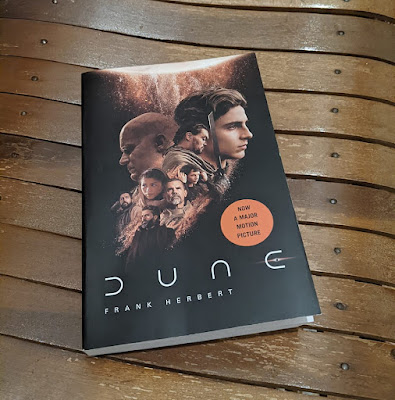
Dune by Frank Herbert


I think I'm going to feel silly saying anything at all about Dune by Frank Herbert after nearly a lifetime of hearing about it and wanting to read it; but, I've decided to go with a Q/A format. 

Warning: There may be some minor spoilers in this review. If you're planning to read Dune, soon, and don't want to take a chance of reading a spoiler, please skip down to the recommendation near the bottom of this post. 

What's Dune about?

The Emperor has instructed the Atreides family (the Duke, his concubine Jessica, and their son Paul) to leave their home planet and move to Arrakis, also known as Dune, where they'll be in charge of the spice trade. Spice is extremely valuable and it seems likely that the Baron Harkonnen, who was previously in charge of spice, will have set a few traps. 

Here's the Google description of the movies:

In the year 10191, a spice called melange is the most valuable substance known in the universe, and its only source is the desert planet Arrakis. A royal decree awards Arrakis to Duke Leto Atreides and ousts his bitter enemies, the Harkonnens. However, when the Harkonnens violently seize back their fiefdom, it is up to Paul [Kyle MacLachlan in 1984; Timothée Chalamet in 2021], Leto's son, to lead the Fremen, the natives of Arrakis, in a battle for control of the planet and its spice. Based on Frank Herbert's epic novel.

Have you seen the movie versions?

Yes, I saw the new Dune movie that only covers half of the book (almost to the page count) and then decided to watch the 1984 version, which I didn't see back in the 80s because I heard it was so awful. It definitely departed farther from the book than the new movie, which is both more accurate and a visual feast. But, in both cases the story kept us glued to the TV. 

Did the book meet your expectations?

Yes and no. It had more of a fantasy aspect than I was expecting, with the Bene Gesserit (the females often referred to as witches, of which Paul's mother, the Lady Jessica, is one) and their powers, then the rituals and rules of the Fremen (the desert people). I'm not big on fantasy but I like sci-fi and I was most interested in finding out the subtle details that can't be portrayed in a movie. So, I guess you could say I liked everything but the religious aspect, although I was fascinated by the way the author blended a bunch of religions and I definitely found myself thinking he either did some rocking fine research or simply had a huge knowledge base. 

Would you recommend Dune?

Absolutely. I know there are people who won't be able to tolerate it, for one reason or another (the somewhat confusing politics, the annoying made-up lingo), but I'm so glad to have finally read it! I felt like there was this Dune-shaped hole in my pop culture knowledge (there are a lot of other holes, unfortunately) and I found that it was an epic story with a huge depth and breadth that captured me in every form. Even as inaccurate and visually unappealing (often repellent) as the 1984 version of Dune was, the story still was compelling. 

What did you find surprising and special about Dune?

It was way ahead of its time in regard to ecological preservation. You don't get this from the movie (at least, not from the 1984 version) but the planet has at some point been ravaged and yet, in spite of being almost entirely desert, the indigenous people, the Fremen, are in the process of a plan to renew the planet that will take many, many generations. And, yet they know its value isn't in the harvesting of a single product. They also know how the spice is generated and have control over that, if need be. So, while I expected the political aspect because of what happens in the movies, I was most thrilled by the fact that it said a planet can be brought back from disaster if you have the patience and dedication. 

Did the book answer all your questions about the movies?

Yes, and then some. The one thing that I didn't get when I watched the movies was, "Why would Duke Leto take his family, his security team, and everyone else who ran their home and grounds to Arrakis if he knew spice was the most valuable thing in the universe?" Clearly Baron Harkonnen wouldn't willingly give up the planet's harvest. So, it seemed like kind of a set-up and I actually said that, as I was watching the first movie (the newer one). The book answers that question early on. Since a great deal of the book is internal and the newer movie is heavily visual, the movie does leave some questions lingering. But, there's much more to the book than either of the movies and everything was answered. 

Highly recommended - While I disliked the more fantasy-oriented aspects of Dune, it is such an amazingly detailed world and so incredibly plotted that I probably should have given it 5 stars just for the depth of detail. But, I took a point off for annoying made-up language. That's the thing I actually can't tolerate about fantasy, all the weird words and names and strange religiosity. I tend to have trouble remembering made-up language. I like sci-fi, though, and Dune is a blend of sci-fi and fantasy. So, while it will not become an all-time favorite classic for me, it was well worth the read and I still highly recommend it. At around 700 pages, it's a bit of a chunkster and surprisingly, I've come to enjoy sinking into a world for a longer time. I used to consider anything over 400 pages a chunkster and was a little terrified of those longer books. Not anymore. 

Because I like how and where the book ended, I don't plan to read any of the many sequels. However, this particular copy has an afterword by the author's son that made the continuation sound tempting. 

©2022 Nancy Horner. All rights reserved. If you are reading this post at a site other than Bookfoolery or its RSS feed, you are reading a stolen feed. Email bookfoolery@gmail.com for written permission to reproduce text or photos.

Wednesday, March 31, 2021

Retrograde by Peter Cawdron


OK, first things first. After I read Retrograde, at some point I read a couple reviews and found that some readers had been under the impression that it would be like The Martian because it's also set on Mars and there's a disaster at its core. Just forget that, right now. Retrograde is an entirely different story and it deserves not to be compared to The Martian merely because of the words "Mars" and "disaster". 

As the story opens, astronaut and micropaleobiologist Liz (an American) is hanging out in the Chinese living pod where the residents are having a great time playing games and drinking a little too heavily. Then, something happens and the woman in charge of the Chinese scientists in the Endeavor mission angrily sends representatives from other countries back to their own pods. There are 5 groupings of individuals from around the world on this semi-autonomous station (they grow their own food, produce their own oxygen, etc., but require occasional delivery of supplies from Earth). The narrator later explains why they're divided in the way they are but they've worked harmoniously together till now, apart from a few individual tensions.

What happened to cause the sudden animosity? Nuclear war on Earth. Communication with Earth has become difficult anyway because they're in retrograde, but what little they're able to discern is that many large cities have been obliterated. It doesn't actually seem to make any sense at all. If one country was the aggressor against another, why so many large targets in so many different countries? What happened? And, what should the astronauts on Mars do?

There's an immediate split into factions based on region but Liz thinks that regardless of what's happening on Earth, they need to stick together and figure out how to survive. It appears that their supply ship has sailed right past them, for one thing. When things start going wrong on the space station and people begin to die, they must rush to figure out what's happening and why and stop further damage. 

Highly recommended for sci-fi fans who don't mind a slow start -  The first half of Retrograde is more about getting to know the people and their relationships, understanding how the station works and what it looks like, and the initial question: Should we band together to deal with this challenge or split into factions? 

What happens in the latter half, when you start to understand what's happening on the station itself (not just Earth) is a plot that I found wildly implausible, although some real-life scientists are concerned about the possibility. However, I didn't care about whether or not it was implausible or felt that way (I mean . . . it takes place at a space station on Mars, which is still pretty implausible in and of itself). I was in it for this one unique story experience and in the latter half it becomes more like a thriller and a race against time to stay safe and eliminate the danger. I really loved that latter half. And, to be honest, while I had a lot of questions and kept thinking, "Are they sure there was a nuclear war or is this a test to see how they would react to such a disaster?" all my questions were eventually answered so I found the story very satisfying. 

I think I got the recommendation for Retrograde from Instagram, but I'm not 100% certain. At any rate, I enjoyed it immensely and will be looking to see what else Peter Cawdron has written. 


©2021 Nancy Horner. All rights reserved. If you are reading this post at a site other than Bookfoolery or its RSS feed, you are reading a stolen feed. Email bookfoolery@gmail.com for written permission to reproduce text or photos.

Thursday, March 18, 2021

Exit Strategy by Martha Wells (Murderbot Diaries #4)


Note: For convenience, I'm going to use "he" and "him" pronouns, although Murderbot is neither male nor female as it's a part organic and part mechanical being and therefore technically an "it". 

Murderbot is traveling again when he becomes aware that someone is in pursuit of him. And, whoever it is, they've got a well-armed and heavily weaponized security team. He'll have to use all his wits to get away from them. Then, a series of news items indicate that Murderbot's old friend, Dr. Mensah, is in trouble and it's likely Murderbot's fault for causing the devious GrayCris company problems, including exposing the cover-up of illegal activity he discovered in Book #3: Rogue Protocol

Knowing the danger, Murderbot carefully heads out to rescue Dr. Mensah. Some of the team from the original Murderbot book, whom Murderbot once saved, have gone to try to work out a deal for Dr. Mensah's release. But, there are complications. Will Murderbot be able to help them secure Dr. Mensah's release and keep the entire team safe? 

Exit Strategy is the 4th novella in the Murderbot Diaries series and it brings the story full circle yet leaves an opening for the story to continue. In fact, I read a review saying the book was originally intended to be the end of the series, although there's now a novel and another book is coming out soon (a friend who has read it says the coming release is novella length). I have the novel and the new book coming out in April, Fugitive Telemetry, is one that I pre-ordered before the end of 2020. I'm so glad I did. 

Highly recommended - Another edge-of-your-seat read. The Murderbot series needs to be read in order but they each stand alone. There are no cliffhanger endings.

I have absolutely no regrets about buying them all. None. They are so entertaining. As with all the other novellas, there's always some set-up in which Murderbot must figure out what's happening before a series of breathtaking action scenes. I loved the interaction between Mensah and Murderbot in the first book and it was very satisfying to read more of the same as they're reunited. 

I'm saving the novel for later since Murderbot books make terrific slump breakers but I confess it's been difficult staying away from the next book, this time. I really want to read on. 


©2021 Nancy Horner. All rights reserved. If you are reading this post at a site other than Bookfoolery or its RSS feed, you are reading a stolen feed. Email bookfoolery@gmail.com for written permission to reproduce text or photos.

Wednesday, January 27, 2021

Rogue Protocol by Martha Wells (Murderbot Diaries #3)


In this third installment in The Murderbot Diaries series, Rogue Protocol by Martha Wells, Murderbot (a part-human, part android who no longer works for a corporation, having been freed by his scientist friend) goes looking for answers to some nagging questions. Why did the corporation that used to own him as a Security Unit (SecUnit) abandon a terraforming project? Is GrayCris involved in more deception? If so, and they weren't really terraforming at all, what were they up to? 

As in the second book, Artificial Condition, a good portion of Rogue Protocol is set-up to the action that takes place in the last third or so as Murderbot goes through a space port and figures out how to get to its destination without drawing attention to itself. Once Murderbot arrives at its destination, it figures out a way to tag along with a group going to check out the abandoned station and, in the process, is obligated to make friends with one of the group's personal androids, Miki, who turns out to be smarter and more sensitive to nuance than expected. 

Then, the action really begins. While Rogue Protocol and the previous book spent much of the time building to the exciting scenes, it doesn't matter one bit because there's always something happening. Unexpected extra passengers on the ship that obligate poor Murderbot to cram itself into a closet, for example. There are lots of little twists and turns and plenty of grumpy humor on the part of Murderbot. I did surprise myself by predicting one of the plot twists in this one but again, it didn't bother me. I just kind of nodded to myself and kept on enjoying the book. 

Highly recommended - I bought the entire Murderbot Diaries series on a whim and pre-ordered the newest release before my book-buying ban began, so I've got more fun Murderbot reading ahead. Because most of the books are short (only one is novel length, so far; the rest are novellas) and action-packed, they make great slump breakers. Best whim ever. It was risky buying an entire series without having even read the first but I trusted my friend Alyce's recommendation and I'm so glad I did. 

©2021 Nancy Horner. All rights reserved. If you are reading this post at a site other than Bookfoolery or its RSS feed, you are reading a stolen feed. Email bookfoolery@gmail.com for written permission to reproduce text or photos.

Monday, July 20, 2020

Artificial Condition by Martha Wells (#2 in the Murderbot Diaries series)


In Artificial Condition by Martha Wells, Murderbot (a part human/part robot that is neither male or female) decides to flee the area in which it is required to stay after being freed from the watchful eye of the corporation that used to own it. Murderbot is in search of answers about what happened in the disastrous killing for which the security unit has given itself the moniker "Murderbot". Was Murderbot responsible for scores of deaths? Did it go rogue or is there more to the story?

To keep from being detected, Murderbot has to interfere with cameras, convince various spaceships to let it aboard, and figure out how not to look like a security unit. During the long, boring parts of flight, Murderbot watches videos.

The best thing about Artificial Condition is probably the relationship that Murderbot builds with a particular ship's bot pilot. I didn't know whether the pilot should be trusted or not for a good portion of the book and I liked that uncertainty.

Recommended - While it takes longer for the action to crank up in Artificial Condition than it did in the first book, Martha Wells' writing is stunning and I have no regrets about buying the entire series. I'm deliberately spacing out the reading and trying to save my Murderbot books for times when I feel myself falling into a slump. They're fantastic for breaking the spell because they're so action-packed it's almost impossible to put a Murderbot book down.

Click through to read my mini review of the first book in the Murderbot Diaries series, All Systems Red. You'll need to page down a bit.


©2020 Nancy Horner. All rights reserved. If you are reading this post at a site other than Bookfoolery or its RSS feed, you are reading a stolen feed. Email bookfoolery@gmail.com for written permission to reproduce text or photos.

Thursday, March 07, 2019

The Book of Strange New Things by Michel Faber


The Book of Strange New Things is my first book by Michel Faber. In spite of the gushing praise I read about The Crimson Petal and the White, a few years back, I haven't gotten around to reading it, yet. In this case, the book was chosen for me. My eldest son has been talking about The Book of Strange New Things for some time, now, and last year he brought his copy along when he came for a visit. I knew I was going to have to return it to him, soon, so I tacked that and a book my other son wants me to read onto my personal challenges for 2019.

In The Book of Strange New Things, Peter is a preacher who used to be an alcoholic until his wife, Bea, introduced him to Christianity when he was down and out and she was his nurse. When Peter gets the chance to travel to another planet to preach the gospel, he's excited to go and disappointed that Bea can't join him.

On Oasis, Peter's stunned to find a peaceful native population and an oddly lifeless group of humans. He quickly discovers that he's happier living with the natives. But, back on Earth, things are going from bad to worse. A string of natural disasters, shortages, and violence is exhausting Bea. Shocked by Peter's emotional distance, she begins to lose the faith that used to be so strong that she was able to share it with Peter and pull him out of alcoholism. Will Peter "go native" and stay on Oasis or will he realize that Bea needs him and find a way to return to Earth?

Recommended but not a favorite - I never saw any kind of a timeline for this futuristic story but I thought of it as another "near future" story because of the fact that the natural disasters mostly appeared to be the result of climate change and most of what happens is among the kind of events that are expected to occur within a relatively short time period if we don't effing do something to mitigate climate change. But, of course, we don't have the technology to travel to distant planets, so you just have to wild-guess at the time period. At any rate, I was not as enamored of The Book of Strange New Things as my eldest son. I found it a little too slow and lacking in conflict. Most of the conflict that exists is between Peter and Bea or Peter warring with himself. It's mild. There were times I fully expected something major to happen and got a little nervous about what might be coming and then . . . nope. I did like the ending, though, and I don't regret reading the book.


©2019 Nancy Horner. All rights reserved. If you are reading this post at a site other than Bookfoolery or its RSS feed, you are reading a stolen feed. Email bookfoolery@gmail.com for written permission to reproduce text or photos.

Saturday, July 08, 2017

Afterlife by Marcus Sakey


London, 1532: A boy with no conscience and no family has been doing anything he can to survive when he sees another boy leave a ship in the harbor. He takes the boy's place and is one of the remaining crew who resort to cannibalism when the ship is badly damaged. Then, he dies. But, he's not done, yet.

Present-day Chicago: FBI agent Will Brody searches for a killer who has already taken 17 lives. He also falls in love. Then, tragedy strikes. When Brody awakens in a world where his gun doesn't work and people are trying to kill him, he's confused. Then, he stops one of the killers and is faced with an entire band of people brandishing weapons. What is going on?

The title is apt: Afterlife is the story of what happens to Will Brody, and later Claire McCoy (his boss and lover), when they're killed and move on to an afterlife that exists in a sort of parallel dimension to what we know as life, one of many levels that overlay the living world. In this dimension, there is no electricity or other power source. Fire doesn't burn, phones don't function. But, the dead can obtain power from each other by killing. When Claire and the serial killer both die and enter this same afterlife, she is concerned and wants to take him out. But, there's a community of souls who have banded together to keep each other safe from the "Eaters", those who are hooked on the power gained from taking other lives. When it becomes clear that Claire's concerns were justified and the serial killer has become even more dangerous, can Claire, Brody, and the others find a way to stop him?

Afterlife is billed as "sci-fi" but it's hard to pin down. I have a little trouble with the sci-fi label. If Afterlife is sci-fi, so is Life After Life by Kate Atkinson, which I tend to think of as general fiction, a "What-if?" with historical backdrop, while Afterlife is similar in its creation of a world in which various lives are layered like a palimpsest but with police procedural and fantasy or paranormal aspects. What if there are different levels of afterlife for different types of death? What if there are still ways in which people can affect each other in this great beyond? And, what if doing so creates a damaging power structure? What if even the afterlife isn't the end?

Whew, lots to digest. But, the result is kind of a freaky fantasy world much like that of Joe Hill's N0S4A2, where bad souls are endowed with a dangerous power and the good must find a clever way to battle the bad and stop it from winning. If the bad wins, it could lead to an endless harvesting of souls as they arrive. The boy from London plays an interesting role that emerges toward the end of the novel but you'll just have to read it to find out where he comes in.

Recommended - A unique, surprising story that poses a fantasy of what might lie beyond our world and examines the idea that even those who appear to be horrible people might actually be good inside. The author then takes that concept and turns it into a wild ride with some gory fight scenes and a final battle between good and evil (plus a bit of travel between those post-life layers). All of this with a love story at its heart. Afterlife is a sometimes-violent rollercoaster and, in the end, satisfying. I loved the fact that you absolutely cannot predict what will happen from one moment to the next.

©2017 Nancy Horner. All rights reserved. If you are reading this post at a site other than Bookfoolery or its RSS feed, you are reading a stolen feed. Email bookfoolery@gmail.com for written permission to reproduce text or photos.