Showing posts with label History. Show all posts

Wednesday, March 02, 2022

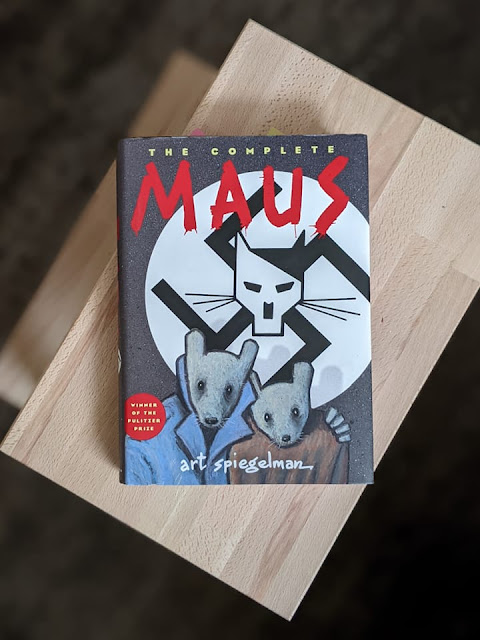
The Complete Maus by Art Spiegelman


I bought a copy of The Complete Maus by Art Spiegelman (both the Pulitzer-winning original and the follow-up in one volume) after reading about Maus's removal from a curriculum in Tennessee. I'm sure you've all heard about that if you're in the US. I've had it on my wishlist for years and at one point actually owned a copy of the original with a cover that was falling off but got rid of it without reading it during one of my book purges. At the time, I didn't know what it was about; I'd bought it used on a whim when I'd never read any graphic novels or biographies, probably out of curiosity. Then, I didn't get around to reading it. 

For those who don't know, Maus I: A Survivor's Tale is a graphic memoir about author and artist Art Spiegelman's parents' experiences leading up to and during WWII and the author's difficult relationship with his father. Art Spiegelman's father was a Polish Jew. Maus I first tells the story of how his parents met, married, and started a family as Hitler was coming into power. During the early years of the war, Art's parents either managed to find jobs, hide, or escape arrest numerous times but had many harrowing close calls. The book goes back and forth between Vladek Spiegelman's experiences and Art's determined effort to get the full story of what happened to his family, including a brother who died during the war, out of his father and try to locate his mother's diaries. 

The second book, Maus II, describes his father's experiences in a concentration camp after he and his wife were imprisoned and separated. Again, it goes back and forth in time as the author deals with his difficult father and gradually learns the complete story. 

I chose to buy The Complete Maus so I could judge its merits for myself after reading that the Tennessee school board members had complained about nudity, violence, and profanity in the book. My questions were, "How much nudity and profanity are there in the book(s)? Is anything portrayed genuinely offensive or is the storyline important enough to negate any negative aspects?"

First of all, you must know that we're talking about people portrayed as mice (Jews), cats (Nazis), and other animals (pigs were, I think, Poles who were not Jewish, but I'm not certain), except when he portrays his mother's suicide. In that case, he reverted to human images and showed a partial image of his mother's naked body in the bathtub, where she took her life. I counted a total of 7 instances in which profanity was used, all of which are words heard regularly on TV. When the Jews were forced to stand around naked, you do see tiny little man parts on the mouse bodies. And, yes, there are images of legs and feet when Nazis hanged Jews, either as punishment or for sport. All of this is less offensive than the factual horror of what the Nazis did, of course. Who cares about a few bad words and a little nudity when Maus has, as teachers say, told the historical truth of Nazi cruelty effectively?

Highly recommended - There is nothing in The Complete Maus that kids today haven't seen when it comes to the items school board members in Tennessee found offensive, and Maus is an important book, one that not only describes the Holocaust and its horrors but also portrays a difficult relationship between father and son that likely has made a lot of people with equally difficult relationships feel a little less alone. Suicide is a third topic that is addressed, although only marginally as his father describes his mother's battle with recurring depression that first began as postpartum depression. 


©2022 Nancy Horner. All rights reserved. If you are reading this post at a site other than Bookfoolery or its RSS feed, you are reading a stolen feed. Email bookfoolery@gmail.com for written permission to reproduce text or photos.

Thursday, October 29, 2020

Matrimony, Inc. by Francesca Beauman


Matrimony, Inc: From Personal Ads to Swiping Right: A Story of America Looking for Love by Francesca Beauman is the story of the evolution of personal ads, the resistance to them (via editorial articles, in particular), and why they came into being and continued with only one fairly significant gap in the growing United States. 

I found that the text was slightly clunky, which made for slow reading, yet the reasons people advertised for husbands and wives (and sometimes for less moral purposes) and how they played out were particularly fascinating. 

Starting with personal ads in the 18th Century, when there were more men than women and the odd man without social connections advertised, the book continues through the years when large cities were exploding and people found it difficult to meet likeminded people of the opposite sex or were lonely after immigrating. And then, of course, there were the men who went West to farm or seek gold and found that the only way to obtain a wife was to advertise in the big cities and hope someone would be willing to travel to join them. Matrimony, Inc. finishes with a chapter on modern dating, from the Swinging Sixties (when marriage was not the objective) to computer programs like Match.com and apps like Tinder. The bulk of the book, however, is about newspaper personal ads. 

I particularly liked reading the full story of a personal ad and how things turned out (when a marriage was long-lasting, especially), when available. Because few people kept journals or diaries in the early years of the country, there's often no way to know whether or not a match was even made, much less successful, via the earlier ads. 

The author also talks about people who used the ads for fraudulent purposes, like asking numerous applicants for money for a train ticket so the advertiser and respondent could meet (and then just keeping the money), and serial killers who advertised and then murdered. Belle Gunness is a notorious female serial killer whose gruesome story is told in Matrimony, Inc. It gave me the shivers. 

Apart from the writing style, I had only one complaint about Matrimony, Inc., and that may be amended in the final print version (my copy is an ARC): the personal ads reproduced in the book are mostly too small to read. This could have been worked around if the author had put the entire text of the ad below it (although it's nice to see them, even if you can't read them). She did often put excerpts in the text but seldom the entire ad. After a good bit of eyestrain, I decided to give up on trying to read them. However, I don't have access to the final copy so I can't say whether or not they enlarged the personal ads that are reproduced in the book. 

Recommended - Very entertaining, if not the smoothest read. I enjoyed Matrimony, Inc. enough that I'm interested in Beauman's earlier book about British personal ads, Shapely Ankle Perferr'd: A History of the Lonely Hearts Ad 1695 - 2010. I imagine that, given the delightful British turn of phrase, there could be some very interesting material in that book. 

Interesting side note: Francesca Beauman is the owner of Persephone Books in London. Cool. 

My thanks to Pegasus Books for the review copy!


©2020 Nancy Horner. All rights reserved. If you are reading this post at a site other than Bookfoolery or its RSS feed, you are reading a stolen feed. Email bookfoolery@gmail.com for written permission to reproduce text or photos.

Wednesday, October 21, 2020

Mini reviews - The People Speak, ed. by H. Zinn, Cat Knit by Jacob Grant, and Writers and Lovers by Lily King

None of these books felt like they needed a page of their own but after writing the mini reviews, I find that I wrote more than expected about all of them. Sorry about that. Bit wordy. 

I'm not going to repeat all the subtitles on this book and just leave it big enough for you to read them. The People Speak, edited by Howard Zinn, is a slim book of readings that were dramatized by well-known people at a celebration of the anniversary of Zinn's A People's History of the United States. I have not yet read the original book but figured this was a way to dip into it and get an idea of how Zinn views history after A People's History of the United States was panned by our current president. 

Each reading has an introductory part and then a writing or speech from the book, which apparently uses primary source documents. Zinn takes the actual words of either the oppressed or the oppressor, giving the reader a clear viewpoint of how those who suffered did so because they had no voice. 

The most glaring and horrifying example, to me, was a letter by Christopher Columbus in which he describes the Arawak natives of Hispaniola as generous, well-built, handsome, and unfamiliar with weapons. His conclusion: "They would make fine servants. . . . With fifty men we could subjugate them all and make them do whatever we want." He did more than that. He wiped them out entirely. 

Recommended especially if you want to get a taste of Zinn's way of viewing history without diving into the longer book. I'm looking forward to reading A People's History of the United States but I have quite a few other nonfiction titles ahead of it in the queue, so it was nice to at least get a peek at what I'll be getting into. 

Cat Knit by Jacob Grant is a picture book about a cat (Cat) with a human (Girl) who is into knitting. When Girl brings home a ball of yarn, Cat finds that it's a delightful toy and has a great time playing with it. Then, Girl takes it away and turns it into something entirely different: a sweater. 

Frustrated with the new shape of his old toy, Cat wriggles out of his sweater with the help of a branch. But, it's snowy and cold outside and once that sweater is off, Cat becomes aware of just how nicely it suited the purpose. He decides it's OK to be friends with Yarn in its new form.

Finally, Girl brings home several more colorful friends and the final image is one of Cat wearing not only his new sweater but a hat and booties. The expression on Cat's face is golden. 

Highly recommended - There are few words in Cat Knit and simple but expressive illustrations of the cat. I loved it and I'm glad I happened across this book and bought it on a whim. It'll be a fun one to read to the grandkids when I see them again. 

Writers and Lovers by Lily King is a book that I've been looking forward to reading since its release, mostly because I was so completely blown away by Euphoria. And, I liked it a lot but I didn't love it. Maybe my expectations were a little too high. 

It's 1997. Casey has had a crushing experience with a lover and lost her mother. She has been working on a novel for years. To support her writing habit, she's living in a moldy garage apartment that used to be a potting shed and working as a waitress in a fancy restaurant. Casey begins dating two different men but each comes with his own complications. 

I'm going to stop there. There are some other things going on, like the fact that Casey can't pay her bills even while living in a crappy little hovel, but I think it's worth saying what I liked and didn't like and leaving it at that. 

What I loved: Writers and Lovers could easily be used as a lesson in writing. While Casey is finishing her novel and then pitching it to an agent, you get a very good look at the craft of writing. I also liked the realism of the love triangle. It didn't feel manufactured. In fact, I was certain that Writers and Lovers is a fictionalized account of the author's own experience and when I looked her up, I found that I was likely correct. Maybe the countries she lived in were different but it sure seemed like there were some parallels. 

What I disliked: There were times I had no idea what she was talking about when Casey was at work — and I've been a waitress. I guess waiting tables isn't the same across different types of restaurant. There was also a picky detail about a health crisis Casey went through that ticked me off because it was just wrong; I've experienced it and that's not how it works. Again, I think she has likely had a similar experience but she just didn't look into how that particular thing would be handled. It's a little harder to write off mistakes when you've been through what's written wrong and know it would be pretty easy to find out the details. 

I read Writers and Lovers specifically to discuss it with an Instagram friend. She liked it a lot more than I did. We have both written fiction and appreciated the technical details about writing. When you write fiction, you will often hear that it's self-indulgent to write about writers; we'd both heard that advice. But, we agreed that she handled the characterization of a writer better than most and it didn't feel annoying in any way. The writing aspect was quite informative. 

Recommended, but not a favorite

©2020 Nancy Horner. All rights reserved. If you are reading this post at a site other than Bookfoolery or its RSS feed, you are reading a stolen feed. Email bookfoolery@gmail.com for written permission to reproduce text or photos.

Wednesday, May 22, 2019

The Free Speech Century, ed. by Lee C. Bollinger and Geoffrey R. Stone


When sovereignty resides in the citizenry, then there can be no place for the State to tell the people what they can and cannot say or hear. The process of self-government must be insulated from the intrusion of official censorship, and it is the proper role of the judicial branch to provide that insulation. 

~p. 6, from "Dialogue" in Advance Reader Copy of The Free Speech Century (some changes may have been made to the final print copy)

The Free Speech Century, edited by Lee C. Bollinger and Geoffrey R. Stone, is a book of writings on the topic of free speech published to commemorate the 100th anniversary of the first Supreme Court decision interpreting the speech clause of the First Amendment. The book opens with a dialogue between the two editors and then dives into the writings, which are divided into three parts:

1. The Nature of First Amendment Jurisprudence
2. Major Critiques and Controversial Areas of First Amendment Jurisprudence
3. The International Implications of the First Amendment

The simplest way to look at those three sections is probably to say that the earlier writings lay the foundation for the modern interpretation of the First Amendment, while the second section goes into the disputes and problems with current interpretation, and the third section (the shortest) observes how the U.S.'s First Amendment has influenced the writing of constitutions in other democracies throughout the world and examines new and coming challenges, with focus on free speech on the internet and the responsibility of social media platforms.

Up front, I have to say that I have a limited understanding of law and had to look up a lot of legal terminology. The Free Speech Century's collection of writings, though, is varied enough that I found some of them breezy and straightforward, as a layman, while others were difficult to read. But, those that were more challenging were worth the effort involved in reading and parsing. And, much like reading something like a Georgette Heyer novel, the farther you get into the reading, the easier it is to understand as you become accustomed to the language.

Among the topics are the original purpose of the amendment (to allow citizens to keep the government in check), why the amendment was considered less important till WWI upon the decision in Schenck v. the United States (written by Oliver Wendell Holmes) that the book commemorates, the judges who made important decisions and how they changed how we view free speech, America's influence on the constitutions of other democracies, current problems with the First Amendment and challenges going forward.

I marked up the book so thoroughly with flags that I ended up intimidating myself with the sheer number of quotes I found flag-worthy. Flipping through all those quotes, though, has served as a reminder of the depth of free speech topics that are covered in The Free Speech Century. I found some topics more interesting than others, of course. One that I was particularly interested in was, "The Classic First Amendment Tradition under Stress: Freedom of Speech and the University" by Robert C. Post, about the concept of speech sanctioned by a university and whether or not state schools have the right to ban speakers. That was a topic I've wondered about, since some speakers (particularly those with radical right-wing views) have recently been banned from speaking on campuses, prompting some conservatives to claim that free speech is being throttled by the universities that have banned them.

The purpose of classic First Amendment principles is to protect the process of self-government. But speech within universities does not serve this purpose. It serves the purpose of education, which requires an entirely different framework of speech regulation and protection. Speech within campus is ordinarily protected according to principles of academic freedom, as distinct from freedom of speech. [...] The plain implication is that [students'] speech may be regulated in ways that facilitate their education. [...] No competent teacher would conduct a class on the premise that all ideas were equal. 

~p. 112, from "Freedom of Speech and the University"

"Keeping Secrets" by David A. Strauss is worth a read if you have a strong opinion about recent leakers of government information because it compares the Pentagon Papers to recent leaks and explains recent leaks, like that of Edward Snowden, in a way that has been glossed over by the press. Like the argument about free speech on university campuses, it's a topic I've wondered about.

Snowden leaked because he was concerned about government surveillance programs. But Snowden, unlike Ellsberg [leaker of the Pentagon Papers], was not deeply knowledgeable about the materials he was leaking. He had no particular background or training that would enable him to evaluate either whether the government was acting wrongly or how damaging the release of the information might be. He had access to all that information not because he was an expert but because he was an IT guy.

~p. 128, from "Keeping Secrets"

Highly recommended - While the reading can be challenging, at times, The Free Speech Century is an excellent book. I learned a great deal about such things as the meaning of "clear and present danger" in relation to free speech (words first used in the Schenck decision), how Canada is getting the problem of porn as free speech right but the U.S. allows for exploitation of women and children, why free speech rights have nothing to do with what kind of speech a business considers acceptable and can forbid on its platform or from its employees, why the ACLU "features prominently, if not centrally, in most histories of the modern First Amendment," when leaked government information has been punishable or not and why, and many other topics.

Notably, I just yesterday read an article by an artist who claimed that her right to free speech was being quashed by Facebook because her art — which contains controversial images in protest of their recent usage — has led to her being banned completely from Facebook and losing not just years' of posts but, more importantly, the list of followers that help her maintain an income. I already knew that how a business chooses to regulate speech is not covered by the First Amendment, as she suggests, but I definitely gained a deeper understanding of why that's true and the historical purpose of the amendment from The Free Speech Century.

Ugh, it's hard to shut up about this book. It was definitely a terrific learning experience. I won my Advance Reader Copy of The Free Speech Century from Oxford University Press via a Shelf Awareness Drawing and I feel privileged to have read it.


©2019 Nancy Horner. All rights reserved. If you are reading this post at a site other than Bookfoolery or its RSS feed, you are reading a stolen feed. Email bookfoolery@gmail.com for written permission to reproduce text or photos.

Wednesday, February 06, 2019

Kivalina: A Climate Change Story by Christine Shearer


Climategate is emblematic of the "discourse of doubt" deliberately employed by the fossil fuel industry and its allies. This discourse sets up certainty as the only acceptable standard for acknowledging and thus acting on climate change, while simultaneously manufacturing uncertainty, to ensure such certainty is never achieved. Demanding certainty is also a deliberate misrepresentation of science, as science consists of gathering and assessing reliable data, producing replicable results, establishing areas of consensus, and building on the findings for greater understanding, while acknowledging areas in need of further research. In demanding certainty while manufacturing uncertainty, industries can forever frame the discussion as "the science is out and more research is needed," delaying regulations indefinitely even when evidence of harm and danger is overwhelming. 

~ p. 16

While downplaying and attacking government science, those opposed to regulations have also drummed up support by funding research institutes, such as the Harvard Center for Risk Analysis, that produce primarily dire economic analyses of the possible consequences of regulation. Such reports have contributed to a widespread public perception that regulation in any form is inevitably expensive [...] These analyses seldom factor in, however, the costs already borne by society due to increased sickness and disease and thus medical care, as well as environmental degradation and clean-up -- public costs that therfore act as invisible subsidies to industry. Such cost-benefit analyses also systematically downplay or ignore the value and benefits of a healthy society and healthy ecosystems. 

~ pp. 32-33

Under the New Jersey and Rhode Island courts' reading, since former lead paint manufacturers do not presently "control" the premises containing lead hazards, meaning they do not own the buildings, they are not liable -- a decision deliberately ignoring the evidence suggesting that the companies knowingly created the nuisance in the first place. 

~ p. 48

The growing understanding of anthropogenic warming has been a process of international, cross-disciplinary scientific inquiry and collaboration going back more than a century. Weather refers to atmospheric conditions including temperature, wind, and precipitation over a short period of time, while climate measures the mean (average) and variability of weather over a relatively longer period of time. The term "global warming" describes the increasing average surface temperature of the earth due to steady buildup of heat-trapping gases in our lower atmosphere, while "climate change" more fully captures the scope of the effects. 

~ p. 77

More evidence of anthropogenic warming was unearthed in the 1980s, as samples of ancient air trapped in ice cores showed correlations between carbon dioxide levels and temperature. A two-kilometer-long ice core drilled in 1985, carrying a 150,000-year record, showed carbon dixoide levels rose and fell in line with records of past temperature shifts. Records going back 800,000 years show carbon dioxide levels got as low as 180 parts per million (ppm) in cold periods and 280 ppm in warm periods, but never higher. In 1980, the concentration of carbon dioxide in the atmosphere was 340 ppm. As of 2011, it is about 390 ppm and rising at an average rate of about 2 ppm per year. 

~ p 82


First, a note. Kivalina: A Climate Change Story was published in 2011 and there is no update  reflecting what has happened since publication, although I just looked up the "current concentration of Co2 in the atmosphere" and Google tells me it was up to 405 ppm in 2017. In spite of the book's age (things are definitely changing fast), the book is still revelant because it's not just about the battle against rising water in a single island town. Instead, fully half of the book is about how corporations were allowed to grow and thrive, quickly giving them more rights than individuals, how and when human-driven climate change was first discovered and acknowledged (over 100 years ago) and how and why we have been deceived by corporations in ways that are not just damaging but deadly. It even describes how the American justice system has favored corporations over individuals, over the past century.

If you've read The Radium Girls and felt like screaming at the injustice, you'll feel the same about Kivalina. Rather than just describing climate change, it goes into other known hazards that were deliberately covered up by corporations who benefitted from the production of harmful products: leaded paint, tobacco products, and asbestos (which has never been banned and is actually making a comeback, in spite of being a known carcinogen) are the major products discussed.

The second half of the book is dedicated to Kivalina itself, a small island in Alaska. The history alone is rage-inducing. The children of Alaskan natives, now in "a small Inupiaq village that sits on a barrier reef island", were forced to attend a school where they would be taught like white people, deliberately keeping the children from being taught the traditional ways of their people, in the last century. Their school was built on the island of Kivalina in 1905, forcing families to relocate to the island. They're a people who practice subsistence living and the government tried to stop that, as well, but did not succeed. When climate change began causing the ice to melt sooner, removing protection from the island during storms and eating away at its shores, the islanders sought help relocating their population. They selected a location that works for continued subsistence. But, it turns out there is not a single U.S. government entity that has been created for the purpose of helping people relocate due to climate change.

Highly recommended - I'd like to see an update added to Kivalina: A Climate Change Story because the only articles I can find online are outdated (although there is still a website dedicated to amassing funds for a future move and info online indicates that the island is expected to completely disappear by 2025) but even slightly outdated the book serves the purpose of educating readers about how they've been deceived. It is equally fascinating and horrifying to find out just how far corporations will go -- to the point of letting people die -- to suppress important information about health and well-being in the name of making money. Everyone should read this book. It's a little on the dry side, especially in the first half. At times, I felt practically assaulted by information. But, it's incredibly well-researched, organized, and intelligently presented.

Note: I tried to adjust the color of the photo, above, and couldn't get it to come out quite right. The book is actually closer to black and white with a slightly brownish tinge -- nowhere near as brown as it looks. I bought my copy of Kivalina: A Climate Change Story from Haymarket Books.

And, just FYI, Haymarket Books is currently having a sale on books on "black liberation". I placed an order so I can have some reading material for Black History Month and thought that was worth sharing (black liberation titles are 50% off). I can't wait till they arrive! I've been very happy with all of the Haymarket titles I've purchased.

©2019 Nancy Horner. All rights reserved. If you are reading this post at a site other than Bookfoolery or its RSS feed, you are reading a stolen feed. Email bookfoolery@gmail.com for written permission to reproduce text or photos.

Thursday, January 31, 2019

Fighting Fascism: How to Struggle and How to Win by Clara Zetkin, Ed. by Mike Taber and John Riddell


Fighting Fascism: How to Struggle and How to Win by Clara Zetkin is a series of writings about fascism. Clara Zetkin wrote the main work in this book in 1923. At that point in time, Mussolini had been in power for 4 years and fascism was spreading. Zetkin, a Communist, had a plan. She first described the elements of fascism and the spread of fascism in Italy. Notably, fascism always begins with the frustration of the working class -- exactly what led to the election of Trump, who has been compared by those who study fascism to hisorical fascists (there's a little about this in the introduction). Zetkin pointed out where the fight against fascism in Italy had gone wrong, what the fascists promised and how their promises had not only fallen flat but often rights were taken away, workers' hours made longer and pay reduced, the rich became richer and corporations more corrupt, promises were broken consistently.

Zetkin suggested that people needed to be educated about fascism at all levels and that the masses needed to unite in protest and prepare for violent response by fascists, who were already killing and imprisoning those who spoke out against them. She said ideology and politics were less important than unity -- that it would take a strong, united front to defeat the growing movement.

Unfortunately, the text (and notes) eventually goes on to describe how her platform was adopted and then rejected. The movement splintered and weakened as a result. And, just after her last speech, where Nazis were waiting and wanted to kill her (she was ill and nearly blind), she died. That was 1933. We all know what happened after that point.

Zetkin stressed that it would be easy for most people to just keep their heads down and try to get through fascism but defeating fascists can't work without strength in numbers. And, then she had to watch her predictions come true.

Highly recommended - Important reading during a time of upheaval such as what we're currently going through. Sad from a historical viewpoint but also very informative. I'd like to see this particular book written in more common language, so that people who don't understand words such as "proletariat" and "bourgeoisie" could understand it. Zetkin herself recognized that peasants in Germany and elsewhere would not understand the terminology and one of her suggestions was to print brochures and books that would explain fascism and how to fight it for all levels of education.

It's pretty amazing that Clara Zetkin survived to die of old age. There's a glossary of important characters and organizations in the book and many of the characters described were killed for their activism.

I bought Fighting Fascism from Haymarket Books (along with 3 other titles). I've been so impressed with the 3 I've read, so far, that I'm hoping to buy more from them in the future.


©2019 Nancy Horner. All rights reserved. If you are reading this post at a site other than Bookfoolery or its RSS feed, you are reading a stolen feed. Email bookfoolery@gmail.com for written permission to reproduce text or photos.

Wednesday, January 23, 2019

Soon by Andrew Santella


The virtual-world distractions that tempt us at work -- tweeting, online gambling, fantasy sports, online shopping, porn, Pinterest, clips from last night's Conan -- have inspired a neologism: cyberloafing. [...]

The drive to eliminate such distractions has produced a small industry of software, surveillance technologies, and apps with names like Concentrate! and Think. There is money to be made in protecting ourselves from our impulses. Among the acknowledgments for her novel NW, Zadie Smith thanked the Internet-blocking apps Freedom and SelfControl for helping free her from distraction. 

[p. 160]

Soon: An Overdue History of Procrastination, from Leonardo and Darwin to You and Me by Andrew Santella is just what it sounds like from its lengthy subtitle. It's a history and an entertainment, but also a look at the positive side of procrastination. Santella describes at length, for example, the many years that Charles Darwin spent studying barnacles after his voyage on the Beagle led to the theory of evolution that would later be written about in On the Origin of Species. In fact, there's a full twenty-year span between the publication of The Voyage of the Beagle (which, incidentally, I read about twenty years ago, maybe longer) and On the Origin of Species (which I have not -- although I'm not equating my procrastination with that of Darwin). Could that delay have allowed Darwin time to refine his theory while he took long walks around the private path he built in his yard and examined barnacles? This is the kind of avenue Andrew Santella leads you down.

The one thing Soon is not: a book on how to avoid procrastination and become more productive. In fact, the author goes into the history of productivity and how a single man with a timer ended up being the founder of all that misery-inducing emphasis on doing things faster to increase the bottom line. The author also mentions cases (besides Darwin and his barnacles) in which procrastination may have led to better results in the long run. If anything, it's a paean to the joys of procrastination.

Recommended for those interested in a light read on the history of procrastination - If you're looking for a book on how not to procrastinate, I recommend The Procrastination Equation by Piers Steel, PhD, an author and researcher who is casually mentioned in Soon. I reviewed The Procrastination Equation in 2011 and have meant to reread it but I've put it off. Haha. The link through the first mention of the title will take you to my review and it's worth adding that the author took my advice in my review of The Procrastination Equation, so there's now some form of summary card in the book. Soon is written with a lighthearted touch and I enjoyed it mostly for the change of pace. I found myself reading passages aloud to my husband, so that gives you an inkling of how much it interested me. I seldom read aloud from non-fiction books unless I find something either fascinating or entertaining enough to consider it worth sharing (partly because Huzzybuns won't listen if I read passages too often).

There is, in fact, a passage that I think is worth mentioning because I disagree with it so strongly:

For me, and I bet for most procrastinators, the whole point of the to-do list is that it enhances the satisfaction in blowing something off. If you didn't first list the thing you are now putting off, you might not ever realize that you weren't doing that thing. And where is the fun in that?

[p. 75]

Au, contraire, Mr. Santella. I'm an inveterate list writer and I write lists for the purpose of reminding myself what needs doing (because, frankly, I'm an airhead) and for the satisfaction of placing a little checkmark beside each item completed. I cannot even begin to imagine taking joy in writing a list and then blowing off everything on it.


I received a copy of Soon in return for an unbiased review from HarperCollins. Many thanks!

A note on the updated mention of ARCs. I have, in the past, felt like there's no need to mention the fact that I receive an ARC from a publisher within the review post because I post photos and sources of every book that arrives on my doorstep in my Monday Malarkey posts and I thought that enough to fulfill the obligation to mention the source of a book for purposes of the FTC requirement (so I will have mentioned receiving an ARC from the publisher before I review it). However, one of the publishers for whom I review has recently sent a letter insisting on such mention within a review post, at risk of being removed from the review list. OK, fine. I'll mention the source of each book I receive from a publisher. I don't know if I'll bother saying, "I checked this one out from the library!" or "This book was a purchase bought because some irresponsible blogger/twitter/Instagram friend told me it was great." If you're interested in knowing the source of every book, let me know and I might mention them all, for fun. We shall see.

I've mentioned the reason I blog, in the past, but this seems like a good time to restate that. I started a book blog because I needed a place to spill about the books I'm reading, for better or worse. Whether I love a book or hate it, you'll know how I feel. I'm not paid, although I do receive books from publishers in return for an unbiased review, and I have chosen not to allow any advertisements on my blog because I want it to remain what it was when I started blogging in 2006 -- a place where I can write freely about how books make me feel. It also used to be a place where I shared my photographs and told anecdotes about the kids, but the damn kids grew up and moved away, cutting off my access to some really great material (I loved having kids around, I confess --  Empty Nesting was hard). At any rate, my purpose hasn't changed. I will always need some sort of writing outlet, whether here or elsewhere, and blogging has served that purpose for a dozen years, now.

Also of note, the watch I used as a prop in the photo of Soon served two purposes:

1. To reflect the passage of time (as it related to putting off tasks) and
2. To cover the bite marks in the cover because a naughty kitty chewed on the book.

Cats. Who gets 'em.

©2019 Nancy Horner. All rights reserved. If you are reading this post at a site other than Bookfoolery or its RSS feed, you are reading a stolen feed. Email bookfoolery@gmail.com for written permission to reproduce text or photos.

Wednesday, August 22, 2018

Six Weeks in the Sioux Tepees: A Narrative of Indian Captivity by Sarah F. Wakefield


Six Weeks in the Sioux Tepees by Sarah F. Wakefield is the memoir of a woman who was held captive during the Dakota War of 1862, a war between Native Americans and the whites occupying their former lands. Author Sarah Wakefield describes how she was captured and imprisoned after describing the lead-up to the war. She talks about why she chose to wear native clothing during her captivity and behaved the way she did (acting as if the natives were her friends, working with them, speaking only positively about them), and defending the native man who kept her safe.

Wakefield wrote her narrative primarily to explain herself because she was criticized and ostracized for defending Chaska, the man who protected her and was arrested because he stayed behind when she and her children returned at the end of the war (he stayed with them to make sure they were safely delivered home). If only for the fact that Sarah Wakefield was rare in defending her captors, the narrative is interesting. She had a unique perspective, having lived near the natives for a time and already knowing their language. She was also well aware of what the natives had given up -- land and their ability to subsist on it -- and the fact that the government was very late delivering the promised food and money they were to receive in return for their land. She knew they were starving and angry; the uprising was not entirely unexpected.

Recommended - While the writing is a bit awkward, the book contains a lengthy introduction that's nicely explanatory and copious notes that also help clarify much of what the author talks about. I saved the introduction for last and I'm glad I read it that way because I preferred to read the author's explanation of events first, more detailed description later, although there's really only one possible spoiler if you don't want to know how things ended up in advance of reading the author's description. It's a sad story. I'd never read anything at all about the Dakota War, nor had I even heard of it, but I found it admirable that the author was willing to defend her captors in the face of the "Let's kill all the natives" frenzy that happened after the war ended.


©2018 Nancy Horner. All rights reserved. If you are reading this post at a site other than Bookfoolery or its RSS feed, you are reading a stolen feed. Email bookfoolery@gmail.com for written permission to reproduce text or photos.

Wednesday, August 15, 2018

Unpunished Murder by Lawrence Goldstone


OK, bummer. I've been staring at the computer screen because I feel like Unpunished Murder is so important that I want to get it right, but the pressure is making me draw a blank. So, I'm going to make this review a self-interview to see if I can get the words out. Today, I will be interviewed by a Sharpie pen. It's the handiest thing.

Sharpie Pen (SP): I'd rather be writing.

Bookfool (BF): Me, too, but it's not going well.

SP: Well, then, shall we?

BF:  Yes, please.

SP:  Tell me about Unpunished Murder. Who was massacred and where is Colfax?

BF:  Colfax is a town in Louisiana that was founded in 1869. In 1873, a white supremacist militia attacked the town, the home of former slaves or "freedmen". About 100 blacks and 3 of the white militia members were killed, most of the blacks gunned down after they surrendered.

SP: And, why are you having so much trouble describing this book?

BF:  I think I waited a little too long and should have written about it immediately, like the moment I closed the book. Having said that, the book describes a fairly complex background situation.

SP: What was complex about it?

BF: It goes into details about Reconstruction and the balance of political parties, the choice of a white supremacist for vice president, the slow changeover from Abraham Lincoln's party to domination by the Democrats (who were then the party of white supremacy) and how that change of party balance altered the course of Reconstruction, closed off legal rights that freedmen had obtained, and led to the rise of white supremacist groups and state laws that restricted black rights. It goes into some detail about states' rights and laws versus federal and the why federal law was not always enforced.

Basically, the slaves were freed and the Southern whites were angry but Reconstruction was on the road to being a positive thing and blacks were happily exercising their new rights. And, then the political pendulum swung, rights were suppressed through violence and intimidation, and lawlessness and cruelty took over. I guess it's a bit complex to me because so much of it is new. I'm a fan of history but I really never have read about Reconstruction, apart from snippets saying that it was a disaster. The author argues that Reconstruction was not quite what many historians have claimed. I feel like I need to reread it for the details to fully sink in, to be honest.

SP: What's the point of the book?

BF: The dual goal is both to spread the true story about what happened in Colfax (an incident I, for one, had never heard of) and to set the record straight about the fact that this particular incident was stone cold murder. Toward the end of the book, the author talks about how the slaughter of 150 black men was reframed as a riot, the whites declared heroes, and even a monument dedicated to the white murderers placed in the town.

SP: What else does it describe?

BF: It goes into great detail about how and why only a few of the men responsible for the slaughter were tried and then, eventually, nobody was punished. One man even went on to murder again and was still not brought to justice. In fact, he ended up being quite prosperous.

SP: You mentioned in one of your Monday Malarkey posts that you didn't know the correct age range for Unpunished Murder. Have you found out who the book is geared toward?

BF:  Yes, the author kindly wrote to me after he happened across my post and he clarified the age range. He said it's geared to high school, "maybe higher middle school for more advanced readers".

SP: You found it a challenging read. Why?

BF: Two reasons. So much of the information was new to me that I had to take my time to keep the political strands straight. I don't know if my education in history was awful or I just memorized instead of absorbing the information, as a kid, but till recently I'd forgotten that the parties flipped and Democrats used to be dominated by white supremacists. I found my brain didn't want to accept Republicans as the people who were trying to make sure freedmen were able to function in white society -- attend schools with whites, vote, etc. Anyway, that was the first reason.

Reason 2 is the fact that it's such a distressing story. Much like women's history (men getting credit for women's accomplishments), Black history has been rewritten or suppressed for far too long. It was only a handful of years ago that I found out about another incident, the so-called Tulsa Race Riot. That, too, was not really a riot at all but a slaughter. There are loads of contemporary illustrations and some of them describe blacks in horrifyingly demeaning terms. Reading about cruelty is miserable. Realizing that we haven't progressed that much is even more deflating. Now and then, I had to put the book down and just catch my breath. But, toward the latter half of the book I was so gripped by the story of how a bunch of men got away with murder that I stopped setting it down and read late into the night. Obviously, I knew how it was going to end (thank you, obvious title) but I had to know how and why. I knew I wouldn't get to sleep till I'd finished.

SP:  So, what's your recommendation?

BF:  I highly recommend Unpunished Murder and feel like it's a very important book -- one that needs to be taught, shared, and talked about. I'll pass my copy on to a school so that more people will have access to it because I feel like it's so necessary for as many people as possible to really understand this terrible tale from our American history.

SP: Any final remarks?

BF: Here's a website where you can read a little about the Colfax Massacre:

BlackPast.org - The Colfax Massacre

Any mistakes in my review are my own. In spite of living for decades in a city whose downfall was an important turning point in the Civil War, I honestly haven't read much about the Civil War. My lack of understanding was definitely brought home while I was reading Unpunished Murder.

SP: Thanks for the fun. I'm going to go hang out with a scratch pad and some googly eyes, now.

BF: These self-interviews really expose me as the knife in the drawer that fell into the garbage disposal, don't they? Thanks Sharpie Pen. You're an inanimate object and yet you managed to help. Amazing.


©2018 Nancy Horner. All rights reserved. If you are reading this post at a site other than Bookfoolery or its RSS feed, you are reading a stolen feed. Email bookfoolery@gmail.com for written permission to reproduce text or photos.

Wednesday, May 16, 2018

Boots on the Ground by Elizabeth Partridge


Boots on the Ground by Elizabeth Partridge is a book of personal stories about people who served during the Vietnam War interspersed with narrative about events that were occurring during the conflict, particularly what was happening within the government: how the serving presidents reacted to various developments, as well as how the war started, grew, and ended with the fall of Saigon.

Boots on the Ground ends with the dedication of The Wall, the Vietnam Memorial in Washington, D.C., and I found that quite interesting. I'm old enough to remember the competition for the design of The Wall and the controversy over the chosen design. In fact, I recall being disappointed in it and I'm aware of how my opinion has been altered over the years by the many deeply emotional photos I've seen of people finding the names of their loved ones and friends on The Wall. The description of the creator's design and what she meant to show, coupled with the reactions of those who tell their stories (including their experiences viewing the wall at the dedication) show just how important that memorial was, and is, to veterans and their loved ones and how the dark granite worked in exactly the way the young designer envisioned. It was quite moving.

While the publicity material says Boots on the Ground is for 7th grade and up, I learned quite a bit. Most of what I've read about the Vietnam War (or, in the case of novels, set during the war) has had some context but not a full overview of the war. It's still not a comprehensive history. When she talks about 1968, for example, one of the assassinations that took place isn't mentioned. But, the way the author interrupts each individual's story with a chapter about what was happening in America and why the war continued to drag on offers readers an exceptional sense of time and place. It's not meant to be a full account of the war; it's meant to be a set of personal stories told within their context and in that, the book succeeds.

The only thing I disliked about Boots on the Ground was the fact that each of the individual stories (from personal interviews) ended abruptly. At the end of the book was a description of what those individuals did after returning from the war, but the author could have put those single paragraphs at the end of the chapters instead of separating them and it would have made more sense, to me. At any rate, you have to flip to the back of the book to get a sense of completion. But, Partridge brings all their stories together at the memorial dedication, so once you get to the end you understand why she left each story hanging -- they weren't finished.

One of the personal stories was that of the man who came up with the idea for creating a memorial during a drunken night of depression. That man, Jan Scruggs, knew he needed some sense that the people he saw die were acknowledged and that other veterans of Vietnam must feel that way, as well, so when he came up with the idea he ran with it. And, the gist of the ending is that it worked, it was needed, and it helped people heal.

Highly recommended - Definitely a terrific read and incredibly moving, packed with photographs and with a lengthy bibliography for those who want to explore the topic further. I only took a half point off at Goodreads for the fact that Boots on the Ground felt so jumpy. I didn't like having to flip to a section at the back of the book to find out what became of each individual, but the author did tie everything up. Among the personal stories was one of a Vietnamese family's escape from Da Nang when the North Vietnamese invasion was taking place. It was harrowing and would make an excellent movie, in my humble opinion. Others told about a nurse who absolutely didn't want to end up in Vietnam but was misled by her recruiter into believing she wouldn't be sent there and an Asian American who had to stay on guard at all times for fear he'd be mistaken for the enemy. A very emotional read that gives readers, young and old, a good sense of what it was like to serve in Vietnam (or escape from the country) within the context of the time period.


©2018 Nancy Horner. All rights reserved. If you are reading this post at a site other than Bookfoolery or its RSS feed, you are reading a stolen feed. Email bookfoolery@gmail.com for written permission to reproduce text or photos.

Wednesday, May 02, 2018

Rocket Men by Robert Kurson


Rocket Men: The Daring Odyssey of Apollo 8 and the Astronauts Who Made Man's First Journey to the Moon by Robert Kurson is the true story of the first mission in which Americans orbited the moon, Apollo 8. I knew very little about Apollo 8, although I'm old enough to remember the first moon walk and (as is made clear in the book) it obviously had to have been a success or man would not have made it to the moon before the end of the 1960s.

What I didn't realize was that Apollo 8 didn't appear likely to happen as planned, after several failures large and small set the program's timescale behind President Kennedy's goal for getting man on the moon by the end of the decade. Kurson evaluates the mission itself, how it was sped up to meet the dual goals of beating the Soviet Union to the moon and reaching the moon in time to keep on track with Kennedy's goal, the lives of the astronauts who flew Apollo 8 and their wives, and what happened to those families after Apollo 8 ended.

Rocket Men was very good, really quite gripping, which surprised me since I already knew Apollo 8 was successful. In spite of the fact that Kurson made it clear it had to have been a success, the author still managed to give the story an edge-of-your-seat sensation. I'm not even sure how he did that. The pages absolutely flew.

Kurson also talked a great deal about the astronauts and their wives because they are all still alive and happily married, which is unusual. He was partly drawn to Apollo 8 when he discovered that it was one of the few successful missions in which all of the astronauts were fully supported and remained married to their wives (to this day -- as of the ARCs printing, all were still alive). That's notable because astronauts had such time-intensive jobs that broken marriages were common. Humorously, all the way through the book, before he mentioned the marriages as a particular oddity, I kept telling my husband I thought his job was bad enough with all the travel and I'm pretty sure I could absolutely not have coped with being an astronaut's wife, having to deal with having reporters camped out on your lawn and photographing you in your own home (each had a contract with LIFE magazine, which often meant a reporter and photographer sitting right there with you in your house during important moments - ugh).

So it was interesting that the author had a reason for choosing the depth of description about the individuals -- how the couples met and married, how the women felt about their husbands' travel and that particular mission, what the women had to put up with as wives and how they banded together or, at least once, insulted each other by refusing to do so, the early years of each astronaut's life and how his childhood influenced the ultimate decision to become an astronaut, what their lives were like after Apollo 8.

Highly recommended - Rocket Men is one of those rare nonfiction books in which the pages flew, my heart pounded, and I sometimes found myself actually leaning forward in anticipation. Amazing that the author managed to make something that happened nearly 50 years ago so exciting. And, certainly a book that gave me an even greater appreciation of the engineering field. Such precision in the calculations of when various events would happen still boggles the mind. I haven't read a great deal about NASA or the Apollo missions but I'm intrigued and want to read more, now.


©2018 Nancy Horner. All rights reserved. If you are reading this post at a site other than Bookfoolery or its RSS feed, you are reading a stolen feed. Email bookfoolery@gmail.com for written permission to reproduce text or photos.

Wednesday, April 04, 2018

Princesses Behaving Badly by Linda Rodriguez McRobbie


Princesses Behaving Badly by Linda Rodriguez McRobbie is a nonfiction book with short biographies of princesses real and fake (apparently, pretending to be a princess is a thing) across many centuries. It's divided into the following sections:

Warriors: Princesses who fought their own battles
Usurpers: Princesses who grabbed power in a man's world
Schemers: Princesses who plotted and planned
Survivors: Princesses who made controversial and questionable choices
Partiers: Princesses who loved to live it up
Floozies: Princesses notorious for their sexy exploits
Madwomen: Princesses who were likely mad, or close to it

Some of those categories interested me more than others and some princesses were more interesting or appealing or weird or just plain fun to read about than others. I enjoyed reading about Hatshepsut, for example, because I'd read about her being erased from Egyptian history and then rediscovered later but knew very little about her, beyond that. Rodriguez McRobbie explained the erasure in a different way than I'd read about in the past and I learned a lot more about the actual person. Princess Margaret's story was interesting, too, as I knew she was always considered a troublemaker and a jealous sister but apparently I didn't pay much attention to the details of her life. For those who aren't familiar with her, Princess Margaret was Queen Elizabeth II's younger sister.

It took me a while to get into Princesses Behaving Badly because of the writing style, which is a bit dry and inaccessible (and slow). I didn't consider abandoning it, but I just wasn't enjoying the book, at first, and then at some point I realized what it's problems were and got used to the pace. Then, I started to enjoy reading about the princesses and the courageous, evil, crazy, etc., things they did. I looked up a few of them online to see images or photographs of them and some of them interested me enough that I'd like to read more about them. A handful were people I'd read about peripherally and got to know a little better and some were the wives of famous men I was familiar with (the Prince Regent, namesake of the Regency Period, for example).

My biggest problem with Princesses Behaving Badly is the problem I had, In general, with history in school. History requires a bit of storytelling flair to be fully accessible, in my humble opinion. Throw too many names, dates, and/or locations at a person (at least, this person) and it all just goes over their head. Occasionally, this author would not only throw in a date where the age of the princess would have done, but then would also give her age in the next paragraph when referring to something that happened at another time, so that you knew her age in one case but not the other. Sheesh. Just tell the reader how old the heroine was when each event happened, rather than make us subtract to figure it out. Even saying, "When Ignatia was 27, in 1543, the ceiling fell on her head" would have worked fine and added few words. The result is a bunch of bios that alternately make your head hurt and mesmerize.

Recommended hestitantly - I enjoyed Princesses Behaving Badly more, the farther I read. But, I still found it stiff and dry. It could have been a much more interesting book. So, mixed feelings on this one but I would say if you like reading about women who broke the mold and don't mind a book of historical bios that's a bit slow, go for it. Just don't expect sparkling descriptions and a quick read. 


©2018 Nancy Horner. All rights reserved. If you are reading this post at a site other than Bookfoolery or its RSS feed, you are reading a stolen feed. Email bookfoolery@gmail.com for written permission to reproduce text or photos.

Friday, January 26, 2018

Forty Autumns by Nina Willner


First sentence:

I was five years old when I learned that my grandmother lived behind a curtain. 

Forty Autumns: A Family's Story of Courage and Survival on Both Sides of the Berlin Wall by Nina Willner is the story of a large German family, from just after the end of WWII to the present day, with emphasis on the four decades that the family was split apart by the Iron Curtain.

Only one child in the family managed to escape East Germany and it took her three attempts. While Hanna got a job in the West and was able to advance at work and eventually marry and move to the United States, the rest of her family lived through hardship and desperation, often hungry, standing in line for hours to obtain necessities, always in danger of being arrested if a neighbor or friend suspected them of saying or doing something subversive against the government. The author, Nina Willner, is one of Hanna's children.

The book begins with the end of WWII in 1945 and the division of Berlin. While families waited for the men to come home, American, British, and Soviet troops divided Germany. There were rumors of atrocities committed by the Soviets, so when the American troops pulled out of the area where Hanna's family lived, some German citizens either left with the soldiers or tried to send their daughters away.

The reality of Soviet occupation and what was to come was immediate. Everyone was told they must turn in all their food to be equally divided and anyone who hid food would be shot. But, the food was never divided and redistributed as promised, so the Soviets brought hunger. That was just the beginning of life in East Germany. Forty Autumns is a well-rounded family biography that takes you through the entire 40 years, till the family was finally reunited after the fall of the Berlin Wall, including the years that the author worked as a U.S. Army intelligence officer serving in Berlin during the Cold War. There are some tense scenes in which she describes various missions into East Berlin.

Highly Recommended - History buffs and fans of memoir, particularly anyone with a fascination for the Cold War, will enjoy this meticulously researched story of a single family in which the author compares and contrasts life behind and outside the Berlin Wall. Included are maps, a Family and Historical Chronology (a comparative timeline that shows what was happening historically and within the author's family), photographs, and epilogue describing what's happened since the fall of the wall, an extensive bibliography, and index.


©2018 Nancy Horner. All rights reserved. If you are reading this post at a site other than Bookfoolery or its RSS feed, you are reading a stolen feed. Email bookfoolery@gmail.com for written permission to reproduce text or photos.

Wednesday, July 05, 2017

Mini reviews - On Tyranny by T. Snyder, Simon and the Homo Sapiens Agenda by Becky Albertalli

It's time to play a little catch-up and, since I've already reviewed almost all of the ARCs I've read, I'm going for mini reviews of those I have not. Afterlife by Marcus Sakey is the only remaining ARC I need to review and I'll give it a full post.

On Tyranny: Twenty Lessons from the Twentieth Century by Timothy Snyder is a book that is meant as a guide for how to behave with an authoritarian in power. While the author didn't mention our current American president by name a single time, he did refer to him on occasion in generic terms. Some examples of the "lessons":


  • Do not obey in advance.
  • Defend institutions. 
  • Beware the one-party state. 
  • Believe in truth. 
  • Contribute to good causes.
  • Be kind to our language. (This chapter includes an exceptional list of recommended reading material to offer additional perspective, as well as some advice readers will love: "... get the screens out of your room and surround yourself with books").
  • Be as courageous as you can.


Before I read On Tyranny, I read some reviews at Goodreads and discovered that it made a few readers burn with anger at the perceived comparison of our current president to the well-known German authoritarian who slaughtered 6 million + people. So, I was watching for direct comparisons. There are none. Not one. There may be comments about behaviors that the latter exhibited and the former is now also showing, but no claims that one is becoming the other. I watched an interview with the author (on video; unfortunately, I don't recall which organization it was that interviewed Snyder, but I expect there are a few available online) and he was pretty clear that comparing 45 to a specific tyrant was not his goal. I highly recommend looking up interviews with Snyder if you intend to read the book.

While not the easiest read, I thought Snyder had some excellent advice, offered from a purely historical perspective, and I plan to reread it soon to help solidify what I learned. It's a quick read, just 126 pages and the book is smaller than a mass market paperback.

Highly recommended to those concerned about today's political climate and certainly not limited to one or the other side. It does help if you take off your red- or blue-tinted lenses and try to remain neutral. Read it for a viewpoint colored by history, not politics.


Simon vs. the Homo Sapiens Agenda by Becky Albertalli is the story of a teenager who has developed an email friendship with one of his classmates. He doesn't know who the classmate is; all he knows is that they're both gay and talking to the friend he calls "Blue" is helping him come to terms with his homosexuality. What he wants most is to find the strength to come out.

Unfortunately, a fellow by the name of Martin has gotten a peek into Simon's email account and now he's blackmailing Simon. If Simon won't help Martin get together with the girl Martin admires, he'll spill the beans about Simon's sexuality. Will Simon summon the courage to come out to more than an anonymous friend? Will Martin give away Simon's secret before he's ready? Who is Blue?

I loved absolutely everything about Simon vs. the Homo Sapiens Agenda. It's a good book that's well paced with a lot going on, great characters, a mystery (Who is Blue?) and high stakes. It's also a book that treats its characters and their emotions with tremendous respect.

Highly recommended - The timing was pretty awesome. I chose Simon, etc. because it was calling to me without considering the fact that I was starting a book with an LGBTQ character right as Gay Pride Month was beginning. It wasn't till I was in the middle of the book that the timing occurred to me. At any rate, it's a good read for any time of the year.


©2017 Nancy Horner. All rights reserved. If you are reading this post at a site other than Bookfoolery or its RSS feed, you are reading a stolen feed. Email bookfoolery@gmail.com for written permission to reproduce text or photos.

Tuesday, February 28, 2017

March, Books 1-3 by John Lewis, Andrew Aydin, and Nate Powell


I read two of the March graphic memoir series in January, took a break, and finished up the third in February, which feels like pretty nice timing because of Black History Month. I wasn't thinking about Black History Month when I bought them, though; the purchase was really a reaction to our current president's bizarre tweets about Lewis, a man of action who did not deserve the lack of respect shown to him. I knew about the March series, but had put off buying them until then.

I'm not going to go into the details of what each of the books covers individually because the truth is, I don't entirely remember and I don't think that the details are all that important. What's most important to know is that the three books, basically a biography and history set in graphic form, describe John Lewis's early years, why he was inspired to get involved in the dangerous fight for civil rights, the progress of the Civil Rights Movement over many years, how participants were trained in peaceful protest, and the final results.

When I read March, Book One, I'm not sure exactly what I was expecting but it begins with John Lewis as a child, the hardships he endured, his sheer determination to acquire an education, and his fiercely independent temperament. Even as a boy, he was courageous. A parallel story is shown, the story of John Lewis attending Barack Obama's inauguration. The final book ends with the signing of the Voting Rights Act on August 6, 1965 and a final scene in which, after President Obama's inauguration, Lewis says he's been thinking about that comic book idea . . . the book you hold in your hands, of course. Wonderful ending.

Highly recommended - I was surprised at how many times I got a little teary and had to set aside the books to take a break. The amount of violence peaceful protestors had to endure for years honestly shocked me -- and I lived through that time! Granted, I was quite young and there was no such thing as Black History Month when I was in school, but I've seen plenty of film clips, over the years. I don't think I'd ever mentally stitched them together and that's what this series is good for. Especially when read back-to-back, you get a genuine sense for the endurance and determination that was required as activists made baby steps toward their right to vote. The only problems I had at all with the books were that sometimes I couldn't follow what was going on in a particular frame or set of frames (a problem I always have with graphic novels) and some of the details about the various organizations that worked together or in opposition to each other (but for the same goal) got mixed up in my head. There were quite a few of them and the meetings they held could be kind of dull, yet they served a purpose as things were not static; they had to constantly adjust to the reactions of those around them. In general, I was impressed and I'm hoping to insert a bit more black history into my reading life because I clearly am lacking in that area.

Important addendum: A lot of people were talking about the March books when I bought the set (I got the slipcased set of all three) and a couple people I know mentioned having read the first book but not the rest, so I was a little surprised to find that the ending of the first March book is a bit of a cliffhanger. They are definitely not meant to stand alone. The series together tells a complete story and I recommend reading them close together, if you can.

©2017 Nancy Horner. All rights reserved. If you are reading this post at a site other than Bookfoolery  or its RSS feed, you are reading a stolen feed. Email bookfoolery@gmail.com for written permission to reproduce text or photos.

Wednesday, February 15, 2017

The Wars of the Roosevelts by William J. Mann


I've always been fascinated by the Roosevelt family, so it was a no-brainer that I'd want to read The Wars of the Roosevelts: The Ruthless Rise of America's Greatest Political Family by William J. Mann when it was offered to me for review.

The Wars of the Roosevelts is about the infighting within the Roosevelt family that went on for decades, including both political backbiting as well as the horrible things they did to each other personally in the name of rising to political power. Warning: This is a long review because I shared a few things I found fascinating. It's not as general as my normal review. Feel free to skip down to my recommendation, near the bottom of the post.

The Wars of the Roosevelts begins with Theodore Roosevelt's concerns about his brother, Eleanor Roosevelt's father Elliott. Elliott and his wife were the partying type and Theodore was concerned that Elliott and his wife Anna's exploits would interfere with his political aspirations.

After Elliott was rude to guests at a party thrown by Theodore's "chief booster and unofficial adviser," Bye, Theodore said, "I am distressed beyond measure."

[...] Theodore was keenly aware of decorum and discretion, as any man with his eye on the presidency would be. He knew careers could be derailed in the drawing rooms of New York society, where Elliott and Anna had made themselves infamous. People would be very reluctant about backing a candidate with a black sheep such as Elliott in his family.

~fr. pp. 10-11 of Advance Reader Copy of The Wars of the Roosevelts (some changes may have been made to the final print version)

It's notable that every generation and every branch of the family managed to cough up at least one black sheep. The author goes on to describe the years of Theodore's attacks on Elliott -- how he constantly tried to separate Anna and Elliott and repeatedly attempted to have Elliott locked away in sanitariums for "moral insanity". The author talks about the impact Theodore's cruel ambition had on Eleanor, who was an outcast even when staying with Theodore's family, the Oyster Bay Roosevelts, and how his determination to physically challenge his own children affected their lives.

In addition to direct family ties, the author also follows the progress of Elliott's illegitimate child, also named Elliott, who was never acknowledged by the family but who was every bit as intelligent and ambitious as the relatives he never got to know. There's a very satisfying conclusion to his story, late in the book.

I have a dozen flags marking passages in The Wars of the Roosevelts. I found it utterly fascinating, not only for the in-depth view of the Roosevelts but also for the political insights. For one thing, I was completely unaware that Progressives were originally a faction of the Republican party. Since Theodore was a Republican Progressive and Franklin a Democrat who became politically active after the Progressives vaulted to the opposite party, you'd think the two sides of the family would have banded together. Instead, they competed with each other and it was for personal reasons that Theodore's daughter Alice spent many years viciously attacking Franklin Roosevelt's policies, even though they were essentially the same as those of her father. By the time Alice's opinions were being regularly published, the Oyster Bay Roosevelts and the Hyde Park Roosevelts (Franklin and Eleanor) had become opponents who were more focused upon their own ambition than their shared interests.

Sometimes, while reading The Wars of the Roosevelts, I was taken aback by the consistency of political arguments. So much of what politicians disagreed about in the early part of the 20th Century has not changed at all. 100 years later, our politicians are still using the same exact wording to make their points.

Theodore's love of the natural world, acquired as a young boy trying to overcome his asthma, was being codified into national policy.

Not everyone saw this as a good thing. Progressives, their critics charged, were all about regulation and control. It was overreach, they argued, to deny Americans the right to develop lands for their own individual gain. 

~p. 126

Sound familiar?

The book continues to describe the various family members who were involved in politics, how their political ambitions were rewarded or quashed, how alcoholism and illness affected their aspirations, and the effects of relationships with friends, lovers, or political connections on the family. I'm most addicted to anything and everything about Eleanor and Franklin Roosevelt, both of whom I admire, although they certainly made their share of mistakes and had their personal flaws. I knew less about Alice and her brothers and how their political ambitions played out. Nor did I realize that Eleanor was encouraged to run for office in 1940.

Citing some of the great warrior queens of the past, [The New York Times] demanded of its readers, "What sound reasons can be advanced against a woman for President of the United States?" 

~p. 450

In 1940! And, we still have never elected a female president. I could quote The Wars of the Roosevelts all day, but I'll end with a favorite comment made by Theodore:

This country will not be a good place for any of us to live in if it is not a reasonably good place for all of us to live in.

~Theodore Roosevelt, quoted on p. 200

Highly recommended - Not including notes, bibliography, and index, The Wars of the Roosevelts is a little over 500 pages long and it's a dense 530 pages, so it took me quite a while to get through the book but it was never an effort. As always with any book about the Roosevelts, I kept my iPad handy and spent a lot of time looking up photos of the various characters and their homes, so that I could picture them when they were described and imagine their interactions. That added to how slowly I plodded through the book but I was always, always absolutely engrossed when I picked the book up to read. The author doesn't just describe the lives and ambitions of the four characters pictured on the cover, incidentally; the author described the political ambitions of any and all Roosevelts who became politically active, including the women who were unable or unwilling to run for office but whose influence was widely respected, often behind the scenes.

The author's attention to detail and heavy use of primary sources is admirable. I appreciated the fact that when quotation marks were used, the reader knew that whatever was quoted was actually said by the various individuals. There was some conjecture (why Alice likely kept the baby who was undoubtedly not her husband's when abortion was illegal but obtainable for women of means, for example) but not a great deal. I'd especially recommend The Wars of the Roosevelts to anyone who has a particular interest in the Roosevelt family or the time periods covered (from Theodore's youth to Eleanor's post-Franklin life, with a jump forward to a modern Roosevelt gathering). Although some of what I've read elsewhere about specific events was glossed over because the focus was on the actors and relationships within this political family, I really enjoyed the additional perspective.

©2017 Nancy Horner. All rights reserved. If you are reading this post at a site other than Bookfoolery  or its RSS feed, you are reading a stolen feed. Email bookfoolery@gmail.com for written permission to reproduce text or photos.

Tuesday, December 15, 2015

Love Letters from Mount Rushmore by Richard Cerasani


Love Letters from Mount Rushmore: The Story of a Marriage, a Monument, and a Moment in History by Richard Cerasani
Copyright 2015
South Dakota State Historical Society Press - Biography/History
195 pp., incl. Index and Sources

Richard Cerasani knew his mother kept the treasures from her many travels in her attic; but, it was dark, cold, and not easy to access, so he seldom bothered taking the time to look at them. It was the idea of finding and framing a particular piece of memorabilia that sent him on a search in the attic. But, an old steamer trunk surrounded by smaller items caught his eye and inside that trunk Cerasani found a surprise, a bundle of letters exchanged by his parents during the time his father was in South Dakota, working at the site of the giant carving of four American Presidents' heads, Mount Rushmore.

Love Letters from Mount Rushmore is the story of the romance of Arthur and Mary and the months when the author's father and mother were separated, reunited, and parted again while Arthur Cerasani, an artist, worked at Mount Rushmore.

Like peeking into the private letters and photo albums of a stranger, Love Letters from Mount Rushmore tells about a young couple very much in love and shows how difficult it was for them to live apart while also giving the reader a glimpse inside the experience of one man working on the creation of a national monument during the Great Depression, when jobs were scarce and the funds for the creation of the monument could fade away for a time, closing down work completely.

Recommended - An intriguing tale of romance and longing, Love Letters from Mount Rushmore is packed with family and historical society photos, making for a quick, fascinating, and very personal read. If there's anything at all that I didn't like about the book, it's the fact that it piqued my interest in the story of the monument to the point that I really want to read more about the creation of Mount Rushmore. Just watch; it will likely become a new obsession in the coming months.


©2015 Nancy Horner. All rights reserved. If you are reading this post at a site other than Bookfoolery  or its RSS feed, you are reading a stolen feed. Email bookfoolery@gmail.com for written permission to reproduce text or photos.