Showing posts with label Zondervan. Show all posts

Tuesday, December 31, 2013

The NIV Ragamuffin Bible: Meditations for the Bedraggled, Beat-Up and Brokenhearted


I received a copy of the NIV Ragamuffin Bible for review, so what I'm reviewing is the meditations, reflections and stories that are placed throughout the Bible, although I will once again attempt to read the entire Bible in 2014 and plan to refer back to the NIV Ragamuffin Bible frequently.  

What's new about the NIV Ragamuffin Bible?  The additional material in this particular Bible is all excerpted from Brennan Manning's writings.  In case you're not familiar with Manning, he wrote a number of works but he's best known for The Ragamuffin Gospel (link leads to Goodreads description and reviews).  It's been a very long time since I read The Ragamuffin Gospel, but what I remember most about it is that it's not always easy reading, both because Manning sometimes can fall into the heavy use of what I'd call "ecclesiastical nomenclature" - very much the wording of a man who has studied the Bible deeply for the purpose of teaching (although a lot of his writing is very straightforward) - but also because Manning really makes you focus inward.  How are we as believers in Christ supposed to behave, treat others, live our lives? When you take the time to read and concentrate, you'll often find yourself taking a breath and saying, "Ooooh." His thoughts are deep and they really sock you in the core.

As in his classic work (and I have not read any other books by Manning, apart from The Prodigal, which he helped writer Greg Garrett plot but did not write), the writings in the NIV Ragamuffin Bible are not always quick-skim thoughts -- most are, but some require careful reading.  However, they're definitely placed to make you think. I deliberately started my reading of the Manning quotations in what Jews know as the Torah and a lot of Christians consider the boring, rule-heavy bit of the Bible.  I chose to begin there not because it's the beginning of the Bible but because there's been a lot of random quoting of scriptures of ancient rules by Christians in recent hot-topic debates and I wanted to see what Manning excerpts would be chosen for those books.  Here's an example:

Caring for Each Other 
read: Deuteronomy 19 
The way we are with each other is the truest test of our faith.  How I treat a brother or sister from day to day, how I react to the sin-scarred wino on the street, how I respond to interruptions from people I dislike, how I deal with normal people in their normal confusion on a normal day may be a better indication of my reverence for life than the antiabortion sticker on the bumper of my car.  We are not pro-life simply because we are warding off death.  We are pro-life to the extent that we are men an and women for others, all others; to the extent that no human flesh is a stranger to us; to the extent that we can touch the hand of another in love; to the extent that for us there are no "others". 

Here's the interesting thing about the placement of Manning's writings: even when you're in the midst of a section telling you when to take your rebellious son to the elders to be judged and stoned or which sexual sins are to be avoided at all costs, the thoughts from Manning's writings that were chosen for those sections are about love, self-evalutation and faith.  Basically, the NIV Ragamuffin Bible is a Bible whose extra material focuses on the reader.  When you're doing or saying something, is it done with love in mind?  How do you treat your fellow man?  Are you acting on faith?  

Boy, do I have a lot of work to do.  

What's not new or great about the NIV Ragamuffin Bible?  Well, there's nothing else besides a chart of weights and measurements, which is pretty standard in any Bible, and a bibliography that will lead you to the correct Manning work from which his thoughts are excerpted. No maps, no study notes, no topic index.  It is, otherwise, just a standard NIV Bible.  I would personally have appreciated a topic index in which you could refer back to what Manning had to say about a particular topic/theme. 

Some people might look at this Bible and think, "Heck, I might as well just buy some of Manning's books," but the really great thing about the NIV Ragamuffin Bible is that you can be reading all the annoying, outdated legalities for a primitive culture and Manning pulls your head right out of that mess to remind you that Jesus disagreed with the Pharisees who focused on legalities and ate with the sinners to make the statement, "We are all sinners." He will tell you the Jews used the Sabbath as a celebration of joy and family before the Pharisees came along and turned the focus on not lifting a finger.  In other words, Brennan Manning had a way of saying, "Look again, people. See where the weight of our focus is meant to be: love, love, love." 

I don't know about anyone else, but I like the reminder.  I have been chastened and uplifted, reminded of miracles and had a bit of hope restored, just in reading a portion of the writings in this Bible.  I want more.  I'm going to do my best to keep the NIV Ragamuffin Bible nearby while I'm reading, this year.

Recommended as a secondary Bible, kept to read in parallel with a good study Bible OR for those who desire an NIV Bible that is pretty basic but includes the occasional thought-provoking story or reflection to remind you as an individual where your focus needs to be.  

Speaking of study Bibles . . . I've yet to find the study Bible of my dreams, unfortunately.  If you've found a particularly illuminating study Bible that helps to clarify the meaning of tricky passages or to set scriptures in their historical context in a clear way, would you please share info about it in the comments?

©2013 Nancy Horner. All rights reserved. If you are reading this post at a site other than Bookfoolery  or its RSS feed, you are reading a stolen feed. Email bookfoolery@gmail.com for written permission to reproduce text or photos.

Saturday, November 09, 2013

The Prodigal: A Ragamuffin Story by Brennan Manning and Greg Garrett


I couldn't find an image that really showed the beautiful cover of The Prodigal: A Ragamuffin Story, so I snapped my own.  Isn't the cover pretty?  

The Prodigal is a modern retelling of the Biblical story "The Prodigal Son".  Jack Chisolm is a television evangelist based in Seattle.  Known as "the people's preacher," Jack has grown a following based on the theme "We have got to do better." 

When Jack makes a very public mistake and his fall from grace is publicized nationally, the church asks him to apologize.  Instead, Jack refuses to say he's sorry or even acknowledge that he has done wrong. In response, Jack is sent packing.  His wife is paid a large sum to keep quiet and disappears with their only child while Jack returns to Mexico, where his error in judgment occurred, to drink himself into oblivion, locking himself into his hotel room. Jack has hit bottom and doesn't know where to turn when his father arrives to take him home to Texas.

Jack has not been home in ten years and has refused to take his father or sister's calls after a public embarrassment, so he's surprised to find his father willing to take him back in, scandal and all.  As Jack begins to recover from his darkest hour and ponders where he's gone wrong, he works in his father's hardware store and tries to quietly help out local people in need.  But, his notoriety follows him and there are many hurts that need to be addressed before he can move on with his life.

The central issue in The Prodigal is the same as that of the parable, a lesson that God's grace is there for us, no matter how badly we've failed, something that applies to anyone and everyone and which was apparently the common denominator in Brennan Manning's books (I've read only The Ragamuffin Gospel and it's been quite a while).

Recommended, particularly to Christian readers of all stripes. The combination of solid storytelling, a great theme and Greg Garrett's breezy writing style make The Prodigal a nice, light read with a purpose.  Jack's stubborn refusal to admit he's done anything wrong is patterned after that of Lance Armstrong but Jack is quite different.  The fictional Jack Chisolm is a man of faith and it doesn't take him a long time to realize he's made mistakes that have hurt a lot of people.  The big struggle for Jack is in accepting that he can still be forgiven and turn a hard lesson into something meaningful. He's helped along by Father Frank, a man who has himself lived through a dark time and learned from his mistakes.  I loved the fact that Jack doesn't get off the hook completely. Not everyone is willing to forgive and forget.  But, like the Biblical lesson, his father is willing to let go of past hurts and accept him as he is.  Lovely.

You can read all about the collaboration between the two authors in the interview, here:

"The Prodigal" and Brennan Manning: An Interview with Greg Garrett

Other books I've reviewed:

Crossing Myself by Greg Garrett
No Idea by Greg Garrett


©2013 Nancy Horner. All rights reserved. If you are reading this post at a site other than Bookfoolery  or its RSS feed, you are reading a stolen feed. Email bookfoolery@gmail.com for written permission to reproduce text or photos.

Friday, May 17, 2013

The NIV Real-Life Devotional Bible for Women and a Fiona Friday pic


The NIV Real Life Devotional Bible for Women is a Zondervan publication.  I got a hardback copy for review and you can view a Sneak Peek into the Real Life Devotional Bible for Women, here.

I am always extremely excited when a Bible becomes available for review because I love Bibles.  They've all got the same substance, of course, but the language changes from one Bible to another and the notes, maps and study aids vary.  I'm a big fan of the New International Version because I find it very readable, and it's apparently the most popular translation.

The Real-Life Devotional Bible for Women is standard in its layout, with 366 daily devotions/essays. It's not a consecutive Bible (the kind that's been rearranged so that the books are in order of when they were written), nor is it divided into daily readings with dates.  Instead, each devotion is numbered and spaced every 2-5 pages.  A highlighted verse upon which the day's devotion is based appears  just to the side of the devotion and there are a few extra verses to explore at the bottom of the devotional page.  The devotions are not divided by date so you'll never need to feel like you're falling behind, even if a year's readings taken you longer than a year -- no biggie.

There aren't a lot of extra materials besides the devotions in this particular Bible and the devotions are very casually written, directed at women and their particular concerns.  There's an author index, for those who find that a particular author's writings resonate, and a topic index for studying specific subjects, along with a weights and measurements chart.  Otherwise, the Bible is rather plain -- which can be a very good thing.  I occasionally revert back to using a Bible with no notes at all, simply because all those notes can get in the way.  

The devotions in The Real-Live Devotional Bible for Women each fill a page so they won't interrupt the reading flow.  The way the readings are divided is a little awkward because there's no clear-cut daily reading, but the spacing between devotions is nice -- a devotion around every 2-5 pages of Biblical text. It should be simple to read the Bible from beginning to end in a year with only a short devotion to ponder, each day.  I'm enjoying my copy, so far.

Recommended - To women looking for a very basic Bible, readable translation and light, women-focused devotions, this Bible is perfect for you.  There are no maps, no lengthy concordance (although the topic index is similar to a concordance) and explanatory notes at the bottom of each page are minimal.  

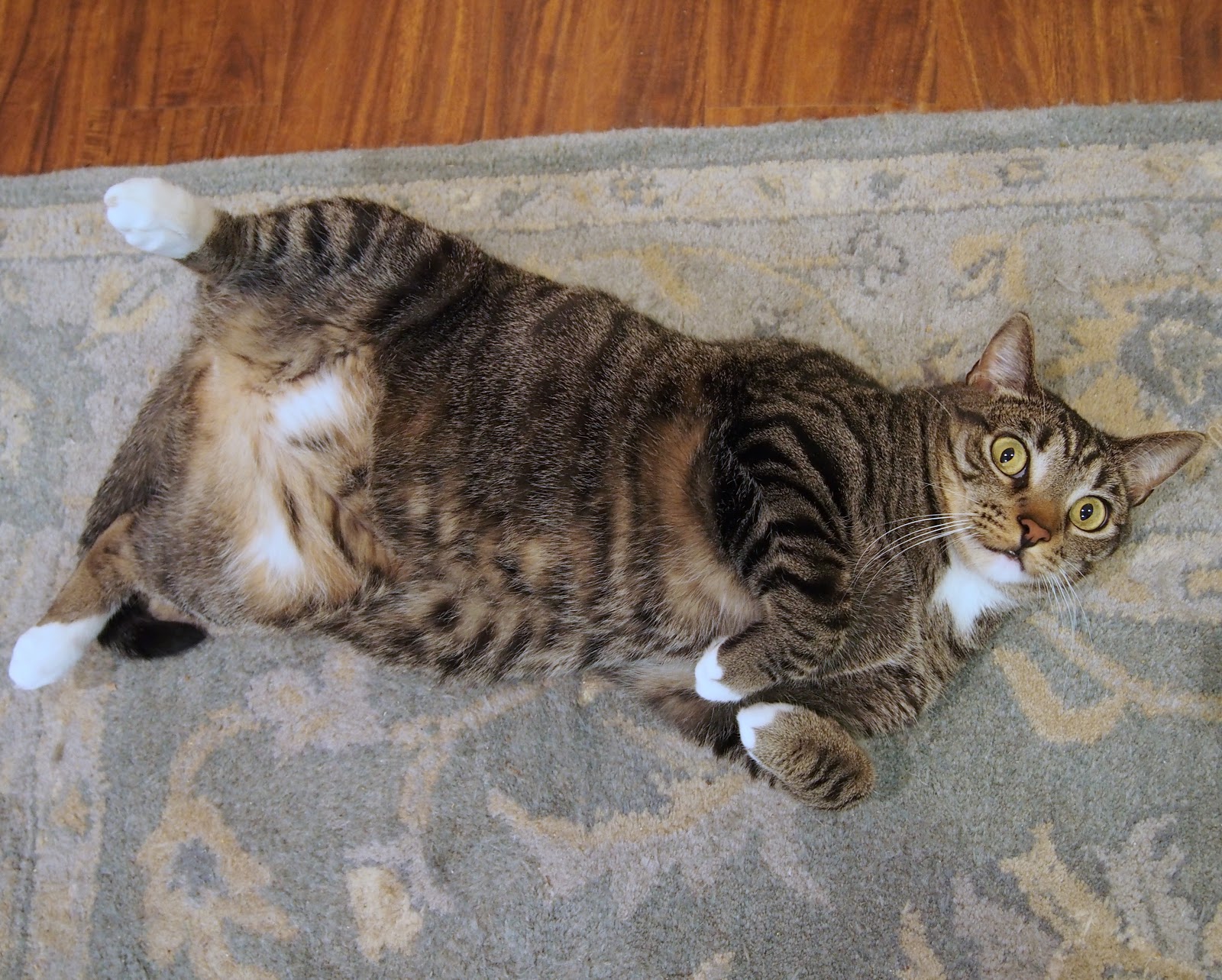
A Fiona Friday post finally stars its namesake:

We call this the "tabby sprawl" because both of our tabbies have been the type to sprawl on their back. Obviously, Fiona was not in the mood to have her picture taken.  


©2013 Nancy Horner. All rights reserved. If you are reading this post at a site other than Bookfoolery  or its RSS feed, you are reading a stolen feed. Email bookfoolery@gmail.com for written permission to reproduce text or photos.

Tuesday, February 19, 2013

The Emotionally Healthy Woman by Geri Scazerro (DNF with link to free sneak peek chapter)


The Emotionally Healthy Woman by Geri Scazzero is subtitled "Eight Things You Have to Quit to Change Your Life".  I should have known better.  When I read the description of this book, I got the impression that The Emotionally Healthy Woman leaned more toward memoir than how-to, because the description talked about some pretty drastic things the author has "walked away" from.  But the subtitle is directed to the reader, clearly indicating that the topic is about how the reader can make changes, rather than how the author did so.  My mistake.

The Emotionally Healthy Woman was, in fact, a DNF for me because I was hoping to read about how one person walked away from or "quit" certain bad habits/practices in order to improve her emotional health.  As I was reading, though, I was frustrated to find that the author's personal accounts of changes she's made in her life ("quitting" the church at which her husband was the minister, for example, and becoming a member of another) were very, very brief.  Even if it was not a memoir, per se, I would have liked to read far more about the author's personal experience.  I only lasted about 50 pages.

The Emotionally Healthy Woman is also a little heavy-handed thematically.  I felt like I could get all I needed from the list of things the author "quit" and the actions with which she replaced them.  From what little I read, I was already getting fatigued with the use of the "quitting" concept.  It's not necessary to flog a theme to death; it's okay to just use it as a guideline.

You can read a free chapter from The Emotionally Healthy Woman at my free chapter blog, but here's a very brief excerpt to give you an idea what the author is referring to with the "quitting" theme:

When we quit fear of what others think, we choose freedom.
When we quit lies, we choose truth.
When we quit blaming, we choose to take responsibility.

If you need or desire to hear those concepts elaborated upon, the author appears to have done a nice job of seeking out scriptures and Biblical examples (The Emotionally Healthy Woman is a Christian book from Zondervan) to back up the ideas.  But, I didn't personally feel like I needed to make a Bible study of the concept.  I think, if anything, I'd be happy just tearing out the one-page list of 8 items to give up and their replacement actions -- to hang on the wall as a reminder.  At this stage in my life, I prefer reading a memoir because I'm just happier vicariously experiencing a concept via a personal account.

Recommended specifically to Christian women who feel like they need a little guidance and some Biblical reference points to help them make life changes for the improvement of their emotional health, particularly those who are heavily involved in church and feeling a little overwhelmed.  There's some good material in The Emotionally Healthy Woman; it just was not the right book for me.


©2013 Nancy Horner. All rights reserved. If you are reading this post at a site other than Bookfoolery  or its RSS feed, you are reading a stolen feed. Email bookfoolery@gmail.com for written permission to reproduce text or photos.
Friday, September 21, 2012

The NIV Rock Solid Faith Study Bible for Teens

I love trying out new Bibles so I jumped at the opportunity to review the NIV Rock Solid Faith Study Bible for Teens. And, it just happens that I have recently begun a new Bible Study, so I've had plenty of opportunity to actually use the Bible and see how it works for me.

The New International Version is my personal favorite because I find it very easy to comprehend, although I think I'll always miss the poetic rhythm of the King James Bible I used in my youth. In the Rock Solid Faith Study Bible (which I'll refer to simply as the "Rock Solid", from here on), there are things that I like and a few that I feel area a little weak. I'll just list the characteristics.

Readability

One of my favorite things about the Rock Solid is the typeset. The font is clear and the type size is reasonable for older eyes. While this particular version is directed at teens, who typically have good eyes, I am currently using this Bible as my primary Bible because it's so clear and easy to read.

The study notes

There are summary notes and teen-directed verbal illustrations which explain portions of whatever story you're reading (we're currently studying tiny Jonah). The study notes are labeled "Rock Solid principles" or "Rock Solid truths", etc., and they explain what they mean pretty clearly: how to apply the truths, principles or other concepts in those verses. I will say I didn't necessarily agree with at least one of the "truths" that I read, so you should bear in mind that the opinion of whoever wrote those study notes shows up. There are also "Unshakeable People" notes, which describe Biblical characters who refused to waiver in their faith.

The teen-directed portions are stories in modern terms that illustrate the principles one can learn from the portion of the Bible they're reading.

Both of these - notes and modern stories - are minimal, which I personally like. Some study Bibles are simply overwhelming, with so many notes (I always feel obligated to read them all) that it seems to double your study time.

Extra study helps at the end of the Bible:
  • Table of Weights and Measures with approximate American and Metric equivalents (a "cubit", for example, is approximately 18" or 45 centimeters).
  • What Do I Read Today? Suggested reading and a place to mark off the chapters read in every book of the Bible.
  • Rock Solid Truths Index - An index by topic, such as Accountability, numerous topics about Jesus and God, Judging, Uncertainty, etc.
  • Rock Solid Promises Index - In Biblical order, the beginnings of selected verses in which God makes promises to us.
  • Rock Solid Principles Index - Also topical, but using only one or two words: Cliques, Falling Away, Divorce, Friends, and Grief are a few.
  • Rock Solid Plans Index - Verses about a little of everything, actually, in relation to looking ahead and planning as a Christian.
  • Unshaken People Index - "Peter obeyed God rather than people" with the page number on which the event occurred is one example.
  • Unshaken God Index - Characteristics of God and where you can read about them.
  • Concordance and Maps - As in other Bibles, but again . . . clear typeset, including that on the maps, makes these very easy on the eyes.

The Bottom Line:

Recommended, with one aside. I'm going to continue using this Bible! I absolutely love the clear type. The aside: I think the notes can be a little iffy, at times, and if I were handing it to a teenager or a child of my own, I'd tell them I don't necessarily always agree with the opinion of the writer of those notes and offer to talk about them. My youngest son actually dislikes study Bibles but he might find this one tolerable because of the minimal amount of interruptions in the text.

Click here to get a sneak peek into the NIV Rock Solid Faith Study Bible for Teens.


©2012 Nancy Horner. All rights reserved. If you are reading this post at a site other than Bookfoolery and Babble or its RSS feed, you are reading a stolen feed. Email bookfoolery@gmail.com for written permission to reproduce text or photos.