Last week, I quickly gobbled down
Bellwether by Connie Willis and I liked it so much that I decided to pull
Doomsday Book, also by Connie Willis, off my shelves. I am now officially a crazed Connie Willis fan girl. While the two books are completely different, the author's hallmark is intelligent, humorous writing in which the author pokes fun at unnecessary roadblocks caused by incompetent, mindless humans.
 I bought a three-foot-long piece of po-mo pink ribbon to take back to the lab, which meant the clerk had to get off the phone again. "This is for hair wraps," she said, looking disapprovingly at my short hair, and gave me the wrong change.
"Do you like po-mo pink?" I asked her.
She sighed. "It's the boss color for fall."
Of course. And therein lay the secret to all fads: the herd instinct. People wanted to look like everyone else. That was why they bought white bucks and pedal pushers and bikinis. But someone had to be the first one to wear platform shoes, to bob their hair, and that took the opposite of herd instinct.
Bellwether, published in 1996 by Bantam books, is labeled "sci-fi" but it's not so much a science fiction book in the usual sense (time travel, outer space, or other woo-woo topics) as it is a book
about scientists. Specifically,
Bellwether is the story of two scientists working for the same company. Their projects are eventually combined after they're thrown together by a serendipitous bit of incompetence on the part of a mail clerk.
Sandra Foster studies fads, how they start and what they mean. Bennett O'Reilly is preparing to study monkey group behavior but he's really a chaos theorist who lost his job and had to grab what was available. HiTek Corporation, where they both work, is a company that uses these scientific studies in order to try to determine the best way to make buckets of money. Studying fads, for example, is something they hope will lead to their eventual ability to create fads of their own.
As the two scientists get to know each other and work together, they deal with an employer who follows the latest managerial trends and constantly updates paperwork so that it's longer and more complex. Meanwhile, the doctors Foster and O'Reilly are totally oblivious to the fact that they're falling in love. Sandra Foster is, in fact, half-heartedly dating another man -- a man who just happens to follow fads like a sheep in quite the opposite way to Dr. O'Reilly's seeming obliviousness to trends. This is one of the things I simply adored about
Bellwether -- there's a touch of romance but the characters themselves are a little obsessive about their work and not very self-aware. It struck me as true to life.
Bellwether is as much a side-splitting observation of incompetent management, silly trends and human behavior as it is a story about science and a slowly developing attraction. A "bellwether", incidentally, is a sheep who unknowingly leads a flock. The bellwether becomes important when Sandra and Bennett combine their studies.
Answers.com calls Bellwether a "tongue-in-cheek fantasy" and
this site refers to her books as "piercing evaluations of social movement excesses", which is definitely a description I can get behind.
Bottom line: Smart, humorous writing that incisively illustrates the human tendency to follow the latest trends, skewers ridiculous corporate practices and lambasts incompetent workers in the midst of unfolding a realistic, slowly-developing romance. I loved this book so much I want to eat it. Kidding. But, I am hungry and I did love the book.
 Doomsday Book
 is quite a different animal altogether, a blend of historical fiction with time travel and more hair-pulling human incompetence.
Mr. Dunworthy, an Oxford professor, is certain that horror is going to befall young Kivrin, a 20-something historian who has wanted to travel back to Medieval time since she became his student. Now, she's dressed and ready to go to the year 1320. The head of the Medieval department has decided to rush into the drop into 1320 without unmanned tests and other necessary preparations but Mr. Dunworthy managed to at least oust the inexperienced tech from Medieval.
The drop is made and Kivrin materializes with the usual time-travel headache. But, she quickly begins to feel worse and darkness is falling. 1320 is in the midst of the mini ice age and the drop site is not quite right; she is in the midst of a forest. Where is the road upon which she was intended to materialize? Will she even find civilization before she freezes to death?
Back in 2054, everyone but the technician, Badri, has dispersed to wait for the "fix" to see if Kivrin landed in the proper time and place. Then, Badri comes rushing into the pub. Something has gone horribly wrong. He races back to the lab with Mr. Dunworthy and the physician who gave Kivrin her innoculations and enhanced her immune system (to avoid contracting any nasty Medieval illnesses) following on his heels.
But before Badri can explain what's happened, he collapses. And, his illness is not minor. With an epidemic raging in Oxford and most everyone on vacation, nobody is available to find out if Kivrin is safe. And, Kivrin herself is deathly ill in the past -- so ill that she has no idea how she arrived in the bustling home of a fairly well-to-do family. When she finally recovers, Kivrin will find that the family has secrets of its own that may keep her from ever finding the rendezvous site and returning home alive.
Doomsday Book starts out a little slower than I anticipated and is pretty repetitive as Badri quickly becomes so incoherent that he can't even speak a full sentence. I have to admit that was annoying and it did take time for the story to develop, but about halfway through, the book became utterly gripping. To say much more would be to give too much away, even though the outcome is pretty predictable.
One of the most fascinating things about
Doomsday Book is that it was published in 1991. Five years ago, the author's version of the future might have been a bit more believable but now that we have iPods and nearly everyone owns a mobile phone, there are some minor concepts that really jump out. Everyone uses land lines with video capability in 2054! People still buy "vids" and play them on "vidders" rather than downloading digital content. Apart from those and a few other minor issues that are only evident because things have changed so quickly in recent years, the author's visualization of a future world still seems pretty startlingly astute and her descriptions of the past are vivid (and smelly -- I would definitely not like to time travel to that particular era).
Bottom line: A massively entertaining little chunkster that blends history and science fiction to brilliant success. At 600 pages,
Doomsday Book does suffer from some needless repetition but it's so visceral and engrossing that its flaws fall away to nothing.
I highly recommend both books and am kind of going minor nutskies searching for my copy of
To Say Nothing of the Dog. Crazed fan girl. Seriously. Also, you may have noticed I'm having an attack of adjectives, today. Sometimes that happens. Let's blame the heat, shall we?
In other news:I received a copy of
Fixing Delilah Hannaford by Sarah Ockler from the
ever-friendly Amy, today. Thank you, Amy!
I'm
fickle, this summer. I've ditched two books and started two new ones. Who knows what I'll manage to complete and what will get set aside, although I'm on the verge of finishing
Take Good Care of the Garden and the Dogs by Heather Lende. It has periodically made me sob, but I think I'm just overtired, this week. When your husband travels to a different hemisphere, it's rather wearing.
What exciting things are going on with you, this week? Tired of the heat, yet? I hear Tropical Storm Bonnie is headed our way. Maybe she will cool us off a bit. One can only hope.
Happy Reading!
Bookfool, happily hiding in air-conditioned home
©2010 Nancy Horner. All rights reserved. If you are not reading this post at
Bookfoolery and Babble, you are reading a stolen feed. Email bookfoolery@gmail.com for written permission to reproduce text or photos.

 Top to bottom:
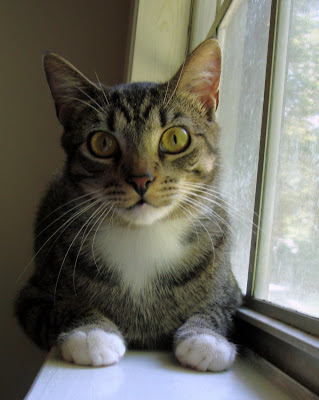
 We were traveling, last week (hence my technical difficulty -- I had strictly limited access to the internet), and when I returned to the vet's to pick up Fiona from her week of boarding on Monday, they were actually holding a kitten for me in the hopes that I would adopt her. Meet Isabel!
 How could I say "no" to a face like that? Isabel (aka "Izzy") is a headstrong little girl, about 12-14 weeks old. Found in the bushes outside the veterinary clinic, she was rescued and taken care of by one of the vets for just over a week. Her past history is unknown but she seems to be healthy and she certainly does let us know what she thinks. She's also extremely mild-mannered and loves to be held. Fiona is not particularly pleased with the intruder, but on the other hand we're not having any knock-down, drag-out fights. Occasionally, Fi will leap on Izzy and Izzy lets out a little sound like a squeaky toy. It's pretty funny.


.jpg)


 Evidence that one of the humans recently left for college and took plenty of ramen noodles with him:


 I've decided to go on part-time blogging status (Fiona is just going to be a full-time handful). That means I'll be here when I can, although not back to regular posting for a while. Blog hopping will not resume for a few weeks.


