Showing posts with label Fawcett. Show all posts
Thursday, March 09, 2017
The Handmaid's Tale by Margaret Atwood
I considered not bothering to review The Handmaid's Tale because I think everyone I know has read it and what could I possibly have to say that hasn't already been said? But, I like to write down my thoughts, so I overruled myself.
The Handmaid's Tale is about Offred, a young woman who must dress in a long red dress that covers all but her hands and head. On her hands, she wears gloves when out in public; her head and face are covered with a white headdress with flaps on either side of her face so that she must turn her entire head to see anything not directly in front of her. She goes out to get food rations and meets up with another young lady dressed in red. Sometimes the person she meets is not the same one she walked with, before, and she knows that's a bad thing. When they walk past a wall that used to be part of a university, there are often bodies hanging and Offred looks to see if any of them happens to be her former husband.
Before she was Offred, she had another name, a husband, a child, and a job. What happened to her world and why is Offred nothing more than an object that belongs to the man of the house, now, subservient to the man's wife and doomed to labor or death if she doesn't conceive within a certain length of time? Where are Offred's husband and child? Who is in charge in this strange, dystopian world?
Not every question is answered but I personally think the way Margaret Atwood gradually reveals the story of Offred's past (if her real name was ever mentioned, I've forgotten it) was masterful. The Handmaid's Tale is both riveting and horrifying. I recall the ending as somewhat hopeful (although it's been over a month and I've forgotten quite a bit, already) but most of the way through the book, the sensation of Offred being utterly and completely trapped overwhelms the small rays of hope. Even when something important changes, there's always the lingering possibility that she could be put to death for that small change in her life.
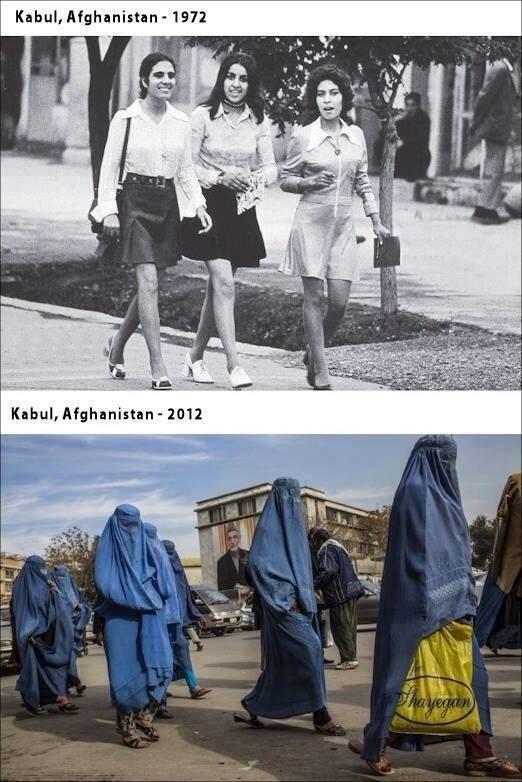
Is this even remotely possible? That's the question that I think most people ask themselves, and they tend to shake it off as ridiculous. But, throughout the reading of The Handmaid's Tale, I kept returning to the thought of women in the Middle East, pre-Al Qaeda and Taliban. I don't want to post an image that might be copyrighted, so I'll just link to the one that really jumps out at me: Women in Kabul, 1970s and today. The fact that women used to be doctors and lawyers, dressed like women in the Western world, drove, and went to college and actually sometimes had rights before American women achieved them (Afghanistan allowed women to vote before the United States) seems to have been forgotten.
In The Handmaid's Tale, the oppressor is unnamed but there are hints that it's a religion dictating the treatment of women as vessels for reproduction or slaves and little else. I found myself wondering if Atwood based the book on what happened in the Middle East. Would women who lived in Kabul in the 70s have imagined what was about to happen to them? I don't think so. And, because of what has already happened in our world, I think I can safely say The Handmaid's Tale is more possible than we'd like to admit. Some of it seems a little far-fetched (the weird ceremonies, for example), but the oppression of women has happened and certainly could happen in other parts of the world.
Highly recommended - Mood-wise, The Handmaid's Tale is miserable. It's depressing and terrifying and sometimes gruesome. But, it's so beautifully done and so thought-provoking that I can see why people have been gushing about it for years. Unlike more recent dystopian reads, many of which are geared toward teen readers, there's no love triangle, no great hatching of a plan to fight back against the oppressor, and the small thread of hope is so slender that it's hard to believe it will amount to anything. I did eventually get to discuss The Handmaid's Tale with an online group, although only a few participated and I keep thinking I would love to someday reread The Handmaid's Tale with my big, noisy F2F group. I'm sure the discussion would be lively.
©2017 Nancy Horner. All rights reserved. If you are reading this post at a site other than Bookfoolery or its RSS feed, you are reading a stolen feed. Email bookfoolery@gmail.com for written permission to reproduce text or photos.
Sunday, February 22, 2015
2 by Native Americans: The Lakota Way by Joseph M. Marshall III and Indian Boyhood by Charles Eastman
I just finished reading The Lakota Way by Joseph M. Marshall III and, I never got around to writing about Indian Boyhood by Charles Eastman (read in November of 2014). So, it's time for another Two for the Price of One review. I purchased The Lakota Way when Borders was going out of business [muffled sob] and bought my copy of Indian Boyhood from a secondhand shop in New Jersey, although you can download it for free in e-book form.

Humility can provide clarity where arrogance makes a cloud. -- p. 12
The Lakota Way: Stories and Lessons for Living (also subtitled Native American Wisdom on Ethics and Character) by Joseph M. Marshall III is divided into chapters headed with a particular characteristic revered by the Lakota, also known as Lakota Sioux, a Native American tribe that were nomadic hunter-gatherers in the Northern Plains and Dakotas for hundreds, perhaps thousands of years. Each characteristic is illustrated by stories passed down in the oral tradition, as well as personal tales from the author's lifetime.
The chapters: Humility, Perseverance, Respect, Honor, Love, Sacrifice, Truth, Compassion, Bravery, Fortitude, Generosity and Wisdom.
There is also an afterward that describes the history of the Lakota from their perspective, which unsurprisingly does not entirely agree with history books.
I love reading Native American tales and appreciated the way the author combined the moral code for his people with the stories that are used to illustrate right from wrong. Marshall's writing transports the reader to another time and place marvelously, whether it's the dawn of time, the 17th century or the 1950s. While I think anyone can benefit from the kind of wisdom in The Lakota Way, the afterword is particularly interesting and would be great for teaching purposes. Most history books have been written by European Americans, after all. It makes sense to teach the alternative viewpoint, as well, when discussing American history.
Highly recommended - A lovely combination of basics in morality, stories that illustrate the importance of strong character, and history. There's a bit of explanation about the spirituality of Native American tradition, as well. Although Marshall can be a little emphatic about the wrongs perpetrated upon his people, I think he has good reason for feeling that way and didn't find the book at all preachy.
Indian Boyhood by Charles A. Eastman (who was also known by his Indian name, Ohiyesa) is a book that was published in 1902. As a child of the 19th century, Eastman straddled two remarkably different time periods for Native Americans. He spent his childhood in the traditional way as a Santee Dakota Sioux, learning to hunt and observing his people living off the land and practicing the old ways. The bulk of his adulthood took place in the white man's world.
It's been quite a while since I read Indian Boyhood so details are fading but I do recall that the book is mostly about the beauty of the land, the joy of growing up in the outdoors and the sensation of freedom that he felt as a child. Occasionally, he compared his life to that of the European settlers and talked about why white children who were captured and became part of an Indian family often escaped to return to Indian life after being rescued by their families.
I can't recall how old Eastman was when his father disappeared but at some point his father was captured in battle and presumed dead. But, eventually, he returned and by then he had long since been converted to Christianity. By that point, Eastman was a grown man and he gave in to his father's influence, joining the world of the white man.
Because Eastman grew up with the traditions of his people but eventually became an Ivy League educated physician living in the modern European sense, he offers an interesting perspective from that of contemporary writers looking backward as he was able to compare and contrast the two cultures in which he participated, although the book is focused on his youth. He also learned about herbal medicine from his grandmother, so you could say Eastman had not one but two types of medical training.
Highly recommended - I've never read anything quite like Indian Boyhood. Most of what I've read regarding Native American culture has been either modern historical viewpoints or, in the case of older material, from the side of settlers. It was utterly fascinating reading about childhood as a Native American by someone who grew up traditionally and then transitioned into a completely different style of living as an adult.
©2015 Nancy Horner. All rights reserved. If you are reading this post at a site other than Bookfoolery or its RSS feed, you are reading a stolen feed. Email bookfoolery@gmail.com for written permission to reproduce text or photos.

Humility can provide clarity where arrogance makes a cloud. -- p. 12
The Lakota Way: Stories and Lessons for Living (also subtitled Native American Wisdom on Ethics and Character) by Joseph M. Marshall III is divided into chapters headed with a particular characteristic revered by the Lakota, also known as Lakota Sioux, a Native American tribe that were nomadic hunter-gatherers in the Northern Plains and Dakotas for hundreds, perhaps thousands of years. Each characteristic is illustrated by stories passed down in the oral tradition, as well as personal tales from the author's lifetime.
The chapters: Humility, Perseverance, Respect, Honor, Love, Sacrifice, Truth, Compassion, Bravery, Fortitude, Generosity and Wisdom.
There is also an afterward that describes the history of the Lakota from their perspective, which unsurprisingly does not entirely agree with history books.
I love reading Native American tales and appreciated the way the author combined the moral code for his people with the stories that are used to illustrate right from wrong. Marshall's writing transports the reader to another time and place marvelously, whether it's the dawn of time, the 17th century or the 1950s. While I think anyone can benefit from the kind of wisdom in The Lakota Way, the afterword is particularly interesting and would be great for teaching purposes. Most history books have been written by European Americans, after all. It makes sense to teach the alternative viewpoint, as well, when discussing American history.
Highly recommended - A lovely combination of basics in morality, stories that illustrate the importance of strong character, and history. There's a bit of explanation about the spirituality of Native American tradition, as well. Although Marshall can be a little emphatic about the wrongs perpetrated upon his people, I think he has good reason for feeling that way and didn't find the book at all preachy.
Indian Boyhood by Charles A. Eastman (who was also known by his Indian name, Ohiyesa) is a book that was published in 1902. As a child of the 19th century, Eastman straddled two remarkably different time periods for Native Americans. He spent his childhood in the traditional way as a Santee Dakota Sioux, learning to hunt and observing his people living off the land and practicing the old ways. The bulk of his adulthood took place in the white man's world.
It's been quite a while since I read Indian Boyhood so details are fading but I do recall that the book is mostly about the beauty of the land, the joy of growing up in the outdoors and the sensation of freedom that he felt as a child. Occasionally, he compared his life to that of the European settlers and talked about why white children who were captured and became part of an Indian family often escaped to return to Indian life after being rescued by their families.
I can't recall how old Eastman was when his father disappeared but at some point his father was captured in battle and presumed dead. But, eventually, he returned and by then he had long since been converted to Christianity. By that point, Eastman was a grown man and he gave in to his father's influence, joining the world of the white man.
Because Eastman grew up with the traditions of his people but eventually became an Ivy League educated physician living in the modern European sense, he offers an interesting perspective from that of contemporary writers looking backward as he was able to compare and contrast the two cultures in which he participated, although the book is focused on his youth. He also learned about herbal medicine from his grandmother, so you could say Eastman had not one but two types of medical training.
Highly recommended - I've never read anything quite like Indian Boyhood. Most of what I've read regarding Native American culture has been either modern historical viewpoints or, in the case of older material, from the side of settlers. It was utterly fascinating reading about childhood as a Native American by someone who grew up traditionally and then transitioned into a completely different style of living as an adult.
©2015 Nancy Horner. All rights reserved. If you are reading this post at a site other than Bookfoolery or its RSS feed, you are reading a stolen feed. Email bookfoolery@gmail.com for written permission to reproduce text or photos.
Tuesday, September 17, 2013
Ice Station Zebra by Alistair MacLean
Copyright 1963
Fawcett Crest - Thriller
224 pp.
First Sentence:
Commander James D. Swanson of the U.S. Navy was short, plump and crowding forty.
Side Note:
Interesting to note that in the movie based on this book, the commander was played by the tall and dashing Rock Hudson. I had pictured someone more along the lines of Ralph Waite, the man who played the father in The Waltons, as I was reading, partly because Commander Swanson was also a cheerful man and I remember Pa Walton smiled a lot. I know I'm old.
First Sentence:
Commander James D. Swanson of the U.S. Navy was short, plump and crowding forty.
Side Note:
Interesting to note that in the movie based on this book, the commander was played by the tall and dashing Rock Hudson. I had pictured someone more along the lines of Ralph Waite, the man who played the father in The Waltons, as I was reading, partly because Commander Swanson was also a cheerful man and I remember Pa Walton smiled a lot. I know I'm old.
Summarize the plot without giving away the ending:
An arctic science station known as Drift Ice Station Zebra has been damaged by a horrific fuel oil explosion and the nuclear submarine Dolphin and its crew have been called upon to attempt to reach Ice Station Zebra's survivors. At the last moment, a doctor has boarded the sub. The commander doesn't trust him; however, after checking to make certain that everything is in order, the doctor is allowed aboard.
But, there's a saboteur on the Dolphin, the damage to Ice Station Zebra may not have been an accident and communication is spotty at best. Will the crew of the Dolphin be able to find Drift Ice Station Zebra? If so, how will they get through the arctic ice surrounding the floating base and what will they find?
Capsule Description:
When a science station near the North Pole is seriously damaged, an American nuclear submarine is sent to the rescue. But, even if the crew of the Dolphin can survive a saboteur's repeated efforts to stop them, will they be able to survive an Arctic storm and a desperate murderer?
What did you like best about Ice Station Zebra?
I loved the language, the fact that things keep happening (it truly is a "thrilling" thriller), the fact that it had a very cold setting and I'm so tired of the freaking heat, the author's sense of humor. The book really is a roller coaster ride - more thrilling than anything I've read in quite a while.
A bunch of excerpts:
The tallest of the three tall men, a lean, rangy character with wheat-colored hair and the definite look of a man who ought to have had a horse between his legs, stood slightly in advance of the other two. Commander Swanson gestured toward him.
"Lieutenant Hansen, my executive officer. He'll look after you till I get back." The commander certainly knew how to choose his words.
"I don't need looking after," I said mildly. "I'm all grown up now and I hardly ever feel lonely."
~p. 8
Commander Swanson's cabin was bigger than a telephone booth, I'll say that for it, but not all that much bigger to shout about. A built-in bunk, a folding washbasin, a small writing desk and chair, a folding camp stool, a locker, some calibrated repeater-instrument dials above the bunk, and that was it. If you'd tried to perform the twist in there, you'd have fractured yourself in a dozen places without ever moving your feet from the center of the floor.
~p. 18
This ridged and hummocked ice cap had a strange quality of elusiveness, of impermanence, of evanescence; one moment there, definitively hard and harsh and repellent in its coldly contrasting blacks and whites; the next, ghost-like, blurring, coalescing and finally vanishing like a shimmering mirage fading and dying in some ice-bound desert.
~p. 53
The ice storm was no longer the gusting, swirling fog of that morning but a driving wall of stiletto-tipped spears, near-lethal in its ferocity, high-speed ice-spicule lances that would have skewered their way through the thickest cardboard or shattered in a second a glass held in your hand. Over and above the ululating threnody of the wind we could hear an almost constant grinding, crashing, and deep-throated booming as millions of tons of racked and tortured ice, under the influence of the gale and some mighty pressure center heaven knew how many hundreds of miles away, reared and twisted and tore and cracked, one moment forming another rafted ridge as a layer of ice, perhaps ten feet thick, screeched and roared and clambered on to the shoulders of another and then another
[. . .]
~p. 64
"What do your men think of your making them risk their lives to save the good name of the submarine service?"
"You heard the captain," Rawlings said. "We're volunteers. Look at Zabrinski there: anyone can see that he's a man cast in a heroic mold."
~p. 71
"Shall we just lie down and die now or shall we first stagger around in circles for a couple of hours and then lie down and die?"
"It's tragic," Rawlings said gloomily. "Not the personal aspect of it, I mean the loss to the U.S. Navy. I think I may fairly say, Lieutenant, that we are--or were--three promising young men. Well, you and me, anyway. I think Zabrinski there had reached the limit of his potentialities."
~p. 78
A pity they had no submarines in the Middle Ages, I thought; the sight of that little lot down there would have given Dante an extra fillip when he started in on his Inferno.
~p. 188
What did you dislike about Ice Station Zebra?
There were moments I couldn't quite follow the logic of the doctor who works to unravel the mystery of what happened at Drift Ice Station Zebra and who is responsible for the sabotage but it's not unusual for me to think, "How on earth did [whoever] come to that conclusion?" Mysteries often go over my head.
Highly recommended - Loads of fun. I must share the cover quotes, all of which I agree with:
"Spellbinding . . . never a dull moment" --The New York Times
Pulse-Pounding adventure beneath the arctic ice -- "An exciting thriller with a macabre and dramatic background." --Publisher's Weekly
"Don't start reading this book unless you have a free evening, for you won't want to lay it aside until the very end." --Seattle Post-Intelligencer
"Only superlatives could describe this story." --Washington Post
Cover thoughts: I love that cover. It's a work of art. In fact, one of the reasons I adore older books is the fact that their covers were so obviously painted specifically for a single book -- not stock images or photos that would be used and then used again with a slightly different coloring or lettering, as we often see, now. The cover image deposits you right in the midst of a scene as three men, the submarine still in view, struggle across the ice. Awesome.
Ice Station Zebra came from my personal library.
An arctic science station known as Drift Ice Station Zebra has been damaged by a horrific fuel oil explosion and the nuclear submarine Dolphin and its crew have been called upon to attempt to reach Ice Station Zebra's survivors. At the last moment, a doctor has boarded the sub. The commander doesn't trust him; however, after checking to make certain that everything is in order, the doctor is allowed aboard.
But, there's a saboteur on the Dolphin, the damage to Ice Station Zebra may not have been an accident and communication is spotty at best. Will the crew of the Dolphin be able to find Drift Ice Station Zebra? If so, how will they get through the arctic ice surrounding the floating base and what will they find?
Capsule Description:
When a science station near the North Pole is seriously damaged, an American nuclear submarine is sent to the rescue. But, even if the crew of the Dolphin can survive a saboteur's repeated efforts to stop them, will they be able to survive an Arctic storm and a desperate murderer?
What did you like best about Ice Station Zebra?
I loved the language, the fact that things keep happening (it truly is a "thrilling" thriller), the fact that it had a very cold setting and I'm so tired of the freaking heat, the author's sense of humor. The book really is a roller coaster ride - more thrilling than anything I've read in quite a while.
A bunch of excerpts:
The tallest of the three tall men, a lean, rangy character with wheat-colored hair and the definite look of a man who ought to have had a horse between his legs, stood slightly in advance of the other two. Commander Swanson gestured toward him.
"Lieutenant Hansen, my executive officer. He'll look after you till I get back." The commander certainly knew how to choose his words.
"I don't need looking after," I said mildly. "I'm all grown up now and I hardly ever feel lonely."
~p. 8
Commander Swanson's cabin was bigger than a telephone booth, I'll say that for it, but not all that much bigger to shout about. A built-in bunk, a folding washbasin, a small writing desk and chair, a folding camp stool, a locker, some calibrated repeater-instrument dials above the bunk, and that was it. If you'd tried to perform the twist in there, you'd have fractured yourself in a dozen places without ever moving your feet from the center of the floor.
~p. 18
This ridged and hummocked ice cap had a strange quality of elusiveness, of impermanence, of evanescence; one moment there, definitively hard and harsh and repellent in its coldly contrasting blacks and whites; the next, ghost-like, blurring, coalescing and finally vanishing like a shimmering mirage fading and dying in some ice-bound desert.
~p. 53
The ice storm was no longer the gusting, swirling fog of that morning but a driving wall of stiletto-tipped spears, near-lethal in its ferocity, high-speed ice-spicule lances that would have skewered their way through the thickest cardboard or shattered in a second a glass held in your hand. Over and above the ululating threnody of the wind we could hear an almost constant grinding, crashing, and deep-throated booming as millions of tons of racked and tortured ice, under the influence of the gale and some mighty pressure center heaven knew how many hundreds of miles away, reared and twisted and tore and cracked, one moment forming another rafted ridge as a layer of ice, perhaps ten feet thick, screeched and roared and clambered on to the shoulders of another and then another
[. . .]
~p. 64
"What do your men think of your making them risk their lives to save the good name of the submarine service?"
"You heard the captain," Rawlings said. "We're volunteers. Look at Zabrinski there: anyone can see that he's a man cast in a heroic mold."
~p. 71
"Shall we just lie down and die now or shall we first stagger around in circles for a couple of hours and then lie down and die?"
"It's tragic," Rawlings said gloomily. "Not the personal aspect of it, I mean the loss to the U.S. Navy. I think I may fairly say, Lieutenant, that we are--or were--three promising young men. Well, you and me, anyway. I think Zabrinski there had reached the limit of his potentialities."
~p. 78
A pity they had no submarines in the Middle Ages, I thought; the sight of that little lot down there would have given Dante an extra fillip when he started in on his Inferno.
~p. 188
What did you dislike about Ice Station Zebra?
There were moments I couldn't quite follow the logic of the doctor who works to unravel the mystery of what happened at Drift Ice Station Zebra and who is responsible for the sabotage but it's not unusual for me to think, "How on earth did [whoever] come to that conclusion?" Mysteries often go over my head.
Highly recommended - Loads of fun. I must share the cover quotes, all of which I agree with:
"Spellbinding . . . never a dull moment" --The New York Times
Pulse-Pounding adventure beneath the arctic ice -- "An exciting thriller with a macabre and dramatic background." --Publisher's Weekly
"Don't start reading this book unless you have a free evening, for you won't want to lay it aside until the very end." --Seattle Post-Intelligencer
"Only superlatives could describe this story." --Washington Post
Cover thoughts: I love that cover. It's a work of art. In fact, one of the reasons I adore older books is the fact that their covers were so obviously painted specifically for a single book -- not stock images or photos that would be used and then used again with a slightly different coloring or lettering, as we often see, now. The cover image deposits you right in the midst of a scene as three men, the submarine still in view, struggle across the ice. Awesome.
Ice Station Zebra came from my personal library.
©2013 Nancy Horner. All rights reserved. If you are reading this post at a site other than Bookfoolery or its RSS feed, you are reading a stolen feed. Email bookfoolery@gmail.com for written permission to reproduce text or photos.
Subscribe to:
Posts (Atom)