Showing posts with label NF and fiction. Show all posts

Tuesday, April 07, 2015

Mixed feelings about these: A Reunion of Ghosts by Judith C. Mitchell and Homemakers by Brit Morin

I had mixed feelings about both of these books, so I've decided to pair them up for mini treatment in spite of the fact that one is a novel and one nonfiction.

A Reunion of Ghosts by Judith Claire Mitchell is a novel about three sisters who believe their family has been cursed. Their great-grandfather invented a toxin that may have been used to kill millions of people. Since then, every generation has been plagued by suicide or tragedy.

Lady, the eldest, has never been happy and has attempted suicide at least twice. Middle sister Vee has had a recurrence of cancer and is no longer willing to fight it. Delph is painfully shy. None of them have children. They've decided to write their story then commit suicide together.

I was reading A Reunion of Ghosts when I went to get my hair colored, last week, and I realized just how awful it sounded when I described it to my well-read beautician. She scowled; I defended it. The writing is, in fact, very witty and light-hearted. But, the characters are not happy people and you can't help but cling to the wish that the three women will discover some unexpected joy that will stop them from deliberately meeting their maker.

Spoiler . . . only highlight this part if you don't fear having the ending ruined:

They don't.  In fact, it appeared that at least one character was on the verge of changing her mind; certainly, she went through a brief time of self-discovery. But, the ending was not at all what I'd hoped for.

Iffy on recommendation - The writing is excellent - clever, detailed, with an interesting historical perspective (although the idea is based in part on reality, the story is heavily fictionalized and the sisters are entirely fictional). Unfortunately, in the end I was immensely disappointed by the denouement and how it occurred -- and I'm pretty sure I didn't want to know about Albert Einstein's personal failings. The final chapter is sweet, touching, a bit clarifying. But, it wasn't enough to redeem the book for this reader.

~*~

I'm clearly not amongst the target audience for Homemakers: A Domestic Handbook for the Digital Generation, but I like books with clever ideas for things to make and do, so I requested a copy from William Morrow when it became available for review. The author is around my eldest son's age and Homemakers is directed at that generation: youngsters who missed out on the joy (gag) of Home Ec, were not even taught to boil an egg, sew or craft by their mothers, and are absolutely tied to their smart phones. It's about new ways to improve your home life, often using current technology, but also about ideas that are still in the works . . . or will be . . . or at least someone is thinking about them.

I own a pay-by-the-minute phone, which makes a good portion of the book completely useless to me; and, I did grow up in the generation of Home Ec, although I confess it was more burden than learning experience. My mother taught me about sewing and cooking; Home Ec just gave me a chance to try to bribe whichever guy happened to be my current crush into adoring me (during the cooking portions). If you grew up in my generation, have been sewing, cooking and crafting for eons and aren't particularly interested in the latest apps to make your life easier, the most you can possibly get out of this book is a craft idea or two, maybe a recipe or a new way to organize. Probably not. I'm really trying to be kind. For my part, I liked a few simple craft ideas like using milk cartons, concrete and paint to make a couple cute bookend planters and this idea for an inexpensive jewelry board:


I also marked the URL for a website from which one can order 3-D printed creations but haven't looked into that, yet. Otherwise, the book was pretty to look at, not particularly useful as a guide to domestic bliss. A few problems I had with this book:

1. Much of what the author mentioned being able to do craft-wise via local businesses is likely not even a whiff of an idea where we live. She's in a large city; I'm living in a mostly-rural state that tends to run about a decade behind the trends.
2. The instructions for various crafts often left me with questions. It felt like there were a lot of missing steps. Even when there were illustrations of the steps, I sometimes couldn't figure out exactly what she'd done to get from one step to another.
3. Overuse of the new, dumb-downed word for everything (formerly known as creative ideas, clever tips, brilliant suggestions): hacks. Gah. I hate that word with a purple passion. Only a true hack could have come up with its new use.
4. The author repeatedly pitched her company. If you have the book in hand, I'm guessing it's not necessary for the author remind you she owns a web-based business after she's mentioned it once.
5. No resources. The best of the crafting/idea books I've read over the years have been those that not only provide readable instructions but also include sources, online and otherwise, for obtaining the items used in the book, particularly those that are harder to find. This is especially necessary for those of us who live in the Boonies.

There are also [long] hair and makeup tips, decorating ideas (kind of lame), tips on how to buy glassware (I do not need 8 different types of glasses taking up cabinet space, no), how to pack -- basically, suggestions for things to do in every room of the house, including the closet. There are a million pictures of the author (she's cute but, good grief, it's tiring to see the same person model everything) and lots of pages with merely a grid, space masquerading as room to take notes.

Recommended only to a specific audience - Clearly, in spite of the fact that I found a few crafts that I might maybe want to someday try possibly, this was not the book for me. However, I absolutely love the theme colors and her airy style. They're "in" and they'll go out quickly but I do like the look. Homemakers is relaxing to page through. It's probably of greatest interest and applicability to the 20- to 30-something crowd, as the cover indicates, and I would recommend the book specifically to that crowd. Older and already crafty? Check it out from the library if you're interested.

©2015 Nancy Horner. All rights reserved. If you are reading this post at a site other than Bookfoolery  or its RSS feed, you are reading a stolen feed. Email bookfoolery@gmail.com for written permission to reproduce text or photos.

Tuesday, January 22, 2013

Mini reviews - Titanic Remembered by Alan Ruffman, Wall and Piece by Banksy and An Unexpected Angel by Janet K. Halling

Time for a few more quickie reviews.  All of the following were recently added to my home library.

Titanic Remembered:  The Unsinkable Ship and Halifax by Alan Ruffman is the official guide and souvenir book from the Maritime Museum of the Atlantic.  I haven't been there; it's just one of those books that popped up in the recommendations at Paperback Swap when I was looking up other Titanic titles, last year.  Because it's a guide book, Titanic Remembered is quite thin at 70 pages but I must say I was totally impressed.  Titanic Remembered is loaded with photographs and tells the story of the Titanic from the Halifax, Nova Scotia end of the story.  
Since Halifax is the place from which recovery ships were sent and where the bodies were buried (those that weren't buried at sea, that is), a good portion is about the process of recovery, identification and burial of bodies.  It was a lot more complex than I'd ever considered.  There are some interesting stories about individuals, both among the perished and survivors (not necessarily the most commonly described victims and survivors) and a few unique tidbits about the collection of souvenirs by those involved in the recovery efforts, as well as a few illicit photos.  Photos of bodies and/or the unloading of them was strictly forbidden but people are sneaky devils.

I found Titanic Remembered surprisingly gripping and the book definitely piqued my interest in the maritime museum.  Highly recommended to those who are not squeamish.  There are a couple photos of dead bodies . . . only a couple.  

Wall and Piece by Banksy was a gift to myself -- you know, one of those cases of, "Three gifts ordered and one tossed in the cart for myself."  For those who are unfamiliar with Banksy, he's a "street artist" from England who uses pre-made templates to quickly paint his works of art on various walls, bridges, billboards and other surfaces.  Since graffiti is considered an eyesore and is often illegal, most of his artwork has been quickly washed away.  I thought it would be fun to get a book of photographs of Banksy's art -- and it is definitely art, not just a bunch of messy fat lettering, like you often see under bridges and on the sides of trains.
Since this is a book written by Banksy, there is also some text.  Unfortunately, the text doesn't lend a lot of insight into the artist and/or reveal context for the vast majority of the paintings.  However, there was enough to satisfy me.  I don't necessarily agree with Banksy's philosophy that if someone advertises it's a one-way street and people have the right to respond (by painting a response directly on the billboard), but I learned a little about why he paints certain images like rats and some of the meaning behind the themes in his artwork.  As the title indicates with a cute bit of word play, he heavily emphasizes war and peace.   Occasionally, I didn't get what he was trying to say and those were the times I yearned for a bit more text to explain what Banksy was attempting to portray.  But, in general, I loved Wall and Piece.  If you're a Banksy fan, Wall and Piece is worth owning.  Highly recommended with a warning that those who are picky about grammar may occasionally cringe.

Quote on the back of the book:  "There's no way you're going to get a quote from us to use on your book cover."  -- Metropolitan Police spokesperson

An Unexpected Angel by Janet K. Halling is a drawing win from Holly at 2 Kids and Tired Books.  It's a Christmas book that plays on the Dickens classic, "A Christmas Carol" and the movie It's a Wonderful Life.  

Ellie hates everything about Christmas.  After working late on Christmas Eve, she stops to pick up some groceries and snaps at the clerk who attempts to engage her in conversation.  She's not interested in talking.  She just wants to be alone.  

But, the clerk turns out to be an angel with an unexpected surprise in store for Ellie.  Instead of the quiet Christmas Eve she's become accustomed to, she is tossed into the past.  Ellie doesn't stay in one time period.  Just as events begin to resolve and her purpose clarifies, she's yanked from one time period and flung into another.  You never know where Ellie will end up next and the reasons she's tossed about don't fully come together until the end, although it's made clear, early on, that Ellie's hatred of Christmas and drive are related to a tragedy in her past.  

I absolutely loved An Unexpected Angel.  When I first began the reading, I thought it was going to be a typical, sappy Christmas story, but that thought only lasted a handful of pages.  While the theme was common, I absolutely loved the sensation that one was traveling through time in An Unexpected Angel and I found the resolution deeply meaningful.  One for the keeper shelves, a lovely little Christmas story with heart.  Keep tissues handy when you read this one.  Highly recommended

I gave all three of these books 5 stars at Goodreads. 

On an unrelated note:  I have no idea how to resolve the problem with those huge gaps between paragraphs of text, one of the new problems with the updated Blogger interface.  There are simply times I cannot remove air space, even by going into HTML mode, where it ought to be apparent that there's a large gap.  If you're aware of a solution, please let me know!


©2013 Nancy Horner. All rights reserved. If you are reading this post at a site other than Bookfoolery and Babble or its RSS feed, you are reading a stolen feed. Email bookfoolery@gmail.com for written permission to reproduce text or photos.

Friday, October 19, 2012

Christmas stories . . . in October? A Christmas Memory by Truman Capote, A Child's Christmas in Wales by Dylan Thomas, and Miracle & Other Stories by Connie Willis


I used to avoid seasonal books like the plague and some years I read hardly any (although I don't avoid them like the plague, anymore), but this year . . . well, I got suckered.  My F2F group leader asked me to come up with ideas for our December read.  Not one to go into such a request lightly, I asked for suggestions on Facebook and Twitter (my Facebook friends were the most helpful) then spent some time looking up Christmas reads on my own.  In the end, my group decided to read three stories from the same book we used last year.  

One could say, "Argh, what a waste of reading time!" But, no.  All three of the following books are really quite special, each in its own way.  I also have one Christmas e-book that I'll be touring, Lola's Secret.  We'll talk about that one when the time comes.  

A Christmas Memory by Truman Capote was originally published in 1956 and is a classic that was not written for children, although it is marketed as such.  A Christmas Memory is exactly what the title makes it out to be, the short memoir of a Christmas in Alabama when Capote was seven years old and living with elderly, distant cousins -- one of whom, Miss Sook Faulk, was his only friend.  I have the copy pictured at left, with a CD narrated by Celeste Holm and watercolor illustrations by Beth Peck.  

A Christmas Memory tells about a simpler time, when most everything was handmade, possessions were few and creativity was a necessity.  As the story opens, Miss Sook declares that it's "fruitcake weather" and then she and the boy she calls "Buddy" gather the ingredients to make 30 fruitcakes.  There's a lot to making such a huge quantity of fruitcake.  All year long, the two must scrounge and work to save every penny they can, just to purchase the ingredients.  

There's a sweet scene involving the acquisition of whiskey and then they dance and drink the last of the whiskey when they've finished (earning a fierce chewing-out from the other relations).  Next up is finding a tree, making the decorations and decorating.  The dog, Queenie, tries to eat an angel.  Then, they make gifts for each other.  They have so little money that they make each other kites and on Christmas Day they go outside to fly them.

The story ends with Capote's reflection that after that Christmas he was forced to leave the house and friendship behind as he was sent to attend a succession of military schools.  He dearly missed Miss Sook.  Queenie's death and then the slow deterioration of Miss Sook are described with touching affection.  

A Christmas Memory is a tender, beautifully written, emotional story.  I can't recommend it enough. I liked the illustrations in the version I purchased and enjoyed listening to the CD that came with it, as well.


A Child's Christmas in Wales by Dylan Thomas is also very short and, while marketed to children, it was the fact that several people wrote about the language being so lovely that they thought adults would appreciate it more than children that led to my choice to purchase the book.  

I was quite surprised to find that A Child's Christmas in Wales is actually quite funny.  The prose is definitely lyrical, which isn't surprising given the fact that Dylan Thomas was a poet.  Copyrighted in 1954, A Child's Christmas in Wales begins with the following sentence:

One Christmas was so much like another, in those years around the sea-town corner now and out of all sound except the distant speaking of the voices I sometimes hear a moment before sleep, that I can never remember whether it snowed for six days and six nights when I was twelve or whether it snowed for twelve days and twelve nights when I was six.  

That made me laugh.  You can actually find the entire story online but I like the little book I bought.  It has lovely illustrations and it's worth hanging onto.  My copy was published by New Directions.  Highly Recommended.

In a slightly-related side note, Welsh author Simon Van Booy once told me his grandfather was Dylan Thomas's newsagent. The words "newsagent" and "Wales" paired together oddly make me crave the melty Welsh cheese I had in Llandudno, North Wales, many years ago.  

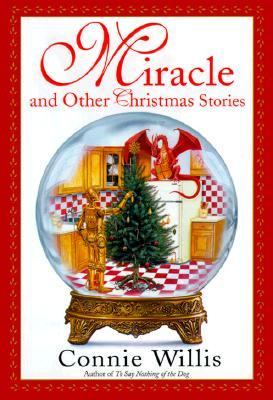
Miracle and Other Christmas Stories by Connie Willis caught my eye because it was not only close to the top of a list of recommended Christmas reads at Goodreads, but also happens to be a book by one of my favorite authors.  

Connie Willis is known as a sci-fi author, although at least one of the books I've read had more of a common scientific setting than the otherworldly type of location and storyline that typifies sci-fi.  

In Miracle and Other Christmas Stories, Willis shows off her knack for observing the absurdities of everyday life.  Some of the stories are humorous, some just a touch magical, one a time travel, one about possible alien invasion and one a mystery.  Willis said she wrote them with the goal of avoiding the usual sappy or depressing fare and I think she succeeded brilliantly.  I absolutely loved this book.  I had favorite stories, of course, but I really liked them all.  Again, Highly Recommended.  


So . . . even though it's only October and it seemed a little bizarre to sit down with Christmas stories, at first, I absolutely loved all three of the books in this post and plan to keep every one of them for rereading.  Usually, I just read Christmas stories and donate them, so that's a pretty unusual statement.  

©2012 Nancy Horner. All rights reserved. If you are reading this post at a site other than Bookfoolery and Babble or its RSS feed, you are reading a stolen feed. Email bookfoolery@gmail.com for written permission to reproduce text or photos.

Monday, May 28, 2012

Mini reviews - The Queen by Robert Lacey, Mia's Baker's Dozen by Coco Simon, Next to Love by Ellen Feldman

It's mini review time! I will write only mini reviews till I've caught up.

The Queen: A Life in Brief by Robert Lacey is a book written by a biographer who has written a large number of books about royalty. At a mere 166 pages, the author gives readers a comfortably brief overview of Queen Elizabeth II's life and 60-year reign. The Queen contains excerpts from some of Lacey's other books, as well as some updated material, and was written especially for Queen Elizabeth's Diamond Jubilee.

I think I can pretty safely say I knew next to nothing about Queen Elizabeth and her family and I'm happy not to have read a book that went into greater depth of detail. While I found the queen herself admirable in many ways and particularly enjoyed reading that her marriage was a true love story, Prince Charles pretty much made me want to heave. I had no idea he was such a naughty boy. During the actual Princess Diana years (when they were occurring, that is), I must admit I was more captivated by her wardrobe than the drama of the royal family and the many affairs. There is a single line in the book that I consider offensive and unnecessary, but otherwise The Queen is very nicely written.

Recommended to those who want to learn about the last 80 years or so of the British Monarchy in brief but are not interested in tremendous detail. If you're looking for a more comprehensive biography, check the page lengths of Lacey's books. He's written quite a few and The Queen: A Life in Brief is the shortest. The Queen was the perfect blend for me and also contains a surprisingly nice variety of photographs for such a small book.

Mia's Baker's Dozen by Coco Simon is one of the books in the Cupcake Diaries series, for ages 8 and up, about a group of young girls who have a small business selling cupcakes. I won my copy in a Twitter drawing, which I entered because I like to regress, now and then.

Mia's parents speak Spanish and so does Mia, but she has never learned to read or write Spanish. When she's enrolled in an advanced Spanish class and has difficulty, Mia's embarrassed to admit that she needs help. She is also thrown out of kilter by the changes in her life, now that her parents have divorced and her mother is remarried.

Mia's Baker's Dozen is very simplistically written. It was fun reading about Mia's challenges and friendships and how she solves her problems. I'm pretty sure I would have gobbled a series like this happily, as a young girl, and definitely recommend this title to youngsters in the right age range. It's nice, clean fun. Reading the book made me want to go play in the kitchen.

Next to Love by Ellen Feldman tells the stories of three women, friends from a young age who are all left behind when their men go off to fight in WWII. The story is based on one small town's loss of a large number of its young men in a single battle. Two of the women are widowed; one is not, but the surviving husband returns with a permanent injury and post-traumatic stress.

Next to Love follows the three women from before WWII to the Sixties and is packed with the love, loss, temptation, danger, violence, prejudice and other challenges of life for women during the time period.

I really enjoyed Next to Love because the relationships and challenges seemed very realistic to me, but there were a couple things I disliked about the book. Chiefly, I disliked the first-person narrative and jumpiness. I liked the fact that the author chose to portray each of the women from her own viewpoint, but instead of going from one character to another and showing how each reacted at a particular time, for example, there would be three scenes from Babe's perspective that take place from September of 1944 to July of 1946 and then you jump back to September of 1944 to view Grace's perspective. And, then the same thing is done all over again with Millie. Jarring.

On the plus side, Next to Love has the ring of a book that has been exceptionally well researched. The sense of time and place throughout the book is both believable and occasionally even reminded me of things my parents mentioned. Definitely recommended for those who enjoy WWII novels and women's fiction.

More minis forthcoming.

©2012 Nancy Horner. All rights reserved. If you are reading this post at a site other than Bookfoolery and Babble or its RSS feed, you are reading a stolen feed. Email bookfoolery@gmail.com for written permission to reproduce text or photos.

Sunday, December 11, 2011

Themed Reading - Native Americans in The Wind is My Mother, Light on a Distant Hill & Edward Curtis: Coming to Light

I've recently read three books about Native Americans, their lifestyle, beliefs and a man known for his determination to photograph them before it was too late. It seems logical to put them together, but this is accordingly a very, very long post.

The Wind Is My Mother: The Life and Teachings of a Native American Shaman by Bear Heart is part memoir, part advice, part history -- an excellent book about one Native American's beliefs and how he believes they can be adapted to fit our lives in today's world. It was published in 1996 but the advice is certainly as relevant now as it was then. I bought The Wind Is My Mother during Borders' going-out-of-business sale and I wish I'd just bought everything they had on Native Americans. If I'd known I was going to become slightly obsessed with reading about North America's first people, I certainly would have.

I learned quite a bit from The Wind Is My Mother. For example, the author says, contrary to popular belief, Native Americans are all monotheistic, so the ceremonies white people thought of as pagan were all, in fact, designed to make requests or thank a single Creator, although they symbolically used creatures and objects which appeared to outsiders to be "gods" to whom they were praying. You can understand how the confusion occurred when you read about Native American ceremonies. Bear Heart also disputes the story that Columbus called the natives "Indians" because he thought he was in India. Here's what the author has to say about the naming of natives by Columbus:

I don't always feel comfortable in talking about Indians; even the word Indian itself is very misunderstood. When Columbus found the natives here, they were gentle people who accepted him, so Columbus wrote in his journal, "These are people of God." In his language, he wrote "In Dios." Later, the s was dropped and Indio eventually became Indian, which originated as "people of God." ~~from p. 160 of The Wind Is My Mother

Here's an interesting story that leads to some always-timely advice:

A witch doctor from South Africa told me how they catch monkeys there. They bore a hole in a pumpkin large enough to slip in a banana, then they reach through the hole with a spoon, clean out the inside and drop in the banana. When a monkey comes around, he smells the banana inside the pumpkin, sticks his little forearm in there, feels around, grabs hold of that banana, and then he's stuck. His brain will not tell him that to free his hand he's got to release that banana. He just holds on. ~~pp. 111-2

The advice:

There are many, many ways to let go of our bananas, so to speak. The way my people take care of something that we're not happy with is to honor it and say, "Thank you, you've taught me a lesson." If its anger, if it's hate, if it's a drinking problem: "Boy, you've been with me for a long time. Now I'm going to try something else. But I want to thank you for teaching me something about myself." Never try to just get rid of it. You can't, it's too strong, it's too embedded. Instead, honor it and say, "Thank you." ~~p. 113

I love that. My absolute favorite part of the book, though, is a tale about a time when the author went to Hawaii to fulfill his deceased son's wish that he could see it. His son had written about the beauty of Hawaii when he landed in there on the way to being stationed in the Philippines. You have to read the book to fully understand the story, but as a baby Bear Heart was dedicated to God by his mother, when he was near death. She kept her promise to raise him the way she prayed she would if God would save his life and these many years later, he went up to Pele Point, a place where, "According to Hawaiian legends, the winds of the universe have their beginning." Because his mother was of the Wind Clan, he wanted to go up there at midnight (he doesn't explain what the Wind Clan and midnight have to do with each other) but he was told he couldn't by park rangers.

He told them he needed to go and they said they'd drive him to the chain across the road and he could walk from there. He agreed, stepped over the chain and as he walked he sang his songs "to each of the Four Directions--East, South, West and North." I'll let him tell you the rest.

When I got through, I said, "My mother, when I was very small, dedicated me. At this time I rededicate myself anew to You--from my heart. I will be Your feet, Your hands, Your eyes, Your voice, just as she said. If there's any love that You have, a special love that You want for people, let it flow through me. Let me touch someone and make them a little happier, so that they can be well and walk with good purpose upon this land. Please use me." I dedicated my life again in that way.

When I came back down, the guards asked who was up there with me. I said, "No one." They said they heard lots of voices singing. They heard it, I didn't. ~~p. 146

Well, that sure gave me chills. I absolutely loved The Wind Is My Mother and found myself quoting it aloud quite a bit. I highly recommend it and plan to reread my copy, hopefully many times.

In the midst of reading The Wind Is My Mother, my face-to-face group voted on Empire of the Summer Moon by S. C. Gwynne for our January reading selection, so I'll be reading that very soon. And, then a book I've had on my wish list at Paperback Swap for at least 4 years became available.

Edward C. Curtis: Coming to Light by Anne Makepeace is a National Geographic book, so it's slightly large with pages about the size of letterhead, around 8" x 11" -- large enough that the details of the many photographs included don't require a lot of eyestrain (although I did occasionally use a magnifying glass to look closer at certain images).

Edward Curtis was, of course, the famously obsessed photographer who spent most of his adult years trying to photograph all of the North American Indian Tribes in costume before their customs, traditions and native costumes ceased to exist. It took him 30 years to create 20 extraordinarily expensive volumes of photographs and the process was as costly as it was time-consuming.

Coming to Light is also extremely informative. The author talks about specific tribal ceremonies and people that Edward Curtis photographed, as well as his personal life, his artistic vision and how his divorce led to the loss of a large number of glass negatives. The author went in pursuit of living Native Americans who were present when the photographs were taken or who had some knowledge of what was happening or who was photographed and her discoveries are also both amazing and entertaining. She also mentioned some of the controversy surrounding his photography and gave examples of what he did that made the accuracy of some of his images questionable.

I highly recommend Edward C. Curtis: Coming to Light especially to those who are interested in actually learning about Edward Curtis. Coming to Light is not really a typical coffee-table book as it only contains a selection of his photos (but a nice selection, in my humble opinion). I'm hoping to someday find a larger book that focuses on display of his photographs, but it was really a more accurate look at Curtis' life that I was hoping to find, after reading a fictional account that I found disappointing, and I thought the text was stellar. I learned much more about Native Americans from the book than expected.

Light On a Distant Hill by B. J. Scott is a novel my friend Paula read while I was in the midst of reading about Edward Curtis. It's fiction, but Paula highly recommended it and I looked it up as soon as I finished reading Coming to Light. There's some crossover between all three of these books, as it's only natural that certain characters are frequently mentioned. In Light on a Distant Hill, a young mail-order bride named Ellen leaves her home in Salina, Kansas and heads west to meet the man she intends to marry, a cavalry officer stationed at Fort Walla Walla in Washington Territory.

On the way, Ellen is kidnapped by Shoshone Indians at a massacre in which she is one of only two survivors. She tries repeatedly to escape from the Shoshone but fails and finally accepts her plight. And, then she finds herself slowly becoming one of them as she learns their ways and falls in love.

Meanwhile, her fiance has refused to believe the accounts claiming Ellen died in the attack. But, he is unable to take enough time to track her down and resumes his job, hunting the people his beloved has come to think of as her own. After white soldiers attack the Shoshone, killing women and children and threatening Ellen's husband, she must run for her life. She ends up following Chief Joseph of the Nez Perce, the man known for the famous quote "I will fight no more forever," made at the time of surrender, after his people had been chased 1500 miles by the militia.

The wonderful thing about this particular novel is that it is so incredibly sympathetic to Native Americans and the horror they experienced. The author acknowledges that the natives were human and not wholly innocent of their own crimes against whites, but places their experience in a context that makes you feel as if you were there, you understand and . . . honestly? . . . you're really pissed off, by the time you get to the surrender of Chief Joseph.

There are author's notes describing changes the author made. He did take a few liberties, but Light on a Distant Hill's setting is apparently very well-researched. Much of what Scott wrote was also described in Coming to Light and the three books together make a fascinating trio. Since I'd already read a little about Chief Joseph and the plight of the natives in general, the effect was very much like going from reading about the horror of the eradication of natives to experiencing it from their viewpoint. Light on a Distant Hill is told as a memory, when a young reporter goes to interview the elderly Ellen in the 1930s.

A side note: I would probably not normally have purchased Light on a Distant Hill because it is apparently a self-published book: the publisher is AuthorHouse. I only read self-published books by people I know or when they're recommended by readers I know and trust, these days. Obviously, Paula is a trusted friend because I did rush over to Amazon to buy the e-book, almost the moment I finished Coming to Light.

There's a bit of a romance aspect to Light on a Distant Hill and a couple brief, graphic love scenes (which I'm never fond of) but in spite of a bit of mush and sex, I have no complaints. I thought the writing, while not brilliant, was very good. However, it's both the sense of time and place and the author's ability to empathize with Native Americans without glorifying them that make the book shine. Definitely recommended, especially when paired with non-fiction about Native Americans.

I have to add that there are quotes throughout both Coming to Light and Light on a Distant Hill that will doubly horrify readers -- quotes by army officers and famous white Americans of the time, in which they speak of Indians as subhuman. Sound familiar? It struck me as particularly odd that the invading Europeans spoke of the natives as lesser life forms and set about eradicating them whilst stealing the people of another culture they considered lesser life forms, at the time (Africans). Throughout history, people have described opposing cultures in similar ways and enslaved or killed their chosen enemies but it struck me as odd that there were two cultures being destroyed at around the same time by the same people. And, isn't it horrifying how the same thing keeps happening, the world over? The author compared the eradication of Native Americans to the slaughter of Jews by Hitler. The more I read, the more I agree.

At any rate, the plight of the natives in the United States is a sad one but a tale that I think we all need to learn -- the truth, that is. From The Wind Is My Mother I learned why the natives responded with what most of us probably consider weakness when they made agreements with white men but the white men not only didn't keep up their end of the bargain but also eventually killed them off and shuffled the natives around on death marches to camps hundreds of miles across the country. It all has to do with the peace pipe. Bear Heart explained that when his people smoked the peace pipe, they were making a promise before their Creator. And, promises made in the presence of God could not be broken. So, they were not meek little lambs being led around but extremely devoted, spiritual people.

If you made it through all three reviews and the rant at the end, I must offer you a virtual hand-shake. Sorry this post is so long. The reading of the three books was quite an experience and I'm looking forward to learning more, sad as I know it will be. I'll post a photo of the other books I've purchased, some time soon. I think this post is quite long enough!


©2011 Nancy Horner. All rights reserved. If you are reading this post at a site other than Bookfoolery and Babble or its RSS feed, you are reading a stolen feed. Email bookfoolery@gmail.com
for written permission to reproduce text or photos.

Wednesday, November 16, 2011

Mini reviews - Don't Look Now, How to Be an American Housewife and The Education of a British-Protected Child

I've got such a backlog of books to review that I'm going to do a few minis to make it a bit easier to get caught up. All of the following are from my personal library.

Don't Look Now by Daphne du Maurier is a collection of 5 of du Maurier's creepy short stories, most of which I would guess are closer to novella length. My copy was printed in 1971, when Dame du Maurier was apparently still churning out bestsellers, the copyright date: 1966.

The title story, "Don't Look Now" is my favorite. It begins in a Venice cafe, where a grief-stricken couple, John and Laura, have traveled to try to lift Laura's spirits. While playing a silly game, imagining things about people nearby, they meet two older women. One of the women makes a dire prediction and accurately describes their deceased child, whom she claims to have seen happily sitting at the table with her parents. But, she is blind. After the old woman warns them something is going to happen and says John should leave Venice soon, their vacation takes a frightening turn. Is the blind lady truly psychic? What is the meaning of her warning to John?

"Don't Look Now" is one of those stories that is just predictable enough to make you want to say aloud, "No! Don't go down that alley!" But, it's still surprising enough to satisfy. The remaining 4 stories are a little less fulfilling. "The Breakthrough" tells the story of an engineer who gets tangled up in a frightening experiment. "A Border-Line Case" is the story of a woman who tries to fulfill her father's dying wish but ends up in a frightening situation that leads to a revelation she probably was best off not knowing. And, "The Way of the Cross" is about entanglements and intrigue on a group tour to Israel.

"Not After Midnight" was really the only other story that fully captured me -- enough so that after finishing the story I went on a search for someone to chat with about it. I'm not certain I understood the ending (I didn't find anyone to discuss it with, so if you have the book on hand and want to chat with me, I'll happily reread it). "Not After Midnight" is about an art teacher who becomes intrigued by the odd behavior of an American couple while on a painting holiday in Greece and finds himself falling into the same traps as a man whose curiosity led to his death, the year before.

While only 2 of the 5 stories really thrilled me, I still recommend Don't Look Now. Du Maurier's writing is always vivid and atmospheric; the collection is worth checking out, if only for the title story and would have made an excellent read for the RIP Challenge if I'd ever bothered to sign up. In the fall, I always feel compelled to read something spooky, signed up or not.

How to Be an American Housewife by Margaret Dilloway tells the story of Shoko, an ailing Japanese woman who married an American soldier just after WWII. Her damaged heart may not hold out much longer; and, she longs to return to her home country to reunite with her estranged brother before she dies. After her doctor forbids her to travel, she takes a dramatic turn for the worse. So, she asks her daughter to go to Japan in her place.

Divorced mother Sue agrees to travel in Shoko's stead and takes her daughter along on the journey. In Japan, Sue becomes privy to family secrets and helps to heal the wounds Shoko and her brother have carried with them for decades.

How to Be an American Housewife is told in two parts, the first part from Shoko's point of view and the latter from Sue's. The change of perspective was a little jarring, at first, because I'd grown to love Shoko and the author did an excellent job of giving the two women distinctive voices. Her skill at making the characters distinctive made the transition difficult, in other words. By the mid-point, I also found that I was predisposed to dislike Sue because Shoko doesn't understand her. It doesn't take long to see events described by Shoko from Sue's perspective and to like her, as well.

I loved this story for many reasons. First and foremost, the storyline drew me in and the pages flew. But, apart from that, I loved stepping into Shoko's shoes and seeing what it's like to move to a spouse's home country and leave your own behind. I also liked reading the WWII scenes and some of them were so genuine that I was not surprised to find out they really happened. Highly recommended!

The Education of a British-Protected Child by Chinua Achebe is a book that Amy of Amy Reads talked me into buying when we met up at my local Borders as it was in its dying days. It wasn't a hard sell. I'm always fascinated by Amy's choices but they're far removed from my own, so I was excited to have her point out a book she particularly enjoyed.

The Education of a British-Protected Child is a collection of essays that mainly focus on education, the Nigerian experience (war, politics, imperialism), slavery and other topics important to Achebe, Nigerians and blacks in general. Although it's one of the most post-it filled books I've read, this year, when I first sat down to write about the book I was so overwhelmed by all the passages worth quoting that I think I'm best off just saying that it's worth the time.

Achebe has a unique perspective in being a highly-educated African who has experienced imperialism from the side of the natives, excellent education in an impoverished nation, a wide variety of experiences in other countries (teaching, travel, even more schooling) and war on his own turf. I learned a great deal from this book and felt like my own beliefs were challenged a bit. At times, I disagreed with Achebe, sometimes I was enlightened and in general I was quite simply in awe of him. I may share some quotes in a future post.

My Face-to-Face book group meets to discuss Crooked Letter, Crooked Letter, tonight! I can't wait! Happy Wednesday to all!


©2011 Nancy Horner. All rights reserved. If you are reading this post at a site other than Bookfoolery and Babble or its RSS feed, you are reading a stolen feed. Email bookfoolery@gmail.com for written permission to reproduce text or photos.

Wednesday, September 29, 2010

Why We Fight, edited by Simon Van Booy and some nifty timing

Why We Fight, edited by Simon Van Booy
Copyright 2010
HarperPerennial Modern Thought
216 pages

I believe that philosophy is a subject we have a natural gift for, but a subject often regarded as one with no practical value--and closed to anyone outside the walls of universities. I am committed to the idea that these central questions of life are part of our everyday lives--that we all possess the skill and agility to tackle them, and that by pondering them, we can experience more fulfillment in our relationships, in our work, and in how we view ourselves.

Inside these books are readings, poems, quotations, and visual images that will inspire you to continue exploring the subject for years to come. I have tried my best to present philosophical ideas with no immediate resolution as immediately accessible for everyday thinking.

--from the Preface to the Series in Why We Fight by Simon Van Booy

The material in Why We Fight is an interesting collection that explores why humans argue, bicker, go to war and in other ways battle with each other. I chose to read Why We Fight first of the three books in the series -- which includes Why Our Decisions Don't Matter and Why We Need Love -- because it was the one that interested me the least and I wanted to save the best for last. That makes me chuckle, now, because I found Why We Fight absolutely fascinating and thought-provoking.

Beginning with the biblical story of Cain and Abel, each entry is introduced by the author. The story of Cain and Abel is described as follows:

. . . an etiological story that explores the nature of an aggressive biblical tribe called the Kenites. However, for most people it's a story about murder, crime, punishment, envy, and sibling rivalry--all major themes in ancient literature.

In many ancient stories and myths, people fight because of excessive pride--an emotion that often arises after the experience of rejection.

I've read the story of Cain and Abel dozens of times and loved the way Simon deftly captured both the history and the context of the story in a minimum of words, as he did in all of his introductory descriptions. I've been taking my time reading these philosophy books (I'm currently in the middle of Why Our Decisions Don't Matter) and finding it fascinating how the reading seems to parallel my thought processes along with some of my other reading material and even a photograph viewed this week. I'll provide a link to the photo and explain why the reading folded nicely into my thoughts about the photo when I review Why Our Decisions Don't Matter. It has to do with Hamlet. And, stars. But, back to the subject . . .

Two of the articles in Why We Fight particularly grabbed my attention because the first article, written by an animal psychologist and zoologist, describes human aggression as no different from that of other animals while the second article flatly disputes the concept of inherited tendency to defend our territory. Are we territorial by nature or not? Therein lies the joy of this book and the entire series: food for thought, discussion and to tempt one to further reading.

Love it, love it, highly recommended. There were 2 readings that literally put me to sleep but I did finish them and I think we can at least partially blame fatigue.

And, lest you think, "For crying out loud, everything's been 'highly recommended', lately," I must tell you that's because of that slumpy business I went through during the summer. I've only been reading books that totally grab me and suck me in. Anything that doesn't capture my interest and keep it is still getting set aside. Hopefully, I will soon find the time to share a little about some Did Not Finish books; and, I do plan to review one children's book I didn't like, soon. But, it's not the one in the sidebar. The little chimp book is another one I loved. You'll see.

The Coffin Quilt by Ann Rinaldi is a book that I consider one of those serendipitous reading choices that closely aligned with the thought process in Why We Fight, although I didn't think about the parallel when I picked The Coffin Quilt up to read.

The Coffin Quilt is a fictionalized account of the feud between the Hatfield and McCoy families -- a vicious, bloody feud that began with the theft of the McCoys' pigs in 1878. Ha! Territorial fighting, right? The pigs were a valuable and crucial possession because every part of the pig was used for either food or some other important need, such as soap-making. After the McCoys lost their pigs in a court battle (because some Hatfields were involved in the legal doings and they stuck with their kin, no matter what), the feud exploded into all-out war with ruthless killings after beautiful Roseanna McCoy ran off with Johnse Hatfield and the Hatfield patriarch refused to allow them to marry, destroying Roseanna's reputation.

The Coffin Quilt is told from the perspective of Fanny McCoy, the youngest daughter, and it is by far the best book I've read by Ann Rinaldi. I'm going to quote from the cover blurb (no spoiler included):

As the killings, abductions, raids and heartbreak escalate bitterly and senselessly, Fanny, the sole voice of reason, realizes that she is powerless to stop the fighting and must learn to rise above the petty natures of her family and neighbors and find her own way out of the hatred.

There's a lot of senseless violence, but the novel is a young adult and not too awfully graphic. I wouldn't be surprised if someone, somewhere thought it was worth banning (ha!--got in my comment about Banned Books Week!) but I thought it was well-written and, judging from the author's notes, meticulously researched, the perspective and fictionalized portions chosen with logic and insight.

The Coffin Quilt definitely provided more food for thought on the concept of why humans fight and I also recommend it as a good read with one caveat: The book is written entirely in vernacular. In general, I avoid books that are written in a regional dialect but I've lived in the South long enough that I had no problem understanding the mode of speech. I would advise flipping through The Coffin Quilt or reading an excerpt before purchasing, though, if you dislike books written in that particular style.

In summary:

Why We Fight, edited by Simon Van Booy - Philosophical readings, both fiction and non-fiction, and other material -- highly recommended to both the higher-minded and those who think they're too dim to handle philosophy. I think those of you with slow cogs like mine will be pleasantly surprised at the readability.

The Coffin Quilt by Ann Rinaldi - Solid young-adult fiction based on the real-life feud between two families, recommended for both youngsters and adults with the caution that it's written in Southern dialect.

It took me all evening to write this post, partly because the kitties are kind of needy and getting into a heap of trouble. There have been some fluffed-up tails, banging noises and other bits of excitement. Hope you enjoyed it and that you had a very wahooey Wednesday!

©2010 Nancy Horner. All rights reserved. If you are not reading this post at Bookfoolery and Babble, you are reading a stolen feed. Email bookfoolery@gmail.com for written permission to reproduce text or photos.