Showing posts with label Truman Capote. Show all posts

Wednesday, January 11, 2017

Everything I didn't review in 2016, Part 2

This will be the last post covering the books I neglected to write about in 2016. Fortunately, I kept up pretty well, in general.

Breakfast at Tiffany's by Truman Capote is a book that I had on my shelf for a while but had not gotten around to reading. It was my F2F book group's September selection and that gave me the nudge I needed. Since it's a classic, it was also my classic read for the month. I've attempted to watch the movie and found it bizarre and hard to follow, but I'm sure I would enjoy it, now. Holly Golightly is an interesting character, a woman who escaped her past and remade herself as a woman living off rich male companions. Her story is told from the viewpoint of a neighbor and friend. Now that I understand the character and her motivations, I think I would get the movie just fine. But, I haven't watched it, yet.


The Brief and Frightening Reign of Phil by George Saunders is a book that I happened across when I decided I wanted to own a copy of Tenth of December, a book I read and loved, also by Saunders. Honestly, it's probably the cover that convinced me to buy it. I love that cover. And, the content is every bit as fun and wacky. The inhabitants of a place called Inner Horner come into dispute with their neighbors in Outer Horner when their home suddenly shrinks and they no longer fit on the tiny bit of land alloted to them. A tiny, hilarious book that I presume is an allegory (but, honestly, I just don't know), The Brief and Frightening Reign of Phil is bizarre, thought-provoking, strangely insightful, and also one of my favorite reads of the year. I'm glad I bought it; I plan to reread this one regularly.

Leveling the Playing Field: The Democratization of Technology by Rod Scher was not meant to end up in the end-of-year batch, review-wise. I think I must have not realized I hadn't reviewed it at the blog because I put up a review at Amazon when I was asked to do so. Mea culpa. By "the democratization of technology", the author means that most inventions go from being hard to acquire and expensive to cheap and widely available. He starts out with the invention of fire and then progresses to such things as books (how they became more widely available with the advent of the printing press), computers, 3D printers, The Internet of Things, and the GPS. I had particular favorites amongst the chapters; I can't say why, but the book is fascinating and very readable. A side benefit to this book is that the author described a few websites, one of which I zipped off to check out. I ended up finding a perfect Christmas gift at that website, so thank you, dear author, for that.

The View from Flyover Country: Essays by Sarah Kendzior is an e-book that I purchased after reading a ton of Kendzior's tweets. There's a bit of repetition within the essays but that was not a bad thing for me because it helped clarify some of what she had to say about things like the difficulties faced by a younger generation in which the norm is quickly becoming a requirement to work an unpaid internship in order to qualify for a job and why internships and other poorly paid introductory jobs mean some fields are dominated by people who are already economically advantaged. Although I can't recall the other topics, a good portion of the essays dealt with racial and economic inequality. A very good read and it's notable that she has a doctorate in authoritarian regimes, so her tweets about the incoming Presidential administration are terrifying but informative.

Think Happy Be Happy has no credited author but is a collection of inspirational quotes, sayings, and some miscellaneous fun things like playlists. I've got a flag marking one of those, the "Fearless Playlist" with songs like "Just Say Yes" by Snow Patrol. On the opposite page it says, "'I am not afraid of storms for I am learning how to sail my ship.' -- Louisa May Alcott " So, it's basically a little book of, as it says, "Art, inspiration, joy," very upbeat and beautifully illustrated. One of my favorite pages says, "Hell yes!" with a little devil in a burning background. It was part of the reason I chose "Yes" for my word of the year. I haven't torn that page out, yet, although I'd like to. I'm not so hot at damaging books.

I Could Pee on This and Other Poems by Cats by Francesco Marciuliano is just as silly as you'd expect but it has photos of cats and it made me laugh so I'm glad I finally managed to acquire a copy. I think I may have mentioned this, already, but I stood in Target and read bits and pieces of I Could Pee on This when it was a fairly new release, maybe a year old. It made me smile, so I put it on my wish list and I just finally found it at a price I found tolerable when we were visiting Kiddo, a couple weeks ago. While the guys went into an office supply store to find something to organize papers, I sat in the car reading and laughing. I'll reread this one many times. It's worth owning a few small things that are guaranteed to make you smile.

That's it! I will post my end-of-month for December (it will be brief), publish the full list of books read, and then I'm done with 2016!!

©2017 Nancy Horner. All rights reserved. If you are reading this post at a site other than Bookfoolery  or its RSS feed, you are reading a stolen feed. Email bookfoolery@gmail.com for written permission to reproduce text or photos.

Thursday, March 17, 2016

Books 1 and 2 for #Weirdathon - Other Voices, Other Rooms by Truman Capote and Like Water for Chocolate by Laura Esquivel

Blogger and my ISP are both behaving fitfully, this morning, so I'm going to try to keep this short for sanity's sake.

I'm calling Other Voices, Other Rooms by Truman Capote my first read for #Weirdathon, even though it originally hit my stacks because it was my book group's March selection and I had no idea (because I've only read Capote's sweet Christmas story) just how wacky a Capote book could be. The group's selection was just lucky timing.

Joel has been living in New Orleans with an aunt, following the death of his mother. When his father's second wife writes a letter saying they'll be happy to take him in, Joel is sent to a decaying and isolated mansion. Before he even arrives, Joel is disappointed to find that nobody has been dispatched to meet him, although he was told he would be met near the town where his father lives, so he has to figure out how to get to the house on his own. And, when he makes it to the house, he's confused. Where is his father? Why won't anyone answer any of his questions? Was that a ghost he saw in the window?

Surrounded by eccentric characters and bored out of his mind, Joel seeks friendship while trying to figure out what on earth has happened to his father.

A couple of our group members brought some helpful information to share. Other Voices, Other Rooms can be a little surreal, at times, and it has more of a snapshot feel than the sense of a well-defined plot, but there were some very strong themes. The book is partly about Capote's own loneliness and longing for a father, but there are several other themes that were not quite as obvious to me. I mostly got the sense of longing for love out of it.

Bizarre characters and beautiful language were the two aspects of this book that made me love it. I often felt like I didn't understand what was happening during a scene but then understood it as it was ending. A lot of what I didn't grasp was nicely explained by people in my group so the discussion was excellent. It's a book worth talking about and I loved its oddities.

Like Water for Chocolate by Laura Esquivel is a book that seemingly everyone has read but me. I already owned a copy, purchased in a library sale years ago, so I was happy when not one but several people suggested Like Water for Chocolate when I asked for weird book suggestions.

Tita is in love with Pedro and expecting him to ask for her hand in marriage when her mother informs her that she is never to marry. Instead, Tita will be forced to follow tradition, caring for her mother for the rest of her life. Seeking to be near his beloved, Pedro marries her sister, Rosaura. Tita has learned how to cook from the elderly Nacha, and will eventually take over the cooking duties. But, when Tita's tears over her lost love are mixed into the batter of Rosaura and Pedro's wedding cake, the start of their marriage is ruined. Will Tita and Pedro ever be able to marry or are they doomed to love each other from a distance?

Holy Toledo, there is some serious weirdness going on in Like Water for Chocolate. No wonder so many people recommended it! There's strange magic in Tita's cooking and sexual energy that vibrates between Pedro and Tita, inflaming or repelling those around them via the food. Each chapter begins with a recipe and one of the quirks of this book is the way the author will interrupt her own story with a continuation of the recipe. The storyline bounces around a little, sometimes stepping backward in time so that a deceased character is suddenly alive. I found myself jolted by the changes in time but loved the uniqueness of this strange love story and its crazy ending.

Both highly recommended - I really enjoyed the eccentricities of the characters and the storytelling in both Other Voices, Other Rooms and Like Water for Chocolate. If you're filing away ideas for future #Weirdathon events and you haven't read these titles, definitely add them to your list. They are completely nuts.

©2016 Nancy Horner. All rights reserved. If you are reading this post at a site other than Bookfoolery  or its RSS feed, you are reading a stolen feed. Email bookfoolery@gmail.com for written permission to reproduce text or photos.

Friday, October 19, 2012

Christmas stories . . . in October? A Christmas Memory by Truman Capote, A Child's Christmas in Wales by Dylan Thomas, and Miracle & Other Stories by Connie Willis


I used to avoid seasonal books like the plague and some years I read hardly any (although I don't avoid them like the plague, anymore), but this year . . . well, I got suckered.  My F2F group leader asked me to come up with ideas for our December read.  Not one to go into such a request lightly, I asked for suggestions on Facebook and Twitter (my Facebook friends were the most helpful) then spent some time looking up Christmas reads on my own.  In the end, my group decided to read three stories from the same book we used last year.  

One could say, "Argh, what a waste of reading time!" But, no.  All three of the following books are really quite special, each in its own way.  I also have one Christmas e-book that I'll be touring, Lola's Secret.  We'll talk about that one when the time comes.  

A Christmas Memory by Truman Capote was originally published in 1956 and is a classic that was not written for children, although it is marketed as such.  A Christmas Memory is exactly what the title makes it out to be, the short memoir of a Christmas in Alabama when Capote was seven years old and living with elderly, distant cousins -- one of whom, Miss Sook Faulk, was his only friend.  I have the copy pictured at left, with a CD narrated by Celeste Holm and watercolor illustrations by Beth Peck.  

A Christmas Memory tells about a simpler time, when most everything was handmade, possessions were few and creativity was a necessity.  As the story opens, Miss Sook declares that it's "fruitcake weather" and then she and the boy she calls "Buddy" gather the ingredients to make 30 fruitcakes.  There's a lot to making such a huge quantity of fruitcake.  All year long, the two must scrounge and work to save every penny they can, just to purchase the ingredients.  

There's a sweet scene involving the acquisition of whiskey and then they dance and drink the last of the whiskey when they've finished (earning a fierce chewing-out from the other relations).  Next up is finding a tree, making the decorations and decorating.  The dog, Queenie, tries to eat an angel.  Then, they make gifts for each other.  They have so little money that they make each other kites and on Christmas Day they go outside to fly them.

The story ends with Capote's reflection that after that Christmas he was forced to leave the house and friendship behind as he was sent to attend a succession of military schools.  He dearly missed Miss Sook.  Queenie's death and then the slow deterioration of Miss Sook are described with touching affection.  

A Christmas Memory is a tender, beautifully written, emotional story.  I can't recommend it enough. I liked the illustrations in the version I purchased and enjoyed listening to the CD that came with it, as well.


A Child's Christmas in Wales by Dylan Thomas is also very short and, while marketed to children, it was the fact that several people wrote about the language being so lovely that they thought adults would appreciate it more than children that led to my choice to purchase the book.  

I was quite surprised to find that A Child's Christmas in Wales is actually quite funny.  The prose is definitely lyrical, which isn't surprising given the fact that Dylan Thomas was a poet.  Copyrighted in 1954, A Child's Christmas in Wales begins with the following sentence:

One Christmas was so much like another, in those years around the sea-town corner now and out of all sound except the distant speaking of the voices I sometimes hear a moment before sleep, that I can never remember whether it snowed for six days and six nights when I was twelve or whether it snowed for twelve days and twelve nights when I was six.  

That made me laugh.  You can actually find the entire story online but I like the little book I bought.  It has lovely illustrations and it's worth hanging onto.  My copy was published by New Directions.  Highly Recommended.

In a slightly-related side note, Welsh author Simon Van Booy once told me his grandfather was Dylan Thomas's newsagent. The words "newsagent" and "Wales" paired together oddly make me crave the melty Welsh cheese I had in Llandudno, North Wales, many years ago.  

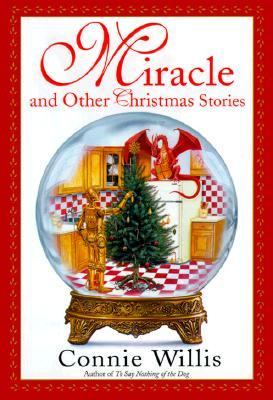
Miracle and Other Christmas Stories by Connie Willis caught my eye because it was not only close to the top of a list of recommended Christmas reads at Goodreads, but also happens to be a book by one of my favorite authors.  

Connie Willis is known as a sci-fi author, although at least one of the books I've read had more of a common scientific setting than the otherworldly type of location and storyline that typifies sci-fi.  

In Miracle and Other Christmas Stories, Willis shows off her knack for observing the absurdities of everyday life.  Some of the stories are humorous, some just a touch magical, one a time travel, one about possible alien invasion and one a mystery.  Willis said she wrote them with the goal of avoiding the usual sappy or depressing fare and I think she succeeded brilliantly.  I absolutely loved this book.  I had favorite stories, of course, but I really liked them all.  Again, Highly Recommended.  


So . . . even though it's only October and it seemed a little bizarre to sit down with Christmas stories, at first, I absolutely loved all three of the books in this post and plan to keep every one of them for rereading.  Usually, I just read Christmas stories and donate them, so that's a pretty unusual statement.  

©2012 Nancy Horner. All rights reserved. If you are reading this post at a site other than Bookfoolery and Babble or its RSS feed, you are reading a stolen feed. Email bookfoolery@gmail.com for written permission to reproduce text or photos.