Showing posts with label Penguin Books. Show all posts

Wednesday, March 02, 2022

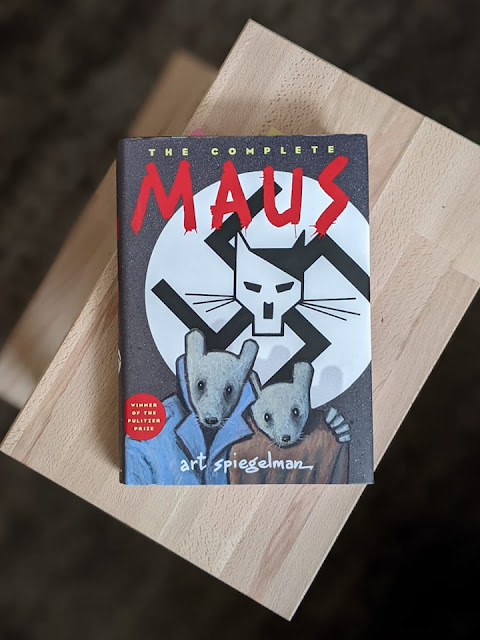
The Complete Maus by Art Spiegelman


I bought a copy of The Complete Maus by Art Spiegelman (both the Pulitzer-winning original and the follow-up in one volume) after reading about Maus's removal from a curriculum in Tennessee. I'm sure you've all heard about that if you're in the US. I've had it on my wishlist for years and at one point actually owned a copy of the original with a cover that was falling off but got rid of it without reading it during one of my book purges. At the time, I didn't know what it was about; I'd bought it used on a whim when I'd never read any graphic novels or biographies, probably out of curiosity. Then, I didn't get around to reading it. 

For those who don't know, Maus I: A Survivor's Tale is a graphic memoir about author and artist Art Spiegelman's parents' experiences leading up to and during WWII and the author's difficult relationship with his father. Art Spiegelman's father was a Polish Jew. Maus I first tells the story of how his parents met, married, and started a family as Hitler was coming into power. During the early years of the war, Art's parents either managed to find jobs, hide, or escape arrest numerous times but had many harrowing close calls. The book goes back and forth between Vladek Spiegelman's experiences and Art's determined effort to get the full story of what happened to his family, including a brother who died during the war, out of his father and try to locate his mother's diaries. 

The second book, Maus II, describes his father's experiences in a concentration camp after he and his wife were imprisoned and separated. Again, it goes back and forth in time as the author deals with his difficult father and gradually learns the complete story. 

I chose to buy The Complete Maus so I could judge its merits for myself after reading that the Tennessee school board members had complained about nudity, violence, and profanity in the book. My questions were, "How much nudity and profanity are there in the book(s)? Is anything portrayed genuinely offensive or is the storyline important enough to negate any negative aspects?"

First of all, you must know that we're talking about people portrayed as mice (Jews), cats (Nazis), and other animals (pigs were, I think, Poles who were not Jewish, but I'm not certain), except when he portrays his mother's suicide. In that case, he reverted to human images and showed a partial image of his mother's naked body in the bathtub, where she took her life. I counted a total of 7 instances in which profanity was used, all of which are words heard regularly on TV. When the Jews were forced to stand around naked, you do see tiny little man parts on the mouse bodies. And, yes, there are images of legs and feet when Nazis hanged Jews, either as punishment or for sport. All of this is less offensive than the factual horror of what the Nazis did, of course. Who cares about a few bad words and a little nudity when Maus has, as teachers say, told the historical truth of Nazi cruelty effectively?

Highly recommended - There is nothing in The Complete Maus that kids today haven't seen when it comes to the items school board members in Tennessee found offensive, and Maus is an important book, one that not only describes the Holocaust and its horrors but also portrays a difficult relationship between father and son that likely has made a lot of people with equally difficult relationships feel a little less alone. Suicide is a third topic that is addressed, although only marginally as his father describes his mother's battle with recurring depression that first began as postpartum depression. 


©2022 Nancy Horner. All rights reserved. If you are reading this post at a site other than Bookfoolery or its RSS feed, you are reading a stolen feed. Email bookfoolery@gmail.com for written permission to reproduce text or photos.

Thursday, October 18, 2018

The Sadness of Beautiful Things by Simon Van Booy


[...] Every heart had belonged to someone, somewhere. 

Lenny had seen films about it, but there were those who were actually present, those whose cries tore the air, whose bones are in earth, turning every thousand years. Those whose lives we still touch through the sadness of beautiful things. 

p. 142

A young family's house burns and they have no insurance, but an anonymous neighbor mysteriously offers to replace it. A man becomes almost paralyzed with depression but when he's reminded of a special memento, he realizes he must fulfill a childhood dream. When a boxer is mugged, it becomes a surprising opportunity to help turn the mugger's life around. In The Sadness of Beautiful Things, the contrast between tragedy and beauty is illuminated in simple, gorgeous prose.

I always take longer than I want to to review Simon Van Booy's new books because I have to read them two or three times, before I can write about them. The first time I just soak up the beauty of his words. The second time, I let myself mark favorite passages. If there's a third time, it's usually just because I can't bear to put the book on the shelf, yet, and want to experience the stories one last time. And, then, of course I return to his books when I need to immerse myself in something wondrous. Once again, the pattern held and I read the new book twice.

The Sadness of Beautiful Things is a collection of short stories (one of which may come close to being novella length, although I can't say for sure) that are written in his typical prose: few words, but with impact and a unique rhythm that is quickly recognizable if you've read any of his previous books. From the title, you can tell that each of the stories delves into real life, the highs and lows, how things can be both beautiful and horrible at the same time, like snow falling on an accident site. Most of the stories in The Sadness of Beautiful Things are based on true stories that were told to the author.

Highly recommended - As usual, I have some particular favorites, but I always fall in love with Simon Van Booy's short stories and The Sadness of Beautiful Things is yet another wonderful volume that I'll place on the good shelves and return to many times.


©2018 Nancy Horner. All rights reserved. If you are reading this post at a site other than Bookfoolery or its RSS feed, you are reading a stolen feed. Email bookfoolery@gmail.com for written permission to reproduce text or photos.

Wednesday, January 11, 2017

Everything I didn't review in 2016, Part 2

This will be the last post covering the books I neglected to write about in 2016. Fortunately, I kept up pretty well, in general.

Breakfast at Tiffany's by Truman Capote is a book that I had on my shelf for a while but had not gotten around to reading. It was my F2F book group's September selection and that gave me the nudge I needed. Since it's a classic, it was also my classic read for the month. I've attempted to watch the movie and found it bizarre and hard to follow, but I'm sure I would enjoy it, now. Holly Golightly is an interesting character, a woman who escaped her past and remade herself as a woman living off rich male companions. Her story is told from the viewpoint of a neighbor and friend. Now that I understand the character and her motivations, I think I would get the movie just fine. But, I haven't watched it, yet.


The Brief and Frightening Reign of Phil by George Saunders is a book that I happened across when I decided I wanted to own a copy of Tenth of December, a book I read and loved, also by Saunders. Honestly, it's probably the cover that convinced me to buy it. I love that cover. And, the content is every bit as fun and wacky. The inhabitants of a place called Inner Horner come into dispute with their neighbors in Outer Horner when their home suddenly shrinks and they no longer fit on the tiny bit of land alloted to them. A tiny, hilarious book that I presume is an allegory (but, honestly, I just don't know), The Brief and Frightening Reign of Phil is bizarre, thought-provoking, strangely insightful, and also one of my favorite reads of the year. I'm glad I bought it; I plan to reread this one regularly.

Leveling the Playing Field: The Democratization of Technology by Rod Scher was not meant to end up in the end-of-year batch, review-wise. I think I must have not realized I hadn't reviewed it at the blog because I put up a review at Amazon when I was asked to do so. Mea culpa. By "the democratization of technology", the author means that most inventions go from being hard to acquire and expensive to cheap and widely available. He starts out with the invention of fire and then progresses to such things as books (how they became more widely available with the advent of the printing press), computers, 3D printers, The Internet of Things, and the GPS. I had particular favorites amongst the chapters; I can't say why, but the book is fascinating and very readable. A side benefit to this book is that the author described a few websites, one of which I zipped off to check out. I ended up finding a perfect Christmas gift at that website, so thank you, dear author, for that.

The View from Flyover Country: Essays by Sarah Kendzior is an e-book that I purchased after reading a ton of Kendzior's tweets. There's a bit of repetition within the essays but that was not a bad thing for me because it helped clarify some of what she had to say about things like the difficulties faced by a younger generation in which the norm is quickly becoming a requirement to work an unpaid internship in order to qualify for a job and why internships and other poorly paid introductory jobs mean some fields are dominated by people who are already economically advantaged. Although I can't recall the other topics, a good portion of the essays dealt with racial and economic inequality. A very good read and it's notable that she has a doctorate in authoritarian regimes, so her tweets about the incoming Presidential administration are terrifying but informative.

Think Happy Be Happy has no credited author but is a collection of inspirational quotes, sayings, and some miscellaneous fun things like playlists. I've got a flag marking one of those, the "Fearless Playlist" with songs like "Just Say Yes" by Snow Patrol. On the opposite page it says, "'I am not afraid of storms for I am learning how to sail my ship.' -- Louisa May Alcott " So, it's basically a little book of, as it says, "Art, inspiration, joy," very upbeat and beautifully illustrated. One of my favorite pages says, "Hell yes!" with a little devil in a burning background. It was part of the reason I chose "Yes" for my word of the year. I haven't torn that page out, yet, although I'd like to. I'm not so hot at damaging books.

I Could Pee on This and Other Poems by Cats by Francesco Marciuliano is just as silly as you'd expect but it has photos of cats and it made me laugh so I'm glad I finally managed to acquire a copy. I think I may have mentioned this, already, but I stood in Target and read bits and pieces of I Could Pee on This when it was a fairly new release, maybe a year old. It made me smile, so I put it on my wish list and I just finally found it at a price I found tolerable when we were visiting Kiddo, a couple weeks ago. While the guys went into an office supply store to find something to organize papers, I sat in the car reading and laughing. I'll reread this one many times. It's worth owning a few small things that are guaranteed to make you smile.

That's it! I will post my end-of-month for December (it will be brief), publish the full list of books read, and then I'm done with 2016!!

©2017 Nancy Horner. All rights reserved. If you are reading this post at a site other than Bookfoolery  or its RSS feed, you are reading a stolen feed. Email bookfoolery@gmail.com for written permission to reproduce text or photos.

Mini Reviews - The Orphan's Tale by Pam Jenoff, Appointment in Samarra by John O'Hara, Wild Pork and Watercress by Barry Crump

Since I have so many reviews remaining from 2016 and another 2 to hit in 2017, I'm going to go ahead and revert to the mini review format, for now. If there are any books that I believe require more depth in reviewing, I'll save them for separate posts. I'll post my December reads, later today.

The Orphan's Tale is my first read by Pam Jenoff, in spite of the fact that she writes about WWII. I don't know what took me so long to get to her books. The story is about two women. Noa was kicked out by her family after falling pregnant at 16, the father of her child a Nazi soldier. Separated from her own child, she has saved a baby found in a freezing train carriage. Astrid was forced to divorce her Nazi husband and leave her home because of her Jewish heritage.

Astrid grew up in a German circus and her family has disappeared. When a neighboring circus takes her in she is grateful but haunted by the loss of her family and perpetually in danger. After Noa shows up with the baby and is also given refuge, Astrid reluctantly teaches her to work on the flying trapeze. When they travel across Germany and Noa falls for the son of a mayor who works closely with the Nazis while Astrid's boyfriend refuses to stop breaking the rules, the dangers sharpen. Will Noa and Astrid be able to keep each other and the baby safe?

There was a lot that I loved about The Orphan's Tale. I liked the fact that I learned about a new facet of life during WWII. I liked the fact that it focused on specific issues that were problematic for women. And, I thought the ending was both heartbreaking and beautiful. There were a couple problems I had with the book, though. The main one was stylistic. The author used the passive voice and it took me ages just to learn to stop mentally rewriting sentences. So many had dones and had beens. The Orphan's Tale needed a dedicated editor to shift its prose away from the passive voice. The other problem was minor: I really don't like circus settings. I thought I would be okay with a circus setting and I did enjoy learning about what it was like within that kind of setting during WWII, but it still was not a setting I enjoyed and I occasionally found myself bored with the details of training someone to be an aerialist.

Recommended but not a favorite - I'm glad I read The Orphan's Tale and I will happily read more by Pam Jenoff but there were some minor frustrations. Definitely a unique setting for WWII and solid storytelling. Crucially, the ending felt perfect in a way few endings do.

Appointment in Samarra by John O'Hara - My classic choice for December, I knew Appointment in Samarra was not going to be a happy tale. I'd read about it a bit and the fable about death finding a merchant in Samarra makes it clear that the ending will not be a pleasant one. But, the writing is superb and I was quickly swept into the story.

Julian English finds one of the members of his club particularly annoying and thoughtlessly tosses his drink in the man's face. The next day, his wife Caroline talks Julian into going to apologize to Harry Reilly, the victim, but Harry is unwilling to see him. It then begins to become clear just how much damage Julian has done to his standing. Slowly, Julian begins to unravel, in the process throwing away everything he's worked for and ruining his closest relationships. What will happen to Julian and Caroline?

Well, the fable makes it pretty obvious but it's still just a bit shocking, in the end.

Highly recommended - Sad as it is, Appointment in Samarra is impressively written and when I look back at 2016's classic choices, I have a feeling it will be one of my favorites.

I ordered a copy of Wild Pork and Watercress by Barry Crump after watching the movie Hunt for the Wilderpeople and finding out that it was based on a book. I love watching a movie and comparing it to the book (better that way than reading the book first and being disappointed, actually) and they were definitely poles apart, although both are set in New Zealand - so, at least the book didn't suffer the fate of being Americanized.

Ricky Baker has been taken in by his Aunt Bella and Uncle Hec. At 12 years old, he's overweight and has spent much of his life being shuffled about. Aunt Bella is warm and loving, a great cook, and happy to step in as a surrogate mom. Uncle Hec is a curmudgeon and former inmate. When Aunt Bella dies suddenly, Hec is heartbroken and decides to head into the bush. But, Ricky will be sent back into foster care if Uncle Hec doesn't take him along. Reluctantly, Uncle Hec agrees to let Ricky come along.  They head into the bush to hide out till Ricky turns 16, when he'll be free of the social system.

That's the book version and they do, in fact, succeed in hiding out for about 2 years, sometimes while being pursued by authorities. Ricky and Uncle Hec make a single friend while on their adventures and Ricky becomes an expert hunter. Because the book is a survival story in which they hide out for literally years, it's quite different from the lighthearted comedy film. But, both are terrific in their own ways. The book is wonderful for being a survival story that ends mysteriously, the movie for its sense of humor. Both describe a building relationship with heart and they both have meaningful, yet extremely different, endings.

Highly recommended - I ordered my copy of Wild Pork and Watercress from Book Depository and it was shipped from Australia. Then, it became available on Amazon. Oh, well. It was worth the wait. I enjoy survival stories and it was fun mentally comparing the book with the movie, as I read. Wild Pork and Watercress has the feel of a YA because Ricky tells the story, although I'm not sure how it would be shelved in New Zealand.

©2017 Nancy Horner. All rights reserved. If you are reading this post at a site other than Bookfoolery  or its RSS feed, you are reading a stolen feed. Email bookfoolery@gmail.com for written permission to reproduce text or photos.

Thursday, February 19, 2015

Two thrillers: North of Boston by Elisabeth Elo and The Girl on the Train by Paula Hawkins

2015, besides being a slower reading year, seems to be one in which I've read a lot of books in pairs: two books about the Great Depression, two thrillers, two children's storybooks (reviews forthcoming). In the case of the two thrillers, I just happened to be in the mood for fast-paced reads at the same time I came up with a story idea that's on the thrillery side (necessitating a little thriller reading to find examples of good pacing).


Briefly, John Rodgers and Jean-Luc square off, shoot subtly hateful glances at each other. Imagining that these two men could agree on anything is like imagining that the north and south poles could overcome their magnetic issues and meet for lunch at the equator.

--from North of Boston 

North of Boston by Elisabeth Elo was one of the books recommended to me when I asked for thriller title suggestions from friends. And, then the friend who recommended the book offered to send me her copy (which has a different cover than the one at left but I couldn't find a decent image). I'm so glad she did.

Pirio Kasparov was on a fishing boat with her friend Ned on a foggy morning when a freighter ran into the boat, killing Ned and leaving Pirio clinging to flotsam for hours in frigid water. Convinced that the collision was not an accident, Pirio begins to investigate, uncovering a tangled web of deceit that leads her to discovery and danger.

I have mixed feelings about North of Boston. I loved the writing, adored some of the characters (especially Pirio and her best friend's son, Noah), appreciated those who were unreliable, liked the added interest of the question, "Why did this character survive something that kills most?" and really liked where Pirio's search led -- to a legitimate world concern. But, I didn't find the book gripping, nor did I always find Pirio's ability to keep going in spite of serious injury entirely believable. Still, a solid read, definitely well-written and recommended.

The Girl on the Train by Paula Hawkins was a total risk. You've undoubtedly heard of it, by now -- the book everyone is calling this year's Gone Girl, the story of a woman who sees the same couple from the train most weekdays and imagines their perfect life until . . . a kiss, a death, a mystery, and somehow Rachel ends up in the middle of a tangled web.

I haven't read Gone Girl but I'd read a few reviews of The Girl on the Train, knew friends were reading it, and saw that the buzz was growing. What convinced me to spend some of my Christmas money was none of the above. I simply liked the idea and the setting. A London setting is always going to grab my attention, especially when the story happens to fit the characteristics of something I'm seeking (in this case, of course, an engrossing, fast-paced read) with gift card money in hand.

As it turned out, I did find The Girl on the Train every bit as gripping as I hoped. The reviews I read before buying were mixed. A lot of people didn't like the characters. Too flawed, too unlikable. I tolerate unlikable characters a lot better if I know they're coming, so I opted to go ahead and order the book and hope for the best.

Fortunately, The Girl on the Train was exactly what I was looking for and, nope, I didn't mind the characters. Yes, the women are definitely unlikable -- all of them. But, each is flawed in ways that I found believable. I particularly found the alcholic and unreliable main character had the ring of truth. I also thought the use of three viewpoints worked very well and, even though I figured out "who done it" around 100 pages before the end of the book, the pages continued to fly. Highly recommended.

North of Boston and The Girl on the Train both have substance-abusing characters in addition to a mystery and it was fascinating to see how that played out in both books. I thought it was a little better handled in The Girl on the Train but Rachel is the character I considered the female protagonist, in spite of the fact that the book is told through several different points of view, and in North of Boston it's Pirio's best friend who is the substance abuser so Rachel's alcoholism is key to the plot while Thomasina's (that of Pirio's friend) is not. That may have impacted how I feel about the use of substance abuse in the characterization. Both fed nicely into the reading of my book group's latest read, The Road to Echo Spring: On Writers and Drinking by Olivia Laing. More on that later, I hope.

©2015 Nancy Horner. All rights reserved. If you are reading this post at a site other than Bookfoolery  or its RSS feed, you are reading a stolen feed. Email bookfoolery@gmail.com for written permission to reproduce text or photos.

Tuesday, July 29, 2014

Mini reviews - The Truth About the Harry Quebert Affair by J. Dicker, Parson's Green by F. Bagley, Goodnight June by S. Jio


None of the following books were sent to me by publishers and none left a lasting impression, so I'm going to just give them quickie reviews.

The Truth About the Harry Quebert Affair by Joel Dicker is a chunkster at 656 pages and I do believe it could have easily been edited down to a much more reasonable length but I still found it engrossing enough to finish within just a couple days. 

Harry Quebert is a famous novelist whose protégé, Marcus, has himself become a bestselling novelist. The deadline for Marcus's second book is looming and Marcus hasn't written a word, so he goes to visit Harry, hoping for inspiration. While visiting, Marcus becomes involved in a murder investigation. Decades in the past young Nola, the love of Harry's life, disappeared and now her body has been found with evidence that incriminates Harry. Marcus believes Harry is innocent and sets out to solve the mystery.

I found the fact that both writers became fabulously wealthy very difficult to buy into and grew weary of Harry and Nola gushing about their love for each other. But I was captivated enough to ignore the book's flaws, whip through the reading and give it a 4-star rating, if for no other reason than the fact that I dislike mysteries, in general, so I figure if a mystery can hold my attention for over 600 pages, it ought to get an above-average rating. For the most part, the French author's understanding of Americans is pretty impressive, as well. The Truth About the Harry Quebert Affair is an award winner in the author's home country. Recommended, but you'll probably either love it or hate it.

Add caption
Parsons Green by Fiona Bagley was this month's selection for my F2F book group. Cricket McLean and her mother, Claudia, have always been able to see ghosts. Claudia is a travel writer and when she decides to spend a summer helping out in a friend's bookstore in Savannah, Georgia, she is not surprised to find that her rental house is haunted. But, at least the ghosts are friendly.

Cricket doesn't want to spend all her time in the bookstore, so she goes out in search of a job and finds a position working as a tour guide in a local mansion called Chartwell House. There, a baby was murdered, the baby's mother found guilty and hanged for her crime. But, was she truly guilty? As Cricket explores the house and its history, she is able to see scenes that lead her to believe that there are dark forces at work and she must solve the mystery to put at least one ghost to rest.

I thought Parsons Green was a pretty good story, apart from the fact that a few too many people believed in or saw ghosts. My biggest problem with it was the common self-published-book problem: Parsons Green is desperately in need of a professional editing job. Had the book been much longer, I probably wouldn't have made it all the way through the reading, but it's short and the story is compelling. Recommended with a warning that the sheer quantity of errors is exhausting.

Goodnight June is the first book I've read by Sarah Jio, although I've been hearing gushy praise of her books for several years.

June is a cut-throat New York banker whose job is to take over small businesses that are struggling and sell off their assets. June moved to New York from Seattle and has not returned home for several years. She has few friends, no romantic prospects, and she works long hours. June is so stressed that as Goodnight June opens, she's in the hospital to get her blood pressure under control.  She's only in her 30's.

When June finds out her Aunt Ruby has died and left June her beloved bookstore, June travels to Seattle intending to simply sell the store and rush back home. But, she meets a handsome restaurateur, finds a set of letters connecting the bookstore and her aunt to Margaret Wise Brown's book, Goodnight Moon, and decides she must stay to save the bookstore. The store is failing and June finds herself in the same position as the business owners whose livelihoods she has heartlessly ripped away.

Goodnight June is fluffy, sentimental, beachy reading. It was the right book for the moment -- I was swept away, at first, and I enjoyed the fact that it was a quick read. But, it's more than a little far-fetched and the many strands had a "way too convenient" aspect that pulled me out of the reading. In spite of the fact that I had trouble buying into the storyline, I finished Goodnight June, so I gave it an average rating. Recommended for a fluff break with a warning that the story is extremely far-fetched.

If you've already read Goodnight June, you might be interested to know that Margaret Wise Brown's New York writing cottage, Cobble Court, is under threat and may be torn down to make space for condominiums.

©2014 Nancy Horner. All rights reserved. If you are reading this post at a site other than Bookfoolery  or its RSS feed, you are reading a stolen feed. Email bookfoolery@gmail.com for written permission to reproduce text or photos.

Thursday, March 01, 2012

Three more minis - Cruising Attitude, The Selected Works of T. S. Spivet and Peace is Every Step

Cruising Attitude by Heather Poole is subtitled "Tales of Crashpads, Crew Drama, and Crazy Passengers at 35,000 Feet." I'm guessing that between the flight attendant's uniform and the word play in which "attitude" is substituted for "altitude" that not a single one of you looked at that cover and thought, "Hmm. I wonder what on earth that's about?" Am I right? Actually, I do like the clarity of the cover.

Cruising Attitude is the third flight attendant memoir that I've read, if you count the classic, "Coffee, Tea or Me?" by two anonymous flight attendants who were later accused of making it all up. While Cruising Attitude is not as laugh-out-loud funny as the other two books I've read, I loved the fact that Heather Poole goes all the way back to her training and fills you in on what it's like to be a flight attendant -- how they're trained, what the lifestyle is like, the complexity of scheduling, which planes and cities a career flight attendant aspires to work in and why some attendants commute to their flight base rather than living there, why your flight attendant and pilot might be really, really hungry -- as well as the usual crazy passenger stories, a bit about her love life and stories of friendship with other flight attendants.

Recommended - Engrossing, entertaining and highly informative. I enjoyed Cruising Attitude immensely. While the sheer quantity of rude and crazy passenger stories may make you a little bit more nervous about flying, Poole's reassurance about turbulence and her obligation to put safety above all else offset the stories about the nuts very nicely. You'll also come out of the reading knowing what is expected of you as a passenger -- what can get you removed from a plane, what ticks off a flight attendant, why you should wait to take your drowsy meds till you get on the plane and the reason a flight attendant will awaken a passenger rather than allow him or her sleep through a meal service. The only thing I disliked about this book was the repeated use of the deliberately misspelled "Buh-bye". Annoying.

The Selected Works of T. S. Spivet by Reif Larsen is a book that I'm relegating to mini status merely because it's been so long since I read it. T. S. Spivet is the story of a precocious 12-year-old, map-making genius who wins an award that leads him to set off from Montana on a journey to Washington, D.C.

The Selected Works of T. S. Spivet was the February selection for my face-to-face book group. Unfortunately, it was raining cats and dogs and only 4 people showed up. The conversation was pretty much a dud. Our fearless leader said everyone who called to say, "I'm not coming," at the last minute loved the book. Most of the group members who showed up were a little iffy because they found the illustrations and notes distracting. I loved it.

Highly recommended - An adventurous, brilliantly-written, charming, funny, poignant and surprising story. Young T. S. is a delightful character, humble and lovable in spite of his brilliance. My thanks to SuziQ, whose enthusiastic review led to my purchase of the book as well as the suggestion that the book group read T. S. Spivet along with me. The meeting may have fallen flat, but the reading experience was awesome.

Peace is Every Step by Thich Nhat Hanh is one of the books I removed from my closet, this past weekend, during the Cleaning That Made My House Even Scarier Than Normal. Subtitled, "The Path of Mindfulness in Everyday Life," it contains writings about how to become more "mindful," which I'm interpreting as "in the moment" -- aware of what you are doing, who you are speaking to, how you respond, your emotions, the life around you, etc. It's about living a peaceful, joyful life and turning the negatives of your life into positives.

I had a migraine that was really pissing me off, while I was reading this book, and loved the fact that he was telling me to be mindful of my pain so that I'd appreciate it more when I'm not hurting. I was also informed that my anger can be turned to compost to grow happier thoughts. There are lots of gardening metaphors.

Highly recommended - You don't have to be a Buddhist to learn and practice the kind of thought process Thich Nhat Hanh recommends. A wise, thought-provoking, wonderful little book.

In other news:

I'm going to upload my Fiona Friday post then take off a week to practice mindfully cleaning my house and peacefully reading. I moderate comments, so don't freak out if you try to comment and it takes a day or two to show up, okay?

This may end up being one of those months that I end up doing a lot of mini reviews and periodically disappearing for large stretches, especially given the fact that Kiddo will be home for Spring Break somewhere in the middle and I like to be present when he's around. The weather is fickle but on the good days the sun shines and a breeze blows. These are days that I need to spend my time outdoors, before the real heat descends. We broke a heat record, today, with a high of 83 degrees, so we're getting there quickly.


©2012 Nancy Horner. All rights reserved. If you are reading this post at a site other than Bookfoolery and Babble or its RSS feed, you are reading a stolen feed. Email bookfoolery@gmail.com for written permission to reproduce text or photos.

Tuesday, January 17, 2012

Me Before You by Jojo Moyes


When Bellezza wrote about Me Before You, I knew I absolutely had to read the book. I already was a fan of Jojo Moyes and the story touches on an issue that's very important to me: the right to die with dignity. But, I had no idea just how deeply moving the story would be. Like Bellezza, I have to write about it right now, while the feeling is still fresh, with 3 crumpled, damp tissues nearby and Isabel kitty still recovering from watching with wide-eyed concern as I sobbed.

Me Before You tells the story of two people whose lives have abruptly changed. As the book opens, we meet Will Traynor, a man who is a successful businessman and world traveler, a man who loves life and lives it to the fullest. He is dashing off to work in the pouring rain when tragedy strikes, leaving him unable to function on his own, a quadraplegic who can feel pain but has very limited movement in only one arm.

Fast-forward two years. Louisa Clark has just lost her job as a waitress at the Buttered Bun, a cozy cafe near the town's castle. 26 years old, living at home, dating the same man she's been with for 6 years, Lou has no interest in change and no idea what to do next; however, she has no choice but to work. Her father is likely to lose his job, her mother is tasked with caring for her grandfather, who had a stroke, and her sister's job pays very badly.

Lou applies for a job as carer for a paraplegic as a last ditch effort. It's a temporary job and she has no experience caring for a disabled man. But, Will's mother isn't looking for experience. Will has only promised his mother 6 more months before he plans to take his own life at Dignitas. Mrs. Traynor hopes that Lou's bright personality will help Will to realize that his life is still worth living.

It takes time for Will and Lou to warm up to each other, but her playful sense of humor and sparkling wit can't be overlooked by a man as sharp as Will Traynor. Slowly, she draws him out of his bitter shell and their relationship deepens. And, it's a two-way street. At the same time Lou is making Will's days pleasant, he is teaching her how to step outside her self-imposed boundaries, to live life to the fullest.

I won't tell you how the book ends, apart from saying that I was a bit astonished to find the story both heartbreaking and beautiful without being depressing. Me Before You is a love story, but it's so much more. It's about really living life every day, the question of whether or not anyone has a right to die with dignity at a time of his or her own choosing, the emotional and physical pain of quadriplegia and how a relationship that lacks the usual physical comforts can be much deeper and more intimate than the norm. Me Before You is a powerful story that brings up a lot of questions and would make an excellent discussion book (although, perhaps, one that could potentially lead to a bit of a shouting match between those with differing opinions).

Highly recommended to those who love a meaningful story of love, life and loss. Miserably, compulsively readable, with exceptional dialogue and character development and not a single wasted word in its 481 pages (in my humble opinion). Me Before You was just released this week by Penguin Books, although it appears that it's a UK release and not yet available in the US [Update: The author has confirmed that Me Before You has just been released in the UK but said she hopes a US release will be coming up "very soon"]. Bellezza very kindly sent me her copy when I mentioned how much I love Jojo Moyes' writing. Thank you, Bellezza!!

Be sure to check out Bellezza's review of Me Before You and Jojo Moyes' website. I've read two other books by Jojo Moyes: Foreign Fruit and The Ship of Brides. And, I have two others waiting on my shelves. Wahoo for that.

I suppose this means my "blogging break" has just gone out the window. Well, that's fine. If saying I'm going to step away leads to suddenly finding that I'm ready to write reviews, I'm okay with that.

©2012 Nancy Horner. All rights reserved. If you are reading this post at a site other than Bookfoolery and Babble or its RSS feed, you are reading a stolen feed. Email bookfoolery@gmail.com for written permission to reproduce text or photos.

Wednesday, December 14, 2011

Matched by Ally Condie

Matched by Ally Condie

I've had Matched on my wish list at Paperback Swap since its release but when I saw a copy at Sam's Wholesale Club for a reasonable price, I snatched it up. It seemed a likely candidate to help me break my reading slump and, as it turned out, Matched definitely helped me get back into my reading groove.

Cassia has always been very trusting and obedient. When the book opens, she's excited about her Matching banquet, where she'll see the name and face of the boy she'll eventually marry. She's particularly excited to find out she's matched to a good friend, Xander, but when she begins to read the data about him, another face briefly flashes onto her screen and then disappears. She knows that face, as well. Did the Society make a mistake when matching her? Why is the other boy, Ky, labelled in a way that makes it impossible for him to be matched?

When Cassia and Ky end up on a work team together and find that sparks are flying, Cassia becomes determined to find answers while fighting her urge to let go of her Xander, whom she knows to be an excellent match.

I was expecting a run-of-the-mill dystopian novel, to be honest, but I found smart, thought-provoking writing, likable characters and a dilemma easy to find yourself quickly invested in, along with a nicely fast-moving plot with moments of slow build.

In a Twitter chat, this week, author Jay Kristoff said, "I think the most important thing to remember when worldbuilding is that worlds are populated by PEOPLE. Character first. Always." That's where Ally Condie really shines. Her characters are believable and the world seems to be built around them not designed first and populated later. While there are times that you feel like, "Sigh, another dystopian. Same old struggle against the powers plotline," Matched is suitably unique and I'm quite anxious to read the next book in the series. There was a bit of a cliff-hanger ending but the book pretty much felt complete to me.

Recommended to lovers of Young Adult dystopian fiction. Light reading, quick-paced but with well-rounded characters and very good writing.

©2011 Nancy Horner. All rights reserved. If you are reading this post at a site other than Bookfoolery and Babble or its RSS feed, you are reading a stolen feed. Email bookfoolery@gmail.com for written permission to reproduce text or photos.

Garlic and Sapphires by Ruth Reichl

Garlic & Sapphires: The Secret Life of a Critic in Disguise by Ruth Reichl is one of several memoirs by the former New York Times food critic and details her time working for the New York Times, including how she came to move to New York, her personal choices about reviewing, many of her experiences eating out in disguise, some recipes and a number of her columns for the New York Times (as well as the praise and/or backlash she received for her ratings).

Garlic & Sapphires is really quite fascinating. I don't think you have to be a foodie to appreciate reading about a woman whose job carried such surprisingly celebrity status that she had to continue to find new ways to disguise herself to make sure she received food and service in the way any other New Yorker might, for better or worse. It's particularly enjoyable to read about how she felt in disguise, how each new costume made her feel as if she was a completely different person.

Highly recommended to memoir lovers, foodies, and anyone who likes reading a book with recipes scattered throughout. My beloved daughter-in-law, who is a fabulous cook, loaned me her copy of Garlic and Sapphires. Thanks, Sarah!


©2011 Nancy Horner. All rights reserved. If you are reading this post at a site other than Bookfoolery and Babble or its RSS feed, you are reading a stolen feed. Email bookfoolery@gmail.com for written permission to reproduce text or photos.

Tuesday, June 14, 2011

Regeneration by Pat Barker

Regeneration by Pat Barker
Copyright 1991
Penguin Books - Historical Fiction/WWI
252 pages

Regeneration is the first in a series of books by Pat Barker that are set during WWI. I don't know how the series continues, whether it follows the same characters or new ones, but Regeneration is set at a mental hospital for shell-shocked soldiers called Craiglockhart in Edinburgh, Scotland.

The year is 1917 and W. H. R. Rivers has a new patient set to arrive. The patient is Siegfried Sassoon. Although Sassoon has had nightmares and a few horrifying hallucinations in the past, he is being sent to the facility mostly to keep people from having to actually address the issue Sassoon has brought up. Having composed a letter saying he thinks England needs to get out of the war, that men are dying needlessly, there are a few people who want him silenced and the best way is to make him appear unstable. His best friend also wants to prevent a court martial and helps to get Sassoon sent to Craiglockhart.

Sassoon is perfectly sane, although he does eventually develop an interesting problem with ghosts. But, he's required to chat with Rivers and through the interaction between doctor and patient, as well as a few other key characters, you get to know the doctor and his humane treatment methods in a time when post-traumatic stress was not yet identified or named and certainly not understood.

There's a lot to Regeneration, in spite of its fairly short page count. Toward the end, Sassoon is due to go in front of the medical board. In those days, a "cured" patient was sent right back overseas to fight, again. Sassoon, in spite of being strongly against the war, desires to return to the front. Rivers, meanwhile, has determined that he (Rivers, himself) is due for a change and there is a short but wrenching section during which he goes to London to check out the hospital where he will be working. There, the contrast between humane and cruel treatment is clearly drawn during a horrifying scene describing the "treatment" of a mute soldier forced to speak after hours of torturous shocks with electrodes.

I didn't realize Rivers, Sassoon and many other characters were actual historical figures until I got to the end of Regeneration and read the author's notes. Then I dashed over to Wikipedia to read a bit more. The Wikipedia entry about the Regeneration series is fascinating. I only read about the first book; from there, I jumped to the entry about Rivers and then read about Sassoon. The third book in the series, The Ghost Road, won the Booker Prize in 1995.

The bottom line:

A fascinating, sometimes horrifying but very vivid and realistic look at treatment of post-traumatic stress and injuries during WWI, with telling descriptions of experiences by the soldiers in treatment. While the author occasionally lost me -- sometimes in dialogue, chiefly when describing things that might be common knowledge in the British Isles or for those who are knowledgeable about WWI, but certainly vague in my eyes -- I thought Regeneration was engrossing and quite a learning experience. I do plan to read on, although I own a copy of Regeneration but not the other two books and it may be some time before I get around to the following two. Recommended, with a warning that Regeneration can be a painful, jarring and even gruesome read at times because it is so realistic. An excellent fictionalized account of real-life characters.

Former blogger Kookie (aka "Michelle") didn't like Regeneration, but I neglected to ask her why. I did think the author's writing was sometimes a little nebulous where it could have easily been made clear, but other than that . . . I really thought it was so very engaging and the characters so well-developed that I can't pick on it too much. I liked the way the characters seemed to make so little sense, at times, in their thought processes. It occurred to me that humans really don't necessarily make sense. We're illogical. We say one thing and do another or change our minds abruptly. That was a part of where the realism came into play.

Cover thoughts:

That's not the cover of my book, but it's my favorite of the images I found on Google Images. Mine is ugly. But, there is something very special about my copy. It has a few pages with little mouse bites. You can actually see the tiny teeth marks! I'm probably the only person on the planet who thinks that's cool.

In other news:

I am having a terrible, horrible, no good, very bad time getting around to blogging. I think it's probably a combination of heat and feeling a little overwhelmed with all that I have to accomplish in the coming months. So, while I keep thinking I want to clear out my sidebar by whipping out several reviews at once, it's not happening. If I continue to feel blah, I'll just take a couple weeks off. I don't have any scheduled reviews until June 30 so if I disappear for a couple weeks, you know when to return. I will have a post of Dug Down Deep by Joshua Harris posted on the 30th.

Photo of the day:

The cats aren't too energetic, either. Note the difference in size between my two girls. Isabel is now full-grown, so I guess she's just going to stay tiny and delicate. "Tiny" is, in fact, one of her nicknames. I've been calling her that since she arrived at our house. Last time she was at the vet, Izzy weighed a mere 5 pounds. I'd guess she's up to 6 pounds, by now. Fi, on the other hand, is a 13-pounder.


Facebook friends will have already heard this story, but I must share a little cat tale from this morning. I went out to pick up my new eyeglasses and when I returned, Isabel greeted me in the living room. I said hello and asked her, "Where's your sister?" Izzy looked at me, looked toward the kitchen and then went bounding off (bounce, bounce -- she really has the cutest way of running) to the breakfast nook, where she stopped directly below the chair in which Fiona was sleeping. She looked back at me and, of course, I exclaimed at her cleverness. And, then she jumped up into the chair next to Fi and ducked her head for a little grooming from sis.

That Isabel is one smart cookie! In fact, I've only had one cat I considered a little dim (Miss Spooky) but after her tremendously intelligent adoptive sister passed away, I discovered that I just wasn't paying attention. Spooky wasn't necessarily as sharp as Sunshine, but cats are pretty amazing creatures and they understand more than we often realize. Anyway, a little fun from the House of Bookfool.

Happy, happy day!

©2011 Nancy Horner. All rights reserved. If you are reading this post at a site other than Bookfoolery and Babble or its RSS feed, you are reading a stolen feed. Email bookfoolery@gmail.com for written permission to reproduce text or photos.

Wednesday, May 04, 2011

The Winter Ghosts by Kate Mosse

The Winter Ghosts by Kate Mosse
Copyright 2009
G. P. Putnam's Sons (Penguin)
Historical Fiction/Paranormal
265 pages

In his right hand, Freddie carried directions scribbled on the back
of a napkin from Bibent, where he'd lunched on filet mignon and a blowsy Bordeaux. In his left-hand breast pocket, he carried a letter patterned with antiquity and dust. It was this--and the fact that, at last, he had the opportunity to return--that brought him back to Toulouse today. The mountains where he'd come across the document had some strong significance for him, and though he had never read the letter, it was precious to him.

p. 4 of The Winter Ghosts, ARC (some changes may have been made to the final print version)

What's it about?

The Winter Ghosts is the story of Freddie, a grown man whose psyche has been wounded by parents who ignored him and the shock of devastating loss. During WWI, Freddie had a bit of a breakdown after his brother's death and he's still trying to come to terms with his loss a dozen years later. You could say he retains only a tentative grip on his sanity; at first, it seems as if he may fall apart at any moment.

The year is 1928. Seeking to resolve his feelings, Freddie travels to the Pyrenees, where he gets caught in a blizzard, has a wreck and hears the whispering of a ghost. Injured, he makes his way to a remote town in the mountains . . . and has an even more bizarre ghost experience. But, a young woman named Fabrissa leads Freddie to an important discovery that will help him recover and lead an entire village to healing and redemption.

What did Bookfool think?

Bookfool thinks you should be patient with this one. The Winter Ghosts is one of those books that I nearly abandoned because of a slow beginning and a sad wimp of a protagonist. At least, Freddie is hard to love, at first. As his background is revealed, Freddie's breakdown makes more sense. After his accident and hike into the mountains, things start to become more interesting. The pace picks up, more characters are introduced and -- although none of them are treated with much depth -- there is a sense of place that comes to the fore when he reaches the village.

Is The Winter Ghosts creepy?

I would use the words "haunting" and "atmospheric" but I didn't find this particular ghost tale creepy or frightening. The plot is even a little transparent, once you get to a certain point. Did I mind? No, by that point I actually liked the fact that I was pretty sure I knew what was going to happen and why.

I don't know that everyone would find it so predictable. I used to be absolutely terrible at figuring out plots before I reached endings, but it's really a rare author who totally catches me off-guard, these days. Sometimes I like being surprised at every turn and other times (as in the reading of Taichi Yamada's Strangers), I enjoy a slow unfolding of events because I'm swept up by craftsmanship and the overall storyline. In those cases, a certain amount of predictability doesn't hinder my enjoyment. And, I did like Kate Mosse's writing style, once I became accustomed to her pacing.

The bottom line:

Definitely recommended to the patient reader who doesn't mind a slower pace for the sake of lovely writing. Nearly two weeks after I finished reading The Winter Ghosts, it still hasn't let go of me. An atmospheric book with a well-grounded historical basis for its ghostly elements. The Winter Ghosts is slow-paced, but picks up speed, midway. The book is weakened a bit by a rather unlikable protagonist and his "redemption" is a bit rushed so I wouldn't call it the perfect novel, and yet The Winter Ghosts has somehow has managed to become a recent favorite.

If you're looking for action-packed suspense, The Winter Ghosts is not the book for you. I liked learning the history from whence the ghost story came (further description in the author's notes makes it doubly touching) and I think I'll actually enjoy the book more if I ever reread it. There was just something about it that grabbed me and held on, even after I closed the pages. I can't quite put a finger on it.

In other news:

Gah, I do not feel good, today. I'm tempted to pretend there's not a treadmill sitting beside me, but a very big part of me says, "No, no, no. You're fat." Wish that part of me would just freaking shut the heck up. I want a 24-hour nap, darn it.

What did Bookfool do, today?

First, Bookfool was rudely awakened very early by a friendly but persistent kitty who was not entirely clear about her demands. I think she was just in the mood to walk over me repeatedly and say, "Hello." Since I was up (bah, humbug to morning), I ran some errands and then walked around downtown Vicksburg to take flood pics. We went to the dock on Sunday. Here's the dock wall, where you can see marks describing various past flooding events, as taken on Sunday:

Oh, so hard to see! The bottom mark says "1961 Gage 44.9." Below that is a sign referring to the Corps of Engineers, the folks who are responsible for tracking such things. The Corps sign is visible under normal circumstances. As of 3 hours ago, the water level was at 48 feet and rising at a steady pace (between the second and third marks up from the water line). See the top mark? That's the level the water would have reached during the Great Flood of 1927 if the levees had held (62.2 feet) -- but they didn't, so the next mark down (56.2) is the actual flood level. The river is expected to crest above the actual 1927 flood level. I've heard 57, 58 and somewhere in between. Either way, it's a horror.

Around our area, this is huge. An entire school has been closed, Civil War artifacts are being moved to high ground, Red Cross shelters have been opened. You can't get to the dock, now. This is what I saw, today:

Those fellows to the right are Americorps volunteers. They were waiting for some equipment; they didn't sit around for long. You can see there's a little water outside the dock exit. The dock does occasionally get swamped but during the 2008 flood, they had few enough timbers that you could actually walk fairly close to the entrance and exit and look over timbers to see the flood water. Here's a wider view. I didn't reduce the size of this one, so hopefully you'll be able to click on it to enlarge. If you ever come to Vicksburg, the flood wall is worth seeing. It's taken many years to decorate, but all of the panels are now painted with murals, each of which portray some event in Vicksburg's history.

To the left of the red train station building and caboose, an additional barricade is being built. That means that gorgeous old railroad station (which is being turned into a museum) is going to be swamped. I imagine it'll survive but cost a pretty penny to clean up. In the background, you can also get a glimpse of the trees that are already partly under water. You can usually see the sandy opposite shore. I think, actually, this isn't really even the Mississippi River but the Yazoo Diversion Canal. Oh, wow. I'm going to have to run to the overlook to snap some bridge pictures. I'd forgotten about that -- must get pics of the actual Mississippi. It's fascinating watching the river rise, but horrifying to realize how many people this flood has already hit and will impact in the coming weeks.

Anyway, enough for one day. Tomorrow, The Peach Keeper!! Saturday, the world! Or, maybe a nap. Nighty night!


©2011 Nancy Horner. All rights reserved. If you are reading this post at a site other than Bookfoolery and Babble or its RSS feed, you are reading a stolen feed. Email bookfoolery@gmail.com for written permission to reproduce text or photos.

Thursday, March 31, 2011

Between Shades of Gray by Ruta Sepetys

Between Shades of Gray by Ruta Sepetys
Copyright 2011
Philomel Books - YA/WWII
352 pages

Lina, a Lithuanian, is 15 years old and looking forward to art school when the Soviet secret police pound on her family's door, allowing them mere minutes to pack. It's 1941. Her father has already been taken away, probably imprisoned, maybe already put to death in a prison camp. Lina, her brother Jonas and her mother have no idea where they're going. Ahead of them lies a treacherous journey to Siberia.

Along the way, Lina draws clues to let him know where they've gone, hoping he will be able to follow their path. Will Lina's father find her messages? Is he even alive? How long will her family be able to survive the cold and starvation?

One thing that never ceases to amaze me: How completely bottomless the well from which the stories of WWII are drawn. Ruta Sepetys is the daughter of a Lithuanian refugee and in the author's notes she describes how and why the stories of Lithuanians were suppressed. Stalin "cleansed" the Baltic region? I had no idea.

It's been a couple weeks since I finished reading Between Shades of Gray and Lina, upon reflection, is an interesting but fairly flat character so she hasn't stuck with me all that well. What has continued to roll around in my head is the story, itself. As Lina packs, she sets a loaf of bread in the window without realizing how valuable food will become to her family, instead packing the art supplies she values. When soldiers try to separate Jonas from Lina and their mother, her mother finds a way to keep them together. Cold, hunger, endless train rides followed by life working as slave labor on a farm and then more travel and deprivation, disease and cruelty -- and occasionally, amongst the horror, small acts of friendship. Those are the things that really linger in my mind.

Between Shades of Gray is a young adult novel that is gut-wrenching, believable, shocking and moving. The fact that it's aimed at a teen audience does not diminish the story in any way. I particularly loved Lina's mother. She's a character of immense strength and grace who not only manages to keep the family together and fed but also manages to make friends with almost everyone who crosses her path. Definitely recommended.

In other news:

I was aiming for "brief" with this review. How did I do?

I finished reading Home to Woefield two days ago and it was so completely wonderful that I'm having trouble getting excited about the books in my sidebar. I can't wait to babble about Woefield. In the meantime, I'll just go ahead and tell you it's worth buying. It's a five-star book. Trust me on that.

For the last week or two of March, I dropped the ball and didn't bother to keep track of books in/books out. But, I've got two arrivals sitting beside my head (there's a dresser not far away) and I'll dash to the bedroom to grab the others. Here you go . . .

Arrivals:

Dreams of Joy by Lisa See - from Random House
The White Devil by Justin Evans - from Harper (YA - creepy-looking!)
In Grandma's Attic and More Stories from Grandma's Attic - from B & B Media Group
True Courage by Steve Farrar - from B & B Media Group
The American Heiress by Daisy Goodwin - from St. Martin's Press

6 books went out the door, this week. I can probably get my records up-to-date but last time I looked, I had a net outgo of approximately 106 books for March. Not bad. I think I'll shoot for another 100-150 in April.

It has cooled off dramatically in our area but thanks to early heat, Mississippi is looking ridiculously colorful. It got so hot so fast (record-breaking upper-80s temps, last week) that a lot of things bloomed early and I totally missed the chance to photograph the wisteria. I always look forward to the wisteria. Here are some wet flowers from our library's garden:

And, a planter, still at the library. I haven't planted, yet, but I have some flowers sitting on the porch. It's rained most of the week. Hopefully, this weekend will be dry so I can get to the planting.

Kiddo read Jumper by Steven Gould, yesterday and has verified the comments I've read that the book is better, much better than the movie. Every time I turned around, there he was with the book in his hands. He used a paperclip as his bookmark. He's not particular, but he doesn't dog-ear (Thanks be to God Almighty -- I abhor dog-earing).

I'm a little worried about My Jane Austen Summer. Woefield after-effects aside, it's striking me as . . . weird. I just can't seem to follow the author's thought process. It's a tour book so I'll do my best to finish but I find I'd rather put it in a hamster cage than read it. Probably a good thing I don't own a hamster.

I think that's all the news. My headache has boomeranged on me and returned with a vengeance. Crap. I hate that. How has your week been?

©2011 Nancy Horner. All rights reserved. If you are reading this post at a site other than Bookfoolery and Babble or its RSS feed, you are reading a stolen feed. Email bookfoolery@gmail.com for written permission to reproduce text or photos.

Thursday, October 28, 2010

Nightshade by Andrea Cremer

Nightshade by Andrea Cremer
Copyright 2010
Philomel Books - YA/Paranormal
464 pages
Andrea Cremer's website

Calla Tor isn't a typical high school girl. A warrior and an alpha werewolf, she will soon turn 18 and be united with the alpha male from another pack, their packs combined in a secret ceremony. In the meantime, she goes to school as a human during the weekdays and takes her turn patrolling the woods with her best friend in the pack, Bryn, in her wolf form.

But, after Calla veers from her duties and risks her own life by saving the life of a human named Shay, things begin to change. When Shay appears at Calla's school and she finds that he has an unknown role in the lives of the Guardian wolves, nobody can figure out what's going on. While Calla tries to unravel the mystery of Shay's place in upcoming events with his help, she finds her attraction to Shay growing deeper. As they begin to uncover secrets and lies, she questions her place in a world where the male is the leader and finds the union with her future mate, Renier, threatened. Ren is none too pleased with Calla's obvious attraction to Shay. Will Calla abandon hundreds of years of her heritage and the destiny that's been hers since birth? What are the secrets being kept from Calla, Ren and their packs?

Nightshade is truly a knock-your-socks-off dive into an exciting new paranormal world. Before I even opened the book, my teenager managed to sneak off with my copy, read it in a single night and declare that I will be expected to acquire the next books in the series. I figured on that basis it was probably Kiddo's kind of book and not mine, but I was wrong. Nightshade held my attention with lots of action, interesting relationships between various pack members and their new leader or "Keeper", as well as a surprisingly believable love triangle that keeps the reader wondering, "Will she? Won't she?" till the end.

Calla is, at first, totally dedicated to her pack and convinced that her union, her job, her history is all as she has been told. She's a Guardian and she's tough, but she's also a follower. But, she slowly begins to question her place as she and Shay discover that the wolves' history is not at all what they've been led to believe. And, it's not just other wolves that she has to worry about.

I liked the dilemmas Calla was faced with, including the fact that she was going to fall second in leadership to the male head of the pack. Amy wrote to author Andrea Cremer to ask about the exploration of pack dynamics via gender in her fabulous review and got a terrific response. Actually, I just loved everything about Amy's review. Go read it. It's so much better than anything I have to say. I did manage to figure out Shay's place in the story long before the ending, but maybe that's just because I'm getting old and many, many storylines are becoming predictable for me. There were plenty of surprises and the book kept me guessing; I certainly had no idea what was going to happen in the end, in spite of guessing Shay's role.

The bottom line:

Action, emotion, group dynamics and a young woman growing as she learns to question her place and stand up for herself make Nightshade an exciting, well-paced addition to the world of paranormal reading and a book worth talking about. Definitely recommended for teens and adults.

Cover thoughts:

I just love that cover. The female looks like the heroine described in the book and calla lilies speckled with blood fit the name of that same character as well as depicting the dangerous, bloody world of werewolves at battle with other evil forces. My thanks to Penguin/Philomel for the advanced reader, which I received via Shelf Awareness.

©2010 Nancy Horner. All rights reserved. If you are reading this post at a site other than Bookfoolery and Babble, you are reading a stolen feed. Email bookfoolery@gmail.com for written permission to reproduce text or photos.