Showing posts with label graphic memoir. Show all posts

Wednesday, March 02, 2022

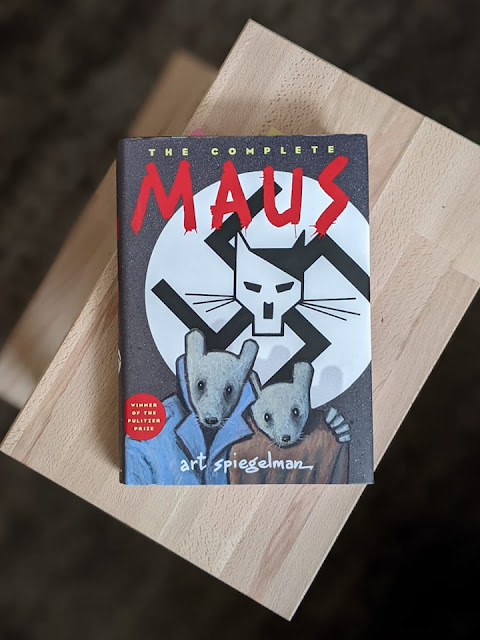
The Complete Maus by Art Spiegelman


I bought a copy of The Complete Maus by Art Spiegelman (both the Pulitzer-winning original and the follow-up in one volume) after reading about Maus's removal from a curriculum in Tennessee. I'm sure you've all heard about that if you're in the US. I've had it on my wishlist for years and at one point actually owned a copy of the original with a cover that was falling off but got rid of it without reading it during one of my book purges. At the time, I didn't know what it was about; I'd bought it used on a whim when I'd never read any graphic novels or biographies, probably out of curiosity. Then, I didn't get around to reading it. 

For those who don't know, Maus I: A Survivor's Tale is a graphic memoir about author and artist Art Spiegelman's parents' experiences leading up to and during WWII and the author's difficult relationship with his father. Art Spiegelman's father was a Polish Jew. Maus I first tells the story of how his parents met, married, and started a family as Hitler was coming into power. During the early years of the war, Art's parents either managed to find jobs, hide, or escape arrest numerous times but had many harrowing close calls. The book goes back and forth between Vladek Spiegelman's experiences and Art's determined effort to get the full story of what happened to his family, including a brother who died during the war, out of his father and try to locate his mother's diaries. 

The second book, Maus II, describes his father's experiences in a concentration camp after he and his wife were imprisoned and separated. Again, it goes back and forth in time as the author deals with his difficult father and gradually learns the complete story. 

I chose to buy The Complete Maus so I could judge its merits for myself after reading that the Tennessee school board members had complained about nudity, violence, and profanity in the book. My questions were, "How much nudity and profanity are there in the book(s)? Is anything portrayed genuinely offensive or is the storyline important enough to negate any negative aspects?"

First of all, you must know that we're talking about people portrayed as mice (Jews), cats (Nazis), and other animals (pigs were, I think, Poles who were not Jewish, but I'm not certain), except when he portrays his mother's suicide. In that case, he reverted to human images and showed a partial image of his mother's naked body in the bathtub, where she took her life. I counted a total of 7 instances in which profanity was used, all of which are words heard regularly on TV. When the Jews were forced to stand around naked, you do see tiny little man parts on the mouse bodies. And, yes, there are images of legs and feet when Nazis hanged Jews, either as punishment or for sport. All of this is less offensive than the factual horror of what the Nazis did, of course. Who cares about a few bad words and a little nudity when Maus has, as teachers say, told the historical truth of Nazi cruelty effectively?

Highly recommended - There is nothing in The Complete Maus that kids today haven't seen when it comes to the items school board members in Tennessee found offensive, and Maus is an important book, one that not only describes the Holocaust and its horrors but also portrays a difficult relationship between father and son that likely has made a lot of people with equally difficult relationships feel a little less alone. Suicide is a third topic that is addressed, although only marginally as his father describes his mother's battle with recurring depression that first began as postpartum depression. 


©2022 Nancy Horner. All rights reserved. If you are reading this post at a site other than Bookfoolery or its RSS feed, you are reading a stolen feed. Email bookfoolery@gmail.com for written permission to reproduce text or photos.

Tuesday, August 04, 2020

They Called Us Enemy - George Takei, Elsinger, Scott, and Becker


They Called Us Enemy is George Takei's graphic novel about his family's time in two separate internment camps during WWII. It tells a little about his life before the bombing of Pearl Harbor and how sentiment turned against Japanese Americans, the signing of the bill that led to the imprisonment of both American citizens and those who had been residents of the US for a long time without becoming citizens, how traumatic leaving their home was, the conditions they lived in at the camps, and how people banded together to make their lives more tolerable.

Takei talks a little about how this experience fed into the kind of escapism and pretend that led to his acting career and how this story was told as a play.

Highly recommended - I'm not a big fan of graphic memoirs but this one is excellent and very moving. It has very clear illustrations and text. My distaste for graphic memoirs is two-fold: sometimes people seem to share a little too much for my taste (a little harder to ignore if there are illustrations) and I don't always understand what's happening. There was never a point that I didn't understand what was going on in They Called Us Enemy. It's very well done. I thought Takei's story was also fascinating for the fact that his story was a little different than the other tales of Japanese Internment I've read because his parents made the choice not to sign a document saying they rejected the Emperor of Japan, due to the wording. That put them in much worse circumstances, for a time.


©2020 Nancy Horner. All rights reserved. If you are reading this post at a site other than Bookfoolery or its RSS feed, you are reading a stolen feed. Email bookfoolery@gmail.com for written permission to reproduce text or photos.

Wednesday, October 31, 2018

Two Graphic Novels: Hey, Kiddo by Jarrett Krosoczka and To Kill a Mockingbird by Fred Fordham

Hey, Kiddo: How I Lost My Mother, Found My Father, and Dealt with Family Addiction by Jarrett J. Krosoczka is a graphic memoir about the author and illustrator's life. The book begins by telling about Krosoczka's mother and her family, how his mother became pregnant and was rejected by the father of her child and how baby Jarrett ended up spending most of his time living with his grandparents while his mother flitted in and out of his life, writing to him but seldom showing up.

Krosoczka's life was interesting for the colorful language of his grandparents, his mother's method of encouraging his art from afar, and how he handled the challenges of not knowing who his father was and what his mother was up to. Eventually, he learned the truth: his mother was an addict who came and went from home to the street to jail or halfway houses. Because she occasionally wrote to him and showed up when she was able, Krosoczka knew his mother loved him but he always missed having her in his life when she was away.

Highly recommended - I don't feel like I'm doing an adequate job of describing Hey, Kiddo, so I'll just skip to the bottom line. This is a highly readable graphic novel that gives you a distinct sense of what it's like to grow up not really knowing either parent and how erratic the life of an addict is. It also tells about the author's artistic journey, how his talented mother and his caring grandparents encouraged his art, and what he learned from art instructors that influenced him, as well as his stylistic choices. It's a touching, deeply meaningful story about coming through an unusual and sometimes difficult childhood and the destructiveness of addiction to the addict and everyone around her. I found this was one of the clearest graphic novels I've ever read. Usually, authors rely a little too heavily on the artwork to do the explaining but there's plenty of text and I didn't find the art confusing as I often do.


To Kill a Mockingbird by Harper Lee, illustrated and adapted by Fred Fordham is a graphic adaptation of the classic novel by Harper Lee. You can tell what you're getting into by the prominence of Harper Lee's name on the cover and the words "illustrated and adapted". Sure enough, Fred Fordham -- the illustrator who adapted the novel -- almost exclusively used words directly pulled from the novel. He only altered them when necessary for clarity (I couldn't tell when that occurred: I just know it because the author said so).

I've only read To Kill a Mockingbird once, but it's one of those books that sticks with you because it's so brilliant and meaningful. Still, there were times I didn't understand what was going on in a particular frame or set of frames. But, in general, when I couldn't figure out what was happening it was quickly clarified, so a handful of frames that perplexed me was never enough to cause a problem. Also, the farther you get into this particular graphic novel, the better it becomes.

Highly recommended - An excellent adaptation of a classic novel into graphic novel form. The characters are clearly identifiable and there were only a few instances in which I couldn't tell exactly what was happening but the confusion didn't last long. I particularly appreciated the use of Harper Lee's actual wording. I didn't know it was hers till the author's note but I presumed so because of the language, which is pretty distinctive and a little old-fashioned.

Additional notes:

Hey, Kiddo has a particular colored palatte that was a deliberate choice and a little unusual -- not full color but limited to about 4 colors. The finished copy of To Kill a Mockingbird appears to be full color. I have an ARC that's black and white but I looked online and found a video at Amazon of the author and he talks about using watercolor washes and shows himself coloring in some of the images. It looks beautiful and I think maybe the final, colored version will make some of those frames that I had trouble with make sense. In at least one case, there was a series of frames that were so dark that they were almost entirely black. Colored, I would imagine the characters stand out better, even though the reason they were dark was because they took place at night. At any rate, the graphic novelization of To Kill a Mockingbird would probably make a super gift for those who claim it as their favorite book. In my case, it made sense of at least one scene that I had trouble understanding when I read the book, years ago, so it's also great for anyone who loves the language but may have been slightly baffled by a scene or two.

©2018 Nancy Horner. All rights reserved. If you are reading this post at a site other than Bookfoolery or its RSS feed, you are reading a stolen feed. Email bookfoolery@gmail.com for written permission to reproduce text or photos.

Tuesday, February 28, 2017

March, Books 1-3 by John Lewis, Andrew Aydin, and Nate Powell


I read two of the March graphic memoir series in January, took a break, and finished up the third in February, which feels like pretty nice timing because of Black History Month. I wasn't thinking about Black History Month when I bought them, though; the purchase was really a reaction to our current president's bizarre tweets about Lewis, a man of action who did not deserve the lack of respect shown to him. I knew about the March series, but had put off buying them until then.

I'm not going to go into the details of what each of the books covers individually because the truth is, I don't entirely remember and I don't think that the details are all that important. What's most important to know is that the three books, basically a biography and history set in graphic form, describe John Lewis's early years, why he was inspired to get involved in the dangerous fight for civil rights, the progress of the Civil Rights Movement over many years, how participants were trained in peaceful protest, and the final results.

When I read March, Book One, I'm not sure exactly what I was expecting but it begins with John Lewis as a child, the hardships he endured, his sheer determination to acquire an education, and his fiercely independent temperament. Even as a boy, he was courageous. A parallel story is shown, the story of John Lewis attending Barack Obama's inauguration. The final book ends with the signing of the Voting Rights Act on August 6, 1965 and a final scene in which, after President Obama's inauguration, Lewis says he's been thinking about that comic book idea . . . the book you hold in your hands, of course. Wonderful ending.

Highly recommended - I was surprised at how many times I got a little teary and had to set aside the books to take a break. The amount of violence peaceful protestors had to endure for years honestly shocked me -- and I lived through that time! Granted, I was quite young and there was no such thing as Black History Month when I was in school, but I've seen plenty of film clips, over the years. I don't think I'd ever mentally stitched them together and that's what this series is good for. Especially when read back-to-back, you get a genuine sense for the endurance and determination that was required as activists made baby steps toward their right to vote. The only problems I had at all with the books were that sometimes I couldn't follow what was going on in a particular frame or set of frames (a problem I always have with graphic novels) and some of the details about the various organizations that worked together or in opposition to each other (but for the same goal) got mixed up in my head. There were quite a few of them and the meetings they held could be kind of dull, yet they served a purpose as things were not static; they had to constantly adjust to the reactions of those around them. In general, I was impressed and I'm hoping to insert a bit more black history into my reading life because I clearly am lacking in that area.

Important addendum: A lot of people were talking about the March books when I bought the set (I got the slipcased set of all three) and a couple people I know mentioned having read the first book but not the rest, so I was a little surprised to find that the ending of the first March book is a bit of a cliffhanger. They are definitely not meant to stand alone. The series together tells a complete story and I recommend reading them close together, if you can.

©2017 Nancy Horner. All rights reserved. If you are reading this post at a site other than Bookfoolery  or its RSS feed, you are reading a stolen feed. Email bookfoolery@gmail.com for written permission to reproduce text or photos.

Thursday, December 12, 2013

Hyperbole and a Half by Allie Brosh


Ohmygosh, read this book.  Seriously, just buy a copy and make Allie Brosh comfortably rich so she can write a thousand more books because WE NEED THEM.  She is so very, very relatable and real and funny as hell.

You probably all have heard of Hyperbole and a Half, since it's zoomed to the bestseller list like a rocket, right?  You know she's a blogger and some of the material is from the Hyperbole and a Half blog, don't you?  You know all that.  Why am I even bothering to write a review? BECAUSE IT'S THE BEST STINKING BOOK, EVER.  

And, I never use all-caps because that's yelling, but I feel like Hyperbole and a Half is worth shouting about.  I've actually only read the author's blog once - just one time when one of her posts went viral.  It was wonderful and I laughed.  It was about depression, but still . . . she made it funny.  I never went back, but not for lack of desire.  I'm just really forgetful that way.  I'd already given up on Google Reader (it was so intimidating to see 1,000 posts turn up overnight) and I never have replaced it with a similar service.  So, yeah, I forgot about Hyperbole and a Half, sorry.  

And, yet, the moment I saw the book mentioned on Chris's blog, I thought, "Oh, yeah!  I remember that one post . . . the one about . . . there was a piece of corn and . . . well, I remember the characters and I know I loved it."  That was enough for me.  I decided I was going to buy that book on the way to Tulsa and, thanks to the fact that it's a bestseller, it had the most prominent placement a bright yellow book can possibly have without knocking you on the head.  

I'm so glad I bought Hyperbole and a Half.  It's a memoir . . . oops, did I forget to mention what it's even about?  Okay, so Hyperbole and a Half is Allie Brosh's memoir, told via text and her oh-so-charming art.  It's more graphic memoir than regular memoir.  Much of the material came directly from the blog but some is new.  The thing you don't realize till you get into the book is that Allie Brosh's artwork is deceptively simple.  She's actually quite a talented illustrator.  Look at that dog's expression.  When she illustrates her dogs, you look at those illustrations and laugh so hard you're looking for the nearest restroom.  They are perfect, just perfect, the expressions on those little doggie faces.

Also, I really think we should all bankroll Allie Brosh because she is the perfect pet owner.  Her two dogs are far from the ideal pets.  One is a shy on brains, the other is a little angry (my favorite chapters tend to be the dog chapters).  But, they're forever pets.  It doesn't matter that they're not everything she dreamed a dog would be; she's in it for their entire lives.  Oh, how I love her for that.  If for no other reason, you should buy Hyperbole and a Half because the author is a super pet owner.  But, buy it because it's funny.  Buy it because she's honest and reminds you that you're not alone in your weirdness.  Buy it because it will remind you of every stupid, embarrassing incident from your childhood and make you laugh about them.  

HIGHLY RECOMMENDED SO MUCH I CAN'T TURN OFF THE CAPS. Buy yourself a copy and then buy one for all your friends. Also, hot pink.

You're welcome. The End.

©2013 Nancy Horner. All rights reserved. If you are reading this post at a site other than Bookfoolery  or its RSS feed, you are reading a stolen feed. Email bookfoolery@gmail.com for written permission to reproduce text or photos.