Showing posts with label highly recommended - good for discussion. Show all posts

Wednesday, March 02, 2022

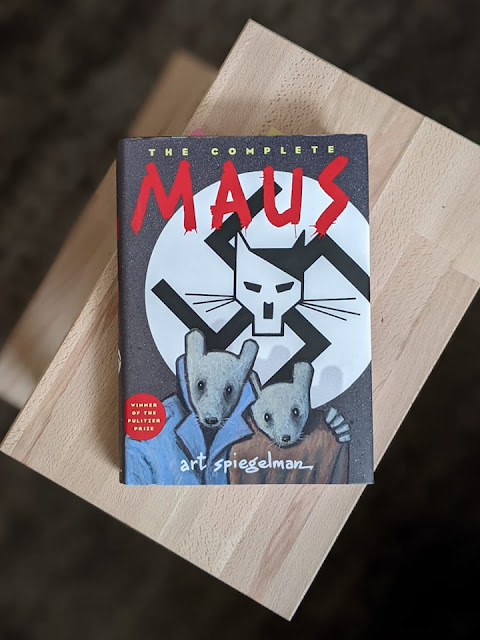
The Complete Maus by Art Spiegelman


I bought a copy of The Complete Maus by Art Spiegelman (both the Pulitzer-winning original and the follow-up in one volume) after reading about Maus's removal from a curriculum in Tennessee. I'm sure you've all heard about that if you're in the US. I've had it on my wishlist for years and at one point actually owned a copy of the original with a cover that was falling off but got rid of it without reading it during one of my book purges. At the time, I didn't know what it was about; I'd bought it used on a whim when I'd never read any graphic novels or biographies, probably out of curiosity. Then, I didn't get around to reading it. 

For those who don't know, Maus I: A Survivor's Tale is a graphic memoir about author and artist Art Spiegelman's parents' experiences leading up to and during WWII and the author's difficult relationship with his father. Art Spiegelman's father was a Polish Jew. Maus I first tells the story of how his parents met, married, and started a family as Hitler was coming into power. During the early years of the war, Art's parents either managed to find jobs, hide, or escape arrest numerous times but had many harrowing close calls. The book goes back and forth between Vladek Spiegelman's experiences and Art's determined effort to get the full story of what happened to his family, including a brother who died during the war, out of his father and try to locate his mother's diaries. 

The second book, Maus II, describes his father's experiences in a concentration camp after he and his wife were imprisoned and separated. Again, it goes back and forth in time as the author deals with his difficult father and gradually learns the complete story. 

I chose to buy The Complete Maus so I could judge its merits for myself after reading that the Tennessee school board members had complained about nudity, violence, and profanity in the book. My questions were, "How much nudity and profanity are there in the book(s)? Is anything portrayed genuinely offensive or is the storyline important enough to negate any negative aspects?"

First of all, you must know that we're talking about people portrayed as mice (Jews), cats (Nazis), and other animals (pigs were, I think, Poles who were not Jewish, but I'm not certain), except when he portrays his mother's suicide. In that case, he reverted to human images and showed a partial image of his mother's naked body in the bathtub, where she took her life. I counted a total of 7 instances in which profanity was used, all of which are words heard regularly on TV. When the Jews were forced to stand around naked, you do see tiny little man parts on the mouse bodies. And, yes, there are images of legs and feet when Nazis hanged Jews, either as punishment or for sport. All of this is less offensive than the factual horror of what the Nazis did, of course. Who cares about a few bad words and a little nudity when Maus has, as teachers say, told the historical truth of Nazi cruelty effectively?

Highly recommended - There is nothing in The Complete Maus that kids today haven't seen when it comes to the items school board members in Tennessee found offensive, and Maus is an important book, one that not only describes the Holocaust and its horrors but also portrays a difficult relationship between father and son that likely has made a lot of people with equally difficult relationships feel a little less alone. Suicide is a third topic that is addressed, although only marginally as his father describes his mother's battle with recurring depression that first began as postpartum depression. 


©2022 Nancy Horner. All rights reserved. If you are reading this post at a site other than Bookfoolery or its RSS feed, you are reading a stolen feed. Email bookfoolery@gmail.com for written permission to reproduce text or photos.

Tuesday, December 15, 2020

One Day in December by Josie Silver


Look, another e-book! I am on a roll, here, all the way up to one per month. 

One Day in December was my first read of the month and I chose it because the cover made it look light and fun. It got a lot of attention at some point, thanks to Reese's Book Club, and everyone seemed to be reading it at the time (Last year? The year before?), but I bought my electronic copy long after the buzz had died down. 

Laurie is sitting on the upper deck of a London bus when it pulls into a stop and she sees a man who instantly sets her heart aflame. Their eyes meet and he even attempts to board the bus, but he's too late. For a year, she looks for the man she has come to think of as "Bus Boy" but London is huge and she never manages to spot him, again. Just as she's finally decided to give up, her best friend and roommate brings home a new boyfriend, Jack, the man she claims that she intends to marry. And, you guessed it . . . he's Bus Boy. They recognize each other but pretend otherwise. Clearly, Jack is off-limits, now that he's dating Sarah. And Jack, likewise, is unwilling to hurt Sarah by acknowledging that he's seen Laurie before, although he remembers that fleeting connection that passed between them very well. 

Years pass. Laurie and Jack gradually become fast friends and they only cross the line once. Eventually, Laurie finds a love of her own. But, the reader knows Laurie and Jack are meant to be together. Will they ever find a way to each other?

Highly recommended - I loved One Day in December, not just for the romance but for the deep and enduring friendships throughout the book. Laurie and Sarah have an incredibly special relationship and this creates a tremendous tension. There's obviously always some kind of spark between Jack and Laurie. But, they're good people and neither would ever do anything they know will cause Sarah pain, so they work hard at becoming friends and suppressing their attraction. It's absolutely lovely how careful they are not to step out of bounds for the sake of their mutual friend. 

While One Day in December is not the kind of book my F2F group would discuss (they like literature; I can't imagine they'd go for anything romantic), I think there's a good deal to discuss. "What would you do?" is the most obvious question. What if you were Laurie? What if you were Jack? How would you react if you were Sarah and you found out about that one kiss? Should Laurie have immediately spoken up and said, "Hey, your new guy is Bus Boy"? 

Also, One Day in December is remarkably complex and believable, in my humble opinion. It isn't a quickie romance. Each year, Laurie writes down her goals and the reader sees how they play out. There are life changes for all of the characters, and the interaction between the characters has its ebbs and flows. Laurie's life is particularly complicated by the challenge of trying to find her place in the working world and by the health of her father, as well as the memory of a childhood loss. Jack, meanwhile, goes through a significant challenge of his own that threatens everything he holds dear. 

I loved this book and I'll definitely be looking for more by Josie Silver. It is, incidentally, always a sign that I enjoyed a book if I read it electronically and manage to finish. I still do have the problem of not feeling like e-books are real. It's very easy for me to set down my reader and forget I'm reading an e-book. So, if I finish it, I was engrossed. In this case, I was mesmerized, charmed, eager to find out what would happen, and ultimately satisfied. 

©2020 Nancy Horner. All rights reserved. If you are reading this post at a site other than Bookfoolery or its RSS feed, you are reading a stolen feed. Email bookfoolery@gmail.com for written permission to reproduce text or photos.

Tuesday, August 25, 2020

Why Are All the Black Kids Sitting Together in the Cafeteria? by Beverly Daniel Tatum, PhD


Expressing [...] deep frustration in response to [George] Zimmerman's acquittal, Alicia Garza, a community organizer based in Oakland, California, posted this message on Facebook: "I continue to be surprised at how little black lives matter . . . Black people, I love you. I love us. Our lives matter." Garza's friend, Patrisse Cullors, a Los Angeles-based activist, shared the Facebook post and added the hashtag, powerful in its simplicity, #BlackLivesMatter. Opal Tometi, a social-justice activist living in New York City, reached out to Garza and offered to help build a digital platform that could mobilize action for meaningful change. [...] The #BlackLivesMatter message resonated with many across the social media platforms of Facebook and Twitter, and with that amplification a rallying cry for the millennial generation was born. 

~p. 27

I chose this quote because I watched a video, a few days ago, in which a White man held a sign saying "Black Lives Matter" and people yelled abuse at him, calling him a traitor to his race, flipping him off, asking him, "What about White lives?" Maybe those people will never get it but it's always been clear to me what the protesters in the BLM movement are saying has never meant Black Lives Matter More Than Others. If they did, I'm sure that's what the hashtag would say. No, it's always been about the fact that Blacks are treated with less value and dignity, killed by police and incarcerated at a higher rate, discriminated against quietly through societal structure. Black people in this movement —a peaceful movement started by women— have done their best to explain, although it shouldn't be necessary. But, the anger amongst certain groups who choose to take offense persists. And, Why Are All the Black Kids Sitting Together in the Cafeteria? makes it crystal clear why such a movement is necessary, why it's particularly necessary for young people of any color to find their people, at least for a time.

The author of Why Are All the Black Kids Sitting Together in the Cafeteria? is a psychologist who was charged with teaching about racism at university level, way back in the 80s or 90s (I didn't mark the date mentioned), who has been researching, talking about, and living racism as a light-skinned Black woman, for decades. She knows her stuff. The book I read is the updated 2017 version; the original was published in 1997. And, it is not exclusively about Blacks. It's about the psychology of why Black kids cluster together (the short answer: because they need to, at least for a time, to understand who they are) but the book is also about dominant groups and how those who are dominant convince the people they consider beneath them that they are, in fact, lesser. That includes women and other minorities.

The relationship of the dominants to the subordinates is often one in which the targeted group is labeled as defective or substandard in significant ways. For example, Blacks have historically been characterized as less intelligent than Whites, and women have been viewed as less emotionally stable than men. The dominant group assigns roles to the subordinates that reflect the latter's devalued status, reserving the most highly valued roles in the society for themselves. Subordinates are usually said to be innately incapable of being able to perform the preferred roles. To the extent that the targeted group internalizes the images that the dominant group reflects back to them, they may find it difficult to believe in their own ability. 

~p. 104

The comment about the targeted group internalizing images reflected back by the dominant group explains the women who claimed Hillary Clinton should not be president because women are weak.  If you've never seen the video in which a woman said Hillary shouldn't be president because she might have a hormone swing and start a war to Jordan Klepper, and then he asks, "But, haven't all wars been started by men?" you should. It's both hilarious and a good object lesson.

I'm getting off-track. There is so much depth to this book that I feel like I can't adequately describe it but it's a 5-star read that talks not only about the importance of developing identity for Blacks but about the concept of redlining that's kept blacks in less affluent neighborhoods, Affirmative Action (how it started and what it does and not do; the false concept of "ratios" as a legal imperative, for example), the ideology of "color blindness", White identity, multi-racial identity, and also that of Latinx, Native, Asian and Pacific Islanders, Middle Eastern/North African . . . everyone has some need to band together with other people who bear some similarity to them as their identities are developing. Tatum also goes into the importance of making sure children of other races and ethnic backgrounds adopted by White parents are exposed to people like them and how damaging it can be to not do so.

Highly recommended - I wish every adult would read this. An incredibly detailed and easily digestible book about race that goes far, far beyond what you expect from the title of the book but also explains the reasoning for banding together as one is developing his or her identity in a way that has completely clarified it, at least for this reader. In my case, I felt like I learned a lot about myself, as well. For example, while my friends were not entirely homogeneous, I mostly hung out with Christians because my identity was so thoroughly wrapped up in church, as a child. And, it was the Native Americans clustered together on the steps at lunchtime that I always wondered about, not Blacks. There were not many Blacks or other minorities in my hometown, in fact. It was White Bread City, probably 98% White. I'm fortunate that I grew up with a father who made it clear to us that racism was wrong. Most of my friends from home didn't learn that lesson.


Link to review of another book I recommend highly:

When They Call You a Terrorist: A Black Lives Matter Memoir by Patrice Kahn-Cullors and Asha Bandele


©2020 Nancy Horner. All rights reserved. If you are reading this post at a site other than Bookfoolery or its RSS feed, you are reading a stolen feed. Email bookfoolery@gmail.com for written permission to reproduce text or photos.

Wednesday, May 27, 2020

The Paris Hours by Alex George


Jean-Paul loved his wife most when she was singing. It was the ravishing vigor with which she performed that laid siege to his heart. Music coursed through her, a joyous river. It illuminated her from within, filling her with the light of a thousand suns. When there was a tune on her lips, his wife was always the most beautiful person in the room. 

~p. 98 of The Paris Hours

In The Paris Hours by Alex George an Armenian genocide survivor, a struggling artist, Marcel Proust's maid, and a journalist all converge in the same location on a night in 1927. Who are they and how did they all end up in the same place? What will be revealed when an important notebook is sold, its secrets bound to cause damage?

Oh, my. There is so much to say about The Paris Hours. First and foremost, I think it would make an excellent discussion book and I've already told the host of my book club that we need to discuss it, some time. We read A Good American back when it came out in paperback and that discussion was quite a lively one, so she is definitely interested (but I have to wait for it to come out in paperback because that's one of the group rules). It's the kind of book you want to reread once you've been through it a first time, so I'm already looking forward to that eventuality.

But, back to the story. The main storyline takes place within a single day in 1927. But, as each character's story unfolds, the reader is taken back in time to fill in the gaps. How did an Armenian survive the genocide and end up working as a puppeteer in Paris? What is in the notebook that belongs to Marcel Proust's former maid and how did she end up with it? What will happen to the artist when his time to pay a debt to a notorious loan shark runs out? And, how does the journalist help tie these people together?

Because so many American artists, writers, and musicians lived the ex-pat life in Paris during the 1920s, there are appearances by Ernest Hemingway, Gertrude Stein, Josephine Baker, and the owner of Shakespeare and Company, Sylvia Beach, among others. But, they're background characters who give color to the time period in Paris rather than main characters. I think that may be part of the reason I felt like they were more believable than a lot of real-life historical characters fictionalized in novels, but it also is undoubtedly down to the skill of the author.

The only thing I disliked about this book? I found the ending a bit abrupt. But, only briefly. After I'd let it roll around in my head for a time, I realized that if the author had taken that final scene one step further it would have entered entirely different territory as what's about to happen in the end is both an ending and a beginning, if that makes sense. Well, just read it and you'll see.

Highly recommended - Exquisite writing in a beautifully drawn tale that brings four seemingly disparate lives together for an evening of drama and tragedy followed by hope. Personal opinion: The Paris Hours is a five-star read. I chose the quote above at random because I didn't mark anything while I was reading (too engrossed to look for the flags) and it was just serendipity that it happened to be a quote about music. There is always music in Alex George's books and he has a particular talent for describing it, probably because he's a musician and music lover, himself. I couldn't help but smile when I randomly opened the book to that paragraph.


©2020 Nancy Horner. All rights reserved. If you are reading this post at a site other than Bookfoolery or its RSS feed, you are reading a stolen feed. Email bookfoolery@gmail.com for written permission to reproduce text or photos.

Thursday, March 26, 2020

Such a Fun Age by Kiley Reid


A little background on the purchase of Such a Fun Age by Kiley Reid, up front. I started out reading a different novel about a black woman and her son whose father was white for Black History Month and then a friend who'd just read it said, "Read this instead," about Such a Fun Age. She didn't say that to me, personally; it was just a general announcement that she'd read both and one story was more authentic than the other, in her opinion, which she made on Facebook.

I was already reading the one she thought was the lesser and enjoying it but not far into it at the time of my friend Amy's post. She said the difference between the two was night and day, that the one written by a white woman didn't have the ring of authenticity but Such a Fun Age, by a black woman, does. I thought it would be fun to compare the two as Amy had, so I bought a copy of Such a Fun Age. I'm not mentioning the title of the other one because it eventually became a DNF and I can't find it to quote from. I figure I shouldn't pick on the author for no good reason if I can't point out the specific problem I had with it.

At any rate, I bought a copy of Such a Fun Age because I trust Amy. Then, about 1/3 of the way into the other book, there was a sentence that I found offensive and inaccurate about the son having both black and white genetics and mostly looking black but he didn't have to worry about his blackness because he lived this cushy middle-class life. That may have been disproven in the story, but by that point I was frustrated with the characters. They felt more like caricatures than well-rounded humans to me and I just couldn't buy into the storyline at all. It was frustrating me.

Finally, after about 5 days of reading for a little bit and then setting the book aside out of inattention, I decided to give up on it for good (I was a little more than halfway into it) and a few days later I started on Such a Fun Age, mostly out of curiosity due to Amy's thoughts but also because I saw Kiley Reid on Trevor Noah's show and she was utterly fascinating. She said she likes cringe-y scenes and I wanted to see if her book made me cringe.

On to the story . . .

Emira Tucker is 25, black, and has a bachelor's degree but she's a babysitter working for the very white and upper class Chamberlain family. She is aware that she should probably do something different; she's about to fall off her parents' insurance when she turns 26 and she's got skills. But, she's just not sure what she wants to do or how to go about it. She adores her little charge, Briar, who is precocious and a little hyper-sensitive. As much as she knows she should probably move on, she loves Briar as if she were her own and the idea of leaving her is unbearable. There's another child, a baby, but Briar's mom usually keeps the baby with her and ignores Briar.

Alix Chamberlain is a go-getter who is used to having everything her way. She married well and lives in a fabulous house but she's been thrown off-kilter by the family's move from New York City to Philadelphia. She misses her friends and her packed schedule. As an "influencer" she has built a huge following and she knows she can keep it up from her new home. But, the move has made her sluggish and she's so unsure about what her change of location will do to her brand that she's still pretending to work from New York. She has a book deal but that's going nowhere, as well. And, then her world is upended when her babysitter is accused of kidnapping Briar.

The inciting incident in this book happens when a window is broken in the Chamberlain home because Alix's newscaster husband said something that's been construed as offensive (he claims he didn't mean it the way it's being taken). Alix calls Emira, who is dressed for a party, and asks her to take Briar away from the house until the police have left. It's while Emira's out with Briar at a grocery store that someone accuses her of kidnapping the child. There, she also meets a man named Kelley, whom she begins to date, eventually. But, there's something weird about both the way Alix and Kelley treat Emira, like she's some sort of token they should be proud of.

Highly recommended - I love how realistic Such a Fun Age feels. The characters ring true to me in a way that makes me feel both uncomfortable and, at the same time, nod along at how much I can relate to various aspects I'd rather not relate to. I understand, for example, what it's like to be an adult who feels like you're not doing adulthood right, that you ought to be doing something else, earning better money, finding your place in the world. That unsettled feeling that Emira has . . . I don't have that anymore, but I remember it well. My plans were rocked off their foundation when I was quite young and it took me a very long time to figure things out.

There were brief moments that I wanted the story to move a little faster and I never did buy that the object thrown into the Chamberlains' window would have broken the window unless there was already some damage to the glass, but Such a Fun Age tackles some subtle acts of racism in a powerful way and it's just a good story. And, yes, it did make me squirm a time or two.

I think it's worth mentioning that while I bought Such a Fun Age with Black History Month in mind, I'd heard a lot about it and probably would have bought it eventually, regardless of the time of year. I also thought it would be a great book for discussion and may mention it to my F2F group leader when I return to meetings (which, I presume will be suspended till the pandemic is under control).


©2020 Nancy Horner. All rights reserved. If you are reading this post at a site other than Bookfoolery or its RSS feed, you are reading a stolen feed. Email bookfoolery@gmail.com for written permission to reproduce text or photos.

Tuesday, March 17, 2020

Freedom is a Constant Struggle by Angela Y. Davis


Racism, as it has evolved in the history of the United States, has always involved a measure of criminalization so that it is not difficult to understand how stereotypical assumptions about Black people being criminals persist to this day. Racial profiling is an example. The fact that driving while Black can be dangerous. Recently, one of the trending Twitter conversations had to do with "criming while White." A whole number of white people wrote in and described crimes they had committed for which they were never suspected, and one person pointed out that he and a Black friend were arrested by the police for stealing a candy bar. The cop gave the white person the candy bar, and the Black person was eventually sentenced to prison. 

~pp. 33-34

I chose Freedom is a Constant Struggle as my read for Black History Month and I'm obviously a bit late getting around to talking about it so it's not as fresh in my mind as I'd like it to be, but I remember enough to say a few words about it.

Freedom is a Constant Struggle is a set of speeches and interviews about the intersection of racism in the U.S. and oppression in other countries. The author is a well-known activist who travels the world speaking about oppression, the history of oppression and ways in which large corporations contribute to the problem, why oppression is profitable, and how prison is used to oppress certain populations, among other things. She offers alternatives and ideas for change.

I like these words on what keeps Angela Davis going:

[...] I don't think we have any alternative other than remaining optimistic. Optimism is an absolute necessity, even if it's only optimism of the will, as Gramsci said, and pessimism of the intellect. 

~p. 49

One of the things Davis talks about quite a bit in Freedom is a Constant Struggle is the private prison system and how profit-making leads to a higher level of incarceration. I remember the Obama administration had started working on closing down private prisons for exactly that reason but I've since read that the current administration is doing the opposite, allowing for more private prisons and expanding their reach by using the same corporation(s) who run prisons to take on housing of immigrants. The book was published in 2016, so it's a little outdated in that regard but you can fill in the blanks of what's happened with a little reading up on the Internet. It's still got a lot of valuable information.

The only thing that I kept puzzling over was the fact that Davis is for banishing imprisonment entirely. As in no prisons, whatsoever. I kept thinking, "So, what do you do with the hard-core criminals, those who committed violent crimes?" That was not addressed and it's something I would love to ask the author, if I were given the opportunity to talk to her.

Highly recommended - A very thought-provoking book, worth reading and discussing. I was familiar with the name Angela Davis but I didn't realize she was a Black Panther, although it's clear from the reading that she's been an activist for a very long time. I'd actually love to read more about her. She is highly educated and I often found myself thinking, "This is just a bit above my intellectual level" but it's not at any point unbearably dry; it's very readable but with moments that required extra concentration. The reading made me want to get to my book about the Black Panther Party, which I also bought for last year's Black History Month. I may go ahead and read that, this year, if I can fit it in. I would also love to reread Freedom is a Constant Struggle with a group, some time. It's ripe for discussion.


©2020 Nancy Horner. All rights reserved. If you are reading this post at a site other than Bookfoolery or its RSS feed, you are reading a stolen feed. Email bookfoolery@gmail.com for written permission to reproduce text or photos.

Wednesday, January 08, 2020

You Were There Too by Colleen Oakley


I planned to finish my 2019 reviews before barreling into 2020 but You Were There Too says it was released on the 7th (that's today as I write but will be yesterday when you read this) so I'm going to go ahead and review it and I'll continue to interject reviews of more recent reads if there's a genuine reason like "Fresh release!" or "I have to say something right now!"

You Were There Too is the story of Mia. Since high school she's occasionally had dreams that feature the same man. Sometimes they're good; often they're nightmares. In her everyday life, Mia is happily married to a surgeon named Harrison. Mia and Harrison have recently moved to a small town called Hope Springs from Philadelphia after Harrison lost a child in surgery and he felt like he needed a change. Mia is struggling with the move and her desire to have a baby, which keeps ending in miscarriage.

Then, one day something bizarre happens. Mia sees the man she's been dreaming about for so long. And then she's introduced to him. Oliver is the brother of a patient whose life Harrison saved, and she feels like she's known him forever. Eventually, Oliver admits that he's been dreaming of Mia, as well. But, what can it possibly mean? In their search for answers, Mia and Oliver become friends. Mia's very open about their friendship with Harrison, but at the same time she's developing a surprisingly deep and meaningful friendship with another man, fault lines have emerged in her loving marriage. Mia works hard at making it clear that she can't be with Oliver, and yet she can't deny to herself that she feels attracted to him.

What will become of the friendship? Will Oliver and Mia step over the friendship line and into romance? What about Harrison? Something is a little off about him but Mia can't put a finger on it and with the rift in their marriage growing, will she be able to help him? Will Mia and Oliver figure out what their dreams and nightmares mean? Or is something about to happen that can't be prevented?

Highly recommended - Ohmygosh, I loved this book. The author kept me guessing all the way through and I loved the way she handled the relationships, the confusion, the questions about marriage and what love can or cannot overcome. There's a shocking prologue at the beginning of the book so you know that Oliver's and Mia's dreams clearly are psychic in some way, but not who Mia is with when tragedy strikes.

This is actually the only book I've ever read that has attempted to address the concept of psychic dreaming and I loved it in part because I am an occasional psychic dreamer, myself. I could relate to Mia's obsession about what it all meant, although I've never heard of two people dreaming about each other and that's far from my experience. I have dreamed about things that happen before the news breaks. Not long ago, I started sharing stories of my psychic dreams (and a couple of what I call "waking visions" because I wasn't asleep when they occurred) with a friend and I realized there were so many of them that it would take a while to share them all with her.

As to meaning . . . I don't know that there is any meaning to those dreams that have come true for me, although a couple of them have felt like warnings. That's one of the questions in You Were There Too. Are Oliver and Mia being warned about something to come? If so, is there anything they can do to prevent something bad from happening? What about the dreams that are not nightmares but the opposite? Do they mean Mia should give up on her marriage and that she really belongs with Oliver? Why do Oliver and Mia both have this strange mix of dreams? It's a really intriguing set of questions and I loved this book so much that I will absolutely seek out more by Colleen Oakley.

I received a copy of You Were There Too from Berkley Books in exchange for an unbiased review. Many thanks! I'm excited to have found a new author who kept me riveted until the wee hours of the morning (although I didn't appreciate the way I felt the next day).

©2020 Nancy Horner. All rights reserved. If you are reading this post at a site other than Bookfoolery or its RSS feed, you are reading a stolen feed. Email bookfoolery@gmail.com for written permission to reproduce text or photos.

Friday, September 13, 2019

The Rent Collector by Camron Wright


I had to ponder The Rent Collector for a bit before even considering writing a review. There were things about it that felt a little off to me (more on that in a minute) but in general it's a fascinating story from which I learned about a place that's escaped much notice from me. Apart from the occasional book about the Vietnam War, I've seldom read much about or even mention of Cambodia.

The Rent Collector is the story of a little family in Cambodia (based on real characters but heavily fictionalized). Sang Ly and Ki Lim live in a literal dump and pick through trash to find items they can sell. Their baby, Nisay, has been sick all his life. Even when they occasionally manage to get treatment, once the antibiotics run out he goes right back to being sick.

Sopeap is a drunken woman who collects the rent monthly. When Ki Lim finds a children's book in the garbage, Sang Ly is excited. Nisay will have a little treasure. But, something remarkable happens to Sopeap when she sees the book and Sang Ly realizes the rent collector knows how to read. She asks Sopeap to teach her, so that she can better their lives. Gradually, Sopeap's former life (before the Khmer Rouge slaughtered the educated) comes out through her teaching.

I was most fascinated by the mystery of Sopeap. Who was she? How did she end up in a dump if she was an educated woman and why did she drink heavily? What had happened to her to make her such a mess?

The story is told a little like a fable and very much like the stories that Sopeap teaches Sang Ly to read. Inside the story, there are lessons. They aren't always what you want to hear. Heroes and villains may have elements of evil or humanity in them, respectively. Things may not turn out the way you expect. But, somewhere in there are the universal themes and similar tales that continue to be retold — always a journey, whether internal or external.

I glanced across a few reviews and noticed that people spotted the same things I did. Sang Ly does not sound like a poor person who lives in a dump. She has a pretty substantial vocabulary and she learns to read at a startling speed. But, I think if you focus on such details, you're missing the point.

The Rent Collector is about literature, about life, about finding the meaning in both that may or may not be hidden. If you look at it too literally, what the author is attempting to say will just buzz right past you. One of those themes was obviously that you should find beauty wherever you are. Kind of a "bloom where you're planted" thing. A little trite, maybe, but I loved the unfolding mystery of Sopeap's past, the growing friendship between Sang Ly and Sopeap, the way Sang Ly helps Sopeap find redemption, the quest for a cure for little Nisay, and the general loveliness of the storytelling.

Highly recommended - While not a 5-star read because I did occasionally have trouble with clinging to reality instead of sinking into the story itself and allowing it to envelope me like a dream, I thought it was a terrific read and it makes me want to learn more about Cambodia and its people.

I bought The Rent Collector for group discussion and I'm looking forward to my next book group meeting. I think we'll have a lot to discuss. If I feel like anything said during the discussion is worth mentioning, I'll return to post about it, after the meeting.

I didn't get any great cat photos, this week, so if I manage to snap anything tonight, I'll post it on Saturday. If not, Fiona Friday will return next week.

©2019 Nancy Horner. All rights reserved. If you are reading this post at a site other than Bookfoolery or its RSS feed, you are reading a stolen feed. Email bookfoolery@gmail.com for written permission to reproduce text or photos.