Showing posts with label picture book. Show all posts

Tuesday, February 15, 2022

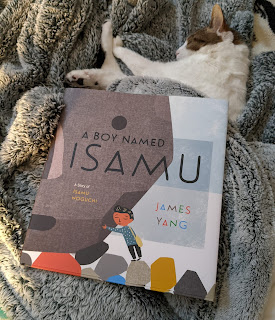
A Boy Named Isamu by James Yang and Unspeakable: The Tulsa Race Massacre by Carole Boston Weatherford and Floyd Cooper

Both of the following are children's picture books. Full disclosure: James Yang, author of A Boy Named Isamu, is a high school friend. While these are both 5-star reads, I have very little to say about either, so this will be just a couple of slap-dash, quickie reviews. 

A Boy Named Isamu by James Yang is a story that imagines artist Isamu Noguchi as a boy, on a single day when he goes to the market with his mother and drifts away. It shows his boundless curiosity and sense of wonder as he notices the shapes and textures that will inform his art. 

The illustrations are fabulous. I'm a fan of James's art but I think he really knocked it out of the park in A Boy Named Isamu. And, I loved the way he portrayed how an artist sees and thinks. There's a nice bio of Isamu Noguchi in the back of the book. 

Highly recommended - I loved A Boy Named Isamu so much that I read it, recorded it in my reading calendar, and then read it again. As I said elsewhere . . . forget the grandkids, this one's for me. But, I'm sure the grandchildren would appreciate it, as well. 
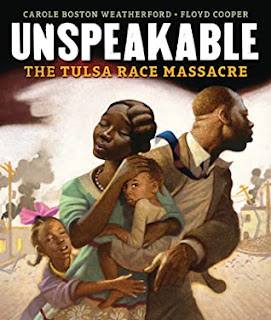

Unspeakable: The Tulsa Race Massacre by Carole Boston Weatherford and Floyd Cooper (illustrator) is a book I bought after seeing it on a list of books that some politician or conservative group wants banned. I was curious why on earth anyone would want to ban a children's picture book, especially about such an important topic. 

Brief note: My husband and I grew up in Oklahoma and neither of us ever heard of this particular historical event, although Hubby says his friend told a story of his grandfather hiding a Black man in the 1920s and he's pretty sure it was during what has elsewhere been called the "Tulsa Race Riot" (a name which, this author notes, places blame on the victims). 

Unspeakable tells the true story of the Tulsa Race Massacre  and places the blame squarely where it belongs, on the people of that time period who murdered, looted, and burned a prosperous black community to the ground. It's well written, appears well researched, and the illustrations are marvelous. It ends with a photo of the burned remains of Tulsa's Greenwood district. As an Oklahoman who didn't hear about this violent travesty until a few years ago, I'm glad to see it talked about. 

Highly recommended - The hardback was sold out everywhere when I looked this book up, so I bought the e-book and the electronic version is perfect. There were no issues at all with the images. This story was suppressed for far too long and I can't imagine why anyone would desire to ban it other than a continued desire to suppress the truth. It's told in a very positive way and the illustrations are just stunning. 

©2022 Nancy Horner. All rights reserved. If you are reading this post at a site other than Bookfoolery or its RSS feed, you are reading a stolen feed. Email bookfoolery@gmail.com for written permission to reproduce text or photos.

Friday, January 21, 2022

Wordy Birdy and Wordy Birdy Meets Mr. Cougarpants by Tammi Sauer and Dave Mottram

Just a couple quickies. I bought these two books shortly after seeing a review of one of them and thinking, "Oh, how cute!" But, I likely wouldn't have bought them if the author, Tammi Sauer, didn't happen to be a favorite children's book author. Good decision. 

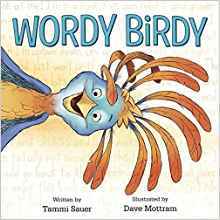
The eponymous bird in Wordy Birdy by Tammi Sauer and Dave Mottram (illustrator) is just what she sounds like, a bird who can't stop talking. But, she's not a good listener and doesn't particularly pay a lot of attention to her surroundings. So, when she sees a danger sign, she just admires it and keeps going, ignoring the message. Her friends try to stop her but she doesn't listen to them, either. And, then a second warning sign . . . same thing. When she arrives at the point of danger, her friends are there to help her escape. Wordy Birdy will be paying more attention, from now on. 

A sweet, funny, charming story with vibrant, expressive illustrations and a nice lesson in friendship and paying attention to one's surroundings. I loved it. 

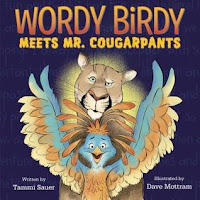
In Wordy Birdy Meets Mr. Cougarpants by the same author and illustrator, Wordy Birdy and her friends have gone camping. She talks so much that nobody can get to sleep. But, then a hungry cougar shows up at their campsite and she drives him out of the camp with her chattiness, saving herself and her friends. 

There's one fantastic line in this book and it's the cougar saying, "Did she just call me Mr. Cougarpants?" Ohmygosh, the expression on the cougar's face is a hoot!

Both highly recommended - I loved both of these books but my personal favorite is Wordy Birdy Meets Mr. Cougarpants because of that moment when the cougar is stunned and the sheer hilarity of a bird talking a predator away from the camp because he just wanted a nice peaceful meal. So, so cute. Also, I hate to say it but Wordy Birdy reminded me of myself as a child. I got told to please be quiet a lot

These are picture books for younger ones, with few words. My only issue with them is that I never have liked reading picture books that have word balloons to small children because I always felt obligated to point at whoever is speaking. I prefer dialogue to be described within text saying who is saying what. But, that's a personal preference and it's really not a big deal. The stories win out. 

©2022 Nancy Horner. All rights reserved. If you are reading this post at a site other than Bookfoolery or its RSS feed, you are reading a stolen feed. Email bookfoolery@gmail.com for written permission to reproduce text or photos.
Wednesday, November 17, 2021

Walrus Song by Janet Lawler and Timothy Basil Ering


Where is Walrus? 
On a floe. 
Hop flops. He plops. 
Where did he go?

Walrus Song by Janet Lawler and Timothy Basil Ering (illustrator) is a gorgeous children's rhyming picture book about walruses that I'm absolutely in love with. 

Some of the things children will learn about in Walrus Song:


  • Herding/socializing behavior
  • How big a walrus is and about the fat layer that keeps them warm and stores energy
  • What walruses eat and how they hunt for food
  • How they play with birds(!)
  • The growth of tusks and how they're used to lift a walrus from the water and chip ice to make space to dive
  • How they use their flippers to walk and fight
  • The sounds they make
  • Mothers and babies: how often walruses give birth and how long they stay with mother
  • The danger of global warming to walruses


All of this is told in simple, rhyming text. But, there's also an explainer section at the end of the book that goes into greater detail about what various lines mean. For example, the line saying Walrus is "on a floe" describes the meaning of the word floe (an ice sheet). And, a line describing the way a walrus swims, "Twirling, whirling, flippers swirling," is further described in the explainer section in this way:

"A walrus swims by wiggling its whole body and stroking with its back flippers. It steers with its front flippers."

I took an interior shot to show you just how gorgeous the illustrations are (you should be able to click on the image to enlarge):


Highly recommended - I've read and reviewed a lot of children's books and I'm sure some of the animal books I've read (along with a single book I remember from my childhood) have had walruses in them along with other animals. But, Walrus Song is the first book I've read that's totally dedicated to walruses. I enjoyed learning about them and I think little ones will appreciate the gentle rhythmic text while they're still small enough to sit on laps, then will enjoy learning more about walruses as they grow. Walruses need love, too! Walrus Song would also be a great book for libraries and classrooms, since it has some nice added details in addition to the lovely story showing a walrus throughout its day. 

My thanks to Candlewick Press for the review copy! 

©2021 Nancy Horner. All rights reserved. If you are reading this post at a site other than Bookfoolery or its RSS feed, you are reading a stolen feed. Email bookfoolery@gmail.com for written permission to reproduce text or photos.
Wednesday, August 11, 2021

Where is Our Library? by Josh Funk and Stevie Lewis


You get an early peek at one of the books I bought in my second Book Outlet order (the one I think of as "the naughty one") before my Monday Malarkey photo of next week. Yay. I knew you'd be thrilled. 

I have loved author Josh Funk's Lady Pancake and Sir French Toast series (also children's picture books) and I added Where Is Our Library? to my wish list when Josh posted about it on Twitter. Oh, how I wanted that book! It took a couple of years, though, because I often feel like I can't excuse the purchase of children's books, my grandchildren being so far away and no other children in my orbit. But, at about half the retail price, I was so excited you would have seen nothing but a blur if you were watching me put that book in my cart. 

Good decision. Where Is Our Library? is a delightful rhyming tale in which the New York Public Library's lion statues, Patience and Fortitude, come alive at night. They walk to the children's book section of their library branch, as is their habit, but find it empty! Where have the books gone?

Patience and Fortitude go in search of the children's books and in so doing, take the reader on a lovely tour around New York City, including Central Park and some of New York City's branch libraries. 

Highly recommended - Particularly of interest to those who have visited or live(d) in New York City and library lovers of all stripes. I felt swept into their adventure and found myself reminiscing about walks around New York City. I haven't been to Central Park but now I want to see it, next time I'm up that way! 


©2021 Nancy Horner. All rights reserved. If you are reading this post at a site other than Bookfoolery or its RSS feed, you are reading a stolen feed. Email bookfoolery@gmail.com for written permission to reproduce text or photos.

Wednesday, April 21, 2021

Edmund the Elephant Who Forgot by Kate Dalgleish and Isobel Lundie


Edmund the Elephant Who Forgot by Kate Dalgleish is just what it sounds like, the story of a young elephant who has a bad memory. When Edmund is sent to fetch some items for his brother's birthday party, his mother teaches him a song about memory and then sends him with a list, which he promptly discovers that he's forgotten. 

Colin the Cricket tags along to try to help Edmund but Edmund can't quite hear what Colin is shouting. The end result is like a game of telephone. Colin shouts, "It's a bunch of balloons!" and Edmund says, "Aha! A gang of masked raccoons!" and promptly places them in his wagon to take home. Here's a spread showing how Colin's shouted reminder to pick up twenty pointy party hats becomes "seven sassy dancing cats!" You should be able to click on the following image to enlarge.


As you can see, the illustrations by Isobel Lundie are dynamite. There is not only a ton to look at to keep little eyes busy, but she also has hidden Colin the Cricket throughout the book. At the end of the book, the number of Colins to be found is mentioned (25) and there's a foldout illustration of what happens when Edmund brings home all the wrong items. Edmund has forgotten to send out the invitations but his brother says he thinks he's about to have the best party ever!

Highly recommended - This book is a serious gigglefest. If my grandkids were within driving distance, I'd dash over to read it to them because I just know they'd have a great time laughing at Edmund's silly mistakes and enjoying the crazy illustrations. So. Much. Fun. 

Many thanks to Sterling Children's Books for the review copy!! My copy of Edmund the Elephant Who Forgot is going on the favorites shelf to save for grandkid visits. 


©2021 Nancy Horner. All rights reserved. If you are reading this post at a site other than Bookfoolery or its RSS feed, you are reading a stolen feed. Email bookfoolery@gmail.com for written permission to reproduce text or photos.

Tuesday, March 23, 2021

Bindu's Bindis by Supriya Kelkar and Parvati Pillai


First things first: A bindi is the decoration South Asian females often wear on their foreheads, which is known as a "third eye" and is meant to keep evil away. I thought that was what a bindi was, as I went into the reading of Bindu's Bindis, but I wasn't certain so I looked it up. It's good to know that going into the book, in case the child you're reading to has questions. 

Bindu is an American girl who loves wearing bindis. She wears different designs depending upon her mood, using stick-on bindis that come in a variety of colors and shapes. Her grandmother sends her a new set each month and she wears them to the temple, on holidays, and at home. Then, one month her grandmother brings them to Bindu in person. 

Bindu wears a "brilliant oval bindi" to greet her grandmother, or Nani, at the airport. But, when they turn from the gate, her family is surprised to find that they're being greeted by protestors with signs telling them to go home. Bindu holds her head up high and so does Nani. 

Nani has always loved dancing and she teaches Bindu some of her moves. When Bindu dresses up to dance in a school assembly, she's excited at first. But, then some of the children giggle at her beautiful outfit and she's hesitant. Nani tries to excite her by offering different bindis for Bindu to try but it doesn't work. So, Nani goes up on the stage and starts dancing, then Bindu joins her. 

Recommended - I like the story, love the vibrant illustrations in Bindu's Bindis, and particularly appreciated the fact that there are two separate challenges that are tied together: dealing with protestors who are xenophobic and children who make Bindu nervous about her ethnicity. Both are obviously common, right now, in the US. There was one thing I wish the author had done and that's add a single sentence or phrase defining the word "bindi" at the beginning of the book. However, once you know what it is, you know . . . and there's no longer a need for a description. So, after I thought about it for a while, I decided it's no big deal. Bindu's Bindis is a children's picture book, after all, and the illustrations alone make it pretty clear. There is some information about who wears bindis, other names for them, and why they're worn, in the back of the book. 

Incidentally, as I was reading the scene with Nani getting up on stage, I was reminded of the similar scene in About a Boy when Hugh Grant gets up on stage and makes a fool of himself to encourage his young friend to perform. I love the cringeworthy humor of that scene (and the movie, in general), so Nani's dancing brought back a fond memory. In Bindu's Bindis you get a similar feeling from Nani's dancing. It's a little uncomfortable but her joy is infectious. I wanted it to be real and to be transported into that scene. 

My thanks to Sterling Children's Books for the review copy!

©2021 Nancy Horner. All rights reserved. If you are reading this post at a site other than Bookfoolery or its RSS feed, you are reading a stolen feed. Email bookfoolery@gmail.com for written permission to reproduce text or photos.

Wednesday, November 04, 2020

All the Buildings in London: That I've Drawn So Far by James Gulliver Hancock


I bought All the Buildings in London: That I've Drawn So Far by James Gulliver Hancock on a whim when I placed an order from Book Closeouts, a couple months back. It only has a few solid pages of text and the rest of the book is just the drawings with maybe a line or two of text, sometimes no description other than the name of the building and where it's located. 

Here's an interior shot (pardon the London tourist trinkets; I needed something to hold it open):


Here's a closer image of the text about Liberty, the department store (you should be able to click to enlarge):


London is one of my favorite places on the planet, hence this emotional purchase. I've been there enough times that it almost feels like a second home (and would love to live there). I knew from the cover image that I liked the artist's style and his story is quite interesting, too, so even though the text is minimal, it's fun reading. I particularly enjoyed seeing how he rendered buildings I'm familiar with and found myself thinking, "I can use this as sort of a guide for some new places to see, next time we're in London." Wow, that sounds kind of uppity. I hope there's a next time.

Highly recommended to architectural art lovers and London aficionados -  A fun look at a fascinating city with a lengthy architectural history and a stunning variety of buildings, new and old. The artist has some particularly unique flourishes he brandishes in his illustrations that make them almost look dynamic rather than static. You can see a little of that in the top part of the cover image. I love that sensation that the buildings are solid yet there's a sense of action. 

All the Buildings in London: That I've Drawn So Far would make a nice coffee table book. There are coffee table books that you keep out for sparking conversation and coffee table books for yourself. This one is mostly for me to flip through and reminisce. But, I'm OK with any conversation-sparking that happens when the pandemic ends and we can have people over, again, of course!

And, speaking of art . . . I'm working on a collage to combat Election Anxiety, right now (and we watched mindless TV, last night, for the same reason). Hope everyone else out there is holding up.  

©2020 Nancy Horner. All rights reserved. If you are reading this post at a site other than Bookfoolery or its RSS feed, you are reading a stolen feed. Email bookfoolery@gmail.com for written permission to reproduce text or photos.

Tuesday, June 30, 2020

Bubble Kisses by Vanessa Williams and Tara Nicole Whitaker


In Bubble Kisses by Vanessa Williams (the singer) and Tara Nicole Whitaker, a little girl sings about her goldfish, Sal, and why they're the best of friends. As she's talking about Sal and how she gives perfect bubble kisses, the heroine (the little girl on the cover) is swept into a fantasy world in which she has become a mermaid and the goldfish is no longer trapped in a bowl but free in a large body of water.

The entire book is a single song and it comes with both a CD and a QR code that you can scan with your phone or tablet. I mentioned Bubble Kisses when it arrived and at the time, I thought it was very strange that it had a CD because most people don't have CD players, anymore. Mine is in the garage, somewhere, and I have no idea how to load music to a phone so I have to listen to the radio in the car and thought I'd have to pull out my old car to listen to it! But, I hadn't bothered to take the CD out, yet, so I didn't realize there was a QR code behind it (although that was probably in the publicity material and I just forgot).

At any rate, all that's to say that I was wrong and unless you have no phone, tablet, DVD player, or CD player, you're going to be able to listen to the song. I presume probably 95% of people have access to at least one of those.

The song is kind of an upbeat, jazzy song that . . . sorry . . . reminds me of a 1950s television advertisement. I can't think of anything else to compare it to. I can easily imagine my eldest granddaughter bobbing to the song when she was a little bit younger (she's 5 and reading at 3rd grade level, now) and I have a feeling my youngest granddaughter would enjoy it, too. It's definitely got the sound of a children's song, a little repetitive and very cheerful.

Recommended but not a favorite - Maybe one of the best things about Bubble Kisses is the fact that it has an African American heroine. I really appreciate the fact that children's publishers have been working hard at embracing diversity in the stories they acquire, in recent years. I do like the upbeat music, the quirky but charming illustrations, and the fantasy of the story. The only thing I dislike is the fact that it's written as a song and if you just want to read the book aloud, it's going to sound a little weird. That keeps it from being a favorite because I love to read aloud to children and a good story that's readable will always be my favorite. But, it only takes one listen to catch on to the rhythm and for children who love to dance and sing, Bubble Kisses will make a cute and fun addition to a home library.


©2020 Nancy Horner All rights reserved. If you are reading this post at a site other than Bookfoolery or its RSS feed, you are reading a stolen feed. Email bookfoolery@gmail.com for written permission to reproduce text or photos.

Tuesday, March 03, 2020

Nerp! by Sarah Lynne Reul


Nerp! by Sarah Lynne Reul is an unusual book and I love it for that. An incredibly silly tale about a little monster who doesn't want to eat anything offered to him, it's written entirely in gibberish and yet still totally comprehensible. "Nerp," for example, is obviously "nope". I think it's easier to show illustrations, in this case, so I took a couple interior photos:


Pardon my poor job of cropping. You can see how, even though there's no such thing in reality as "frizzle frazzle hotchy potch," it's clear that it's a food item and the little monster is saying, "No way. I'm not eating that."

The unnamed little guy is offered dish after dish after dish, all with hilarious names, and turns them all down. Then, as the determined parents walk into the room with two more dishes to try to persuade him (or her) to eat, they hear a lengthy slurp and find their little monster has chosen to eat something . . . unusual. But, they're happy the kiddo is eating.

Highly recommended - I had a huge grin on my face while I read this book and I know absolutely without question that my eldest granddaughter would be doubled over in peals of laughter if she was close enough to read it to her. Actually, she's reading on her own, now. She might need a little help with the nonsense language, but I'll bet she'd have a blast reading it between the giggle fits. I love it that an entire book is told in gibberish and yet still completely clear of meaning. And, the illustrations are absolutely perfect. So expressive. You know immediately how that little monster feels. So. Much. Crazy. Fun.

My thanks to Sterling Children's Books for the review copy. Nerp! has just been released, today! Cool. If you have a little picky-eating monster (or even if you don't), you should rush right out to get this one. The giggles will be worth every penny.


©2020 Nancy Horner. All rights reserved. If you are reading this post at a site other than Bookfoolery or its RSS feed, you are reading a stolen feed. Email bookfoolery@gmail.com for written permission to reproduce text or photos.

Wednesday, October 30, 2019

Moldilocks and the Three Scares by Lynne Marie and David Rodriguez Lorenzo - #3 for Children's Day


IN A HUGE HAUNTED HOUSE —
with room enough for four,
there lived three Scares:
Papa Scare, 
Mama Scare,
and Baby Scare. 

You can see where this is headed, already. Moldilocks and the Three Scares: A Zombie Tale by Lynne Marie and David Rodriguez Lorenzo is an updated, zombie-slash-monster version of Goldilocks and the Three Bears, and the first page (quoted above) hints at the twist at the end, as does the next page spread, which begins with Papa's musings:

One chilly night, Papa
sliced finger sandwiches and 
brewed a batch of Alpha-Bat 
Soup. "This recipe serves four. 
Just enough for one more."

Hint, hint. Mama wishes for an assistant. Baby says there's too much time and nobody to play with. The soup is poured in three bowls sized perfectly for Papa, who looks very much like Frankenstein, Mama, a Mummy (hahaha), and Baby, a little vampire. But, it's too hot. It boils Papa's bolts, unravels Mama, and gives Baby fang-ache, so they go off to walk the dog, Plasma. While they're gone, Moldilocks shows up, sleepwalking. She smells the soup and is lured to the house, which smells like home. She calls out but nobody is home so she tiptoes inside and, of course, samples all the soup. Too hot, too cold, just right, so she eats Baby's soup all up. You know the story. Moldilocks tries their chairs. Too hard, too soft, just right, but the baby's chair breaks. She tries their beds because she's sleepy. Too hard, too tight, and just right. She falls asleep.

The Three Scares arrive home, declare that someone has eaten their soup, tried their chairs, and tested their beds, always with Baby's being the one she ate, broke, or . . . fell asleep in, and there she is. Here's where the classic story takes a turn.

"HOW DARE YOU . . . 
. . . eat without us!" exclaimed Papa. "I've always
wanted another mouth to feed."

"You could be my
 lab assistant," mused 
Mama. "My nightmares have been answered." 

And, Baby is excited to have a playmate. As hinted at in the opening, there's room for four and the family is excited to add an extra member.

Highly recommended - What fun! I love an updated classic children's story and Moldilocks and the Three Scares is a joy with fun word play, like Baby holding out his Deady Bear and asking if Moldilocks wants to play Corpse and Robbers. Great for Halloween but also fun for any time of the year. Kids who love a surprising use of words will get the giggles and it's a sweet way to introduce the topic of adoption, showing how awesome it can be to add a family member! I love this book.

My thanks to Sterling Children's Books for the review copy! I would have loved to read this to my eldest granddaughter, this past weekend, since it's so perfectly holiday-appropriate, but it was way too noisy and crazy around the house with all the relatives and I totally forgot about it. Bummer. Might have to mail it to New Jersey so the kids can enjoy it. This is the final review for this Children's Day event! Thanks to all who stopped by!


©2019 Nancy Horner. All rights reserved. If you are reading this post at a site other than Bookfoolery or its RSS feed, you are reading a stolen feed. Email bookfoolery@gmail.com for written permission to reproduce text or photos.

The End of Something Wonderful by Stephanie V. W. Lucianovic and George Ermos - #2 for Children's Day


FIRST you need something dead, meaning
something that was once alive but isn't any longer. 
Your Something Dead will most likely be something
wonderful you loved very much as a pet, like a guinea
pig or a fish. 
Perhaps a pill bug. 


This is an oddly blunt beginning to a book about losing a pet, I thought, but when I read The End of Something Wonderful: A Practical Guide to a Backyard Funeral, it occurred to me that it's a necessary evil, talking about the loss of pets, and bluntness with a little dark humor is not unwarranted.

In The End of Something Wonderful, author Stephanie Lucianovic talks about the process of burying a pet but she keeps it light and fun. You'll need a box, but careful about the box you choose. A litter box, for example, is too stinky and jack-in-the-box is too springy. A shoe box is good for many pets. You'll have to dig a hole but the size depends upon the size of the Something Wonderful. You'll need permission to dig a hippopotamus-sized hole but most pets will fit in a fairly small hole. Don't bury something that's alive; that's rude. Sing or say a few words if you feel like it, maybe tell stories about your Something Wonderful.

You could also explain how being dead won't ever change how much you love them. But if you don't feel like saying it out loud, it's perfectly okay to hug that thought inside your heart, too. 

She tells you it's okay to laugh or cry at a funeral. The author also advises you not to dig your Something Wonderful back up, later, to see how things are going and then tells you it's okay if you're not quite ready to feel like the backyard funeral is over, after you're done.

You see, it's possible you still aren't all-the-way ready to say goodbye to your Something Wonderful that is now your Something Dead. 

Highly recommended - There is only one thing I really dislike about The End of Something Wonderful and I ran it past both Huzzybuns and Kiddo. Am I being picky? I asked. They both said yes, but I'll share anyway. On the final spread, it says funerals happen at the end of Something Wonderful but it's not the end of everything. You can always begin something wonderful again. And, the spread is an illustration of a little girl looking into a lobster tank, the implication being that maybe she can get a lobster for her new pet.

The problem I have is that there are fish on ice in the background and some of them are chopped into sections. In a book that has a fish as one of the Somethings Wonderful that were pets, I found that a little disturbing. Again, the family thought I was nuts. Fish are in the seafood shop; get used to it, woman. It still bothered me the second time I read the book but in general, I loved the book because it's such a positive look at losing a pet, laying it to rest, and moving on. Most children will have a pet of some kind and losing them is hard when they die. I've never read a book about burying a pet, as far as I can recall, and I love the fact that such a thing is available. I think there should be a book for everything and loss and grief are things children experience, so I'm giving this one two thumbs up. Apart from that final spread (Did I mention I refuse to touch raw meat and I'd happily go vegetarian if the cook would let me? I might be a little biased.) I also love the illustrations.

Many thanks to Sterling Children's Books for the review copy! This is #2 for Children's Day. The final review will be up later today.


©2019 Nancy Horner. All rights reserved. If you are reading this post at a site other than Bookfoolery or its RSS feed, you are reading a stolen feed. Email bookfoolery@gmail.com for written permission to reproduce text or photos.

The Many Colors of Harpreet Singh by Supriya Kelkar and Alea Marley with S. J. Singh - #1 for Children's Day


Harpreet Singh loved his colors.
Bright, muted pastel, or neon, he had one for every occasion. 
He wore yellow when he felt sunny, 
spreading cheer everywhere he went. 
He wore pink when he felt like celebrating, 
bopping along to bhangra beats. 
And he wore red when he needed 
an extra boost of courage. 


The Many Colors of Harpreet Singh is about a Sikh boy who color-coordinates his outfits with his patkas (turbans) and chooses the color based on his mood. He wears blue when he's nervous, gray when he's sad, white (that's white) when he wants to disappear. When Harpreet's family moves all the way across the country, from a land of beaches to a colder climate where it snows, Harpreet begins to wear colors that reflect the fact that he's not particularly happy with the move. He doesn't like the cold or snow and he just wants to be invisible at school. 

But, then one day Harpreet finds a hat with a smiley face on it and he knows who it belongs to. He takes it to the little girl who lost it and after exchanging a few words with her, he has a new friend. Harpreet starts wearing bright colors again: red for a regular school day, pink for a class party, then finally yellow

Yes, Harpreet Singh loved his colors. 
He had one for every occasion. 

Even for just hanging out with a 
FRIEND

Highly recommended - Besides the tale of Harpreet, the creative little boy who likes to match his outfit to his mood, and a story of dealing with a difficult move and finding a friend, there is an extra page of information about Sikhism by a "scholar and professor of Sikhism", just after the final page of the story. I love a book that teaches something new. The first time I read the book, I was evaluating as I read and it concerned me that "patka" wasn't immediately defined. This time, I knew that it was defined within the story and there was no need for a glossary, so I enjoyed the story more. A good tale for reinforcing color skills, talking about moving house and making new friends, and for learning about a religion that a lot of people don't know anything about. Lovely illustrations reflect the many moods and colors. I love this book. 

I received a copy of The Many Colors of Harpreet Singh from Sterling Children's Books for review. Many thanks! Today is Children's Day at Bookfoolery and this is the first of three posts. Back in a few hours!

©2019 Nancy Horner. All rights reserved. If you are reading this post at a site other than Bookfoolery or its RSS feed, you are reading a stolen feed. Email bookfoolery@gmail.com for written permission to reproduce text or photos.

Thursday, June 06, 2019

If You Had Your Birthday Party on the Moon by Joyce Lapin and Simona Ceccarelli - Children's Day #5

This is the final post for Children's Day! Thanks for reading! 


When you're weightless, there's no up or down. 
In fact, if your birthday cake floats upside down, it'll
be just as safe as it is right-side up. 

If You Had Your Birthday Party On the Moon takes young readers and listeners from a little after take-off to the return flight to Earth as author Joyce Lapin imagines what it would be like to celebrate a birthday on the moon. Topics discussed are gravity or the lack of it (on Earth, in space, and on the moon), how long it takes to fly to the moon, what it's like to experience weightlessness, how astronauts sleep, what the moon looks like up close and why it looks that way, light from both the Earth and the sun, how long a moon day lasts vs. the length of an Earth day, why the sky is black instead of blue when you look up from the moon and much more.

As impressively informative as If You Had Your Birthday Party on the Moon is, I think my favorite thing about it is the illustrations, which I absolutely love. They're such happy images. Children jump in low gravity, sit on boulders to watch the Earth rotate, play ball, make angels in the moon dust, play freeze tag, and try to hit a piñata. In every case, the science behind what happens (balloons fall because there's no air on the moon; balls fly six times as far because of the lower gravity) is described. There's even a two-page spread about things that were left behind on the moon by astronauts, why they're still exactly where they were left, including the footprints, and why the flags have faded.

Highly recommended - A delightful way to present a science lesson about the moon and space travel. When I signed up to review If You Had Your Birthday Party on the Moon, I expected something a little more silly and less informative. I was definitely pleasantly surprised.

My thanks to Sterling Children's Books for the review copy of If You Had Your Birthday Party on the Moon!

One little note:

Today is my 13th bloggiversary at Bookfoolery. I usually don't say much about it — I usually just post a picture of a slice of cake with the right number of candles (or number-shaped candles) beneath a photo and a few words about the anniversary of D-Day. But, I forgot to make or buy cake and I feel a little speechless at the thought that this is the 75th anniversary of the landing at Normandy. I was born less than 20 years after the end of WWII, watched the first moon walk from the dining table on a tiny black-and-white TV, and I remember the end of the Vietnam War.

Even in blog years, I'm feeling old. 13 years ago, I had a child in junior high and one working on his first college degree. Now, my eldest child has 4 (yes, 4!) university degrees, a wife, and two children. My youngest has just set a wedding date and is finishing up his second degree. We do love learning in this family. Both of my grown children are avid readers and that is, I think, the best thing about my life. I raised two readers. Bloggiversaries make me all sappy, obviously. To those who are still reading my blog, I appreciate you!

©2019 Nancy Horner. All rights reserved. If you are reading this post at a site other than Bookfoolery or its RSS feed, you are reading a stolen feed. Email bookfoolery@gmail.com for written permission to reproduce text or photos.

Koala is Not a Bear by Kristin L. Gray and Rachel McAlister - Children's Day #4


Koala has never been to camp, before, so she doesn't know her way around. When Grizzly invites her into the Bear Cabin, Kangaroo announces that Koala is not a bear. Grizzly says Kangaroo is a know-it-all. Koala notes that she has sharp teeth and claws, a bear trait. The bear says Koala must be a bear.

"HA!" 
said Kangaroo.
"Crocodiles have sharp teeth
and claws. And they, most
certainly, are not bears." 

You can see where this is headed. Koala can climb trees, but so can lemurs. Koala can growl, but so can tigers. But . . . Koala doesn't have a tail, although she does have thick, wooly fur. The duck says if Koala walks like a bear and talks like a bear, she must be one. But, Kangaroo replies that she has it on good authority that Koala is not a bear. And, there are ways in which Koala is not so similar to bear, like her eating habits. When Kangaroo points out the fact that Koala and Kangaroo both have pouches and Koala pulls out a photo of her family, which includes Kangaroo's great-aunt Quokka, the light bulb goes off, so to speak. Koala asks Kangaroo if she rode in a pouch, was called a joey when young, and is from Australia.

Kangaroo scratched her chin. 
"Western Australia. So that makes us . . . "

"Cousins?" guessed Grizzly. 

"Confused?" asked Duck 
"Marsupials!" said Kangaroo. 

"Family!" added Koala. 

And, Kangaroo shows Koala to the Marsupial cabin.

Highly recommended - Koala is Not a Bear could have been repetitive and unsurprising, but instead it was sweet, informative, charming, and even a little funny, especially with the ending duck joke in which the duck asks the platypus which way it is to the duck cabin. I love this story.

Many thanks to Sterling Children's Books for the review copy. One more post to go!

©2019 Nancy Horner. All rights reserved. If you are reading this post at a site other than Bookfoolery or its RSS feed, you are reading a stolen feed. Email bookfoolery@gmail.com for written permission to reproduce text or photos.

Slinky Malinki's Cat Tales by Lynley Dodd and Oi Frog! by Kes Gray and Jim Field - Children's Day #3

These two books were both purchased for my personal collection.


Slinky Malinki
was blacker than black,
a stalking and lurking
adventurous cat. 
He had bright yellow eyes,
a warbling wail
and a kink at the end
of his very long tail. 

He was cheeky and cheerful, 
friendly and fun,
he'd chase after leaves 
and he'd roll in the sun.

Slinky Malinki and Scarface Claw were mentioned in my cat group by an Australian cat lover who thought cat lovers from other countries might be interested in the cat books Australians grew up with. It's a huge cat group with over 150,000 members from around the world. I have to wonder how many other non-Australian cat lovers rushed online to see if they could find a Slinky Malinki book or two to read, as I did.

Slinky Malinki's Cat Tales contains a variety of stories about Slinky Malinki stealing things, causing all sorts of chaos when Slinky Malinki figures out how to open doors, playing outside with other cats at night, and waking his family (then going for a nap after they all rise). The fifth story is about Scarface Claw and what a tough cat he is, except when he sees his own reflection — the only thing he's afraid of!

Highly recommended - Cat-loving kids (and old folks like me who love to read children's books) will adore Slinky Malinki and Scarface Claw because they're so very, very true to the reality of the kind of mischief and silliness that cats get up to. Even my husband loved this collection of stories.


Oi Frog! Sit on a log!"
said the cat. 
"But I don't want to sit on a log," said the frog.
"Logs are all knobbly and uncomfortable. 
And they can give you spliinters in your bottom."
"I don't care," said the cat.
"You're a frog, so you must sit on a log."
"Can't I sit on a mat?" 
asked the frog. 
"Only cats sit on mats," said the cat.

Oi Frog! is a book that I bought almost entirely based on the cover. I just thought it was so stinking cute. And, the illustrations are by far the best thing about the book, which continues to talk through what various animals sit upon. Hares on chairs, mules on stools, frogs on logs. Because they rhyme and it's a British book, there are a few that don't quite rhyme if you're American, like gophers on sofas, but if you're as ridiculous as I am, you can always read the book to your child in a British accent (it's okay if you're terrible at British accents — kids don't care).

Some of the rhymes are delightfully nutty, like parrots sitting on carrots, fleas on peas, and storks on forks. But, the ending is by far the best part.

"What do dogs sit on?" asked the frog. 
"I was hoping you weren't going to ask that," said the cat . . . 

The final illustration shows a frog beneath a dog's bottom, holding a white flag that says, "Help!" I laughed out loud at that final page spread.

Recommended but not a favorite - It's the illustrations that make Oi Frog! a delight. Admittedly, I did find myself zoning out a bit at the sheer number of rhyming descriptions of what various animals sit on. But, I'm sure little ones will have giggle fits at the silliness. It's a super cute book. There's a whole series, in fact. I don't plan to buy more. Oi Frog! was a total whim. I'll have fun reading it to the grandkids (or they'll have fun reading it with Mom or Dad), though. I'm definitely curious to see what else Jim Field has illustrated. I do love the illustrations.

©2019 Nancy Horner. All rights reserved. If you are reading this post at a site other than Bookfoolery or its RSS feed, you are reading a stolen feed. Email bookfoolery@gmail.com for written permission to reproduce text or photos.

Butterflies on the First Day of School by Annie Silvestro and Dream Chen - Children's Day #2


Rosie practiced raising her hand, writing her letters, and saying her teacher's name. 
She couldn't wait to start school. 
But the night before her first day, Rosie couldn't sleep. 
In the morning, her belly hurt. 
She didn't touch her chocolate chip pancakes. 
"Maybe I'd better stay home," said Rosie. "I don't want Emily to be lonely."


Butterflies on the First Day of School by Annie Silvestro and Dream Chen is about how one little girl gradually gains confidence throughout her first day of school. Metaphorical butterflies represent nervousness. When Rosie and her friend Isabella do something courageous (talking to a stranger on the bus when Rosie first speaks to her seat mate, Violet, for example), one or more butterflies will fly out of each girl's mouth, symbolizing that little bit of nerves that is flying away.

Butterflies on the First Day of School shows Rosie getting ready for school, riding on the bus, having circle time in which the children share three things about themselves, having playtime inside and out, making friends, and then waving goodbye to her new friends and arriving home.

Recommended, especially for new preschoolers or kindergarteners - The activities shown (painting, circle time, playtime, flipping through books) are done in both preschool and kindergarten so Butterflies on the First Day of School covers nervous schoolgoers across those ages but since some children don't attend either, I'm sure it'll work for 1st graders, as well. I adore the use of the butterflies to show how Rosie loses her nervous feelings and gains confidence throughout her first school day. I also am quite fond of the fact that Rosie has a cat at home so illustrations of her preparing for school, sleeping, and having breakfast include a kitty.

I received a copy of Butterflies on the First Day of School from Sterling Children's Books for review. Thank you!


©2019 Nancy Horner. All rights reserved. If you are reading this post at a site other than Bookfoolery or its RSS feed, you are reading a stolen feed. Email bookfoolery@gmail.com for written permission to reproduce text or photos.

There's Only One You by Heling, Hembrook, and Butcher - Children's Day #1

Today is Children's Day at Bookfoolery! I've got 4 books from publishers and two that I purchased. The reviews will appear every two hours, so buckle up! 


Your knees might feel knobby;
your ears might stick out.
Are you tall? Are you short?
Are you thin? Are you stout?

You might be outgoing, 
or maybe you're meek.
Whatever – you're awesome,
being unique!


There's Only One You is a rhyming book about embracing uniqueness that talks about everything from physical characteristics to personality and how a child handles emotions to special talents and skills. It includes such things as the use of wheelchairs and walkers, hearing aids and glasses, having one friend or a wide circle of friends, speaking with an accent or eating different foods, and shows different types of families a child may belong to.

In vibrant colors children are shown exploring in a field, running in the snow, watching fireworks, reading, dancing, playing with toys, hitting a piñata, watching a play, eating ethnic food, doing magic, visiting the zoo, stargazing, attending a costume party, and more. I'm frankly amazed at how much territory is covered in this picture book.

Highly recommended - I love books that are about about embracing differences and There's Only One You does a fantastic job of showing diversity of not only skin and hair color and other characteristics but a wide variety of other attributes (having two fathers or mothers) that may set a child apart. I'd recommend There's Only One You to anyone and everyone but it's an especially useful book for young children who feel uncomfortable with the differences between them and the children they play with or see at school and need a little reassurance.

My thanks to Sterling Children's Books for the review copy!

©2019 Nancy Horner. All rights reserved. If you are reading this post at a site other than Bookfoolery or its RSS feed, you are reading a stolen feed. Email bookfoolery@gmail.com for written permission to reproduce text or photos.

Friday, May 24, 2019

Pinky Got Out! by Michael Portis and Lori Richmond


"Welcome to the zoo. Showing you around is my favorite thing to do," said the zookeeper. "These birds always stick together. So today, be like a flamingo and stay with your flock."

"Uh-oh," said Penny. 

Pinky is a famous flamingo at the local zoo. When a group of children go on a field trip to the zoo, Penny is the first to notice that Pinky has escaped from the flamingo enclosure. She tries to get the zookeeper's attention but fails. As the class walks around the zoo — learning about meerkats, seals, monkeys, pythons, and other animals, along the way — the news of Pinky's escape slowly spreads.

Penny tells Mia and Mia tells Joey. Penny. and Max tell the zookeeper Pinky's in the giraffe exhibit and the zookeeper says, "Don't be silly." Pinky is good at hiding. By the time they've seen the pandas and ostriches, passed the ice cream cart, played in the children's area, and visited the gift shop, everyone knows that Pinky got out. They tell the zookeeper in chorus, making her jump, and in the next page spread the children are climbing onto the bus while the zookeeper stands behind a fence with Pinky. All is well.

Recommended - I particularly love the fact that Pinky hides in most of the illustrations (he's snorkeling in a tank in the spread with the seals) giving little ones the job of hunting him down in each page spread. In the final spread, it's night-time and the zookeeper is counting the flamingos, as she does at the beginning of the book. She counts to 9 and says, " . . . and . . . wait." Pinky is flying away again. I predict giggles and a lot of fun pointing out the mostly-hidden flamingo from children who are read Pinky Got Out! I always loved reading books with an interactive quality and ones that tickled their funny bones. My children would definitely have loved Pinky.

I received a copy of Pinky Got Out! from Penguin Random House for review. Many thanks! 

It's Friday, but this is a tour post so Fiona Friday will be posted on the wrong day (Caturday, of course), this week! 

©2019 Nancy Horner. All rights reserved. If you are reading this post at a site other than Bookfoolery or its RSS feed, you are reading a stolen feed. Email bookfoolery@gmail.com for written permission to reproduce text or photos.

Tuesday, April 16, 2019

Growing Season by Maryann Cocca-Leffler - Children's Day #6


In Growing Season by Maryann Cocca-Leffler, El and Jo are the best of friends. They're the two smallest children in their class and their names are short, too. They sit together at perfectly-sized desks, help each other reach things that they couldn't reach alone, and pose together for class photos. They play elves together in the Holiday Show and are small enough to share the special reading chair (I assume this chair is in their classroom, as the beginning of the book takes place at school).

Then, suddenly Jo has a tremendous growth spurt in the spring and El is left behind. Jo doesn't need El's help reaching things anymore. She can move to a bigger desk and she's able to reach over El when everyone is told to go get a flower to take home and grow over the summer break. El's the last to get a plant and her little aster is completely devoid of blooms. She feels sad and small but her teacher, Mr. Diaz, assures her that her plant will bloom.

Mr. Diaz leaned in. "El, that's an aster plant. Aster means 'star'."
"It's no star. It's just a little, plain green plant," said El.
"Just you wait! In time, it will grow and have beautiful purple blooms," said Mr. Diaz.
El was not so sure. 

Jo notices El's envious glance between her plant and Jo's and Jo hands El her zinnia, which is covered in blooms, saying she's going to be at her grandma's all summer, anyway. El puts the two plants in her garden, waters them, talks to them, and waits all summer (with her adorable kitty, Maddy -- another book with a cat, yay!) and the girls write to each other while they're apart.

At the end of the summer, both flowers are blooming, Jo comes home, and El realizes something big has happened. She's grown, too!

Aster had finally bloomed . . . and so had EL!

Highly recommended - I absolutely love this sweet story about growing plants, growing bodies, and friendship. At the end of the book, there's a page entitled "Plant life cycles" that describes annual, perennial, and biennial flowers, as well as tender perennials, which I'd never heard of (they may or may not return, depending upon the climate) but have experienced because we're in a climate zone where certain plants I knew as annuals when living farther north come back year after year, here. I'm always especially fond of children's books in which there's some factual information to round out a story. I already enjoyed the tale of the two little girls who grow at different speeds in the same way their plants bloom at a different rate but the extra info just added to what was already a 5-star read.

This is the final review for today's special Children's Day event and not a dud in the bunch. Awesome. Many thanks to Sterling Children's Books for another wonderful pile to read and share with the world!


©2019 Nancy Horner. All rights reserved. If you are reading this post at a site other than Bookfoolery or its RSS feed, you are reading a stolen feed. Email bookfoolery@gmail.com for written permission to reproduce text or photos.

Holy Squawkamole! by Susan Wood and Laura Gonzalez - Children's Day #5


Holy Squawkamole! Little Red Hen Makes Guacamole by Susan Wood and Laura Gonzalez is an updated version of the old "Little Red Hen" story in which nobody will help the Little Red Hen gather ingredients and cook. In Holy Squawkamole! she's making guacamole instead of baking bread. She asks Coati, who is up in the trees when she goes to the avocado grove, to help her pick the avocados she needs for her guacamole. Coati says no.

"I'm hanging out. But I'll help eat it when it's done, gallinita roja. Nothing beats a tasty guacamole."

"Then I'll gather the avocados myself," said Little Red Hen. And she did. 

Similarly, she asks the snake to help her pick tomatoes, the armadillo to help her pull onions, and the iguana to help her snip cilantro from the garden. All turn her down and none will help her do the cooking, either. So she does all the work of harvesting and cooking, and at the end she adds a special ingredient. When the guacamole is done, everyone is happy to help her eat it and they all choose a different way to eat it -- in a taco or a burrito, rolled into a tortilla, or straight. But, they get a surprise. The special ingredient she added was a hot pepper and the guacamole is super spicy. 

Suddenly they stopped chewing. 
They huffed and puffed.
They winced and wheezed. 
They sweated and slobbered. 

The Little Red Hen confesses to having added a surprise ingredient, but agrees that nothing beats a tasty guacamole and they all finish it up. 

The story is followed by a two-page spread entitled, "The Story of Guacamole" that tells how guacamole (then known as ahuacamolli, or "avocado sauce") was created in Mexico, in the 1300s, and brought back to Europe by Spaniards in the 1500s. It talks about the fact that guacamole recipes have a regional flair, depending on the country in which the guacamole is made, and about National Guacamole Day in America. I didn't realize there was a National Guacamole Day. I must plan for this. 

There's also a guacamole recipe with helpful hints (how to choose a perfect avocado, how to keep your guacamole from turning brown, ideas for extra ingredients to add). The following three pages contain an illustrated glossary of terms used in the book. "Gallinita" is Spanish for "little hen", for example, and "roja" means red, so when Coati calls the hen "gallinita roja", he's calling her "Little Red Hen". 

Recommended - I didn't give this my highest recommendation because I thought making the guacamole hot but still sharing was a little weaker than the lesson in the original "Little Red Hen" story, in which the other animals are taught that if you're not willing to help out with the work involved in harvesting and cooking, you don't get to share when it's time to eat. But, I love Holy Squawkamole! anyway. I love it for all the extra bits of information. And, I'm crazy about the illustrations. They're both vibrant in color and give the illusion of action. And, it's true that nothing beats a tasty guacamole.

I received a copy of Holy Squawkamole! from Sterling Children's Books for review and it's definitely one of my favorite books of this lot to look at. I adore the illustrations. Many thanks to Sterling!

©2019 Nancy Horner. All rights reserved. If you are reading this post at a site other than Bookfoolery or its RSS feed, you are reading a stolen feed. Email bookfoolery@gmail.com for written permission to reproduce text or photos.