Showing posts with label all recommended - some more highly than others. Show all posts

Thursday, January 06, 2022

More Stuff I Read in 2021 but Didn't Get Around to Reviewing - In a Holidaze by Christina Lauren, The 2021 Short Story Advent Calendar, and The True Believer by Eric Hoffer

Last of the 2021 reads!


In a Holidaze by Christina Lauren was a buzz read in 2020 and the reviews I read were all positive. So, when I happened across it during one of my mid-year purchases, I tossed it in the cart. And, I'm glad I did. 

A Christmas version of the movie Groundhog Day, In a Holidaze has a heroine named Maelyn, who has just made a terrible mistake (kissing an old friend while drunk). And, then her family finds out that the friends who own the home where they meet up twice a year with the same group of college buddies from her parents' university days are selling the house. While driving to the airport to leave their annual Christmas get-together, everyone in her family is upset about the house and the uncertainty of what will happen to their gatherings when something happens and Maelyn finds herself back on the plane, on her way to the Christmas gathering that she just left. What happened?

When things happen exactly the same way they did the first time she experienced the holiday, Maelyn is stunned. But, when she keeps getting thrown back onto the plane and reliving her Christmas vacation (each time lasting a bit longer before something happens to return her to the past), she realizes it's up to her to make changes if she wants to break free from the time loop in which she's stuck. 

Loved it and recommend it. Like Groundhog Day, In a Holidaze is basically a romance (it eventually gets a bit steamy) in which the heroine must figure out how to win the man she loves. But, she also has some other challenges to figure out and some reflecting to do on her life and what direction she wants it to take. I totally enjoyed In a Holidaze and will definitely read more by Christina Lauren if I get the opportunity. 


This is my second year of purchasing and reading The Short Story Advent Calendar, this year edited by Alberto Manguel with an "around the world" theme so that each story's author came from a different country. Oddly, I just now realized that I didn't think of this as a "book purchase". It didn't even occur to me that I was buying reading material! So funny. And, I think it's fine because it's an advent calendar. I'm always looking for some sort of advent calendar to usher in the Christmas season.

Well. This is a nice new tradition that I'll definitely keep going. I absolutely loved popping the seal on a new short story, every night. And, this year there was a bonus. Two friends let me know that they'd bought their own copies of The 2021 Short Story Advent Calendar after reading my review, last year. Brittanie was one of them and we texted regularly about what we thought of various stories. That honestly doubled the fun. 

As with the 2020 Short Story Advent Calendar, there were stories I loved and some that didn't thrill me. Some of the authors were well known (Oscar Wilde, Muriel Spark, Hans Christian Andersen), some I'd never heard of. I didn't take notes on them, this year, because I won't be buying many books so it's pointless to write down favorite new authors but I know Brittanie did. Loads of fun and highly recommended!


The True Believer by Eric Hoffer is subtitled "Thoughts on the Nature of Mass Movements". It's about the kind of people who get involved in mass movements, the characteristics of a mass movement's leaders, what factors keep a mass movement going, and how they end. 

I don't know how I found out about The True Believer but I must have read about it somewhere. It's a classic, published in 1951, and therefore dated in some ways (he talked about the Iron Curtain and why he believed the Soviet Union would continue to exist for at least another 30 years, which turned out to be correct . . . closer to 40) and the slow rise of Communism elsewhere. 

But, what's most astounding to me is how comparable our last president was to Hitler. I have resisted comparing anyone to Hitler because he's pretty much considered the penultimate evil bad guy that everyone wants to use for comparison. But, throughout the reading, I realized that the former president did, indeed, parallel the actions of Hitler, Stalin, and other dangerous fanatics — holding rallies, declaring himself the only arbiter of truth, discouraging trust in experts and government entities (and successfully dismantling some of them), choosing a sector of the population to demean, and encouraging violence. 

Interestingly, the author also talks about why a quieter, more competent leader cannot maintain the following of a radical who is not as well educated but has the ability to stir up the masses to dangerous anger, even when there's really little to genuinely be angry about. 

I highly recommend The True Believer but it's not an easy read. Still, it's relevant in spite of its age and kind of scary, although there were rays of hope. 

Okie dokie, then! This is the end of my 2021 reads! I will post my full list of reads and links on Saturday, since tomorrow's kitty pic day. Then, I'm hoping to finally write a post about favorites, although it will not be a Top 10, as most people do. I'm too eclectic a reader to narrow down to 10 books, so I'll probably do it by category. 

Happy reading!

©2022 Nancy Horner. All rights reserved. If you are reading this post at a site other than Bookfoolery or its RSS feed, you are reading a stolen feed. Email bookfoolery@gmail.com for written permission to reproduce text or photos.

Wednesday, June 10, 2020

Minis - The Malady of Death by M. Duras, Talkative Man by R. K. Narayan, All Systems Red by M. Wells, and Jacob the Baker by N. benShea

I have not finished any ARCs, lately, and I don't actually have long to go before I'm totally ARC-free, apart from older titles from last year's slump (partly deliberate; partly a plague thing, since many publishers temporarily shifted to e-galleys only). So, it's mini review time! All of these are under 200 pages.

The Malady of Death by Marguerite Duras is only 60 pages long, novella length at best, and that's why I read it. This year has been my most sluggish reading year in ages and I just needed to feel like I was reading productively, if only for a short time.

The story of a man who hires a woman to spend several weeks with him by the sea, The Malady of Death is very erotic, like everything else I've read by Duras. The male protagonist claims to have felt no love or desire in his life and is apparently trying to find out if he can acquire them. His lack of love is what the female, who claims not to be a prostitute, calls "the malady of death" — perhaps because there's something dead inside him.

Interesting, weird, thought-provoking, and a little unsettling, The Malady of Death is pretty much just a woman lying naked on white sheets with the sound of the black sea, the man exploring her body, without any feel for how time is passing. I'm sure the black and white emphasis is relevant. In the last few pages, the author describes how she believes the story should be staged if put on as a play or filmed.

Talkative Man by R. K. Narayan is my first by Narayan and I was impressed and delighted but thrown by the fact that I thought it was going to be about the Talkative Man, the narrator. It was not. Instead, the narrator tells the story of a man he encountered in the past.

When a stranger arrives in Malgudi (a fictional town in India) and takes up residence in the train station's waiting room, the Talkative Man (whose name is only mentioned once — mostly he goes by TM) is asked by the station master to find the stranger lodgings so that the station master won't lose his job if an inspection takes place.

The stranger, Rann, is disinterested in everything he's shown so TM moves him into his lavish home. But, what is Rann up to? He claims to be doing a job for the UN and writing a book. But, there's something shifty about this secretive world traveler. When TM figures it out, he comes up with a plan to save the young lady Rann is planning to run away with, a girl he's known since she was a baby.

Wonderful writing and not among the books Narayan is best known for. I can't wait to read more by him.

All Systems Red by Martha Wells is the first in the Murderbot Diaries series. Murderbot is what the part-human, part-robot narrator calls itself (it is neither male or female).

Murderbot is a security unit that has hacked its own governor module, meaning it isn't entirely controlled by outside forces. Instead, it can download updates to its system, shove them off to the side without actually inputting them, and pretend to follow the rules. When not on duty, it spends time watching videos.

Murderbot is not a big fan of humans and just wants to be left alone. But, on this particular job, the humans are friendly, a team of scientists conducting tests on a planet, where their corporate sponsors want to find out if mining the planet's resources will be profitable. There are two teams of scientists on the planet but when communication with the second team is suddenly lost, the scientists must find out what's going on.

All Systems Red is by far one of my favorites of the year, so far, for the action, the humor, the plot. I loved everything about it. I bought the first two (novella length) books in the series after a friend recommended them and then after reading All Systems Red, I bought the next two. And, you may have noticed that I bought the first full novel, last week. So, now I've got the entire series and I can bake my brain on Murderbot books, the next time I need a wild escape.

And, finally, this last book is one I bought from a salvage store, back when we had one that occasionally received book stock. Just an FYI, this is not the cover of the book I own but I couldn't find a decent image of the correct cover.

Jacob the Baker: Gentle Wisdom for a Complicated World by Noah benShea is the story of a man who writes down little bits of wisdom that pop into his head. He's also, of course, a baker. When he accidentally bakes one of his little bits of wisdom into a loaf of bread, the woman who bought the loaf of bread shows up to ask if he can share more bits of wisdom in further loaves to be given to her friends.

This begins Jacob's notoriety as a man of wisdom, from whom people seek answers. Jacob is patient with those who ask him for his thoughts, but sometimes he just wants to be alone. Still, he feels like it's important to share what he understands about life.

When I opened this book and started reading it, I thought I was going to hate it. I liked Tuesdays with Morrie, a similar kind of book, but generally speaking I'm not a fan of books filled with platitudes. And, yet, I enjoyed Jacob the Baker, primarily because of the protagonist. Jacob is very human. He's just a naturally philosophical guy. If he doesn't know the answers, he's not afraid to say so.

I liked all 4 of these books but All Systems Red and Talkative Man were 5-star reads, Jacob the Baker was interesting and somewhat meditative but not a book I'll hang onto, and The Malady of Death is a book that's a little too creepy for me, but definitely thought-provoking.


©2020 Nancy Horner. All rights reserved. If you are reading this post at a site other than Bookfoolery or its RSS feed, you are reading a stolen feed. Email bookfoolery@gmail.com for written permission to reproduce text or photos.

Thursday, January 09, 2020

Mini Reviews - Here and Now and Then by Mike Chen, Island of Sweet Pies and Soldiers by Sara Ackerman, and Angel in a Devil's Arms by Julie Anne Long

More minis! I've put my favorite of the three at the top, just in case anyone decides my reviews are boring and can only get through the first. It is soooo good.

Here and Now and Then is about Kin Stewart, a man who was a time-traveling agent till he got stuck in the past for 18 years. Although it was against the rules to get involved in the time period he visited, after getting stuck in the 90s Kin got a job in IT, married, and had a daughter, Miranda. But, now he's back in 2142 and traveling through time again could kill him. When Kin figures out a way to email Miranda and then finds out her life is in danger in the timeline he's left behind, can he come up with a way to save her? Or, will he have to sacrifice himself trying?

Highly recommended - I loved the world building in Here and Now and Then but the main thrust of the story is about the importance of family, which I also loved. In fact, I loved the book so much that I immediately pre-ordered Mike Chen's next book, which is due to be released on the 14th of January (one week!!!) so I'm probably going to drop everything and read till my eyes pop when that arrives. The new book is called A Beginning at the End. I love Chen's titles.

There are some references to Dr. Who (although nothing overly exciting), hence the painting of the TARDIS in the background. And, that little car in the front is called a "car of the future" — it was a gift from my eldest and since they have flying cars in 2142, I thought it was appropriate.

Island of Sweet Pies and Soldiers by Sara Ackerman is about a woman whose husband has disappeared and whose daughter is traumatized. It's the 1940s and America is at war. Violet and her daughter Ella are just trying to survive after the disappearance of Violet's husband, a year ago. Ella knows what happened to him but she's terrified and unable or unwilling to speak about what she saw. Violet doesn't know what's wrong with Ella, although it's not for want of trying to get her to open up.

When finances become tight, Violet and her friends come up with the idea to open a pie stand and sell pie at the local encampment of soldiers nearby on Hawaii's Big Island.

There's a lot going on in Island of Sweet Pies and Soldiers. Some soldiers Violet and her buddies befriend start hanging out at the house she shares and Violet becomes attracted to one of them but doesn't know quite how to behave. Is her husband alive or dead? She's devoted to her husband but it's nice to have the comfort of a kind man. Other things happening: a neighbor of Violet's with Japanese ancestry is arrested and then Violet is accused of spying. And, the soldiers have a pet lion cub whom little Ella becomes attached to.

What happened to Violet's husband and why does Ella refuse to talk about it?

Recommended but not a favorite - I had mixed feelings about Island of Sweet Pies and Soldiers. I liked it but I didn't love it. And, yet, I would definitely read more by Sara Ackerman so maybe the timing was wrong. I did love how it ended.

I read and loved the first book in The Palace of Rogues series by Julie Anne Long, Lady Derring Takes a Lover, but I don't know if anyone offered me the second book (I may have deleted an email offer when I was shutting down intake of review books). When I heard it had been released, I ordered Angel in a Devil's Arms because I so enjoyed Lady Derring's story.

Lucien Durand, The Duke of Brexford, was thought drowned in the Thames a decade ago but now he has returned to London in search of revenge. And, he's staying at The Grand Palace on the Thames.

Angelique has a painful history. It's only since her unusual partnership with Lady Derring, now happily married and still running The Grand Palace on the Thames with Angelique, that her life has become secure and comfortable. The last thing she needs in her life is another man to use and discard her. But, after a single kiss with Lord Bolt, she is conflicted and Lord Bolt's heart is lost to her. Can Julien convince Angelique that she's safe with him?

Recommended - Angel in a Devil's Arms didn't stick with me in the way that Lady Derring Takes a Lover did but I enjoyed it. My very brief Goodreads review says I thought it had great characters and a fantastic ensemble cast, most of whom are likable, but I thought the author occasionally lost the plot in this particular installment. I also said I loved it. So, I'll keep reading this series.


©2020 Nancy Horner. All rights reserved. If you are reading this post at a site other than Bookfoolery or its RSS feed, you are reading a stolen feed. Email bookfoolery@gmail.com for written permission to reproduce text or photos.

Wednesday, December 06, 2017

All the leftovers - More Was Lost by Eleanor Perenyi, The Goddess of Mtwara, and The Lost Words by Robert Macfarlane and Jackie Morris

I haven't skipped reviewing many books, lately, but there are a handful I haven't gotten around to -- all purchases -- so I'm going to do a quick wrap-up of those, before writing my October and November review posts.

More Was Lost by Eleanor Perenyi is a memoir that tells the story of a WWII-era romance. The author met and fell in love with a Hungarian baron in 1937, at the age of 19, while on a European tour. His family owned a castle and a working farm with a number of outbuildings, although not the kind of crenellated stone building that one typically sees in picture books or photos (there's a photo section in the NYRB Classics edition, shown at left). After their marriage, the couple moved into the family castle and set about bringing the farm back to life and eventually dealing with the changes wrought by WWII.

The majority of the book describes the romance and the author's everyday life, running a large household and farm, learning the Hungarian language, rearranging the castle to suit their needs, interacting with the locals, the farm workers, society, and family, and the complexities of the changing borders. I don't know that I ever fully understood or followed the the intricacies of what was going on around the castle and the reasons it came in and out of the family's ownership (although I got the gist of it) because I'd never heard of some of the ethnic groups in the area. It was a little challenging to sort out their characteristics and the details of the changing political situation. But, I found More Was Lost immensely entertaining.

Highly recommended - Eleanor Perenyi was one determined and impressive woman. For a 19-year-old to marry the man of her dreams, in spite of expectations, and not only learn the language and how to run a farm and maintain a castle but deal with the coming war and the changing political situation was pretty astounding. The ending is fairly sad, but I found this memoir charming and a very enjoyable read.

The Goddess of Mtwara and Other Stories: The Caine Prize for African Writing, 2017 is a book I bought when I had time to waste while waiting for a flight at O. R. Tambo International Airport in Johannesburg. The stories are so diverse that it's almost impossible to describe them all, plus I spaced the reading out pretty dramatically. Some are so very, very African -- with words from various African languages mixed into the text -- that I found them difficult to follow and longed for a glossary. Others were only different from other English language stories in their setting or their very uniquely African type of magical realism. Some were favorites, some less so because they were disturbing and one was almost completely incomprehensible to me (I ended that one feeling as if it was, perhaps, a bit of experimental writing).

Recommended, if you happen to be in South Africa. There's not even an image of The Goddess of Mtwara at Goodreads, so I presume it's not an easy book to get hold of outside of South Africa, but I would definitely recommend it to those who are interested in reading some uniquely African writing.

I kind of hate not writing a full post about The Lost Words by Robert Macfarlane and Jackie Morris but I'll try to show and describe as much as I can in a small space. I think I've mentioned the fact that I started following Robert Macfarlane - an Oxford professor, collector of words, naturalist, and author - earlier this year. I'm not sure of the accuracy of what I've read, but somewhere I read that The Lost Words is the result of his determination to bring words that were being taken out of the Oxford English Dictionary back into use after he heard they were being removed.

The resulting children's book is beyond impressive, a book of words in which each letter of the word has a sentence of its own. Kingfisher, for example:

Kingfisher: the colour-giver, fire-bringer, flame-flicker, river's quiver.
Ink-black bill, orange throat, and a quick blue, back-gleaming feather stream.
Neat and still it sits on the snag of a stick, until with . . .
Gold-flare, wing fan, whipcrack the kingfisher - zingfisher, singfisher! -
Flashes down too fast to follow, quick and quicker carves its hollow
In the water, slings its arrow superswift to swallow
Stickleback or shrimp or minnow.
Halcyon is its other name - also ripple calmer, water nester,
Evening angler, weather-teller, rainbringer and
Rainbow bird - that sets the stream alight with burn and glitter!
I don't have a photo of the kingfisher spread but here's an interior shot of one of the other illustration spreads -- some of the artwork is across a single, facing page, some spans two:


This is an oversized book, probably what one would call coffee-table sized and it is absolutely breathtaking.

Highly recommended - Spectacular in every way, with beautiful, poetic wording and stunning illustrations. The book is British and a bit pricey (I ordered my copy from Book Depository) but worth it. There are some British spellings (like colour in the kingfisher wording, above) and at least one word that may not be familiar to Americans: "conker". A conker is a kind of nut that you'll occasionally read about in British lit, mostly in regards to children playing games with them, but I can't say I know what kind of nut it is - from what tree, that is. No biggie; it's an excuse to learn something new and I can't imagine any word-loving, reading fanatic child not falling instantly and deeply in love with this book.

OK, this is all the leftovers but one. I just noticed I missed one book. I don't want to make this post any longer, so I'll save it for another day.

©2017 Nancy Horner. All rights reserved. If you are reading this post at a site other than Bookfoolery or its RSS feed, you are reading a stolen feed. Email bookfoolery@gmail.com for written permission to reproduce text or photos.

Wednesday, January 11, 2017

Mini Reviews - The Orphan's Tale by Pam Jenoff, Appointment in Samarra by John O'Hara, Wild Pork and Watercress by Barry Crump

Since I have so many reviews remaining from 2016 and another 2 to hit in 2017, I'm going to go ahead and revert to the mini review format, for now. If there are any books that I believe require more depth in reviewing, I'll save them for separate posts. I'll post my December reads, later today.

The Orphan's Tale is my first read by Pam Jenoff, in spite of the fact that she writes about WWII. I don't know what took me so long to get to her books. The story is about two women. Noa was kicked out by her family after falling pregnant at 16, the father of her child a Nazi soldier. Separated from her own child, she has saved a baby found in a freezing train carriage. Astrid was forced to divorce her Nazi husband and leave her home because of her Jewish heritage.

Astrid grew up in a German circus and her family has disappeared. When a neighboring circus takes her in she is grateful but haunted by the loss of her family and perpetually in danger. After Noa shows up with the baby and is also given refuge, Astrid reluctantly teaches her to work on the flying trapeze. When they travel across Germany and Noa falls for the son of a mayor who works closely with the Nazis while Astrid's boyfriend refuses to stop breaking the rules, the dangers sharpen. Will Noa and Astrid be able to keep each other and the baby safe?

There was a lot that I loved about The Orphan's Tale. I liked the fact that I learned about a new facet of life during WWII. I liked the fact that it focused on specific issues that were problematic for women. And, I thought the ending was both heartbreaking and beautiful. There were a couple problems I had with the book, though. The main one was stylistic. The author used the passive voice and it took me ages just to learn to stop mentally rewriting sentences. So many had dones and had beens. The Orphan's Tale needed a dedicated editor to shift its prose away from the passive voice. The other problem was minor: I really don't like circus settings. I thought I would be okay with a circus setting and I did enjoy learning about what it was like within that kind of setting during WWII, but it still was not a setting I enjoyed and I occasionally found myself bored with the details of training someone to be an aerialist.

Recommended but not a favorite - I'm glad I read The Orphan's Tale and I will happily read more by Pam Jenoff but there were some minor frustrations. Definitely a unique setting for WWII and solid storytelling. Crucially, the ending felt perfect in a way few endings do.

Appointment in Samarra by John O'Hara - My classic choice for December, I knew Appointment in Samarra was not going to be a happy tale. I'd read about it a bit and the fable about death finding a merchant in Samarra makes it clear that the ending will not be a pleasant one. But, the writing is superb and I was quickly swept into the story.

Julian English finds one of the members of his club particularly annoying and thoughtlessly tosses his drink in the man's face. The next day, his wife Caroline talks Julian into going to apologize to Harry Reilly, the victim, but Harry is unwilling to see him. It then begins to become clear just how much damage Julian has done to his standing. Slowly, Julian begins to unravel, in the process throwing away everything he's worked for and ruining his closest relationships. What will happen to Julian and Caroline?

Well, the fable makes it pretty obvious but it's still just a bit shocking, in the end.

Highly recommended - Sad as it is, Appointment in Samarra is impressively written and when I look back at 2016's classic choices, I have a feeling it will be one of my favorites.

I ordered a copy of Wild Pork and Watercress by Barry Crump after watching the movie Hunt for the Wilderpeople and finding out that it was based on a book. I love watching a movie and comparing it to the book (better that way than reading the book first and being disappointed, actually) and they were definitely poles apart, although both are set in New Zealand - so, at least the book didn't suffer the fate of being Americanized.

Ricky Baker has been taken in by his Aunt Bella and Uncle Hec. At 12 years old, he's overweight and has spent much of his life being shuffled about. Aunt Bella is warm and loving, a great cook, and happy to step in as a surrogate mom. Uncle Hec is a curmudgeon and former inmate. When Aunt Bella dies suddenly, Hec is heartbroken and decides to head into the bush. But, Ricky will be sent back into foster care if Uncle Hec doesn't take him along. Reluctantly, Uncle Hec agrees to let Ricky come along.  They head into the bush to hide out till Ricky turns 16, when he'll be free of the social system.

That's the book version and they do, in fact, succeed in hiding out for about 2 years, sometimes while being pursued by authorities. Ricky and Uncle Hec make a single friend while on their adventures and Ricky becomes an expert hunter. Because the book is a survival story in which they hide out for literally years, it's quite different from the lighthearted comedy film. But, both are terrific in their own ways. The book is wonderful for being a survival story that ends mysteriously, the movie for its sense of humor. Both describe a building relationship with heart and they both have meaningful, yet extremely different, endings.

Highly recommended - I ordered my copy of Wild Pork and Watercress from Book Depository and it was shipped from Australia. Then, it became available on Amazon. Oh, well. It was worth the wait. I enjoy survival stories and it was fun mentally comparing the book with the movie, as I read. Wild Pork and Watercress has the feel of a YA because Ricky tells the story, although I'm not sure how it would be shelved in New Zealand.

©2017 Nancy Horner. All rights reserved. If you are reading this post at a site other than Bookfoolery  or its RSS feed, you are reading a stolen feed. Email bookfoolery@gmail.com for written permission to reproduce text or photos.

Wednesday, May 25, 2016

Three mini reviews: In a Handful of Dust by M. McGinnis, The Prime of Miss Jean Brodie by M. Spark, Signs Preceding the End of the World by Y. Herrera

I bought all three of these books and don't have a lot to say about them, so I figured they're good candidates for mini reviews. [Note after writing the so-called "mini reviews": Apparently, I had more to say than I realized. Apologies for the length of this post.]

In a Handful of Dust by Mindy McGinnis continues the story of Lynn and Lucy from Not a Drop to Drink (link leads to my review). I never did find out what exactly it meant when I heard the first book was marketed as a "cross-over" novel, but In a Handful of Dust, like its predecessor, is not for the faint of heart. If you haven't read Not a Drop to Drink, this brief review may act as a spoiler, so be wary.

Ten years have passed since tragedy struck and Lynn had to make a crucial decision about whether to join up with neighbors to defend her stream or fend for herself. A community of sorts has been built up but now disease has struck the area and is rapidly killing off everyone Lynn and Lucy know and love. In an effort to save her surrogate daughter, Lynn decides that she and Lucy should walk from Ohio to California, where she's heard desalination plants allow for abundant drinking water.

Walking for that great a distance in a dystopian world obviously poses its challenges. And, some of the things they encounter are truly gruesome. But, that didn't bother me so much as two plot points. Both are spoilers but I can tell you that one of them had to do with the ending. It felt almost perfect and then I thought it was ruined by a decision by Lynn that made little to no sense. Beyond that, I can't say without ruining it but the ending disappointed me enough that I don't intend to hold on to the book for a reread. Not a Drop to Drink, on the other hand, was a 5-star read that I intend to revisit at some point. I'm glad I read In a Handful of Dust and I recommend it. I just didn't fall in love with it.

The Prime of Miss Jean Brodie by Muriel Spark has been sitting on my classics shelf for many years. I saw the movie starring Maggie Smith when I was quite young -- maybe 8 or 10 years old -- and it left such a strong impression that I've wanted to read it since I found out the movie was based on a novel. I'm presuming my copy of the book is one of many books that I bought from a salvage store when they got the remaining stock from a bookstore fire. That salvage stock was discounted so dramatically that it made a huge impact on the size of my home library. I've probably been hacking away at the books I purchased for at least 15 years.

At any rate, I chose The Prime of Miss Jean Brodie after ditching my first classic selection, earlier this month. Miss Brodie is an unorthodox teacher in a private girls' school. Rather than sticking to the prescribed curriculum, Miss Brodie tries to prepare her students for life by teaching a broad range of subject matter through storytelling and experience. A certain number of her students are known as the "Brodie set", the girls that she has chosen to invite to her home, to play golf with her, and to attend other weekend activities and whom she favors for reasons I never really could quite discern.

The book is told in retrospect by Sandie, one of the Brodie set who in later life became a nun. Miss Brodie's teaching method is often challenged and a number of people want to find a reason to fire her, but she's able to continue teaching for many years . . . until she's betrayed by one of her set, the girls she kept close and so completely trusted. As Sandie tells the story, the mystery of who betrayed her and why unfolds.

As young as I was when I saw the movie, I remembered the movie because of the betrayal. It so thoroughly shocked me that I've never forgotten it. The book was somewhat less shocking, maybe because of the expectation. I enjoyed The Prime of Miss Jean Brodie but it's definitely not my favorite by Muriel Spark. That would be A Far Cry from Kensington, a book I've read more than once. I read Spark's memoir, Curriculum Vitae, back in the 90s and from that I learned that she had a teacher who taught like Miss Brodie, so it was particularly fun revisiting her teaching method

Signs Preceding the End of the World by Yuri Herrara, translated by Lisa Dillman, is a book that came highly recommended by a friend who reads a very wide variety of international material (unlike me . . . I tend to stick a little too closely to the Anglo world). It had been sitting on my wish list for probably a year when I read an article that compelled me to go ahead and buy a copy.

Makina's brother crossed the border from Mexico to the U.S. when he heard that there was a parcel of land that belonged to his family. He never returned. Now, Makina's mother has decided the time has come for him to return, so she sends Makina to ask favors of three dangerous men who will help Makina cross the border and find her brother.

Makina is her tiny town's telephone operator. She speaks three languages (or, perhaps, two languages and a second dialect that is almost a third language) but she's discreet and never divulges the information in the conversations she overhears. She's a strong woman and knows she's important to the town because of the trust she's earned. She plans to return to Mexico.

But, when Makina arrives in the U.S., nothing quite meets her expectations. Her brother is elusive, the land the family allegedly owned clearly does not exist, and the crossing was much more dangerous than she anticipated. When she finally locates her brother and hears his story, she makes a startling decision.

Signs Preceding the End of the World is a pretty amazing book. Stylistically, it's very understated and minimalist but there's an immediacy to the writing that leaves you feeling like you were there. I gave it 4 stars because of one particular word that the translator used repeatedly, but upon reflection I think it's really a 5-star book and the translator's interference was its only problem. The word is "versed" -- a word that she used generally to replace other action words like "walked" or "exited" or other words involving movement from one place to another. I didn't like it but after realizing it was kind of a made-up word, I started playing a game, of sorts, trying to mentally pick out the best word that could have been chosen in its place.

My favorite paragraph:

Makina had no idea what so-called respectable people were referring to when they talked about Family. She'd known families that were truncated, extended, bitter, friendly, guileful, doleful, hospitable, ambitious, but never had she known a Happy Family of the sort people talked about, the sort so many swore to defend; all of them were more than just one thing, or they were all the same thing but in completely different ways: none were only fun-loving or solely stingy, and the stories that made any two laugh had nothing in common. 

~p. 79

Author Daniel Alarcón  (whose book War by Candlelight I read and loved in 2005) says Signs Preceding the End of the World is a "haunting and moving allegory about violence and the culture built to support and celebrate that violence." That kind of comment makes me want to go back to school to take the literature courses I missed out on. I would never have caught that, although violence is clearly a prominent theme. I'm definitely going to want to reread this one.

©2016 Nancy Horner. All rights reserved. If you are reading this post at a site other than Bookfoolery  or its RSS feed, you are reading a stolen feed. Email bookfoolery@gmail.com for written permission to reproduce text or photos.

Friday, December 18, 2015

Mind Your Monsters by C. Bailey, Dining with Monsters by A. Buruzzi, The Color Monster by A. Llenas, and Monster Trouble by L. Fredrickson

I can't believe I didn't get around to reviewing these books sooner. All four were sent to me by Sterling Children's Books. When they arrived, I immediately sat down and started reading them. I loved a couple of them so much that I read parts to my husband aloud and I reread The Color Monster numerous times because it's a pop-up and it's just so darned fun I couldn't help myself. Here they are the day they arrived, piled up on my legs as I prepared to dig in:


Mind Your Monsters by by Catherine Bailey, Illustrated by Oriol Vidal, begins with these words:

Wally enjoyed a quiet, normal life . . . until one day monsters invaded his small town and made a mess of everything.

It goes on to describe the chaos as monsters began to tear up Wally's town -- and not just generic monsters but zombies, vampires, werewolves, a giant octopus, a blob, and an ogre, among other creatures. Nothing works, including numerous traps so the townspeople vote to leave . . . and an ogre blocks their way. Then:

Wally was fed up. "Will you PLEASE stop breaking all our stuff?" Wally shouted. 
"Okay," burbled the octopus.

And, that's all it takes to get the monsters to behave themselves and set things right.

But eventually, it was time for the monsters to leave. They were homesick for their caves, planets, lairs, and holes. Monsters are monsters, after all. 

Wally asks them to return for future visits but they refuse to answer until he says the magic word.

Recommended - A crazy-cute way to teach children manners with brightly-colored, fun illustrations and a clear theme. For ages 4-8.

Dining with Monsters, written and illustrated by Agnese Buruzzi surprised me because it opens upward so that the book is held vertically rather than horizontally. Awkward. But, it's also ridiculously fun and certainly a unique way to learn counting.

The Horrible Monster, Black-as-Coal introduces you to his monster friends at the opening of the book and then he begins the counting exercise with a flap that opens up his mouth to show him eating a spider:

The Horrible Monster, Black-as-Coal . . . 
Gobbled up one spider whole. 

Eww. Well, I guess monsters don't have the best diets, haha. Next:

The Many-Eyed, Icy Scriggle-Scroggs . . . 
Gobbled up 2 leaping frogs.

And, so forth. To be honest, I was really put off by the vertical opening design, at first, but I have to admit that the uniqueness won me over. It's hard to imagine a child who wouldn't love opening up a monster's mouth to see what's inside.

Recommended - Dining with Monsters is a hoot. The awkward design is negated by the fun of peeking inside the flap of each monster's mouth to see what he's eaten and learning to count in the process. For ages 3-5.

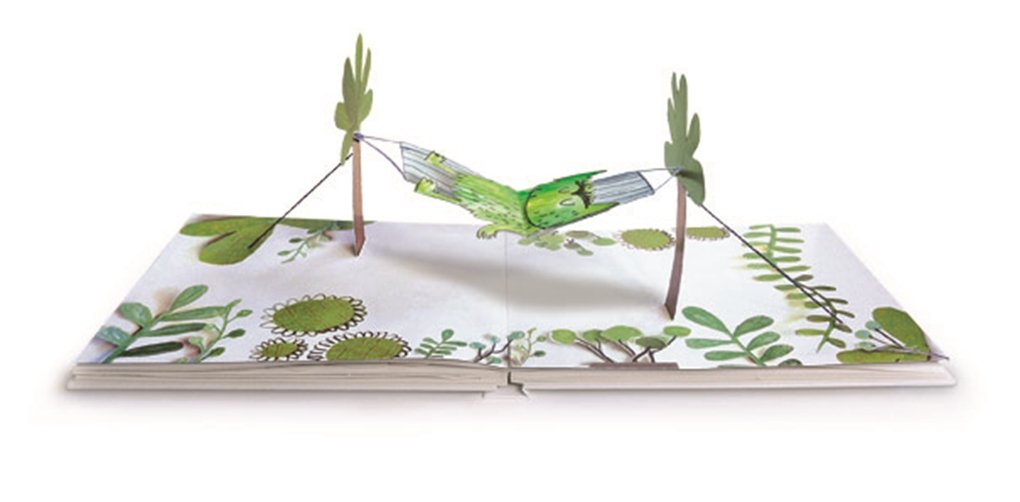
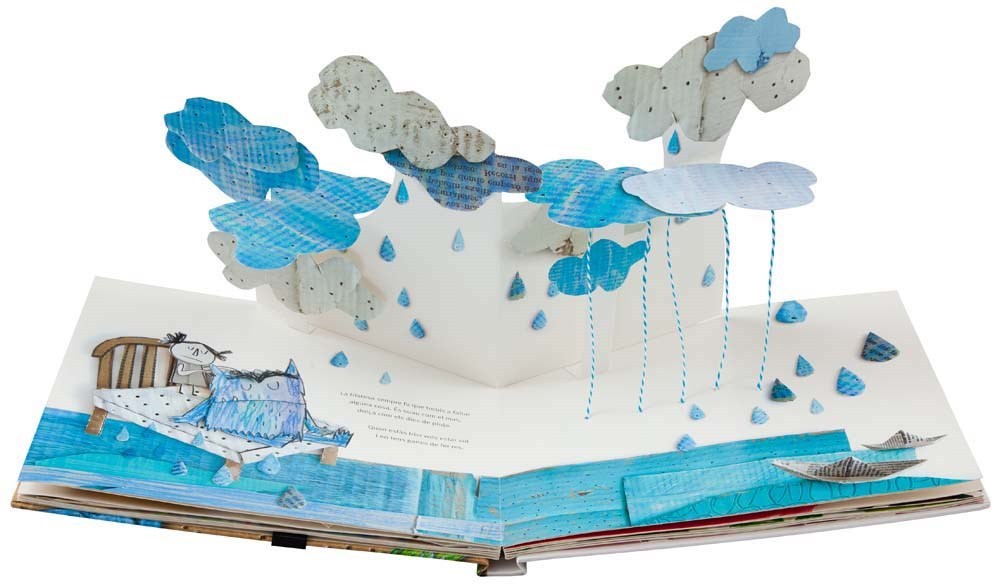
The Color Monster: A Pop-Up Book of Feelings by Anna Llenas is one of the most wonderful pop-up books I've ever seen and I'm not sure quite why it is that I love it so much. I just want to step inside the book and hang out. I kept it by the bed and read it now and then, just for the joy of it, for quite some time You can look up almost the entire interior of the book by googling the title but I will tell you my favorite pop-up is the color monster in a hammock because it looks so deliciously soothing.

The Color Monster is subtitled "A Pop-Up Book of Feelings" because it's about emotion. The monster on the cover of the book is multi-colored to reflect the fact that his emotions are all "jumbled up". Each color represents a particular feeling: yellow is happiness, blue represents sadness (hit this link to see blue - blue is totally cool), red is anger, black is fear, green is calm (hence, the hammock). There are empty bottles at the beginning of the book and the next to the last page shows the emotions separated, each into its own bottle. There's one more feeling at the end, pink with hearts: love, of course, although it doesn't say so.

Highly recommended - You don't have to have a child who needs to understand his or her emotions better to enjoy this book -- although, I think it would be excellent for its true purpose -- you can be a messed-up grown-up who just wants to play with pop-ups. Yeah. Don't be surprised if this one never makes it into the hands of a grandchild. Ages 3-7. Allegedly.

Monster Trouble by Lane Fredrickson, illustrated by Michael Robertson begins:

Winifred Schnitzel was never afraid.
Not of monsters or ghouls or the noises they made.
She loved scary movies and werewolves and thunder
and peg-legged pirates who bury their plunder. 

Still Winifred's bedtime was hardly spook-free.
The neighborhood monsters would not let her be.
Each night they'd show up and attempt to be scary.
Some would growl; some would belch. Some were slimy, some hairy.

Poor Winifred. She's not afraid of monsters at all but they're a bit pesky and end up keeping her up all night. Tired of having her sleep interrupted, she checks out a book of ideas called "Monsters Beware!" and creates a trap. When that fails, she tries driving them off with stinky cheese and then building her own spook traps. It's not till she's thoroughly exhausted that she happens across a solution when she sleepily kisses a monster and it hastily backs away. Monsters hate being kissed! From then on, Winifred is set. If a monster bothers her, all she has to do is give it a kiss.

Highly recommended - Monster Trouble has a nice rhythm and cheerful illustrations; it's one of my favorites of this batch of monster books. I like a good rhyming book (always fun to read aloud) and the monsters are cute enough not to slip into frightening territory. Ages 4-8. Also great for reading to cats.

©2015 Nancy Horner. All rights reserved. If you are reading this post at a site other than Bookfoolery  or its RSS feed, you are reading a stolen feed. Email bookfoolery@gmail.com for written permission to reproduce text or photos.

Three Christmas Books: A Boy Called Christmas by Matt Haig, Blue Christmas by Andrews, A Child's Chrismas in Wales by Thomas

Getting closer to being caught up on reviews! The following books were all purchases. I didn't receive any Christmas books for review, this year.

The tower -- the prison -- was a scary place. Yet, although it was horrid, it also had very nice comforting things written on the stone walls of the staircase, from its time as the Welcome Tower. Things like 'Welcome' and 'Strangers are just friends with weird faces' and 'Hug a human'.  [p. 128]

'An impossibility is just a possibility that you don't understand.' [p. 140]

Father Topo's words came back to Nikolas. You just close your eyes and wish for something to happen. Perhaps a wish was just a hope with better aim. [p. 152]


When Matt Haig said his new Christmas book, A Boy Called Christmas, was available for pre-order, I dashed off to look it up and discovered that it's not available in the U.S. But, of course there's a way around that: Book Depository. My copy arrived within days of its release.

A Boy Called Christmas by Matt Haig tells the story of Father Christmas. Nikolas is a poor boy in Finland (nicknamed "Christmas" because he was born on Christmas day) who owns only two toys: a wooden sleigh and a doll made of a carved turnip. When his father has to go away for two months, an abusive aunt arrives to care for him. And, when his father, Joel, doesn't return, Nikolas goes off to search for him with only his mouse friend Miika as a companion.

And, here, I must confess that I only remember bits and pieces of A Boy Called Christmas, which I liked but didn't fall madly in love with. I have a feeling I'll like it better upon the second reading because I didn't expect it to be quite so dark, but now that I've read it I want to read it, again. What I loved about the book was the way Haig took elements of the story of Father Christmas (or Saint Nicholas, Santa, etc.) that I've never seen explained elsewhere in a satisfactory way and did a marvelous job of spinning a magical, adventurous tale that explained those elements. There's also, of course, Matt Haig's trademark pithy wisdom, as you can see in the quotes above.

Recommended - While it wasn't a 5-star book for me, A Boy Called Christmas definitely has the feel of a new Christmas classic worth revisiting.

I bought my copy of Blue Christmas for a dollar when I ran into the local dollar store to grab my 2016 calendar. Naturally, I had to wander down the book aisle. I'm not a fan of Mary Kay Andrews, in general, but I figured at that price it was worth a chance.

Blue Christmas tells the story of Weezie Foley, a Savannah antiques dealer who is determined to win the local decorating contest. But, her first attempt is a disaster and then things start to go missing from her second display.

There's a bit of animosity between Weezie and her competition, a crazy Southern family dinner, a chef boyfriend who is constantly letting her down, the missing items, and a mysterious homeless woman who exchanges gifts with Weezie in what turns out to be a warm, sweet, funny holiday book.

Recommended - Maybe I'm better off reading Mary Kay Andrews in small doses. At 196 pages (including a couple recipes that sound just awful to me), Blue Christmas was just the right length and delightfully heart-tugging.

A Child's Christmas in Wales by Dylan Thomas was the selection for our December F2F book group meeting and a reread for me.

A tiny book that other members said was a poem, it does have a lovely rhythm but I still want to call it a short story. We chose A Child's Christmas in Wales primarily because it's short and several of us had already read and loved it. In December, we gather around a roaring fire (fortunately, it was just cool enough that a fire didn't sound appalling, although I sat too close and kept sinking farther and farther into the leather chair, threatening to fall asleep), sip eggnog or wine or both, discuss a short story or two, and then just talk. It was raining and the 30-mile drive was, at times, terrifying, but I couldn't bear to miss out and I absolutely love the book.

We mostly spent time reading our favorite passages of this autobiographical story about Christmas in Wales from a child's-eye view, talking about Dylan Thomas and how short but accomplished his life was, and comparing copies of the book. Everyone had a different copy. I like mine (shown at left). It's small and the illustrations are just like the one shown on the cover, black and white They look fitting to the time period. But, some of the other copies were more heavily illustrated, one with fabulous watercolor paintings portraying the wit and humor of the artist and the story.

My favorite passage is a quotation by a little boy:

"It snowed last year, too. I made a snowman and my brother knocked it down and I knocked my brother down and then we had tea." [p. 22]

So very British.

Highly recommended - An enchanting, beautifully crafted tale of childhood that is often wickedly funny and one of my Christmas favorites.

I briefly reviewed A Child's Christmas in Wales in October of 2012.

©2015 Nancy Horner. All rights reserved. If you are reading this post at a site other than Bookfoolery  or its RSS feed, you are reading a stolen feed. Email bookfoolery@gmail.com for written permission to reproduce text or photos.

Monday, December 14, 2015

More minis: Well Wished by Billingsley (reread), Orphan Train by Kline (reread), I Love It When You Talk Retro by Ralph Keyes

She eased onto the ice and cast her words in front of her, threading the air with her voice and tugging it taut with a bright invisible line. And the ice flowed into her legs -- or maybe it was that her legs flowed into the ice -- and even when she took the air in a jump there was some secret that whispered between the ice and her feet. 

[p. 62]

Well Wished by Franny Billingsley is a reread but I'll go ahead and write a bit about it, just for grins and because I happen to love Franny Billingsley's writing.

Nuria lives with her grandfather, whom she calls "the Avy", in tiny Bishop Mayne, a village with a magical Wishing Well. One can only make a single wish in a lifetime and that wish must be worded very carefully or things can go very, very wrong. One such wish caused all the children in town to disappear -- all but 11-year-old Nuria, who lives up on the mountain.

When a single child returns, Nuria becomes friends with her. Catty Winter is unable to walk after illness took away the use of her legs. She and Nuria spend time together in a cabinet under the stairs, which they have decorated. They're very imaginative children. When Catty convinces Nuria to make a wish with her and the wish goes horribly wrong, Nuria wants to rescind the wish. But, Catty does not. How will she convince Catty to speak up so things can return to normal but without making Catty's life as bad as it was, before?

Highly Recommended - There are a lot of things I love about Well Wished: its complexity, the relationship between Nuria and her grandfather, the creativity of the children, the word game ("Bring me a description") Nuria plays with the Avy, the way the story is resolved. It's a lovely story. I read a few reviews while I was reading the book because I noticed it didn't have a very high rating at Goodreads and found that some people considered Nuria a bit snarky. She's a wit, definitely, but I don't think of her as negative. Rather, it seemed to me that she's a good person who wants to do the right thing. And, the writing is lovely.

Orphan Train by Christina Baker Kline is also a reread. This time, I read it for discussion with my local book group. I suggested it when our group leader asked me if I knew of any discussion-worthy books that weren't downers, as we'd read a series of truly dreary books and everyone was in need of an upper. I recommended Orphan Train, which she quickly read and added to the schedule for discussion.

I'm not going to write a full description since I've reviewed Orphan Train in the past (that's a link, at left, to my old review) but it's a story that flits between the story of a teenager in foster care in the present day and a historical story about a young orphaned Irish girl who was sent on a train to the West. Their lives, as it turns out, bear some uncanny parallels. The story ends on a very happy note.

We discussed Orphan Train, last month, and used some of the questions in the paperback version for discussion (but it was also a partly organic conversation). I don't recall anyone at all saying they disliked the story and it was definitely a good choice. Everyone was relieved to have a break from sadder reading material and there was plenty to talk about.

Still highly recommended - Loved it the first time; appreciated Orphan Train even more upon rereading.

I Love It When You Talk Retro by Ralph Keyes is about the crazy things we say, the origins of some of the words and phrases that we use, and how some of them have been altered by time, shifting their meaning -- sometimes to its opposite.

I bought I Love It When You Talk Retro as a remainder and had set it on the end table with the thought that I planned to read it soon. If you're a regular here, you know I decided to go ahead and read the book after my husband spilled coffee all over my copy. It's not in great shape.

Although I can't recall what rating I gave the book, I liked it a lot but didn't love it. The history of words and phrases is, of course, fascinating to me because I'm a lover of words (I'll bet most of you share that with me). There were only a couple problems with the book. One is that sometimes the author was wrong. It didn't happen often, as far as I know, but I did catch a few mistakes. The second problem is that the author seemed to grow tired of his subject matter toward the end of the book. Within the last 50 pages, the depth of history seems to narrow, the passion wanes and the reader is left with questions that were answered earlier in the book when describing other retro terminology. The final problem is kind of shocking for the type of book: the author inserts his opinion where it is absolutely not appropriate. He may, for  example, say the origin of a phrase came from a particularly bad movie, for example -- his opinion, not necessarily the opinion of the reader or even the popular viewpoint.

Recommended with slight hesitation - Because of the three problems mentioned, I can't give I Love It When You Talk Retro an enthusiastic recommendation but it was fascinating enough that I occasionally read passages to my husband and he enjoyed them as much as I did. So, it's worth reading, even though it may not be a perfect book.


©2015 Nancy Horner. All rights reserved. If you are reading this post at a site other than Bookfoolery  or its RSS feed, you are reading a stolen feed. Email bookfoolery@gmail.com for written permission to reproduce text or photos.

Thursday, July 30, 2015

Mini reviews - Possibly a failed attempt at randomness


I haven't felt like writing blog posts, this week, and sometimes that means I should walk away but sometimes it means I need to stop allowing myself to feel confined by what I usually do. So, I attempted to make this post structureless. I'm not sure I succeeded but at least it helped me knock out a few more reviews, if only for the sake of personal record-keeping.

The recent read that I think I've found most difficult to even begin writing about (apart from a couple of books I loved so much I feared I couldn't do them justice) is Life in a Box is a Pretty Life by Dawn Lundy Martin, a book I read during the #flashreadathon in June. It's poetry but it's not necessarily for the everyday reader who has difficulty understanding poetry (me, for example, haha). It's complex, choppy, the kind of poetry that requires you to completely shut off expectation and stop trying to understand. I found it easier to "get" after I quit, metaphorically, squinting so hard at its ideas. I think the best way to describe the book would be to go back and look at what I said on Facebook, just after I finished reading:

Life in a Box is a Pretty Life was rough. I had to keep walking away from it after I began to "get" it (poetry - not the easiest) because it's about being black, being a woman, being victim-blamed, racially profiled or judged based on color or sexuality, etc. Apropos given recent headlining stories. I wouldn't say it's for everyone and I'm not even sure it was entirely for me but I got something out of it and at times it absolutely took my breath away. 

Bottom line - A hard read about rough topics but very timely. It does deserve a language warning as sometimes it's graphic.

When the Emperor was Divine by Julie Otsuka is not a book I ever anticipated having difficulty writing about, but it's one that I pulled off my personal shelves so I just didn't feel obligated to say anything, at least at first. I keep a running draft of books completed and when I post about them I add a link to what I've written and then I have a post of "books read" for the year, complete with links, ready to go at the end of the year. The items on that list that don't contain a link bug the hell out of me. Weird, but true.

The topic of When the Emperor was Divine (a novel) is one I've read about before and would like to read more about: Japanese internment during WWII. There's a museum that's dedicated to an internment camp in Arkansas, not all that far from us -- maybe two hours' drive, I'd guess, possibly a bit longer. No physical remnants of that camp now exist. I can't recall which camp the family in When the Emperor was Divine was taken to, but that doesn't matter. From other reading, I know that the sites of those camps were chosen specifically for the fact that they were terrible -- too hot, too cold, too dry . . . places you wouldn't choose to live. That alone is enough to tell you the experience could not have been a comfortable one. And, yet, I've read real-life stories that convince me the culture of Japanese Americans sustained them in a way that not every culture might have.

The title alone gives hints that change has occurred in a family's beliefs in When the Emperor was Divine. But, it's less about the specific culture (although that's a factor) than a story of a family's horror at being shunned, having to quickly dispose of pets and possessions, knowing they were to be forcibly taken from their home but not where and, of course, deeply dismayed at a life they never would have chosen. It's also about a torn family, what it was like living in camp without the husband and father, the head of the family having been taken away before the rest of the family was forced to move. It's well-written and plausible but the one thing I thought the book lacked was a view of the positives. As I said above, I've read some remarkable stories of courage, creativity and determination, much of which rested in the culture itself. I'd have liked to see a few glimpses of beauty within the text. But, I did think the book was a good one, reflective and with a tone that is sad, but for good reason.

Julia's Cats by P. Barey and T. Burson is one I've mentioned but not elaborated upon and that's because I closed it thinking there wasn't much to say. That doesn't mean I didn't think it was a good read; I did enjoy it. I have to admit I am fascinated with Julia Child but haven't bothered to learn much about her. In Julia's Cats, the authors have placed her love of felines and the tales of the cats in her life within the context of her cooking life. So, it serves as a casual biography of her marriage and her life in the kitchen, both before and after she was professionally trained and became a well-known personality.

I enjoyed the reading but the one thing I felt lacking in Julia's Cats was a satisfactory wrap-up to the lives of each feline. Because of her lifestyle, her travel, and the sheer number of places she called home, her cat ownership was equally transitory. Some cats were "rehomed" when she moved and some were shared with neighbors or friends. All had similar names, so it also became difficult to distinguish between one cat or another -- definitely not the fault of the authors. Because they were often left behind as Julia moved into a new phase of life or someone else took over the care of a cat, you seldom know what became of any one particular animal. One of the nicest things about the book is that there are photographs. I didn't realize Child's husband was a photographer. The photos are, for the most part, fabulous and the book is entertaining. Here's a peek inside:


And something definitively random to end the post . . . books and Minions!


©2015 Nancy Horner. All rights reserved. If you are reading this post at a site other than Bookfoolery  or its RSS feed, you are reading a stolen feed. Email bookfoolery@gmail.com for written permission to reproduce text or photos.

Thursday, February 19, 2015

Two thrillers: North of Boston by Elisabeth Elo and The Girl on the Train by Paula Hawkins

2015, besides being a slower reading year, seems to be one in which I've read a lot of books in pairs: two books about the Great Depression, two thrillers, two children's storybooks (reviews forthcoming). In the case of the two thrillers, I just happened to be in the mood for fast-paced reads at the same time I came up with a story idea that's on the thrillery side (necessitating a little thriller reading to find examples of good pacing).


Briefly, John Rodgers and Jean-Luc square off, shoot subtly hateful glances at each other. Imagining that these two men could agree on anything is like imagining that the north and south poles could overcome their magnetic issues and meet for lunch at the equator.

--from North of Boston 

North of Boston by Elisabeth Elo was one of the books recommended to me when I asked for thriller title suggestions from friends. And, then the friend who recommended the book offered to send me her copy (which has a different cover than the one at left but I couldn't find a decent image). I'm so glad she did.

Pirio Kasparov was on a fishing boat with her friend Ned on a foggy morning when a freighter ran into the boat, killing Ned and leaving Pirio clinging to flotsam for hours in frigid water. Convinced that the collision was not an accident, Pirio begins to investigate, uncovering a tangled web of deceit that leads her to discovery and danger.

I have mixed feelings about North of Boston. I loved the writing, adored some of the characters (especially Pirio and her best friend's son, Noah), appreciated those who were unreliable, liked the added interest of the question, "Why did this character survive something that kills most?" and really liked where Pirio's search led -- to a legitimate world concern. But, I didn't find the book gripping, nor did I always find Pirio's ability to keep going in spite of serious injury entirely believable. Still, a solid read, definitely well-written and recommended.

The Girl on the Train by Paula Hawkins was a total risk. You've undoubtedly heard of it, by now -- the book everyone is calling this year's Gone Girl, the story of a woman who sees the same couple from the train most weekdays and imagines their perfect life until . . . a kiss, a death, a mystery, and somehow Rachel ends up in the middle of a tangled web.

I haven't read Gone Girl but I'd read a few reviews of The Girl on the Train, knew friends were reading it, and saw that the buzz was growing. What convinced me to spend some of my Christmas money was none of the above. I simply liked the idea and the setting. A London setting is always going to grab my attention, especially when the story happens to fit the characteristics of something I'm seeking (in this case, of course, an engrossing, fast-paced read) with gift card money in hand.

As it turned out, I did find The Girl on the Train every bit as gripping as I hoped. The reviews I read before buying were mixed. A lot of people didn't like the characters. Too flawed, too unlikable. I tolerate unlikable characters a lot better if I know they're coming, so I opted to go ahead and order the book and hope for the best.

Fortunately, The Girl on the Train was exactly what I was looking for and, nope, I didn't mind the characters. Yes, the women are definitely unlikable -- all of them. But, each is flawed in ways that I found believable. I particularly found the alcholic and unreliable main character had the ring of truth. I also thought the use of three viewpoints worked very well and, even though I figured out "who done it" around 100 pages before the end of the book, the pages continued to fly. Highly recommended.

North of Boston and The Girl on the Train both have substance-abusing characters in addition to a mystery and it was fascinating to see how that played out in both books. I thought it was a little better handled in The Girl on the Train but Rachel is the character I considered the female protagonist, in spite of the fact that the book is told through several different points of view, and in North of Boston it's Pirio's best friend who is the substance abuser so Rachel's alcoholism is key to the plot while Thomasina's (that of Pirio's friend) is not. That may have impacted how I feel about the use of substance abuse in the characterization. Both fed nicely into the reading of my book group's latest read, The Road to Echo Spring: On Writers and Drinking by Olivia Laing. More on that later, I hope.

©2015 Nancy Horner. All rights reserved. If you are reading this post at a site other than Bookfoolery  or its RSS feed, you are reading a stolen feed. Email bookfoolery@gmail.com for written permission to reproduce text or photos.

Tuesday, November 25, 2014

3 minis - The Evergreen Bride by Pam Hillman, The Guest Cat by Takashi Hiraide, A Cornish Affair by Liz Fenwick

I'm going to do a few mini reviews to catch up with myself. Almost everything I've read recently has been from my personal shelves or recently purchased.

The Evergreen Bride by Pam Hillman is not my normal fare but the author is a friend and I appreciate nothing more than sweetness and light in a Christmas read. I also was in the mood for something light after a darker read, this weekend (I'll get to the darker read in a sec).

In The Evergreen Bride, Annabelle Denson is preparing to travel from her home in Sipsey, Mississippi to visit her cousin in Illinois. Annabelle is hoping to experience a white Christmas. Carpenter Samuel Frazier looks forward to Annabelle's daily visits to the mill, where he works with her brother, Jack; and, he worries that Annabelle will not return from her journey, presuming she'll meet plenty of young men in Illinois. But, he keeps his affection for her to himself. Will Annabelle begin to think of Sam as a potential beau before it's too late?
The Evergreen Bride is a novella so it's short and it's predictable, which was just what I wanted -- a quick, touching read that I knew would end well. There's no real obstacle to love, apart from Annabelle's planned journey and the fact that she is unaware that Sam is perfect for her. I adored the characters. A delightful upper of a story, recommended to anyone looking for a light, happy Christmas read, particularly fans of romance.

The Guest Cat by Takashi Hiraide is the book I referred to above as a "darker" read. It's not dark, really, but if the author's remarks are accurate, it's the novelization of a series of articles about a real cat and I found it deeply painful because it has the ring of truth.

When a young man and his wife rent the guest house on the property of a large estate, they unexpectedly find their house the second home to a neighborhood cat, a playful white and black kitty who eats, sleeps and plays in their home and follows the young man around when he cares for the garden of the larger home. In the morning, the cat returns to her owners to see their young son off to school. The neighbors are unaware that their cat is spending time in another house; and, when the owners of the larger home must prepare to sell, the young couple is so attached to the cat they call "Chibi" that they anxiously look for a new home close enough that they'll be able to continue their relationship with her.

I loved the author's descriptions of Chibi -- her mannerisms, habits and how she played, as well as the subtle ways she showed her affection and became a valued companion to the young couple.  You can imagine why I consider it a bit dark without any need to elaborate, as she was an outdoor cat and there are many dangers to cats in the outdoor world. I was hoping for a light, happy read. The Guest Cat is lovely in many ways but I was disappointed to find that it wasn't exactly what I was looking for. It is, however, certainly an interesting peek into Japanese culture if you can bear the sad bits.  Recommended, although not a favorite, for the beauty of writing and the themes of love and unexpected friendship.

A Cornish Affair by Liz Fenwick is about a runaway bride. On the day of her wedding to the handsome, successful man her mother has pushed her to marry, Jude comes to the realization that she's given in to her mother's desires all her life, thanks to the fact that Jude has tried to take the place of her beloved sister Rose, who died of kidney disease. Marriage to John, she realizes, would be a mistake. So, Jude runs.

Her plans to move to London with John now scuttled, Jude finds the atmosphere in her parents' New England home unbearable. But, she's taken a 2-year leave of absence from her job. Tired of their criticism, Jude arranges to visit her aunt Barbara in England and, while there, Barbara arranges a job for Jude on the Cornish Coast, organizing the files of an author Jude has long admired.

The author is chaotically disorganized and bent on finding his family's missing treasure to save his estate. Jude is making progress on his files when tragedy strikes. Can Jude help save the estate and convince John that he's not the man for her?

Again, this was a predictable read, but not one I enjoyed quite as much as The Evergreen Bride. I'm not sure if it was bad timing or Liz Fenwick is just not the author for me, but I considered abandoning A Cornish Affair. The only reason I stuck it out was the usual one . . . I was halfway through and decided to finish. I didn't think it was a terrible read and I did think it improved in the second half but it still dragged. And the way A Cornish Affair ended was predictable in a way that I found disappointing. Of course, I knew what was going to happen; I just didn't like Jude enough to want that ending for her, I suppose. Thumbs up to the setting. Not a favorite but I'd recommend A Cornish Affair to romance lovers.

©2014 Nancy Horner. All rights reserved. If you are reading this post at a site other than Bookfoolery  or its RSS feed, you are reading a stolen feed. Email bookfoolery@gmail.com for written permission to reproduce text or photos.