Showing posts with label Little Brown and Co.. Show all posts

Thursday, February 17, 2022

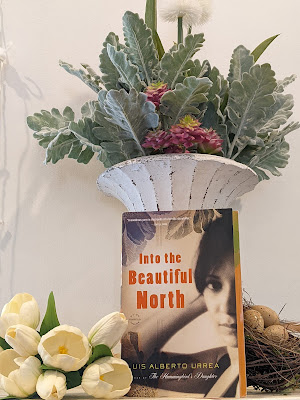
Into the Beautiful North by Luis Alberto Urrea


In Into the Beautiful North by Luis Alberto Urrea, Nayeli's village in Mexico, Tres Camarones, has been invaded by dangerous drugs runners/bandidos but almost all of the men have gone to the United States to find work. Her father has been gone for years without sending money or even a postcard. When Nayeli realizes there is nobody around to save them, she's inspired by the movie, The Magnificent Seven. She and her friends will go to America to bring home her own Magnificent Seven to drive the bandidos away. 

Highly recommended - A marvelous read that treats the "illegal" characters like the humans they are, with joys and sorrows like the rest of us. Nayeli is an especially strong character but a believable one, as are her friends, flaws and all. I was expecting the usual, harrowing border crossing adventure and there's plenty of that. What I didn't expect was the humor. Mexicans complaining that they need a wall on their Southern border. Border Patrolmen who put illegals on the bus back to Tijuana and, after asking, "Will you cross over again?" and being told yes, say "See you next week!" Just an all-around fabulous read, respectful, surprising, and hilarious. 

I don't own any other books by Luis Alberto Urrea, unfortunately, but now I want to read his entire backlist. I love his sense of humor. 


©2022 Nancy Horner. All rights reserved. If you are reading this post at a site other than Bookfoolery or its RSS feed, you are reading a stolen feed. Email bookfoolery@gmail.com for written permission to reproduce text or photos.
Thursday, January 02, 2020

Mini reviews - The Lost Man by Jane Harper, The Same Sky by Amanda Eyre Ward, and The Last Light Breaking by Nick Jans

It just occurred to me that I should use as much of the week as possible while I'm trying to quickly crank out reviews to finish up 2019, so I may go ahead and post on the weekends and/or skip Fiona Friday until I've caught up and posted my final list with links to all reviews from 2019. I'm going to wing it, for now. Husband may not let me get away with that, so we'll just have to see if that works out. I've just gotten my phone back from the store where I left it behind, so I will go ahead and post a Fiona Friday image, tomorrow.

The Lost Man by Jane Harper is about three brothers. One has become an outcast and lives on a remote piece of his family's property. One feels like he's being treated like he's stupid and left completely out of the decision-making. The third was considered the responsible, likable one. He was married with two children but his body has just turned up in a very strange place, next to a lone grave and far enough from his car that it appears he may have committed suicide. But, something doesn't feel quite right about his death and the outcast brother decides to find out what really happened.

I don't have the book next to me but I remember the story well, if not the names of the characters. As in her previous two books, Jane Harper's Australian setting is practically a character in and of itself, it's so vivid. When she talks about the dust, the dryness, the heat, the way the fine red soil gets into the creases of one's clothing, it's so well described that the real world feels a little unreal for a moment, when you set the book down. The characterization is every bit as sharp. I am so impressed by Jane Harper.

Highly recommended - I was a little disappointed when I found out Jane Harper's third book wasn't going to star the police officer with a wounded soul but an honorable heart of the first two books but I shouldn't have been. I'm not a mystery fan but Jane Harper's writing absolutely sweeps me away. The Lost Man has a slightly slow beginning as you get to know the characters but once you've been introduced to the cast and the questions about the death have been posed, the story becomes absolutely mesmerizing. I continued guessing all the way to the end of the book and I closed the book thinking it was Harper's best.

My copy of The Same Sky by Amanda Eyre Ward was ordered from Book Depository so just a warning, up front: that's probably the British cover. The publisher is Blackfriars, which sounds very British, but I'm just guessing. If you're American and this story appeals to you, be aware that you probably won't see this cover if you go looking for it.

The Same Sky tells two interconnected stories. One is the tale of a young Honduran girl who lives with her grandmother and twin brothers. Her mother lives in Austin, Texas and sends home money but after things deteriorate, Carla and her brother, Junior, are constantly starving. When he starts sniffing glue to help him forget his hunger, Carla knows it's past time to attempt the harrowing journey North. Will they survive?

In the second storyline, Alice is infertile due to breast cancer treatment in her college years and a baby she and her husband were going to adopt has been reclaimed by his mother. Is it time to give up on ever having a child?

It's pretty obvious how Carla and Alice's stories will intersect (Trigger Warning for rape) and, as is often the case in books with two storylines, I favored one over the other — the favorite being Carla's story. I didn't feel like Alice's story was entirely necessary but that's a personal preference. After I wrote that I was unsure why the author bothered to tell Alice's story, on Instagram, another reader and bookstagrammer told me she liked the story just as it is. I wondered if Ward showed Alice's side for the contrast. Alice and her husband have a successful business but feel their lives are incomplete without a family. Carla's family is scattered and struggling in ways mostly unimaginable to an American, so there definitely is a stark difference between their lives.

Recommended but I had mixed feelings - While I think immigrant stories are especially important at this moment, I felt like The Same Sky was a little too disjointed and that some of the elements should have been glossed over or eliminated entirely. I gave it 3 1/2 ⭐. For those who may be wondering, yes I've heard of American Dirt. In fact, I've pre-ordered a copy. I tried to win one (I don't know how many drawings I signed up for) but failed. Before I did so, I'd already pre-ordered it, anyway. It just means I have to wait till its release. 


There's an interesting story behind how I found The Last Light Breaking by Nick Jans. About 10 years ago, the first time we went to Alaska on vacation, Huzzybuns neglected to book one night's lodging in the middle of our stay. Seriously, he just skipped that night. When he realized he'd messed up, the only place he could find for us to stay was on the opposite side of the Kenai Peninsula from where we were staying the rest of the time, in a former cannery. He booked it because he had no other options and it turned out to be a cool side trip because it was on the drive across the peninsula that we saw the one and only moose we encountered on that trip. 

Our room in the former cannery was frigid (the thermostat set in the 50s) when we arrived but there was a little lobby area with corner seating where we could hang out while the room warmed up and a shelf of books on each wall for the guests to borrow. I flipped through a few before settling down to read The Last Light Breaking. I only read a single chapter (it's a series of essays about the author's life in Alaska with Inupiat Eskimos) but I was so impressed that I wrote down the title and author and put the book on my wish list. It took several years before I got a copy via Paperback Swap and I suppose it's taken me so long to actually read The Last Light Breaking because of all the ARCs I've given priority, over the years, but it finally called out to me during my winter break from blogging and I listened. 


The essays in The Last Light Breaking tell Nick Jans' story (not in exact timeline order, but so well that it didn't feel like that mattered): how and why he ended up traveling to Alaska, his experience as a new guy (and not a native in a predominantly native region) in town, the jobs he's held, many of the trips he's made around the area to camp, hunt, fish, hike, etc., and what he's learned from his neighbors and friends. Nick Jans is an adventurer and a people person, so the book is particularly fun to read if you like reading about adventure, interaction, and what it's like to live with the Inupiat, who are among the few natives who actually are OK with the word "Eskimo".

Speaking of the word "Eskimo" and why it's not always OK . . . my son had a swim coach from Alaska. He was indigenous but Tlingit, from Juneau, not a people for whom the term "Eskimo" is used, so he considers it offensive if you call him an Eskimo.

Highly recommended - Stunning writing that will make you feel like you've been on an adventure with the author and convince you that the land is sacred. I will be looking for more by Jans and I wish I'd read him sooner.

When we were in Alaska, or maybe before, I read up on the native way of life and why they still consider subsistence living (hunting and fishing in the traditional ways for food, fuel, etc.) important so I had no problem with some of the things Jans did with his friends but I would caution the squeamish and anyone who objects to the killing of animals for any reason that there are a few graphic scenes that you might need to skim.

©2020 Nancy Horner. All rights reserved. If you are reading this post at a site other than Bookfoolery or its RSS feed, you are reading a stolen feed. Email bookfoolery@gmail.com for written permission to reproduce text or photos.

Wednesday, November 06, 2019

The Cats of Tanglewood Forest by Charles de Lint and Charles Vess


I'm going to keep this one short but I want to mention it because I loved it so much and it was the perfect story to keep me from falling into a reading rut. The Cats of Tanglewood Forest by Charles de Lint is the story of a girl, Lillian Kindred, who loves to spend time running barefoot through the Tanglewood Forest. Then, one day, Lillian is turned into a kitten by a magical circle of cats to keep her from dying. She's been bitten by a venomous snake and is lying on the forest floor when the cats surround her and cast a magic spell. They're not supposed to use their magic in such a way and the big cat who rules the kitties of the forest will not be happy, but they can't bear to watch a little girl die.

Can Lillian find a way to become human again? And, if she does, will she be able to bear the consequences of her choice?

Highly, highly recommended - I absolutely adored this magical gem of a book. Lillian is a sweet little girl who loves to explore, loves nature, but above all loves the elderly aunt who cares for her. It's alternately whimsical and terrifying, always magical and imaginative. The Cats of Tanglewood Forest is going on my favorites pile for 2019.

I'm not sure of the age range for The Cats of Tanglewood Forest, but I'm going to say it's probably classified as "middle grade". Of course, that always comes with a grain of sale. I had a child who was reading at middle grade level by 6 or 7 and one who didn't really get going till he was about that same age but then read his all-time favorite book, White Fang by Jack London, at 10 (and immediately dived into other 19th-century writing, which he still loves). At any rate, it's also great for an adult who is in the mood for a touch of magic and whimsy with some scary moments.

Notably, Charles Vess, the illustrator, and Charles de Lint are apparently best buddies and they came up with the idea together, although de Lint wrote and Vess illustrated. I'm so glad I bought this book because I will definitely return to it and it's one that my grandchildren can read when they get older and visit. Yes, I'm already thinking ahead to what they'll read when they hit middle grade age!


©2019 Nancy Horner. All rights reserved. If you are reading this post at a site other than Bookfoolery or its RSS feed, you are reading a stolen feed. Email bookfoolery@gmail.com for written permission to reproduce text or photos.

Wednesday, October 25, 2017

The Little Red Cat Who Ran Away and Learned His ABCs (the Hard Way) by Patrick McDonnell


The Little Red Cat Who Ran Away and Learned His ABCs (the Hard Way) by Patrick McDonnell is, first of all, a book with a mouthful of a title. If I had little ones, right now, I would definitely refer to it as, "Little Red Cat" or "Red Cat ABCs." And, I'd definitely have to come up with some kind of shorthand because I have a feeling little ones will want to read it repeatedly. The illustrations are a hoot.

The first thing that happens, of course, is that a little red cat runs out the door of a house. Oddly, The Little Red Cat Who Ran Away and Learned His ABCs is completely wordless. The story is told through the illustrations and it's up to the grown-up to dictate the storyline for the youngest readers. That totally stunned me when the book first arrived. I loved the illustrations but there were a couple panels in which I was unsure of what the letter for that particular page represented. And, then I discovered the alphabet at the back of the book. The author has provided a list of the words each of the letters of the alphabet represent. So, once you've figured that out, you're golden.

The second time I read the book, I had no problem with the storyline. The illustrations make it perfectly clear and you'll find that the lack of words is no obstacle to the story. In fact, it may even be a little more fun not being constrained by someone else's word choice.

Not-so-quick synopsis: A little red cat goes outside to play but immediately encounters an alligator with open jaws. The alligator wants to eat him! The red cat runs away, past a brown bear, past a chicken. As he runs, each animal follows. When they encounter a dragon, the chicken is so frightened she lays an egg. The dragon blows fire at them and they all put on sunglasses (this was a frame I had trouble with: G is for "glasses"). The cat thinks, "I want to go home!" But, he keeps running. It snows and the alligator, the bear, the chicken, the dragon and the egg (who has miraculously sprouted legs) slide on ice. They swing through a jungle and run past a castle with a king and a princess peering out a window. The princess points out a sign with a picture of the red cat on it and you get to see one of only two words in the book, here: "LOST". The animals cross a mountain range and come to a cliff. "NnnnnOoooo!" shouts the dragon, but it's too late. The other animals fall over a cliff. Fortunately, they all have parachutes. They come to a sign with arrows but no words and they all have a question mark over their heads. They decide to stop for a restroom break. The sun is setting. Everyone is tired. But, then a unicorn shows up with the king and princess on its back! The princess hands out valentines and the other animals wave goodbye to the cat, then the king hands the red cat a scroll. It's a map and X marks the spot - the map leads home! The cat arrives home and runs straight to his bed. He yawns and then falls asleep and Zzzzzzz, sweet dreams.

Highly recommended - Clearly, the story in The Little Red Cat Who Ran Away and Learned His ABCs (the Hard Way) is an obvious one, easy for a parent or teacher to describe and dramatize. The illustrations are a delight, most of the words that go with the letters obvious enough to make telling the story a breeze (a handy key in the back clarifies if you're unsure about any of the words that go with each letter), and the story comes full circle with a happy ending. Great for home or school.

This is Book #4 for Children's Week. I forgot to mention that the last review was #3. Oops. Quite a few more children's book reviews are on the way!

©2017 Nancy Horner. All rights reserved. If you are reading this post at a site other than Bookfoolery or its RSS feed, you are reading a stolen feed. Email bookfoolery@gmail.com for written permission to reproduce text or photos.

Saturday, August 13, 2016

Good-bye, Mr. Chips by James Hilton


My copy of Good-bye, Mr. Chips by James Hilton shows off its age with the hyphen in the word "good-bye". I just finally noticed this, today. The copy shown is an illustrated "Junior Deluxe Edition" printed by Little, Brown in 1962. Because it's technically novella length and it doesn't appear to have been watered down in any way, I'm certain the "junior" aspect is the addition of illustrations, rather than any editing to suit a younger crowd.

I saw the movie Goodbye, Mr. Chips (no hyphen in that title!) as a child and fell in love with its warmth. Like another book I recently got around to reading decades after seeing the movie version, The Prime of Miss Jean Brodie, the story stuck with me, but in a vague way. I knew it was about an elderly man who spent many years teaching and I remembered that he died in the end. Otherwise, the details were lost to time.

But, unlike The Prime of Miss Jean Brodie, I found the book every bit as satisfying as the memory of the movie. Miss Brodie's teaching style is one I've always wished I had access to, but as an individual, her character suffered from an inflated ego and damaged judgment. Mr. Chips, on the other hand, grew in my estimation. He begins the story as a young classics teacher who is only average in his teaching method and not particularly a standout in any other way. But, then he marries a bright, younger woman who is full of energy, enthusiasm, and unexpected wisdom. Her joy and kindness rub off on Mr. Chips during their brief marriage; and, because of her he becomes a favorite of the students. After retiring, he continues to stay involved in the lives of the children, inviting new students to his small home for tea and keeping track of them well into adulthood. He returns to teaching during the Second World War and steps aside when it ends.

Because it's novella length, Good-bye, Mr. Chips is not very detailed. He'll recall, for example, the time a young boy set a mouse loose in the choir loft but the reader is left to imagine what kind of chaos a mouse in a choir loft might have entailed because there's absolutely no description at all. The book is focused on the fact that he grew from a relatively boring teacher to one who was beloved, whose sense of humor was set free, who was changed immensely and made a better person by the touch of a single person's love, even though her presence in his life was short-lived. It's really a lovely story.

Highly recommended - Originally written and published in a magazine, Good-bye, Mr. Chips is a short and tightly written story that is gratifying and heartwarming. I'm glad I finally got around to reading it.


©2016 Nancy Horner. All rights reserved. If you are reading this post at a site other than Bookfoolery  or its RSS feed, you are reading a stolen feed. Email bookfoolery@gmail.com for written permission to reproduce text or photos.

Tuesday, September 29, 2015

I Crawl Through It by A. S. King


I Crawl Through It by A. S. King
Copyright 2015
Little Brown - Young Adult
319 pp.

WARNING: Possible spoilers!

I'm not sure if I spoiled anything, but the unfolding storyling in I Crawl Through It is so unique and special that it might be best to go into the reading entirely blind. If you're afraid I'll give something, anything away, please skip this review and/or page down and only read below the marked "end possible spoilers" line. 

YOU HAVE BEEN WARNED! I'm really nice that way. 

I've got a new label that I came up with specifically because of this book, although it would definitely cover plenty of other books I've read over the years: "The good kind of weird". The weird comes in the fine line between what is real and what is metaphor.

A deceptively compassionate tale of flawed characters, I Crawl Through It is told from several viewpoints, but I felt like it was mostly the story of Stanzi, a girl who has named herself after Mozart's wife after watching Amadeus 50 times. Her real name is often stated as a blank. Stanzi wears a lab coat everywhere. She is a pro at dissection and while she may seem preturnaturally calm at times -- when the "dangerous bush man" jumps out of the bushes and exposes himself to her, for example -- at other times she sees herself as split into two entirely different people.

China is another character who is metaphorically disastrous and realistically damaged. She has turned herself inside-out. Those around her can tell when she's inside-out and when she's summoned the courage to return to normal. She's crying out for help. Stanzi knows it; she is aware of what happened to China, but doesn't have the emotional strength to deal with her friend's problem.

Among the other flawed and damaged characters are a liar whose hair grows like Pinocchio's nose, a gifted young man who is building an invisible helicopter (which Stanzi can only see on Tuesdays, when it is definitely red), a set of parents who travel to the sites of school shootings and then leave a TV dinner and a note that they've gone to bed for their daughter every night, a mother who spends her time having basement parties with an unsavory theme, and the "dangerous bush man" who spends his free time making beautifully-decorated carved letters and exposing himself.

At school, the daily routine has been interrupted by bomb threats for weeks. Who is sending the bomb threats and why? Is Gustav's helicopter really invisible? Why is Stanzi split in two? Will anyone ever acknowledge China's pain?

----------END POSSIBLE SPOILERS-------------

Everyone is flawed and all are brilliantly rendered. There's a humorous confusion of interplay between metaphor and imagination. What's real? What is potentially magical but possibly entirely imaginary? It's sometimes hard to tell and yet, as the characters' stories become fully formed, the fine line between the two becomes less important. What's crucial to this story is its heart -- the examination of trauma and reaction, and how a little kindness and a caring ear make a big difference in how someone who has been traumatized copes.

Highly recommended - I Crawl Through It is my introduction to A. S. King and I was quite simply blown away. For that I have the YA author Andrew Smith to thank. His recommendation was so enthusiastic that I immediately pre-ordered the book. Many, many thanks to Mr. Smith. I Crawl Through It will definitely be one of my top reads of the year. On Twitter, I referred to the book as a "deceptively brilliant story with heart", "deceptive" meaning the unique blend of metaphor, unreliable narration, and bent perception under which lies a tremendous depth of compassion for those who have been traumatized and for whom simply functioning on an everyday basis is a challenge. In the end, it doesn't even matter whether or not the helicopter is real or the holes that are crawled through exist. What matters is that a little kindness goes a long way.

Seriously, so impressed. I've asked a a King fan in my only book group which book I should look for next and she recommended Everybody Sees the Ants (thanks, Melissa!) Any other fans of King out there who would like to share their favorite titles, please do let me know which you've particularly enjoyed. I'm looking forward to reading more by A. S. King!

Addendum: I neglected to mention that while I Crawl Through It tackles some serious topics, the author still managed to make it a fun (even a bit humorous) read. I found myself smiling a lot.


©2015 Nancy Horner. All rights reserved. If you are reading this post at a site other than Bookfoolery  or its RSS feed, you are reading a stolen feed. Email bookfoolery@gmail.com for written permission to reproduce text or photos.

Saturday, October 19, 2013

The Goldfinch by Donna Tartt - Review and F2F Report


This will be my first review since I returned to the blog, so I'll just tell you a few things I plan to change to my reviewing format, up front.  Things are going to be more casual.  I'm all about the time crunch, at the moment, so if my copy of a review book isn't handy I'm not going to bother running to fetch it to prop it up for details.  If it was received from a publisher, "ARC" will appear in the labels (even if it's a finished copy) to distinguish it from books in my personal library or public library books.  I do think it's important to mention that my Face to Face (F2F) book group received copies of The Goldfinch from Little, Brown and Co., which was much appreciated.  We had a lively discussion.  This review/F2F report is a bit longer than you should probably expect in the future because the cats woke me up at 4:30 AM.  

Onward.  An excerpt:

We looked at each other and just laughed; everything was hysterically funny, even the playground slide was smiling at us, and at some point, deep in the night, when we were swinging on the jungle gym and showers of sparks were flying out of our mouths, I had the epiphany that laughter was light, and light was laughter, and that this was the secret of the universe.  For hours, we watched the clouds rearranging themselves into intelligent patterns; rolled in the dirt, believing it was seaweed (!); lay on our backs and sang 'Dear Prudence' to the welcoming and appreciative stars.  It was a fantastic night--one of the great nights of my life, actually, despite what happened later. 
~p. 333 of Advanced Reader Copy (some changes may have been made to the finished print version)

The Goldfinch is Donna Tartt's third book and the first that I've managed to read (also true of the members of my F2F group, who agree they would like to read more by Tartt), although I do have a copy of her first book, The Secret History, and I knew she was from Mississippi.  At close to 800 pages (densely packed, at that), The Goldfinch is a book rich with detail.  Is that a good thing?  Well, let's see what my F2F group had to say.  We'll just go with the interview method. I will be interviewed by the bird on the cover.  

Goldfinch:  Tweet.

Bookfool:  Hello.

GF:  Tell us about the story, please.

BF:  The Goldfinch is the story of Theodore Decker.  When Theo is young (about age 12, as I recall), he and his mother are victims of a (fictional) explosion in New York's Museum of Modern Art (MoMA).  After he regains consciousness, Theo finds The Goldfinch lying nearby and sits with a dying man. Then, he takes the painting with him and keeps it for many years, considering himself its caretaker while realizing he should return the painting.  As Theo grows, he becomes friends with the business partner of the man whose death he attended and moves from place to place.  He keeps the painting, knowing it's considered stolen. What will become of Theo, who suffers from Post-Traumatic Stress, and the priceless painting?

GF:  Did you and your group members know I am a real painting, going into the reading of this book?


BF:  Most of us did.  For those of you who are unaware, The Goldfinch was painted by Carel Fabritius in 1654.  Fabritius himself was the victim of an explosion but the painting has never been stolen.  Although our Dutch F2F member (who is moving away, gosh darn it) has seen some of his paintings, I'm pretty sure she said she had not seen The Goldfinch.  

GF:  What did your group members think of The Goldfinch? [The book title is highlighted in bold, painting name in italics).

BF:  I asked if everyone liked The Goldfinch, loved it or just appreciated the writing (which is stunning in both beauty and detail) in spite of not loving the story.  Absolutely everyone liked or loved the book.  I liked it but I fall closer to the latter category of appreciating the writing more than the story itself, because I personally found it very difficult to read about Theo's drug addiction. The excerpt, above, is from a scene in which Theo and his friend Boris are experimenting with drugs, hence the sparks flying out of their mouths.  Although that scene jumped out at me as one of particular revelation and levity, in general, the portion of the book that takes place in Las Vegas was absolutely miserable to me.  I didn't like reading about the details of his experience and even tweeted about how happy I was to be leaving Las Vegas, when I got to that point.  


However, our group leader found the opening scenes during which Theo lost his mother, realized that he had no place to go and Social Services was going to stick him in foster care the most painful to read.  Nobody else mentioned feeling pained by any of Theo's experiences, although one particular death was a bit more miserable to everyone than the rest (sadly, that is a spoiler).

GF: What other things did you discuss with your group?

BF:  We discussed the length of The Goldfinch and whether or not it needed to be as long as it was, the characters, the theme, the ending, the writing, the relationships between characters, why Theo continued to hold onto the painting instead of turning it over to authorities, the author and her ties to Mississippi.  Our fearless leader had sent us a link to Stephen King's review of The Goldfinch in The New York Times  and we talked about his thoughts and laughed about the comment that it would not be wise to drop The Goldfinch on one's foot.  King's closing thoughts:

There are a few missteps, yes.  It's hard to believe that television coverage of a terrorist attack like the one Tartt imagines would be interrupted with mattress commercials, and there's a lot more about furniture restoration than I needed.  But for the most part, "The Goldfinch" is a triumph with a brave theme running through it:  art may addict, but art also saves us from "the ungainly sadness of creatures pushing and struggling to live."  Donna Tartt has delivered an extraordinary work of fiction.
That said, don't drop it on your foot.

GF:  What did your group think of the characters?  

BF:  One member commented that there were a lot of bad characters (drunk, drug-addicted, cruel, etc.) but we all loved Hobie, the furniture restorer whose kindness Theo leans on and from whom he learns the importance of the type of beauty that outlives us.  Andy, an old friend whose family Theo stays with, was also a favorite.  And, everyone wished they could have known Theo's mother better.  During the times he and others reflect upon her life, she is always described with affection.  Pippa, the redheaded girl Theo falls in love with at first sight in MoMA we found a little perplexing; we discussed spoilery bits in regard to her.  Mrs. Barbour (Andy's mother, who took Theo in without question, when he was on the verge of going into foster care) seemed cold, at first, but later in the book  you see her softer side.  Kitsey turned out to be a disappointment but at least she was herself.  

We also talked about the names of the Barbour children: Kitsey, Platt, Andy and Toddy.  I wondered if naming a character Toddy was her polite wave to Ole Miss ("Hotty Toddy" being a cheer/greeting used by Ole Miss students), where Tartt spent a year of her schooling.  

GF:  What about the theme?  Did you agree with Stephen King?

BF:  I can't say I got a good fix on what other group members thought, although I do think there's some truth in his observation.  When I closed the book, I was a little baffled about what it was about.  What was the author trying to say to the reader?  I came up with this as a theme:  "Life sucks and then you die.  But, if you're lucky, maybe some good will come of all the bad things that happen to you."  When I mentioned my thoughts, there were quite a few nods, although I don't think that means anyone found the two ideas (mine and King's) mutually exclusive. 

GF:  What about the length?  Did anyone skim?  Did they think it needed to be nearly 800 pages long or could it have used some editing?

BF:  This part of the discussion was pretty interesting.  Someone asked if anyone skimmed the book and I think it was pretty unanimous that it's not the kind of book that one skims.  For one thing, it is simply too engrossing.  Our leader said she doesn't usually find it a problem to skim over lengthy description and yet, as descriptive as the book was, she felt like every word was important.  Another member said she thought 2-300 pages could have been edited out, although she was glued to the the book's every word, as well, because there were so many surprises and twists that she thought it was critical to read even the details that could have been trimmed. You never knew when something important was going to happen.  

We didn't all agree about where the trimming necessarily should have taken place, had the book been edited down in size.  I didn't mind the lengthy passages about furniture restoration, useless as they may be to me (our aesthetic leans modern; I'll never own antique furnishings) because those were the times when life was most peaceful for Theo. The detailed drug-abuse scenes drove me nuts.  One member said, "But, that's reality - that's just something people go through," the implication being that experimentation with alcohol and drugs is a normal stage of life.  It's a stage I skipped without regret, but I can see her point.  I think the furniture restoration detail is the bit most commonly considered superfluous.  Point to Stephen King.

GF:  Thoughts about the ending?

BF:  I was personally both disappointed in the ending and relieved because I flipped ahead to read the ending and misinterpreted it.  Reading it in context put it the final words into perspective.  But, I still got a negative vibe from the ending.  Our leader read the ending aloud (two paragraphs, I think) and she said she loved the ending.  That third reading made me see it in a different light.  I thought, in many ways, the book was relentlessly sad, with only occasional reprieves, and the ending was . . . a bit dire in its nihilism, I suppose.  Fearless Leader thought it was beautiful and I admit to understanding her viewpoint when she read it.  Regardless, we all thought the book was an excellent read and felt privileged to have the opportunity to read it in advance of publication.  

GF:  What's the release date?

BF:  The Goldfinch is scheduled for release on October 22, 2013.  Just a few days, now!   

GF:  Recommended?  Not recommended?  

BF:  Definitely recommended by everyone in our group - all of whom found it a stunning read.  And, we also thought it was a terrific discussion book.  Although I came prepared with some generic questions, the discussion was organic.  I did have to ask if we could return to the book, after our chatter somehow managed to veer off to politics in Mississippi (probably because we talked about how Barry Hannah discovered Donna Tartt and Willie Morris facilitated her move out of state to finish her education), but by then we'd pretty much hit all the topics on my question list and all I did was ask if everyone liked, loved or merely tolerated the book and after everyone said they liked or loved it, the meeting broke up.  

GF:  Thank you for letting me interview you.  I'd fly away, now, but I have this ridiculous chain attached to my leg.

BF:  Thank you for interviewing me, little goldfinch. And, thank you to Miriam of Little, Brown for providing the copies for group discussion.  

©2013 Nancy Horner. All rights reserved. If you are reading this post at a site other than Bookfoolery  or its RSS feed, you are reading a stolen feed. Email bookfoolery@gmail.com for written permission to reproduce text or photos.

Tuesday, August 27, 2013

Burial Rites by Hannah Kent, Part 2 - The F2F Group Meeting


I've already written my review of Burial Rites by Hannah Kent, so this particular post will be limited to a description of our face-to-face group meeting. 

Recap of what Burial Rites is about:

Burial Rites is about Agnes Magnúsdóttir, a woman convicted of murder and awaiting execution.  Because there are no facilities for holding convicts in Iceland, Agnes is sent to a family farm where she helps with the housekeeping and chores but is still a prisoner, the frigid temperatures and geography enough to keep her from any escape attempt. 

As Agnus gets to know the family and is counseled by a priest named Tóti, whom she personally requested because of a long-ago encounter, her story is slowly revealed. Is she, or is she not a brutal murderer? Burial Rites takes place in Iceland in the 1820s and is based on a true story. 

I'm unfortunately terrible at coming up with group discussion questions, so we got off to a rocky start.  I'd hoped to be the quiet one, since my day was spent fighting a vicious migraine (and I was not entirely processing, thanks to aftereffects of the medication I took) but our Fearless Leader came rushing to the door with the words, "We're so glad you're here! None of us knows what to say about this one." Eeks.

I confessed I didn't know where to start, either.  Little Brown is apparently in the process of coming up with discussion questions but they were not ready in time for our meeting (I did ask).  Part of the problem when we attempted to discuss the book was that everyone liked it.  Even the people who couldn't make it to the meeting but emailed or told our group leader their thoughts all thought the book was excellent.

I've often said the worst-case scenario at a book group is, "Everyone loves it; nobody has much to say," and I hate it that I was proven right during the discussion of Burial Rites.  Still, we did manage to discuss a few things:

  • How difficult it was to read the opening, in which Agnes was imprisoned in a dark, cold place, chained and filthy (a couple of us wished we could reach in and hose her down).  
  • The oddness of the assistant priest chosen to save Agnes' soul and how she chose him because he was one of the few people who ever did anything kind for Agnes.
  • The extreme difficulty of Agnes' life.  One of our members reminded us that the book took place in 1828, when there were "house children and yard children".  
  • The fact that Agnes was abandoned by her mother, lived a life of servitude and thought that moving in with Natan (the murdered man, who misled Agnes into believing she was going to be the housekeeper, rather than one of the regular servants) would improve her lot in life.  
  • The second dress Agnes acquired, thanks to moving in with Natan. We were all a little mind-boggled at the concept of owning only a single dress (How do you ever wash your one dress?) and talked about how people used to wash seldom and smell awful.
  • Natan's cruelty to Agnes. 
  • The living conditions on a farm and the typical layout of an Icelandic croft house, the way they were covered in turf to keep out the elements and the design of the shared bedroom/living areas.
  • Sex in a shared room and whether Agnes chose to ignore the fact that Natan was sleeping with the other female servant or really didn't know.
  • The real circumstances of Natan's murder and whether Agnes' part in it could be considered "murder".
  • The fact that Agnes was not allowed to tell her side of the story at trial.
  • The setting of the book and how impossible it would have been for Agnes to escape.
  • The strange fact that because Agnes' death served as an example, an axe had to be purchased for her execution.
  • The kindness of the farmer's wife, everyone's favorite character.
  • How Agnes managed to sway her biggest skeptic in the farmhouse.
  • What Natan really did for a living and why the single male involved in the murder (three were accused, two convicted) had reason to be angry with Natan.
  • Those crazy Icelandic place names and how nice it would have been to have a map. There was no map in the ARC but there will be one in the finished copy.

Sounds like we discussed more topics than I realized, now that I've written it down, but we did go off on a lot of little tangents.  I think just having a list of things to discuss would have been helpful. I'll work harder at listing such things when I'm the one who suggested the title or provided copies of the book, in the future. 

The bottom line is that everyone loved the book.  We agreed that it was well-written and even surprising for such a young, first-time author and that we admired the beauty of her writing.  

I'd like to add that I'm very impressed with my group for managing to share the limited number of copies so nicely.  We only received 10 copies of Burial Rites - not enough for our rather large group -- but only one of the people who showed up for the meeting had not managed to read the book, yet.  When the lone person who hadn't read confessed that she hadn't managed to acquire a copy, one of our other members said, "Here, you can read mine," and shoved it down the table.  I love my reading group.  

Burial Rites is scheduled for release on Sept. 10, 2013.  

Copies of Burial Rites were provided to my F2F group by Little, Brown.  

©2013 Nancy Horner. All rights reserved. If you are reading this post at a site other than Bookfoolery  or its RSS feed, you are reading a stolen feed. Email bookfoolery@gmail.com for written permission to reproduce text or photos.


Saturday, August 03, 2013

Burial Rites by Hannah Kent


Burial Rites by Hannah Kent
Copyright 2013
Little Brown and Co.  - Historical Fiction/Iceland
323 pp.

To be released 9/10/13

Motes of dust drift in the sunlight coming through the dried membrane fastened to the window.  As I stare at them, the thrill of escape is sucked away, like water down a geyser.  I would only be trading one death sentence for another.  Up in the highlands blizzards howl like the widows of fishermen and the wind blisters the skin off your face.  Winter comes like a punch in the dark.  The uninhabited places are as cruel as any executioner.  

~ p. 68 of Advance Reader Copy (some changes may have been made to the final print version)

Burial Rites is about Agnes Magnúsdóttir, a woman convicted of murder and awaiting execution.  Because there are no facilities for holding convicts in Iceland, Agnes is sent to a family farm where she helps with the housekeeping and chores but is still a prisoner, the frigid temperatures and geography enough to keep her from any escape attempt.

As Agnus gets to know the family and is counseled by a priest named Tóti, whom she personally requested because of a long-ago encounter, her story is slowly revealed. Is she, or is she not a brutal murderer? Burial Rites takes place in Iceland in the 1820s and is based on a true story.

My thoughts:

Impressive work, especially for such a young, first-time author. Highly recommended - a tale that is both absorbing and atmospheric.  I loved the chilly Icelandic setting (perfect for hot summer reading), the graceful writing and the questions the story brings up. I found the conclusion plausible, the ending sad yet not depressing because of the transformation that takes place in certain characters. I'm really, really looking forward to our group discussion.  

My F2F group received copies of Burial Rites from Little Brown and Co. for discussion.  More to come after our August meeting!

©2013 Nancy Horner. All rights reserved. If you are reading this post at a site other than Bookfoolery  or its RSS feed, you are reading a stolen feed. Email bookfoolery@gmail.com for written permission to reproduce text or photos.

Thursday, March 07, 2013

Life After Life by Kate Atkinson - Review and F2F Report: A Self-Interview of Sorts


Life After Life by Kate Atkinson
Copyright 2013 
Reagan Arthur Books (a Little Brown imprint) - fiction/historical
527 pp.  
Release date: April 2, 2013

You know how sometimes you love a book so much that when it comes to reviewing you're paralyzed with fear that you're not going to do the book justice?  That's Life After Life, for me.  I've thought about it enough that I've begun to think of my review drafts for Life After Life as The Review that Ate My Brains.  So, to save myself from becoming a zombie, I've decided to salvage my reputation and life with Ye Olde Self-Interview.  I apologize in advance for any inadvertent repetition. I worked on this off and on for weeks and I'm afraid I'm tired of editing, so it is what it is.

Of course, it works best if I'm actually interviewed by someone imaginary.  Today, I'm going to be interviewed by a Renegade Zombie Killer.

Renegade Zombie Killer:  Hi, and thank you for letting me interview you on the roof of a tall building so that I can spot potential danger before it's too late.

Bookfool:  Hello.  Could you maybe put down the guns and knives and . . . all those bullet holders?  

RZK:  Sure, but the protective armor stays.  Let's get down to business.  What's Life After Life about and do you have a Personal Escape and Attack Plan (PEAP) in case of zombie invasion?

BF:  Life After Life by Kate Atkinson is the story of Ursula Todd.  Born on a snowy night in 1910, she promptly dies.  And, then she's born again and lives.  As Ursula continues to live and die, events change -- sometimes marginally, sometimes dramatically.  Ursula is often able to remember enough from past lives to alter her future, preventing previous tragedies to herself and others from recurring.  With her uncanny foresight, will it be possible for Ursula to change the fate of the world when she's able to get close enough to kill Hitler?

That was written in my own words but I have to throw in a link because I adore the description of Life After Life at Stylist.co.uk's "Top 10 Reads of March".

And, my PEAP for zombie invasion is to run like hell.

RZK:  What did you enjoy most about Life After Life?

BF:  Just about everything.  The characterization is amazing, the literary references and occasional sentences in various foreign languages (not translated) challenge readers, the story is unique, the author did a good job of setting apart the various lives lived by Ursula with minor changes of perspective or timing to avoid too much repetition.  I loved the fact that a large portion of the book was set during WWII -- a favorite time period -- and the way it made me think.  You can't just disengage your brain and zip through Life After Life; it's a thinking book, yet Life After Life was one of the most thoroughly entertaining books I've read in a long time.  I also love Kate Atkinson's sense of humor.

RZK:  Have you read any other books by Kate Atkinson?

BF:  No, Life After Life was my first.  She was new to quite a few of my book club's members and many of them commented that Life After Life will not be their last (myself included).

RZK:  What did you personally dislike?

BF: Nothing major.  There was a point at which I briefly thought there were just a few too many Ursula Lives, but I do tend to fade at some point when reading longer novels.  And one of Ursula's incarnations was filled with horror upon horror. I couldn't wait for that life to end. Life After Life has an open ending and I didn't mind that at all.  I liked the way my mind keep ticking over like a warm engine, when the book ended.

RZK:  Can you give me an example of her sense of humor with a little set-up?

BF:  Of course. There's a certain major historical event (one I'm sure everyone's familiar with) that leads to the deaths of a number of people in the book -- not just Ursula, but people Ursula loves -- and in several lifetimes in a row she fails to stop Bridget, the young lady who brings about the events that cause the local deaths.  Also, each time Ursula dies, there's some reference to darkness falling or something like a bat raising its wings -- something definitive to let you know that death has occurred.  This is a passage in which Ursula dies after failing to stop Bridget from setting the deadly events in motion for the third time:
"Oh, the silly girl just tripped," Mrs. Glover said.  "You know how clumsy she is.  Well, anyway," she said with some satisfaction, "that's put paid to your London high jinks." 
"Not so," Bridget said stoutly.  "I'm not missing this day for anything.  Come on, Clarence.  Give me your arm.  I can hobble. 
Darkness, and so on. 
~p. 111
I actually laughed out loud when I read that passage, not only because it was surprising that Bridget still went to London but it was so funny the way Atkinson threw out that last line to say, "Yes, yes, dead again."

RZK:  What did one of the women in your Face to Face book club say she thought the book should have been called and why?

BF:  She thought the book should have been entitled Life After Life After Life After Life because the title tends to make people think it's about an afterlife rather than the same life relived (there were nods all around, to that statement).  I had a fleeting thought that Life Upon Life might have been a better title, although I didn't say that aloud.  Regardless, going into the reading knowing that Ursula's life is a life relived repeatedly helps a bit, as the book can be confusing in the manner of The Time Traveler's Wife.  You find yourself flipping back a lot to reorient yourself.

RZK:  So, this leads to the negatives about the book.

BF:  Yes, therein the most common complaints lie.  All that shifting around between times did cause my fellow club members to use words such as "confusing", "chaotic" or "frustrating".  I have to agree it could be confusing at times.

RZK:  But, you loved it?

BF:  I did.

RZK:  What was the general consensus in your book club?

BF:  We had a show of hands and the majority loved it.  I should add that we had a fantastic turnout.  This particular meeting was amazing because there was is so much to talk about in Life After Life that it was one of those noisy people-hollering-over-each-other meetings.  I love that kind.  The enthusiasm over Life After Life made for a really lively, fun, hilarious and, at times, thoughtful meeting.  I can't recall but I think we had 12 members show up.  Advance Reader Copies were provided by Little Brown and almost everyone who managed to collect a book in time came to the meeting.  3 people didn't love the book.  Those who weren't enthusiastic about it just didn't seem to see the purpose.

RZK:  What was the purpose or theme?

BF:  It's a "What if?" In this case, I think, (my wording) "What if everyone lived the same life over and over but just some people had distinctive enough memories from previous lifetimes to make changes?"  In other words, what if those deja vu sensations or premonitions some people feel more strongly than others (and some don't sense at all) are due to the fact that we keep living the same life over again?  

RZK:  Does absolutely everyone have deja vu or premonitions like Ursula in Life After Life?  

BF:  That part's actually quite interesting and maybe a bit of a spoiler. It actually took me a few days to figure it out, after I finished the book and we'd discussed it.  

********POTENTIAL SPOILER WARNING*********  Highlight the following white text to see what I think.

I think the idea was that the book was designed to theorize about why most of us have deja vu at some time but some people have a stronger sense of past lives (and therefore a built-in warning system) than others.  Reincarnation was brought up in our meeting, naturally. The idea is that everyone experiences it but in this case some are more aware of previous events than others. There are hints that other people are also able to make minor changes that impact Ursula's life; they just don't have such strong feelings that they appear freaky, as Ursula does.  The last birth scene, I thought, was very telling.  

RZK:  Deja vu and premonitions are interesting topics that evolve naturally from discussion about Life After Life.  How did that go at your book club?

BF:  That part of the discussion was awesome.  Almost everyone has a deja vu story to tell or can recall a vivid premonition and all the stories are absolutely fascinating.  

RZK:  Did anyone think the book had spiritual connotations?

BF:  Just one person used the word "spiritual".  I think the rest of us shook our heads but you could look at it that way, I suppose.  Reincarnation came up and some people do believe premonitions are a spiritual thing.

I should also mention that my F2F club's members come from nicely varied religious backgrounds and birthplaces (at least one member was raised in another country). I'm so impressed with my group.  They are sharp, open-minded people who will happily shout out their opinions, agree to disagree and leave smiling.

RZK:  Cool.  I'm glad they're not zombies. What are some aspects of the novel that even those who disliked Life After Life agreed that they loved?

BF:  Even the people who didn't love it or felt baffled by its purpose didn't feel like it was a total waste of time because they loved the characters or thought the writing was thought-provoking/intelligent, and the WWII scenes were almost universally beloved.  The author is obviously very learned but she doesn't treat the reader with condescension.

RZK:  Any additional complaints that were mentioned?

BF:  One person thought Ursula's lives were too repetitive.  She also didn't like the fact that the book was open-ended and commented on her frustration over the fact that Life After Life doesn't have a distinctive beginning, middle and end.  I think there were a couple nods to that.  Of the 3 out of 12 who didn't love the book, there was a sense of not getting the point of it . . . that it just kept going, but why?  What was the theme?  What was the meaning of that open ending?

RZK:  Tell us what your group advises about the reading of the book.


BF:  Advice from my group:  Orient yourself early on.  1910 is important to remember because if you know Ursula's birthdate (which never changes) you can figure out her age by subtracting.  That's surprisingly crucial because her lives are often so different that you really need to be able to think back.  What happened at this time or in this place that Ursula will try to prevent or feel compelled to change?

The "What if?" never goes away.  Even in the end, when Ursula has declared that life is ****possible spoiler, hidden by white text, again ****  not circular but a palimpsest, there is a scene that indicates that she'll keep scratching more layers onto that manuscript, possibly forever.  Her mother's final scene, the changeable maybe-off, maybe-on end of an affair, and other little things offer hints that Ursula is not alone in this; she is simply more in tune with her past incarnations. That spoilery bit is about the open ending.

RZK:  I'm out of questions, so I must advise you to build your Zombie-Proof Emergency Shelter and come up with a Personal Escape and Attack Plan, right away.  

BF:  Thank you, but I am amazingly lacking in paranoia, although I suspect we have more than a few zombies in Congress.  

RZK:  Did you hear that sound?  Gotta run.

BF:  *skitters out of the way and shouts "Thank you for interviewing me!"*  

Summary comments on Life After Life:  

Best. Discussion. Ever.  I highly recommend Life After Life for group discussion.  You will want to talk to someone about it, I promise.  Most of our group loved it, although not everyone did. However, everyone had something to say. The worst-case book club scenario is always, "Everyone loves or hates the book and nobody has anything to say about it."  We found that we didn't need pre-written discussion questions to generate conversation; discussion came about easily and organically.  

I gave Life After Life a 5/5 at Goodreads.

Gushy thanks to Jin Yu at Little Brown for providing copies for my group to read and discuss.  

©2013 Nancy Horner. All rights reserved. If you are reading this post at a site other than Bookfoolery  or its RSS feed, you are reading a stolen feed. Email bookfoolery@gmail.com for written permission to reproduce text or photos.

Friday, October 19, 2012

The Lifeboat by Charlotte Rogan


The Lifeboat By Charlotte Rogan
Copyright 2012
Reagan Arthur Books - Historical Fiction
278 pp.

The Lifeboat by Charlotte Rogan is a book I desired to read from the moment I heard about it on Twitter.  It took quite a while to get my hands on a copy and then I gave in to the urge to immediately read it.

It is 1914 and Grace Winter is on trial as The Lifeboat opens.  Why is she on trial?  You have to read about her experience to understand.  After an opening scene in the present, during her trial, the narration then shifts from present to past as Grace reflects upon her time in a lifeboat.  A newlywed, Grace and her husband Henry were on their way home to America from London when a mysterious explosion occurred, quickly sinking the boat.  Grace managed to find a slot on an overcrowded lifeboat; her husband remained behind.

With little water or food and too many people on the lifeboat, the passengers drift, hoping for rescue.  But, as days go by without the appearance of a ship, a power struggle develops and when a storm brews, their lives depend on reducing the number of people in the boat.

After telling the story of who lived and died on the lifeboat, the narration shifts back to present tense with an end to Grace's trial.

The cover flap says:

 "The Lifeboat is a masterful debut, a story of hard choices, ambition and endurance, narrated by a woman as complex and unforgettable as the events she describes."  

I'll agree with all that.  The Lifeboat is endlessly surprising, a harrowing, dramatic book both externally driven and emotionally complex.  I liked the historical setting -- after the Titanic, before the first world war and sinking of the Lusitania.  The Lifeboat is one of those books that makes you ponder, "What would I do in these circumstances?  Would I sacrifice myself or fight to survive?  Stay quiet or stand up and proclaim what I felt to be right or wrong?"  Recommended.  I can't say I loved Grace, and that is the only reason The Lifeboat doesn't get my highest recommendation.

Cover thoughts:  I love the cover!  I think it's absolutely beautiful.

Kitty fix:  Isabel on our new living room rug.  Kind of wild, isn't it?


©2012 Nancy Horner. All rights reserved. If you are reading this post at a site other than Bookfoolery and Babble or its RSS feed, you are reading a stolen feed. Email bookfoolery@gmail.com for written permission to reproduce text or photos.

Tuesday, June 08, 2010

A Mango-Shaped Space by Wendy Mass

A Mango-Shaped Space by Wendy Mass
Copyright 2003
Little, Brown & Co. - YA
221 pages
Includes reading group guide

School starts in a few days, and I'm trying to squeeze every last drop out of summer. Literally. I'm squeezing lemons for the lemonade stand Zack and I set up on our street corner.
"Why don't you just use lemonade mix like everyone else?" Beth asks as she passes through the kitchen and into the pantry. She returns with a few sandwich bags and a Magic Marker.
"This is a quality establishment," Zack replies, carefully stirring in the sugar with a long spoon.
"What are the bags for?" I ask as Beth lays them flat on the counter. Zack stops stirring to listen.
"If you must know, I'm sorting herbs for a big project I'm working on."
Zack and I raise our eyebrows at each other.
"If you turn me into a frog, I'm telling Mom and Dad," Zack says, holding the spoon in front of him like a sword.
Beth grunts and turns her back to us. We continue making the lemonade and leave her to her sorcery.
When we are alone again, I ask Zack, "Does the yellow of this lemon remind you of anything?"
"Huh? Like what?"
"Oh, I don't know. Like the letter a or the number four?"
He stops midstir. "What are you talking about?

"Never mind."

Everyone thinks I named my cat Mango because of his orange eyes, but that's not the case. I named him Mango because the sounds of his purrs and his wheezes and his meows are all various shades of yellow-orange . . .

Mia has kept a secret since the time she wrote a math problem on the board in school and was heckled for explaining that she chose different chalk colors to match the color of each number. Everyone thought she was crazy, even her parents. But, soon she'll know better. She has synesthesia, a condition that causes her to see sounds, numbers and letters in color.

When Mia meets a little boy who also sees things in color, she's shocked. But, then she investigates and finds that she's not alone. As she gets to know other synesthetes via her home computer, she finds ways to enhance her ability, to the point that she's losing touch with reality.

Then, disaster strikes and Mia finds that she has to lose something crucial to realize what she already has.

A Mango-Shaped Space is a quirky and fun book with a very serious side. I'd heard of synesthesia, but I've not ever read much about it. A friend of mine was apparently a synesthete, although I'm not sure she knew that any more than Mia does at the opening of the book. My friend told me she saw numbers and letters as colors and that she saw auras around people, but I think she thought of it as some sort of psychic ability.

In A Mango-Shaped Space, Mia is totally clueless until she meets a little boy in a grocery store and they have a very brief conversation.

He giggles and comes out from behind his mom a little more. "Mia is a pretty name."
"Thanks," I say, flashing him a Winchell smile. My family may not be blessed with height, but we have good teeth and try to show them when we can.
"It's purple with orange stripes," he announces, his voice more assured now. "I like it a lot."
Still smiling, I shake my head and say, "No, silly, it's candy-apple red with a hint of light green." And then what he said hits me. My smile slowly disappears, and my heart starts to pound.

Her encounter with the boy is so brief that Mia doesn't even know if he lives in town. But, now that Mia knows she's not alone in her ability, she investigates -- and tries to hunt down the little boy. She gets the same sort of reaction as she got the first time; everyone thinks she's got a mental problem, at first. Then, Mia is referred to someone who can really help her, a neurologist who understands her condition and even leads a support group. I'm including a lot of quotes because I adored the characters in this book. Mia comes from a really odd but close little family and that gives the book a warm and unique touch. Zack is particularly fun.

"I think it's pretty neat," he says, following me inside.
"You do?"
"Sure," he says, grinning. "Now I know you're the strangest one in the family after all. And you had some stiff competition."

Mia starts connecting with other synesthetes online and finds that there are ways to enhance her ability. She becomes so bent on doing so that it's almost like a drug to her. Then, a shock makes her lose her her ability completely. At that point, she must decide whether she even wants to see color in every number, letter and sound. Is it really necessary to her? It's caused her all sorts of problems, especially in school. But, Mia finds herself feeling very alone and empty.

Bottom line:

I thought A Mango-Shaped Space was just wonderful. Synesthesia is apparently considered a disability and it definitely causes Mia to have difficulty in certain subject areas. But, the author doesn't look at it quite that way. She humanizes Mia's dysfunction and shows how something that seems freaky and is a bit disabling can also have some very dramatic benefits. On the back cover of the book is a note that A Mango-Shaped Space is the "Winner of the ALA Schneider Family Book Award, honoring artistic expression of the disability experience." Cool. I think it's very deserving. It's also always refreshing to read a YA book that is clean. It's been a few weeks since I read the book, but I recall a single kiss and no swearing.

I'm going to try to make this a big whip-out-a-bunch-of-reviews day, in between errands. Okay, forget that. I ended up with more errands than expected, so we'll just stick with this one review for today. Happy Tuesday!