Showing posts with label Sourcebooks Landmark. Show all posts

Thursday, June 05, 2014

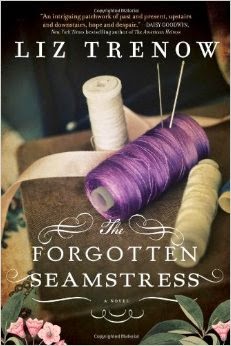
The Forgotten Seamstress by Liz Trenow


The Forgotten Seamstress by Liz Trenow
Copyright 2014 
Sourcebooks Landmark - Historical/Contemporary
Source: Sourcebooks 

Quick note:

You weren't missing much when I skipped this week's Monday Malarkey because The Forgotten Seamstress and Half Bad (from a friend) were the only books that arrived, last week, Anton and Cecil: Cats at Sea the only book I finished besides One Night in Winter (already reviewed) and The Forgotten Seamstress (here you go).  The cats were the same as always - funny, playful, ever-present during reading time.  Still doing my exercising to MeTV's Emergency! reruns and we're almost done cutting down the second of our infested pear trees -- the other one came down last summer. It also rained a lot. Not a particularly thrilling week. :)

On to the review of The Forgotten Seamstress . . . 

Brief synopsis:

At the turn of the 20th century, young orphan Maria Romano and her best friend Nora learn to sew with delicate precision, their skill so admirable that when the time comes for them to go into service they're taken to work at Buckingham Palace. When Maria catches young Prince David's eye and his manservant doesn't do a sewing job to his satisfaction, David has Maria brought upstairs to do a hasty job. The prince is happy enough with the work to call Maria back on occasion. As the prince reaches out to Maria with an affection she never could have imagined, she falls under his spell. But, when she falls pregnant with his child, she is spirited away, locked up in a mental facility where she eventually sews her love into a quilt, knowing nobody around her believes a word she says. Did Maria really give birth to the prince's baby? If so, what became of the child? Is Maria a "fantasist" or were her mental issues created by those who wished to silence her?

In 2008, Caroline Meadows is helping her mother clear her home of unneeded possessions when she comes across a quilt handed down to her by her grandmother. The quilt is made from an odd hodge-podge of designs and fabrics, some of them recognizably of high quality, with a number of embroidered designs and a verse. Curious about its origins and intrigued by an old photo of the quilt and a lady with a twinkle in her eye, Caroline seeks answers to the puzzle of the quilt while her everyday life is both crumbling and soaring with possibilities.  Even when the quilt goes missing, she continues her search. But, the story of the quilt will lead to revelations she could never have dreamed possible.

My thoughts:

Dual storylines -- one historical, one contemporary -- have become a pretty commonly used device in recent years and, to be honest, they aren't my favorite. I tend to prefer one storyline or the other, usually the historical, and end up finding the second a slog. That's pretty much how I felt at the beginning of The Forgotten Seamstress.  Maria's story is told through a series of interviews taken on cassette tape at a mental facility in the 1970s, Caroline's story in present tense. As usual, I was much more intrigued by Maria's story than Caroline's. And, yet, Caroline's search unfolds so realistically and the two stories are interwoven with such skill that by about page 100 I was completely engrossed. I had to know what happened to Maria, what Caroline would find out, whether or not Caroline would ever locate the quilt, what would happen to Caroline and whether she would find love, again.  In the end, I closed the book with a sigh, completely satisfied by the answers and how they had been revealed.

Recommended - By far one of the best historical/contemporary blend novels I've read, with an intriguing mystery, clear prose, a unique historical setting and excellent characterization. Particularly recommended to fans of historical fiction, quilting and/or dual storylines. Even though I'm neither knowledgeable about or all that interested in quilts and tend to dislike a blend of historical and contemporary storytelling, I found The Forgotten Seamstress an extremely satisfying and enjoyable read. The only problems I had with it were a slow beginning and a bit of difficulty buying into the upstairs-downstairs relationship. Once I got past those difficulties, I was surprised how much I enjoyed The Forgotten Seamstress.

©2014 Nancy Horner. All rights reserved. If you are reading this post at a site other than Bookfoolery  or its RSS feed, you are reading a stolen feed. Email bookfoolery@gmail.com for written permission to reproduce text or photos.

Monday, December 23, 2013

Mini Reviews - Jack Absolute by C.C. Humphreys, The Paris Architect by C. Belfoure and At the Bottom of Everything by B. Dolnick

I'm going to go with mini reviews for my last few reads, post a Christmas photo or two and then take off for the holidays.

Jack Absolute by C. C. Murphy tells the tale of swashbuckling hero Jack Absolute. a dashing former soldier in England's 16th Light Dragoons who returns to London on business as he works to restore his family's fortune. While in town in the year 1777, Jack discovers that his friend Richard Sheridan has told Jack's story in a play called The Rivals.  He's a taken aback but becomes accustomed to seeing himself portrayed on the stage.

However, hanging around pretty actresses can end up being a problem.  When Jack becomes entangled in a dangerous liaison and is challenged to an illegal duel, he must run from authorities; and, the quickest way out of England is to return to the service as a spy on the British side in the American Revolution, although he has mixed feelings about the job.

With the help of his best friend Até, a Shakespeare-quoting Mohawk, Jack braves the dangerous world of the American Colonies, where it's difficult to tell which soldiers are still faithful to the crown, who supports the rebels and who is involved in the shadowy Illuminati organization whose intent is to foment anarchy in the hope of taking over the Colonies.

I had trouble getting into Jack Absolute, at first (probably just a mood thing) but this month's attempt was my second and it just clicked, this time around.  There is a lot of violence, of course, since the book is set during a revolution. But, the focus is mostly on action, romance and untangling the mystery of the Illuminati.  I was particularly fond of the fact that the author fictionalized genuine historical characters and placed them in the right place at the right time.

Recommended: I'm looking forward to reading the prequel: The Blooding of Jack Absolute.


The Paris Architect by Charles Belfoure is the story of an architect living in occupied Paris in 1942.  When he's offered a hefty fee to create a safe place for a Jew to hide, Lucien Bernard is wary.  He doesn't want to be thought of as a collaborator and fears what the Gestapo may do to him, should he be caught.  But, the money, the accompanying offer to design a factory, as well, and the creative challenge sway him.  Lucien likes living well. Soon the money begins to run low and he continues to accept dangerous commissions.

When one of Lucien's designs is discovered during the hunt for a fabulously wealthy Jew, another of his designs fails and a Jewish boy in hiding becomes a part of Lucien's life, his work becomes more personal. Will Lucien's work be discovered before the Americans come to save occupied France?

Recommended with mild hesitation - I liked The Paris Architect because it's a good story, the dialogue is believable and the viewpoint is unusual for a WWII story.  But, I had a big problem with Lucien. He is not a nice man.  Although he gradually begins to understand the plight of Jews and his heart softens, even well into the book his true character shows.  On page 322 he is still irrationally vindictive. When a fellow architect who had more jobs before the war but is now nearing starvation asks Lucien to help him find a job, Lucien refuses:

Lucien thoroughly enjoyed rubbing salt into this wound, and he found himself pleased that Devereaux was so desperate.  

That's within 50 pages of the book's ending, so you can see why it would be difficult to think of Lucien as the kind of hero you can really root for.

At the Bottom of Everything by Ben Dolnick is about a friendship, a tragedy and how the ripples created by that tragedy affect two young men in different ways, as the years go by.

I read At the Bottom of Everything over the weekend. It's a quick read and I love the reflective writing style: 

It's always unsettling, seeing people you've almost but not quite forgotten about--not because they've changed [...] but because they've gone on existing, finding jobs and making friends and moving apartments, all without the help of your thinking about them.

~p. 7

There's a moment just after breaking something (the glass slips from your fingertips, your elbow catches the vase) in which it feels like if you stand there, absolutely still, baring your teeth, you should be able to suck time backward like an indrawn breath.  Your hand hangs there in the air, your eyes fall shut, you're like someone playing a children's game with a whistle and a voice that shouts, "Freeze!"

~p. 59

I think travel must have made more sense, psychologically, in the era of ocean voyages; in the three months it took to get from America to India you would've realized the extremity of what you were doing; you would have stepped off the boat knowing exactly how far you were from your old life.  But I, sitting in a plastic lawn chair on the rooftop, gazing out through the smog at what seemed to be the dome of a mosque, still had a receipt from the Bethesda Row CVS in the front pocket of my jeans.

~pp. 93-94

Recommended with a warning - I enjoyed At the Bottom of Everything but it has one of those horrid open endings that make you flip back and forth, wondering if the publisher misplaced the chapter that wrapped everything up.  As I've mentioned in the past, I help myself out with such endings by mentally creating my own. So, I came away from At the Bottom of Everything satisfied after that initial, "What the hell?" feeling passed.  Apart from the lack of conclusion, I really enjoyed the book.  It's sad and felt a little familiar (like I'd read something so similar the book was almost an echo) but I liked the author's writing style. 

©2013 Nancy Horner. All rights reserved. If you are reading this post at a site other than Bookfoolery  or its RSS feed, you are reading a stolen feed. Email bookfoolery@gmail.com for written permission to reproduce text or photos.

Tuesday, September 03, 2013

The Book of Someday by Dianne Dixon


The Book of Someday by Dianne Dixon
Copyright 2013
Sourcebooks Landmark - Fiction
340 pp., incl. Reading Group Guide

First sentence Paragraph:

Her father. Shouting her name.  "Olivia!" His footsteps falling loud and heavy on the wood of the floor.

Summarize the plot without giving away the ending:

Livvi is having an affair with the first man who has ever made her feel truly special.  In her twenties but a deeply wounded by childhood abuse and naive due to her homebound education, she finds it difficult to break away when she discovers her lover's secrets and develops an attachment to someone who reminds her of herself as a child.

AnnaLee's husband is both a doctor and a lawyer but he can't seem to find his place in the working world and limits his hours. Frustrated by her husband's inability to provide for the family, AnnaLee is slowly selling off valuables from the home she inherited. Then, summer arrives and brings with it a refugee from distant and wealthy parents. As AnnaLee tries to break through to the girl who calls herself Persephone, will Persephone's desperate attempts at friendship end in disaster?

Micah has cancer.  To determine whether or not it's even possible to atone for the sins of her past, she goes on a journey, seeking out the individuals she's hurt and hoping they can help her decide whether to live or die.

Capsule Description:

The Book of Someday is the story of three women with interconnecting lives.  The key to their interconnection is a painting/photograph/nightmare of the same thing -- a woman in a silver dress and pearl-button shoes.  One of the stories is told from the 1980s, the other two in 2012.  

What did you like best about The Book of Someday?

Could. Not. Put. Down.

It takes a very long time to get to the point that the connection is explained and I figured it out before the author got to the point of the big reveal, even as she was still hiding little bits of the tragedy that connected their lives.  I didn't mind that I figured out the mystery portion because I was enjoying the book so much.  I loved the fact that I found the book so gripping I actually fell asleep reading (the book falling, fwop, onto my chest woke me up) and turned the light out with deep regret then awoke at 5AM dying to keep reading.  I adore that kind of read.

What did you dislike about The Book of Someday?

There were only 2 things that kept The Book of Someday from being a 5-star read.  One was the constant use of sentence fragments.  I understand using them for impact but they were used All. The. Time. For no good reason.  Sometimes I had to visualize lower-case and correct punctuation to figure out the meaning of a paragraph that genuinely should have been written as a single sentence.

The other problem was the ambiguous ending. I couldn't discern whether the author was telling me Livvi was planning to end up with one guy or the other and I wanted that clearly spelled out.  I don't mind an open ending but this one was just confusing to me.  I reread it several times and then dashed off to read other reviews.  Most readers were not bothered by the ending.  I just found it perplexing and decided to create my own ending, mentally. Still, very solid storytelling with just enough held back to keep the suspense going.

Other notes:  

There is a lot of lightly graphic sex in the book (Livvi and her lover), which probably accounts for the comments other reviewers have made about the book reading "like a Harlequin".  I didn't get that "Harlequin" sensation at all, in spite of all of those scenes. I was too busy being swept away by the storyline and trying to puzzle out the interconnection to be bothered, although I'm not a fan of graphic sex scenes.

Highly recommended - One of the most unputdownable books I've read in a while.  Although I gave it a 4/5 rating at Goodreads, The Book of Someday really deserves a 4.5/5 for the mere fact that I couldn't put it down till it literally fell out of my hands . . . and then I was so anxious to start reading that I woke up early and didn't put the book down till I finished.  In spite of the fact that there's some graphic sex and that's something I don't enjoy, I thought the sexual relationship was crucial to explaining Livvi as a character so it just fell into the background for me.

I received an ARC of The Book of Someday from Sourcebooks in return for an unbiased review.

©2013 Nancy Horner. All rights reserved. If you are reading this post at a site other than Bookfoolery  or its RSS feed, you are reading a stolen feed. Email bookfoolery@gmail.com for written permission to reproduce text or photos.

Wednesday, June 26, 2013

The Firebird by Susanna Kearsley


The Firebird by Susanna Kearsley
Copyright 2013
Sourcebooks Landmark - Fiction/Historical-Contemporary blend w/a touch of paranormal
543 pp.

Source:  From Sourcebooks for review

What The Firebird is about:

Nicola Marter has a special talent.  When she touches an object, she sees scenes from its history.  Her father has the same ability but revealing his gift caused such anguish he will not speak of it; he has coached Nicola to keep her gift buried deeply.  

When a woman arrives at the art gallery at which Nicola works, hoping to sell a Russian carving, Nicola knows she's telling the truth about its origin.  But the vision of Empress Catherine handing it to the woman's ancestor is not enough to authenticate its history so the woman goes home disappointed.  Then, Nicola finds the woman's scarf and learns something more.  Determined to help, she sets off for Scotland to find the one person she knows to be even more gifted than herself.  

Together, Nicola and her handsome friend Rob will travel in pursuit of evidence from the past.  When the two psychics are thrown together with a common goal, will the romance of their past start anew?  Or will Nicola keep running from her ability and the love she gave away?

What I loved about The Firebird:

That was probably a crap description, sorry.  I just hate using the publisher's description unless I'm at a total loss for words.  I am at a loss about how to describe what I loved about the book because The Firebird is another one of those books that so thoroughly swept me away that I'm tempted to say I loved absolutely everything about it.  I adored the characters (especially the hero), the slowly-building romance, the historical context and the story itself.  But, there was one thing I didn't love.  Just one.  Well, no, two.

What I disliked about The Firebird:

It was a little hard to wrap my mind around the concept of two people being so connected that they can actually hear each other's thoughts.  In The Firebird, the two characters occasionally speak telepathically. Sometimes they don't even realize they're doing so.  Kind of a stretch, I thought.  I love the way Susanna Kearsley blends a bit of time travel with a contemporary story, though, and I was not going to let a concept that I found a little unbelievable keep me from enjoying an excellent read.  The only other problem I had with The Firebird was the occasional tedious passage.  I loved the book but sometimes it was just a tiny bit too detailed and I found myself close to slipping into zone-out mode.  That never lasted very long, though.

The bottom line:

Highly recommended - Excellent storytelling, wonderful characterization and stunning historical research make for a terrific, escapist read.  The Firebird continues the story of historical characters first introduced in The Winter Sea, a book I absolutely loved.  In fact, now I wish I hadn't passed on my copy of The Winter Sea because I'd really like to go back and read it, again.  Oh, well.  Read them together, if you can, but The Firebird stands alone fine and both are excellent books, perfect for vacation reading.


©2013 Nancy Horner. All rights reserved. If you are reading this post at a site other than Bookfoolery  or its RSS feed, you are reading a stolen feed. Email bookfoolery@gmail.com for written permission to reproduce text or photos.

Thursday, May 02, 2013

What a Mother Knows by Leslie Lehr


What a Mother Knows by Leslie Lehr
Copyright 2013
Sourcebooks Landmark - Contemporary Fiction/Suspense
336 pp., incl. Reading Guide

What a Mother Knows by Leslie Lehr is about a woman who has been in a terrible car accident.  Over a year after her accident, nearly half of which was spent in a medically-induced coma due to swelling in her brain, Michelle returns home.  But much has changed.  Her husband has moved from California to New York and, after bringing her home, only stays long enough to get her settled in.  Their son Tyler has moved to a boarding school on the East Coast.  And, their daughter Lexi is missing.

Because she experienced traumatic brain injury, Michelle doesn't remember the accident or events leading up to it.  Gradually, her memory will return in flashes, bits and pieces that she must fit together like a puzzle as she tries to remember what happened and why there was a young man in the vehicle with her.  Where was she going and how did the accident occur?  Where is her daughter?  During her time recovering, Michelle received messages from her daughter, but what did they mean?  Is Nikki missing or in hiding or even dead, now?  As Michelle deals with a new life, a lawsuit, rumors and the confusing question of why her husband insists that he can't return to California to work, Michelle searches for her daughter.  

My thoughts:

I found What a Mother Knows rather gripping, and yet . . . it just didn't work for me, primarily for two reasons.  Even though I wanted to know what Michelle would find out about her daughter, I found the answers to the questions that What a Mother Knows poses surprisingly transparent. In the end, I predicted every major plot point.  But, what I  most I disliked about What a Mother Knows was the main character.  Michelle is not likable. Before her accident, she was a hard-nosed Hollywood producer and when she seeks answers, she is forceful and often rude.  

I might have found Michelle's behavior more tolerable if her head injury had something to do with her outbursts.  Traumatic Brain Injuries can cause a dramatic change in personality or loss of self-control.  But, apparently Michelle was just a little on the nasty side to begin with.  As a reader, I found her annoying enough that it was only curiosity and the fairly fast pace to the book that kept me going.

The bottom line:

Recommended but not a favorite - Gripping, suspenseful, satisfying in the end, yet unsurprising.  An unlikeable main character and predictable ending made What a Mother Knows just an average read for me, but there is much to like about the book.  Even though in the end I found that I'd made the correct assumptions about every major plot point, I found the questions compelling enough to keep the pages rapidly turning.

In other news, things are blooming, here:


It's rather difficult to convince oneself to spend time on the computer, this time of year.

©2013 Nancy Horner. All rights reserved. If you are reading this post at a site other than Bookfoolery  or its RSS feed, you are reading a stolen feed. Email bookfoolery@gmail.com for written permission to reproduce text or photos.

Wednesday, April 24, 2013

Thinking of You by Jill Mansell


Thinking of You by Jill Mansell
Copyright 2013 (orig. published by Headline in 2007)
Sourcebooks Landmark - Chick lit
424 pp.

Source:  ARC from Sourcebooks, a May 2013 release

What it's about:

I'm not sure how to describe what Thinking of You is about, because Jill Mansell's books always have so many strands but Ginny Holland is the main character.  She has just become an empty nester and is missing her daughter Jem's company so much that she decides to take on a renter.  She falls for a charming user (don't want to give too much away, here, so I won't go into detail about who she falls for) and so does her best friend, Carla. And, Ginny's renter is turns out to be a bit of a pain.  To get out of the house and away from her depressed renter, Ginny gets a job. Her new boss, Finn, just happens to be a man with whom she's had a bit of a nasty encounter, so she must win him over to keep her job.  Finn has recently had his heart broken and . . . I think he looks like George Clooney?  Or, maybe I just pictured him that way.  There's friendship and betrayal, misunderstanding that leads to a few slapstick scenes, romance and heartbreak and happily-ever-after for anyone deserving.

What I loved about Thinking of You:

Oh, sigh.  I just love Jill Mansell's books.  I started reading Thinking of You because the Boston bombing followed by the Texas explosion and idiocy in Congress started getting me down.  Jill Mansell's books are always uppers, so I knew reading one of her books would be the perfect remedy for a crappy week.  Thinking of You is no exception, although I found myself wanting to shout at Ginny and Gem and Carla, a few times.  Sometimes those plot twists and heartbreaks can be a little angst-inducing, but I closed the book with a smile on my face.  Ginny is a great heroine and I love the depth of the friendships in Thinking of You.  It's admirable the way they forgive and forget wounds inflicted upon each other and I love the reliability of those happily-ever-after endings.

Also, she used the word "malarkey" in there, somewhere.  You know how I love that word. 

What I disliked about Thinking of You:

The characters who are deceitful in Thinking of You are a little too obvious -- enough so that you want to reach in and shake the characters whom you know to be cruising toward disaster, but since everything turns out well in the end there is nothing at all worth complaining about.  

Recommendation:

Highly recommended, especially for escapist, beachy-type romantic reading.  I've been reading Jill Mansell's books since the 90's and they are reliably complex but light-hearted tales.  Her heroines tend to be very much alike in personality -- perky, witty, fun, sometimes clumsy or eccentric, always likable.  It never fails to surprise me how many twists Mansell throws into her books and how utterly she snookers me.  I had an idea who Ginny would end up with, but Jill Mansell is such a pro.  She always makes me doubt myself enough that I'm still pleasantly surprised at the end.  

Favorite photo of the day:

Sometimes you feel like a nut.

©2013 Nancy Horner. All rights reserved. If you are reading this post at a site other than Bookfoolery  or its RSS feed, you are reading a stolen feed. Email bookfoolery@gmail.com for written permission to reproduce text or photos.

Wednesday, April 03, 2013

Shadows and Strongholds by Elizabeth Chadwick


Shadows and Strongholds by Elizabeth Chadwick
Copyright 2013 
Sourcebooks Landmark - Historical Fiction
528 pp.

Quick and easy format, this time . . . 

What's Shadows and Strongholds about?

Brunin Fitzwarin is a12th-century victim of bullying. His father wants him toughened up and trained, choosing best friend and ally Joscelin, Lord of Ludlow to do the job.  At Ludlow, Brunin is taught with kindness.  Joscelin's three young daughters, Hawise, Sybie and foster daughter Marion make him welcome.  As Brunin grows to knighthood, he is called upon to use and perfect his skills in battle after battle fighting for Prince Henry against King Stephen to win the English crown and at times to defend his loved ones.  

There are private and royal battles, love and envy, a bitter old woman, a sad henpecked family, bullying, birth and death, victory and tragedy.  Elizabeth Chadwick's writing covers pretty much everything.

What I loved:

I am always impressed (dazzled, snowed, boggled, astonished, amazed . . . just feel like synonyms, this week) with the author's knowledge of her chosen time period, the way she brings it to life and how engrossing her books are.  She knows how to keep things entertaining; her books are fairly long but never, ever the slightest bit dull.

What I disliked:

Nothing.

The bottom line:

Highly Recommended - Worth buying for the good shelves.  Superb writing, phenomenal storytelling, breathtaking detail, sparkling characterization, a moving tale of love and tragedy with plenty of wit and humor thrown in. As I was reading Shadows and Strongholds, I realized that Elizabeth Chadwick's books definitely should go onto my permanent list of "desert island reads".  In case of potential disaster, bring Chadwick books.  

©2013 Nancy Horner. All rights reserved. If you are reading this post at a site other than Bookfoolery  or its RSS feed, you are reading a stolen feed. Email bookfoolery@gmail.com for written permission to reproduce text or photos.

Tuesday, December 11, 2012

Minis: The Walnut Tree by C. Todd, A Walk in the Park by J. .Mansell, Comet's Tale by S. Wolf & L. Padwa


The Walnut Tree by Charles Todd is subtitled "A Holiday Tale" and I'm not quite sure why.  It may end at Christmas, but otherwise it is most definitely not a Christmas tale.  In fact, it's more of a war tale with a rather lame romantic love triangle and a heroine, Lady Elspeth Douglas, who feels compelled to deceive her best friend, everyone in the service in which she's trained as a nurse and both of the men in her little love triangle.

Get the feeling I didn't like The Walnut Tree?  Well, I did finish the book.  That's saying something. But I think The Walnut Tree is flawed, a bit juvenile and extremely cliche.  Lady Elspeth (again, in a manner that simply does not make sense) ends up on the front line of an important WWI battle and after seeing the casualties, decides to imitate Sybil of Downton Abbey and become a nurse.  By this point, she's helped a friend deal with childbirth and has become engaged.  But, she then encounters an old friend and falls even more in love with the second guy.

In the end, I was able to completely predict the outcome of absolutely every plot point.  It's ridiculously obvious what has to happen at every turn and the tiny hint of a mystery that's tossed in like an afterthought is patently annoying.  Why did I keep reading?  I suppose the war scenes are rather interesting. And, even though the book was terribly predictable, I still wanted to get to the goal and read about the heroine ending up with her guy.  But, honestly, I do wish I hadn't spent money on The Walnut Tree.

Since I've read a number of reviews in which regular readers of Charles Todd have said The Walnut Tree doesn't live up to the mother-son team's normal standards, I'm planning to give one of their mysteries a try, soon, because I'm now doubly curious.  We'll see how that goes.  Not recommended unless you don't mind transparent plotting . . . say you're just a fan of historical fiction and/or romance but you're not picky.  Maybe then.  

I must warn you that the words "have" and "had" are so overused that they even appear in dialogue:
"You must know how much your presence had brightened the lives not only of your cousin but of the other three officers who are working with Sister Macleod."  -- p. 153 
Drop the "had" (or change it to "has") and that bit of dialogue is acceptable, if a bit awkward.  If this particular grammatical atrocity continues in the mystery I intend to read, I will never touch another Charles Todd book.  It truly is unbearable.  But, The Walnut Tree may simply be one of those books that was rushed to press with minimal editing and I figure almost everyone deserves a second chance.  

In A Walk in the Park by Jill Mansell, heroine Lara Carson returns to her childhood home in Bath, England, for the funeral of her father.  At 16, she was kicked out of the house by the father who never loved her and the stepmother from hell -- and they didn't even know she was pregnant.  Now, Lara's daughter Gigi is 18.  Lara's best friend will be marrying soon and it turns out Lara is in her father's will.  So, as much as she'd like to avoid the boyfriend she left behind, Lara will have to stick around Bath a bit more than she intended.

Flynn always wondered what happened to Lara.  One day she was suddenly just gone and he never heard a word from her.  Now that she's back with his biological child in tow, he wants answers.  

Evie is thrilled to finally walk down the aisle but on the day of her wedding, things are going horribly wrong.  After she cancels the wedding, her ex-fiancee won't let go.  Determined to prove he's changed, he pursues her with a vengeance.  But, there's another man wooing Evie.  Will Evie make the right decision, or is there even a decision to be made?  Is Evie destined to make bad choices and remain alone?  

There's always so much going on in a Jill Mansell novel that it's a bit mind-boggling.  I love her books.  They're cheery and plotty and terribly fun. I must admit, I felt dangled a bit more than I like, didn't buy into one of the major plot points and thought A Walk in the Park ended too abruptly.  And, yet, A Walk in the Park is classic Mansell and I enjoyed it.  Recommended, but not her best.

Comet's Tale by Steven D. Wolf, with Lynette Padwa, is a pet story in which -- get this -- the dog doesn't die in the end!!!  Awesome. You have to appreciate that, since most pet memoirs do end with a death.  

Comet is a rescued greyhound.  I had no idea greyhounds came in a variety of colors; you can see from the cover image that she has an interesting calico-like coat of brindle and black and shades between.  When she was rescued, Comet had been left in a cage with a muzzle on.  The author, who goes by the name "Wolf", had two golden retrievers in Nebraska.  But, because his spine was severely degenerating, he was living away from his family and their pets in Sedona, Arizona most of the year.  Colder weather caused even more trouble with his constant pain.

Lonely and depressed after being kicked out of his own law firm, Wolf eventually decided to consider adopting a greyhound and visited the home of some people who fostered quite a few of them.  Comet was off in a corner and appeared to be depressed, herself.  But, just as Wolf was about to make a decision to adopt one of the other dogs, she appeared at his side.  The choice had been made for him.  

Comet's Tale tells about how Comet became not only a devoted pet but also eventually was trained by the author as a service dog when his condition further deteriorated and he needed help with simple tasks like opening doors and picking up dropped items.  Comet's Tale is a deeply touching story.  The only thing I disliked about it was the fact that the author went a little nutso when he had surgery that helped significantly reduce his pain.  However, he eventually "redeemed" himself, just like a fictional character, thank goodness.  An amazing story of love and devotion between pet and human, highly recommended.  

As I was reading Comet's Tale, I found myself desiring to adopt a greyhound -- which is pretty odd because I really don't have the right personality to be a dog owner, although I tend to fall in love with friends' dogs.  The way greyhounds are used and abandoned or killed is truly appalling.  

Here's our little Isabel hanging out on my legs on a day that I stayed in bed feeling yucky, recently.  Rescued pets are the best. 


©2012 Nancy Horner. All rights reserved. If you are reading this post at a site other than Bookfoolery and Babble or its RSS feed, you are reading a stolen feed. Email bookfoolery@gmail.com for written permission to reproduce text or photos.

Saturday, December 08, 2012

Miss Buncle Married by D. E. Stevenson


Ah, Miss Buncle.  You cannot help but love her.  I recently reviewed Miss Buncle's Book, about how Barbara Buncle became a bestselling author but her book riled up her little village when they discovered someone had fictionalized the inhabitants, their quirks and motives with stunning detail.  

Miss Buncle's Book was such a delight that naturally I had to read Miss Buncle Married when I found out it was being reissued by Sourcebooks Landmark.  

In Miss Buncle Married, Barbara is now Mrs. Abbott.  Mr. & Mrs. Abbott are happily married and have a wide circle of friends.  But, their social life has become such a burden that they've decided that it's time to move.  Barbara busies herself with the task of finding a new home.  Eventually she discovers the perfect place, a wreck called The Archway House that has sat empty for many years.  Mr. Abbott is dismayed, but he's utterly unable to resist his wife's charming determination.  They buy the house for a song and Barbara sets about having it redone.

When Barbara first views the house, she is mistaken for a woman much older than herself, who has recently changed her will.  The mistake leads to a bit of inside information that Barbara promises to keep close.  That's a bit too complex to go into and you wouldn't want me to spoil the fun, anyway, would you?  

As they settle into their new home, the Abbotts gradually become popular in their new social circle in Wandlebury.  And, beyond that, there's just so much goofy fun that I can't even begin to describe it all. Somewhere in there, for example, is a little bit of intrigue about a fellow dressed up in Shakespearean garb and mistaken for a ghost.  Trust me, you just have to read it.  

I was slightly more entertained by Miss Buncle Married than I was by Miss Buncle's Book but, as I said in my review of the former, I think that has something to do with the fact that we were in the midst of a move.  Well, that and the huge cast of characters. Miss Buncle is charming and insecure in Miss Buncle's Book but in Miss Buncle Married, she begins to develop self-confidence.  She is a lovely, quirky, wonderful character.  

Miss Buncle Married was originally published in 1936.  Whilst perusing a list of D. E. Stevenson's books at Wikipedia, I discovered there's a book called The Two Mrs. Abbotts.  I hope that's another Barbara Buncle Book and that I can get my mitts on a copy.  I highly recommend Miss Buncle Married.  

Cover thoughts:

Love, love, love the covers of the both books.  I think they reflect the heroine's spirit perfectly.  

©2012 Nancy Horner. All rights reserved. If you are reading this post at a site other than Bookfoolery and Babble or its RSS feed, you are reading a stolen feed. Email bookfoolery@gmail.com for written permission to reproduce text or photos.

Wednesday, September 12, 2012

Miss Buncle's Book by D. E. Stevenson

Miss Buncle's Book by D. E. Stevenson is one of those lovely older titles -- first published in 1936 -- that are being given a second life by publishers. My copy is from Sourcebooks, but I've been told Persephone also has published Miss Buncle's Book. Wahoo for both!

It's been a couple weeks since I finished Miss Buncle's Book, but it's unforgettable. Barbara Buncle is a single woman living in Depression-era Great Britain. Her income has trickled to nearly nothing, so with the idea of making money in mind, she has written a thinly-veiled account of life in her English village with a dash of fantasy in the form of a "golden boy" thrown in.

She meets with a cheery publisher and within a short time her book is selling well under the pseudonym "John Smith". But, there are complications. It doesn't take long for the villagers to discover the book, begin passing it around and wondering who has written about their lives. Most are angry about the way they've been portrayed, although a few think the book is simply entertaining.

While the villagers discuss the book and plot revenge, some of the book's fictional plotting begins to mysteriously come true. Is life imitating art? Or is Miss Buncle just unusually prescient? Will the villagers uncover the real name behind John Smith? And, isn't that cheery publisher charming?

Miss Buncle's Book started out as slow reading for me, although that may have something to do with the fact that I was in the thick of moving, at the time. Once the villagers became riled up and set out to find "John Smith" and teach him a lesson, I had difficulty putting the book down. What would become of Barbara Buncle, once the villagers found her out?

I don't think it's a spoiler to note that everyone in the village thought Miss Buncle couldn't possibly be the author of Disturber of the Peace. At least one person even claimed she was not clever enough to have written a book -- all of which made for some of the most interesting plot points toward the end of the book.

I loved Miss Buncle's Book. Barbara Buncle is a delightful character, her publisher is charming, there are plenty of villagers to love and at least two who are villainous enough to make you cheer when they get their just desserts. My only problem with the book was the fact that there are so many characters it's hard to keep them all straight. I finally reached the point at which I stopped trying to puzzle everyone out and just enjoyed the story. When I did that, the characters kindly stayed consistent and did a knock-out job of clarifying their individual stories so that eventually the cast was not so overwhelming.

Highly recommended to those looking for a good, breezy, old-fashioned tale. Miss Buncle's Book is a breath of fresh air. Light-hearted reading with a surprising plot, a lovable but slightly insecure heroine, a realistically large cast and a satisfying denouement. I will definitely be hunting down more books by D. E. Stevenson!

Miss Fiona says I've been posting too many photos of Isabel. Fi's turn!


©2012 Nancy Horner. All rights reserved. If you are reading this post at a site other than Bookfoolery and Babble or its RSS feed, you are reading a stolen feed. Email bookfoolery@gmail.com for written permission to reproduce text or photos.

Monday, April 09, 2012

Mariana by Susanna Kearsley


Mariana by Susanna Kearsley
Copyright: 1994/2012
2012 Release by Sourcebooks Landmark - Fiction with historical and paranormal elements
364 pages

Reason for Reading: I've desired to read more by Susanna Kearsley since I read The Winter Sea.

Brief description:

Julia Beckett has believed that the old stone house in the West Country was destined to be her home since she first saw it through the car window as a small girl. Years later, she finds out the house is on the market, buys it and moves from her London home, where she works as an illustrator of children's books. But, strange things are happening in the ancient stone home. Julia keeps finding herself thrown back in time, experiencing history through the eyes of Mariana Farr, a young lady who lived in the house during the 16th century and fell in love with the local landowner, Richard deMornay.

What became of Mariana and Richard? Will Julia survive her jaunts back into the mind and heart of Mariana or does she risk becoming trapped in the past? In the present day, will Julia fall in love or is she locked in a dead-end relationship?

What I loved about Mariana:

Gosh. I loved everything about this book -- the setting, the characters, the plot, the dialogue, the denouement. You know how some books just grab you by the hair and don't let go until you reach their extremely satisfying conclusion? That was Mariana, for me. It has that element of "time travel" that I love (although it's not really time travel, but you'll have to read it to find out exactly what the deal is), a hint of romance without anything gushy, a nice dollop of history, and it's stunningly believable for a book with a premise in which a heroine keeps getting yanked back in time.

What I disliked about Mariana:

Nothing. Absolutely nothing.

Recommendation:

5/5 - Highly recommended. Smooth, believable transitions between the 16th century and present-day England, excellent dialogue, nicely rounded characters, a solid plot and satisfying denouement made this book a perfect escape for this reader.

I have two more Susanna Kearsley books to read - one on my shelves and the other in ebook format. It will be interesting to find out whether I feel the same about all of her books.

Cover thoughts:

I'm going to describe my thoughts about the cover image shown above, although I actually have two copies of Mariana, thanks to the fact that I put it on my wish list at Paperback Swap the moment I closed The Winter Sea and I completely forgot it was on my wish list when Sourcebooks offered it for review. I tried to halt the ARC when I found out a copy was coming from PBS, but it was too late. The two copies arrived almost simultaneously.

At any rate, when Julia moves into her house, she's informed that there used to be a ghost that periodically showed up in the garden and she was known as the "Lady in Green". Although the ghost ceased to make appearances something on the order of 30 years before Julia's arrival, that ghost does become important to the plot, so it's very fitting that the cover shows a woman wrapped in a green shawl, although I can't say I'm in love with the bare shoulder. But, come to think of it, there is a moment when a woman in the book is wrapped in nothing but a shawl. There is also a man on a horse who becomes a key character, so the distant figure of the man on horseback is similarly apropos. I like the look and I think it fits the story well!

Some side remarks:

While this book is not strictly "historical", there are enough historical elements to satisfy fans of that genre. It also contains a paranormal element, but it is completely fitting and neither weird, otherworldly or forced. Mariana, it must be remembered, was published long before the paranormal craze.

Since we're talking about green, how about a lizard pic?

Nicely camouflaged, isn't he? This is a tiny fellow, maybe 2" long in the body. He's not used to me, yet. The anole lizards actually can become quite relaxed after being photographed multiple times, I've found. This one kept running away, but he's young.

©2012 Nancy Horner. All rights reserved. If you are reading this post at a site other than Bookfoolery and Babble or its RSS feed, you are reading a stolen feed. Email bookfoolery@gmail.com for written permission to reproduce text or photos.

Wednesday, January 04, 2012

A Darcy Christmas by Grange, Lathan & Eberhart

A Darcy Christmas is a set of three Christmas novellas, all spin-offs of Pride and Prejudice but written by three different authors. I passed up the opportunity to review A Darcy Christmas in 2010 but promptly added the book to my wish list at Paperback Swap. A copy arrived in November, just in time for the Christmas season.

The first of the stories is a Pride & Prejudice version of "A Christmas Carol", in which Fitzwilliam Darcy is visited by the ghosts of Christmases past, present and future. He has given up on Elizabeth Darcy, thanks to pride and hurt feelings. The ghosts naturally convince him that his life will suck without her. I liked the first story, once I managed to shut off my internal editor. Most spin-off authors make mistakes, inserting the occasional modern or even American wording (depending upon the author), so you really have to be able to ignore those things if you want to read a spin-off.

Midway through "Mr. Darcy's Christmas Carol," by Carolyn Eberhart, I was in the groove. The second story is "Christmas Present" by Amanda Grange. It's Christmas season and Elizabeth is heavily pregnant but determined to visit her sister Jane and the newborn Bingley. There's not much to the story, but it's a sweet, lovely tale of a family gathering and new life.

The third novella, "A Darcy Christmas" by Sharon Lathan, is actually a set of short stories about Christmases throughout the years of Fitzwilliam and Elizabeth Darcy's courtship and marriage. It's a good overview of one author's imaginative progression through the lives of the characters.

Each story requires a bit of adjustment as every author endows the various families with a different set of children and her own name choices and some family members may die in one story and reappear in another, but I enjoyed this little tribute to Austen's Pride & Prejudice world. A Darcy Christmas is not, however, a book I will return to. Recommended for fans of Austen who enjoy reading alternate tales of the Pride & Prejudice characters. No previous reading of the authors is necessary.


©2012 Nancy Horner. All rights reserved. If you are reading this post at a site other than Bookfoolery and Babble or its RSS feed, you are reading a stolen feed. Email bookfoolery@gmail.com for written permission to reproduce text or photos.