Showing posts with label contemporary historical mix. Show all posts

Tuesday, November 09, 2021

The London House by Katherine Reay


In the prologue to The London House by Katherine Reay, it's the 1940s in Occupied France. A woman named Caro has gone to the House of Schiaparelli to give her Jewish friend money and encourage her to escape the country before it's too late. But, then a dangerous traitor shows up and grabs Caro. He's going to turn her over to the French police, the Milice, who are known to be even more brutal than the Germans. 

In present-day Boston, Caroline Payne (great niece of Caro in the prologue) is working when she gets a call from an old college friend, Mat. Now a college instructor working toward tenure, he has developed a side business that he hopes will get him onto tenure track, researching family histories and writing about how history sends ripples through families. He's in Caroline's building and wants to talk to her because her family came up while he was researching a German family whose Nazi ancestor was connected to the disappearance of Great Aunt Caro, whom Caroline is named after and has always been told died at the age of 7 from polio. 

Mat has a different story to tell and the documentation to prove it, a letter by a British dignitary who informed her great-grandparents that Caro ran off with her Nazi lover. Mat has already approached her father to tell him that the story will include her family but it's not meant to be incriminating; it's about how the pain of the past reverberates through the generations and how people move on with their lives after tragedy. Caroline's father has threatened him with a lawsuit. 

Caroline has a great deal of difficulty adjusting to the idea that her great aunt lived to adulthood. But, once she does, she decides to visit the family's ancestral home in London's Belgravia, where there are letters and diaries that can give her clues. She only has a limited amount of time to get the research done before Mat's article is submitted and she's also on a tight schedule to return to her job. 

Did Caroline's great aunt, her grandmother's twin sister, betray the family and her country? Or, is there more to Caro's story? Will Caroline be able to untangle the clues from the past that will lead her toward the truth?

Highly recommended - I loved The London House. The story is a very believable one because some things about WWII simply could not be known till recently and it makes sense that one may have had to know where to find clues — and couldn't necessarily find answers in any official sense. I loved the way Caroline slowly uncovered her great aunt's story, the Nazi lover's (in the process), and in so doing changed the direction of both her friend's article and her family's understanding of their history. Also, there is a touch of romance and it unfolded slowly and believably. 

My only problem with this book is an issue a lot of Americans probably won't have. The writing and dialogue by British characters doesn't contain any particular use of Britishisms and lacks a British cadence. So, everyone sounded American to me. I think that's an extremely minor issue because the story swept me up so thoroughly that I didn't really give the dialogue much thought. However, it did eventually jump out at me. I still highly recommend The London House, even if you've been to the UK a bazillion times. It's a good story and I found it nearly impossible to put down. 

My thanks to Harper Muse, Katherine Reay, and Laurel Ann of Austenprose for the review copy!

Interesting side note:

Goodreads has some additional description that I found interesting (I opted not to read the publisher's description but saw this when I went to rate the book):

A stand-alone split-time novel
Partially epistolary: the historical storyline is told through letters and journals

"Stand-alone split-time" is a new descriptor for me. I usually call the split-time books a "contemporary historical mix". Also, the fact that much of the book is told through letters and diary entries is crucial, so I'm glad I glimpsed that for the reminder. Now you know. If you're an epistolary fan, you'll undoubtedly enjoy the way this story is told. 

©2021 Nancy Horner. All rights reserved. If you are reading this post at a site other than Bookfoolery or its RSS feed, you are reading a stolen feed. Email bookfoolery@gmail.com for written permission to reproduce text or photos.

Tuesday, September 28, 2021

The Lighthouse Witches by C. J. Cooke


The Lighthouse Witches by C. J. Cooke tells three interconnected stories. In 1998 Liv, a single mother of three, takes an art commission to paint a mural inside a 100-year-old lighthouse on an island in Scotland. Since her husband died, life has been rough and she's barely been able to support her family. But, this job should keep her going for a while. 

The lighthouse has a hole that leads to a cave where people accused of witchcraft were tortured in the 17th century; and, superstition on the island runs deep. When a child knocks at her door, has Liv found a wildling? Wildlings are supernatural beings that take the place of children, allegedly due to a curse by the witches who were executed in 1662, and they have been accused of causing the deaths of entire families for centuries. 

In 2021, Luna receives a startling call. Back in 1998, her mother Liv and both of her sisters, Clover and Sapphire (Saffy), went missing. Now, Clover has reappeared and Luna is her only known relative. But, when Luna travels to Scotland from her home in Coventry, she is stunned to find that her little sister is the same age she was when she disappeared, rather than a 30-year-old woman. And, she has a mark on her leg that is known to be the mark of the wildling. Is Clover really her sister or a strange being that took her place? Is Luna in danger? 

There's also a third storyline that intertwines, but it's a lesser part of the story. In 1998, Saffy has found the grimoire (a book of magic spells, although it reads like a diary) of a man from 1662. Since there's little to do on the island and not a lot of reading material but Saffy is an avid reader, she reads the grimoire. It describes the accusations of witchcraft that took place on the island and the confessions and deaths of the women accused. 

Highly recommended - Creepy, atmospheric, fascinating, sometimes a little scary, well-written and very meaningful. I didn't find The Lighthouse Witches extremely scary but there were some violent and disturbing scenes so I was also a bit surprised not to have any nightmares at all while I was reading it. In the end, the really great thing about the book is that it has a very satisfying ending (in my humble opinion) and an exceptional theme, really an indictment of cruel misogyny, the author's point being that the world needs to stop persecuting women for simply existing. I loved the depth of meaning and will be watching for more by this author, for sure. 

I did have one issue with the book. The grimoire excerpts read like a contemporary diary to me. In fact, it took me a long time to figure out that that particular storyline took place in 1662 as it lacked a date label, although Saffy may have mentioned it being from that time period. I considered that a minor issue as she did a fantastic job of interconnecting the stories and eventually the time period does become clear, even if the language feels off. 

My thanks to Berkley Books for the review copy! 

As you can see, I was finally able to take an outdoor photo after a long, hot, wet summer. It's warmed back up but we cooled off for 3 or 4 whole days! Wow, was that fun. 

©2021 Nancy Horner. All rights reserved. If you are reading this post at a site other than Bookfoolery or its RSS feed, you are reading a stolen feed. Email bookfoolery@gmail.com for written permission to reproduce text or photos.

Monday, May 24, 2021

Mini reviews - The Magician's Elephant by Kate DiCamillo, Rose Mellie Rose by Marie Redonnet, The Address by Fiona Davis

I don't have much to say about any of these, and this post will catch me up completely (for now) so it may be quiet in here till I finish something. 

I read The Magician's Elephant by Kate DiCamillo on my iPad (where I have a fully-loaded Kindle app that I barely ever touch) when our power went out a couple weeks ago and I just wanted something light to read while we sat around in the dark. 

The Magician's Elephant is about a boy who lives with a sickly man who has been telling the boy all his life that the boy's entire family is dead and that the old man rescued the child. The boy spends his days being drilled to be a soldier like his father and doing his master's bidding. One day, he goes to market and is drawn into a fortuneteller's tent with the promise of learning about his future. He spends the old man's food money on the prediction, which has to do with following an elephant to find the sister he thought dead. But, there are no elephants in this [fictional] town. 

And, then he hears that an elephant has been conjured by a magician and fallen through the roof of the opera house, onto the lap of a woman who is now permanently injured. The elephant is being held captive and the boy must figure out how to save the elephant so that he can follow it. The magician, the newly-disabled woman, and a few others figure into this story and it ends on a happy note. 

Highly recommended - The Magician's Elephant was exactly the read I needed on the day I opened the file. It's warm, witty, stirring, and full of heart. Kate DiCamillo's middle grade books haven't let me down, yet. 

Rose Mellie Rose by Marie Redonnet is the second book I read while the power was out and it's . . . kind of weird. The third in a triptych, Rose Mellie Rose is a short novel about a 12-year-old girl named Mellie who was left in a grotto as a baby and has been raised by an elderly woman, Rose. When Rose dies, Mellie follows her instructions and heads for the city of Oât, where she registers, gets an ID, and becomes a part of the dying town on a lagoon. 

There's a lengthy explanation by the author about the three novels in the triptych after the story and, I confess, I have no idea what she was trying to say. But, apparently there is flooding and a cemetery in all three books and the flooding somehow relates to the death of 19th Century literature? There's a lot of death, at any rate, the story is a tragedy, and there is some really disturbing sex (TW: could be considered rape but is not portrayed as such) . . . yes, with a 12-year-old. 

Neither recommended or not recommended - I mean . . . ugh, I really did find parts of Rose Mellie Rose disturbing but at the same time it was compelling and I don't regret reading it, although I would not seek out the companion novels (all three are stand-alones with apparently the same theme so it's not necessary to read them in any order if you do read all three). Mostly, I just feel like I'm glad I read it and now I can pass it on. I bought it long, long ago when we had a salvage store that occasionally got book stock from floods, fires, etc., and I was building my home library so I'd buy just about anything that appealed to me. It's a French translation.

The Address by Fiona Davis is a contemporary/historical combo that takes place mostly in the Dakota, the upscale apartment building in New York City where a lot of wealthy, famous people live and outside of which John Lennon was shot. 

Sara Smythe is an Englishwoman who travels from England to work as the manager of the Dakota as it's opening and Bailey, in the 1980s, is an addict fresh out of rehab who is offered the job of redecorating her cousin's apartment in the same building. 

In the past storyline, we know that Sara went mad and killed the architect who employed her. What happened to cause this fit of passion?

In the more contemporary part, Bailey finds clues to what happened in the past that might change her own future. 

Recommended - I liked The Address. It's the first book I've read by Davis and I wasn't quite sure what to expect but it was another one of those, "Ah, just what I needed at this moment" books. It's a light, easy read but with a nice little mystery and I'd been reading a nonfiction without finishing it for over a week so I needed the mental break. As is often the case, I pretty much predicted everything that ended up happening. It took me a while to untangle the possibilities and come up with my own theory, though, so no problem. 

Sara is institutionalized in this story, at one point, and when I got to that part, I recognized the descriptions from Nellie Bly's book about her time in the madhouse. Sure enough, Nellie made an appearance. The Address is a fun read. I will definitely be looking for more by Davis. 

©2021 Nancy Horner. All rights reserved. If you are reading this post at a site other than Bookfoolery or its RSS feed, you are reading a stolen feed. Email bookfoolery@gmail.com for written permission to reproduce text or photos.

Tuesday, April 27, 2021

The Last Night in London by Karen White


The Last Night in London by Karen White is a contemporary/historical novel that goes back and forth between present-day London and London just before the beginning of WWII, in 1939, through the Blitz. 

Maddie has been asked to come to London to interview an elderly woman who goes by the name of Precious and just happens to be distantly related to Maddie. Precious was a model in the late 30s to early 40s and the article Maddie writes will be paired with an exhibit at the local Design Museum that will include clothing and accessories Precious saved from her time as a model. The editor in charge is a college friend from when Maddie was studying in England and Maddie will be staying in the spacious Marylebone Road flat in which Precious lives, which is owned by the family of the editor's cousin, Colin, whom Maddie has avoided in the past. 

In 1939, we get to know Precious and her best friend and roommate, Eva. Eva's real name is Ethel Maltby and she is from Yorkshire, the daughter of a laundress and a drunken abuser, while Precious is an American. Eva has an ear for accents and has decided to reinvent herself. In her new persona as Eva Harlow, she meets Graham and falls madly in love. But, Graham is high born and it will be difficult enough for his parents to accept Eva as the daughter of a deceased doctor and his wife. They would absolutely force him to reject her if they knew the truth. 

In the present day, Precious is a bit cagey but says that Graham and Eva disappeared in 1940 and she would like to know what happened to them before she dies. Her heart is failing and she probably doesn't have much time left. While Maddie gathers information and sifts through the various articles of clothing that have been preserved, she also tries to unravel clues about the elusive Eva and figure out why someone's image has been cut from many of the photos that she's able to obtain from Colin's mother, which were kept by Graham's sister, Sophia. 

Meanwhile, as Britain watches Hitler's every move and prepares for war, someone finds out Eva's secret and threatens to tell Graham and his family if she doesn't do as he says. 

In the past, what will Eva do when she is threatened? What became of Eva and Graham? And, in the present, what does Precious know that she's too tight-lipped to share? Will Maddie be able to figure out the mystery of Eva and Graham? What do a sterling silver cigarette case, an address, the deliberately damaged photos, and some unopened envelopes have to do with their story? 

Highly recommended, especially for London and WWII aficionados - A nice, twisty story with a fantastic setting. There were things I absolutely loved about The Last Night in London and a few that didn't feel quite right or consistent with the beginning of the book but in general I loved it once it got going. For example, there's a prologue that takes place during the Blitz that's extremely exciting just before you get into the tale of Maddie and Precious. I need to go back and read it because it doesn't feel like it entirely matched up with the ending. But it was one of those dangling carrots that kept the pages flying and I loved that. I also thought the beginning was ridiculously over-plotted. Too many connections that were unnecessary or hard to buy into. But again, once the story got going that didn't matter one bit; the connections were irrelevant apart from how Maddie's past melded with her present and and the distant connection between Maddie and Precious was only relevant in their mutual turn of phrase and understanding of Southern ways. 

There's also a bit of silliness that leads Maddie to push away Colin. It's a bit of a spoiler but it's something that affects my own life and I just thought it was . . . well, not a very good reason for the heroine to keep doing the, "Come here, go away, go away, come here," thing. And, I did figure out the surprise twist early on. I looked at some earlier reviews of books by Karen White and found that I tend to find her stories predictable, but again, that just didn't matter because I really did enjoy the twists and turns to the story. 

But by far the thing I loved best about The Last Night in London was the setting. I adore London and the familiarity with places mentioned made this read almost comfy to me. In fact, most of the book takes place in the flat in which Precious lives, which is located in an apartment complex called Harley House on Marylebone Road, a real building that I stayed in with a friend whose father lived there. His employer paid for yearly visits from the family members who remained in the US and she invited me to tag along, one year. It was one of the best experiences of my life so revisiting the area through fiction was amazing. It was the Harley House setting that tempted me to accept the book for review and I'm so glad I did. The Last Night in London is by far the best book I've read by Karen White and I think her experience living in Harley House is part of the reason it's so good; her knowledge of the area really shines through. 

I was so excited about The Last Night in London being set in Harley House that I got in touch with the friend whose father lived in Harley House and she was every bit as excited as I was. Her stepmother, who lived in the flat for many years, is also planning to read it. I'm happy to say it was worth recommending to them!! 

Husband and I stayed in the Marylebone area (on Baker Street), a handful of years ago, and Harley House was just around the corner so we sought it out. I thought it looked like the road had been widened but the building looked just the same and I took a single photo: 


It's a big, beautiful building that borders Regent's Park. Some of the windows of my friend's father's flat opened onto the side shown, which is right next to the Royal Academy of Music. It was summer and we kept the windows open so in the morning we'd awaken to beautiful music. 

Many thanks to Berkley Books for the advanced and finished copies and for the excuse to write to my childhood friend. We have emailed sporadically and met up a couple times but it never hurts to find an excuse to contact an old buddy! 


©2021 Nancy Horner. All rights reserved. If you are reading this post at a site other than Bookfoolery or its RSS feed, you are reading a stolen feed. Email bookfoolery@gmail.com for written permission to reproduce text or photos.

Wednesday, June 26, 2019

Map of the Heart by Susan Wiggs


Camille used to be a photographer but she put away her camera and her fearless lifestyle after her husband's tragic death. And, her daughter Julie may as well be packed in bubble wrap. Now, she processes found rolls of film, teasing out images that could easily be ruined. When Julie has an accident, in her rush to get to the hospital Camille ruins an important roll of film preserved from the Vietnam War, throwing her in the path of Finn.

Finn wanted a family but instead he ended up divorced. Now, he lives and works in France, not far from where Camille's father grew up. When something goes wrong at Camille's father Henry's French estate and a mysterious crate is exposed, a set of photos and a camera are sent to Henry in the United States and they pique Camille's interest. As frightened as she is to leave the safety of home, Camille's curiosity about her paternal grandmother convinces her to accompany her father and daughter to France for the summer, where once again she'll meet up with Finn. But, will she let herself dare to open her heart again?

There's also an unfolding mystery set during WWII, which I really enjoyed, but I think the contemporary romance part of the book dominates Map of the Heart.

Recommended but not a favorite - I don't know what it was about Map of the Heart that made it drag, but I had a terrible time getting into it. Once I did, though, I enjoyed it. A sweet, fairly predictable story of WWII combined with a present-day romance. Good for summer reading but not brilliant. I found the fact that Henry's estate just happened to be near the place Finn was working in France a bit too convenient.

I received a copy of Map of the Heart from HarperCollins for review (many thanks!) It's my second book by Susan Wiggs. While I found this one so-so, I absolutely loved the first book I read by her, Between You and Me, and will definitely give her another try.

©2019 Nancy Horner. All rights reserved. If you are reading this post at a site other than Bookfoolery or its RSS feed, you are reading a stolen feed. Email bookfoolery@gmail.com for written permission to reproduce text or photos.

Tuesday, January 29, 2019

The Gown by Jennifer Robson


In the 1950s, two embroiderers, one of whom survived a Nazi concentration camp, work together on Princess Elizabeth's wedding gown in London. In the near present, a young woman's grandmother dies in Toronto and leaves her some embroidered flowers with beads and seed pearls but no explanation as to their origin. Where did the embroidered flowers come from and why did her grandmother leave them specifically for her? Heather's grandmother never shared how or why she ended up in Toronto. Why did she keep her past a secret? As Heather searches for the answers to the origin of the embroideries, the story of their creation and her grandmother's past unfolds in the historical timeline.

I was surprised how much I enjoyed The Gown. I thought it would be interesting (I obviously wouldn't have accepted it for review if I hadn't been intrigued by the storyline) but the concept of the historical/contemporary blend has been totally overdone in recent years and I often feel like they are more exhausting than enjoyable. That was not the case at all while reading The Gown. The focus is heavily on the two embroiderers, Miriam and Ann, how they came to work on the wedding gown, what it was like to be an embroiderer living during a time of strict rationing in post-WWII England, and what became of them after the royal wedding. Heather's story in contemporary Canada and England (where she travels in search of answers) is kept to a minimum, which keeps the back-and-forth sensation from becoming as tiresome as it often can be in a novel set in alternating time periods.

Throughout the reading, I occasionally found myself thinking the modern storyline could have been eliminated completely. But, it's not obtrusive and ended up adding a much-needed conclusion to the embroiderers' story, plus a surprisingly uplifting ending to the book. Because of that, I actually thought the book was better than it would have been if it had only focused on the historical.

Highly recommended - Charming characters, clearly well-researched historical setting, and a solid ending make The Gown a lovely, entertaining, and enlightening read. I enjoyed learning about the creation of Princess Elizabeth's gown, loved the vividness of the historical setting (definitely a "you were there" sensation to this book), and really appreciated the fact that the modern storyline ended up adding to the depth of the story rather than giving me the sensation of being repeatedly flung back and forth in time. An excellent read.

My thanks to HarperCollins for the Advance Reader Copy of The Gown.

©2019 Nancy Horner. All rights reserved. If you are reading this post at a site other than Bookfoolery or its RSS feed, you are reading a stolen feed. Email bookfoolery@gmail.com for written permission to reproduce text or photos.

Wednesday, July 19, 2017

How to Stop Time by Matt Haig


Before I get into a description of How to Stop Time, I need to warn the Americans that it has not yet been released in the U.S. and it looks like you've got a good, long wait. But, the cover above is so much better than the American cover (if Amazon's image is correct) that you might want to do what I did if you appreciate the cover above. I ordered from Book Depository because I absolutely could not wait for the American release. Had I known about the ugly American cover, that would have just solidified my decision. Why are British covers always so much better looking?

Tom Hazard was born in France in the year 1581 and he's still alive, thanks to a condition known as "anageria", which hits at puberty. Those who have anageria age slowly. So, while Tom has been around for over 450 years - long enough to have hung out with Shakespeare - he appears to be closer to his late thirties. Tom discovered early on that he had to avoid settling down for any length of time and try not to develop any meaningful relationships because his slow aging has always been a danger to him and those around him. He's often depressed and anxious, but he made a promise to stay alive and he has kept his promise.

At the end of the 19th century, a man named Hendrich changed his life. Hendrich is several centuries older than Tom and has created an organization for the protection of their kind: "albatrosses", he calls them. "Mayflies" are people who age normally and they can be dangerous to albatrosses. In the early days, it was superstition and fear that caused the danger. In modern life, it's concern that they'll be kidnapped and become victims of experimentation. Since Tom joined Hendrich's society, he has been obligated to move every 8 years, occasionally bringing new people into the society and killing those who know too much. 

Now, Tom has decided to return to London, where he spent his younger years. He finds a job teaching history and naturally he's able to bring history to life in a unique way. But, no matter how hard he tries, Tom can't avoid the pull of the gentle French teacher who has extended the hand of friendship and he must wrestle with the life-long question that he's had to suppress: Is life even worth living without love? 

First things first: I love this book so much that if I could, I'd reread it right now. I want to go back to the beginning and travel through time with Tom, knowing what's going to happen to him in the end.

As you follow Tom, you leap back and forth in time, slowly learning about the experiences that shaped Tom. I think what amazed me the most was the way the author portrayed Tom's life so naturally - even the occasional friendship or run-in with a famous historical character. I've read many books in which historical characters played a role and most of them didn't quite work in some way or other. They just felt off. None of Matt Haig's portrayals gave me that sensation. And, Tom . . . you can't help but root for him. He's so very, very human. Nobody writes about what it means to be human, to live with anxiety and depression and grief and love and everything else that makes us what we are, quite like Matt Haig.

My absolute favorite sentence is a very short one: Grief tilts you. 

How to Stop Time is a beautiful story. The beginning is a bit on the melancholy side. Tom was recruited by Hendrich in 1891 and he's tired of moving every 8 years, tired of being lonely, sometimes to the point of wishing that he'd never agreed to keep on living (a promise he made early in his life). He's experienced heartbreak and love, discovered that things really don't change all that much because people forget the lessons of the past, and he longs to find the missing daughter who inherited his condition. But, the ending is uplifting in just the way I hoped it would be.

Highly recommended - How to Stop Time is a new favorite that has earned a place of honor on the good shelves. An absolutely perfect gem of a book with a protagonist whose emotions will tug at your heart, prose that will give you much to ponder, and absolutely flawless pacing.

Side note: The movie rights to How to Stop Time were sold months before the release date and Benedict Cumberbatch has been cast as Tom Hazard. It's going to be every bit as painful waiting for the movie as it was waiting for the book.

©2017 Nancy Horner. All rights reserved. If you are reading this post at a site other than Bookfoolery or its RSS feed, you are reading a stolen feed. Email bookfoolery@gmail.com for written permission to reproduce text or photos.

Thursday, August 25, 2016

The Woman in the Photo by Mary Hogan


The Woman in the Photo by Mary Hogan is a contemporary/historical novel in which a modern-day adoptee in a closed adoption, Lee Parker, searches for clues to her ancestry while in 1889, Elizabeth Halberlin vacations with her wealthy family at a lake above Johnstown, Pennsylvania. Their two stories are mostly told via alternating chapters, although that pattern is broken a bit toward the end.

I was quickly swept into The Woman in the Photo. The parallel storytelling concept is one that I think has been overdone in recent years and I will sometimes take a break from that particular type of book, but I always return. I don't mind the shifts back and forth; I just find that I tend to prefer one storyline over the other and end up wishing the author had focused on my favorite. I did enjoy the historical storyline more than the present-day storyline, but I also thought the intertwining stories were both well told and wrapped up nicely, if predictably. The Woman in the Photo sucked me in so thoroughly that I didn't give much thought to its minor flaws while I was reading, so I'm just being picky upon reflection.

The historical time and place will ring a bell for those who familiar with the Johnstown Flood -- a devastating flood caused by the collapse of a dam. I read about the Johnstown Flood in Reader's Digest when I was young. Like the story of WWII that first captured my interest, I'm pretty sure it was a "Drama in Real Life", one of Reader's Digest's regular features. I've read a little bit more about the flood, since then, but not a lot. So, much of what I learned about the flood was new to me and I was completely unaware of its cause, the wealthy people who lived on the lake having dammed its spillway to prevent the fish they stocked from going downstream (not a spoiler, since Elizabeth mentions it at the beginning of the book). That and some other details about the flood made it an especially gripping and fascinating read.

Highly recommended - The connection between the historical and contemporary characters is obvious, the romances they both experience predictable, and there were a few minor plot points that I thought were just unnecessary and weird, but none of those things mattered at all to me while I was reading. I thought the prose was very good, I cared about the characters, and the choice of the Johnstown Flood as the historical setting made the story a unique one. I raced through The Woman in the Photo and enjoyed every minute. Five great books in a single week and a book festival combined to knock my reading slump on its knees, so I'll definitely remember The Woman in the Photo fondly for its role in breaking my slump, as well.


©2016 Nancy Horner. All rights reserved. If you are reading this post at a site other than Bookfoolery  or its RSS feed, you are reading a stolen feed. Email bookfoolery@gmail.com for written permission to reproduce text or photos.

Wednesday, February 24, 2016

Orhan's Inheritance by Aline Ohanesian


I'm going to use the cover description because I think it's well-written without giving away too much:

When Orhan's brilliant and eccentric grandfather, Kemal Türkoglu, who built a dynasty out of making kilim rugs, is found dead, submerged in a vat of dye, Orhan inherits the decades-old business. But Kemal has left the family estate to a stranger thousands of miles away, an aging woman in a retirement home in Los Angeles. Intent on righting this injustice, Orhan unearths a story that, if told, has the power to undo the legacy upon which Orhan's family is built, a story that could unravel his own future.

Orhan's Inheritance has a dual historical/contemporary storyline and it's unfortunately another book that didn't grab me for almost the same reasons as the book I mentioned yesterday, What She Knew. I don't think it's a spoiler to say that the woman who has inherited Orhan's home is a survivor of the Armenian Genocide. The author makes that clear pretty early on; she's living in a home for elderly people of Armenian descent and when the narrative shifts to the historical viewpoint, it's immediately evident that the genocide is about to occur.

Well, heck, maybe I'm just having a hard time with hard times. When I started reading Orhan's Inheritance, I just didn't know if I wanted to go through the genocide portions of the book. It is such a horrifying period of history. However, it's also an important one because it's not as widely known (and not acknowledged by Turkey, to this day, from my understanding) that I took a break from the book and then returned to it when I felt like I could move forward.

Recommended but not a favorite - I didn't dislike Orhan's Inheritance; I just found it difficult to get through because I'm not tolerating sad books very well, lately. Again, I must repeat that I'm having a weird reading year and I need to work harder at setting books aside when they're not working for me. I've found in the past that timing is everything; I'm a very moody reader. And, Orhan's Inheritance is a good story that evokes the time and place well. I am having difficulty reading tragic books but I definitely recommend it, particularly to lovers of historical fiction.

Side note: I had never heard of the Armenian Genocide till I read The Sandcastle Girls, a few years ago. I reread that review and found that I was confused when I read The Sandcastle Girls (I mentioned needing maps and having to look up the genocide because of the fact that I knew nothing about it). This time, I had no trouble with the time and place because I was already familiar with it.

Good news: Tomorrow's review is about a book I absolutely loved. And, I am definitely working harder at sticking to my usual, "If it's not clicking, set it aside," commitment. Maybe it's not always bad to be reminded of what works for you.

©2016 Nancy Horner. All rights reserved. If you are reading this post at a site other than Bookfoolery  or its RSS feed, you are reading a stolen feed. Email bookfoolery@gmail.com for written permission to reproduce text or photos.

Thursday, June 05, 2014

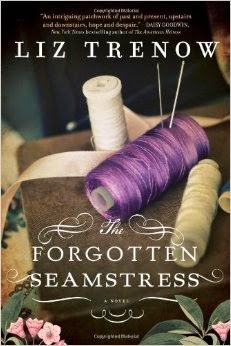
The Forgotten Seamstress by Liz Trenow


The Forgotten Seamstress by Liz Trenow
Copyright 2014 
Sourcebooks Landmark - Historical/Contemporary
Source: Sourcebooks 

Quick note:

You weren't missing much when I skipped this week's Monday Malarkey because The Forgotten Seamstress and Half Bad (from a friend) were the only books that arrived, last week, Anton and Cecil: Cats at Sea the only book I finished besides One Night in Winter (already reviewed) and The Forgotten Seamstress (here you go).  The cats were the same as always - funny, playful, ever-present during reading time.  Still doing my exercising to MeTV's Emergency! reruns and we're almost done cutting down the second of our infested pear trees -- the other one came down last summer. It also rained a lot. Not a particularly thrilling week. :)

On to the review of The Forgotten Seamstress . . . 

Brief synopsis:

At the turn of the 20th century, young orphan Maria Romano and her best friend Nora learn to sew with delicate precision, their skill so admirable that when the time comes for them to go into service they're taken to work at Buckingham Palace. When Maria catches young Prince David's eye and his manservant doesn't do a sewing job to his satisfaction, David has Maria brought upstairs to do a hasty job. The prince is happy enough with the work to call Maria back on occasion. As the prince reaches out to Maria with an affection she never could have imagined, she falls under his spell. But, when she falls pregnant with his child, she is spirited away, locked up in a mental facility where she eventually sews her love into a quilt, knowing nobody around her believes a word she says. Did Maria really give birth to the prince's baby? If so, what became of the child? Is Maria a "fantasist" or were her mental issues created by those who wished to silence her?

In 2008, Caroline Meadows is helping her mother clear her home of unneeded possessions when she comes across a quilt handed down to her by her grandmother. The quilt is made from an odd hodge-podge of designs and fabrics, some of them recognizably of high quality, with a number of embroidered designs and a verse. Curious about its origins and intrigued by an old photo of the quilt and a lady with a twinkle in her eye, Caroline seeks answers to the puzzle of the quilt while her everyday life is both crumbling and soaring with possibilities.  Even when the quilt goes missing, she continues her search. But, the story of the quilt will lead to revelations she could never have dreamed possible.

My thoughts:

Dual storylines -- one historical, one contemporary -- have become a pretty commonly used device in recent years and, to be honest, they aren't my favorite. I tend to prefer one storyline or the other, usually the historical, and end up finding the second a slog. That's pretty much how I felt at the beginning of The Forgotten Seamstress.  Maria's story is told through a series of interviews taken on cassette tape at a mental facility in the 1970s, Caroline's story in present tense. As usual, I was much more intrigued by Maria's story than Caroline's. And, yet, Caroline's search unfolds so realistically and the two stories are interwoven with such skill that by about page 100 I was completely engrossed. I had to know what happened to Maria, what Caroline would find out, whether or not Caroline would ever locate the quilt, what would happen to Caroline and whether she would find love, again.  In the end, I closed the book with a sigh, completely satisfied by the answers and how they had been revealed.

Recommended - By far one of the best historical/contemporary blend novels I've read, with an intriguing mystery, clear prose, a unique historical setting and excellent characterization. Particularly recommended to fans of historical fiction, quilting and/or dual storylines. Even though I'm neither knowledgeable about or all that interested in quilts and tend to dislike a blend of historical and contemporary storytelling, I found The Forgotten Seamstress an extremely satisfying and enjoyable read. The only problems I had with it were a slow beginning and a bit of difficulty buying into the upstairs-downstairs relationship. Once I got past those difficulties, I was surprised how much I enjoyed The Forgotten Seamstress.

©2014 Nancy Horner. All rights reserved. If you are reading this post at a site other than Bookfoolery  or its RSS feed, you are reading a stolen feed. Email bookfoolery@gmail.com for written permission to reproduce text or photos.

Tuesday, September 03, 2013

The Book of Someday by Dianne Dixon


The Book of Someday by Dianne Dixon
Copyright 2013
Sourcebooks Landmark - Fiction
340 pp., incl. Reading Group Guide

First sentence Paragraph:

Her father. Shouting her name.  "Olivia!" His footsteps falling loud and heavy on the wood of the floor.

Summarize the plot without giving away the ending:

Livvi is having an affair with the first man who has ever made her feel truly special.  In her twenties but a deeply wounded by childhood abuse and naive due to her homebound education, she finds it difficult to break away when she discovers her lover's secrets and develops an attachment to someone who reminds her of herself as a child.

AnnaLee's husband is both a doctor and a lawyer but he can't seem to find his place in the working world and limits his hours. Frustrated by her husband's inability to provide for the family, AnnaLee is slowly selling off valuables from the home she inherited. Then, summer arrives and brings with it a refugee from distant and wealthy parents. As AnnaLee tries to break through to the girl who calls herself Persephone, will Persephone's desperate attempts at friendship end in disaster?

Micah has cancer.  To determine whether or not it's even possible to atone for the sins of her past, she goes on a journey, seeking out the individuals she's hurt and hoping they can help her decide whether to live or die.

Capsule Description:

The Book of Someday is the story of three women with interconnecting lives.  The key to their interconnection is a painting/photograph/nightmare of the same thing -- a woman in a silver dress and pearl-button shoes.  One of the stories is told from the 1980s, the other two in 2012.  

What did you like best about The Book of Someday?

Could. Not. Put. Down.

It takes a very long time to get to the point that the connection is explained and I figured it out before the author got to the point of the big reveal, even as she was still hiding little bits of the tragedy that connected their lives.  I didn't mind that I figured out the mystery portion because I was enjoying the book so much.  I loved the fact that I found the book so gripping I actually fell asleep reading (the book falling, fwop, onto my chest woke me up) and turned the light out with deep regret then awoke at 5AM dying to keep reading.  I adore that kind of read.

What did you dislike about The Book of Someday?

There were only 2 things that kept The Book of Someday from being a 5-star read.  One was the constant use of sentence fragments.  I understand using them for impact but they were used All. The. Time. For no good reason.  Sometimes I had to visualize lower-case and correct punctuation to figure out the meaning of a paragraph that genuinely should have been written as a single sentence.

The other problem was the ambiguous ending. I couldn't discern whether the author was telling me Livvi was planning to end up with one guy or the other and I wanted that clearly spelled out.  I don't mind an open ending but this one was just confusing to me.  I reread it several times and then dashed off to read other reviews.  Most readers were not bothered by the ending.  I just found it perplexing and decided to create my own ending, mentally. Still, very solid storytelling with just enough held back to keep the suspense going.

Other notes:  

There is a lot of lightly graphic sex in the book (Livvi and her lover), which probably accounts for the comments other reviewers have made about the book reading "like a Harlequin".  I didn't get that "Harlequin" sensation at all, in spite of all of those scenes. I was too busy being swept away by the storyline and trying to puzzle out the interconnection to be bothered, although I'm not a fan of graphic sex scenes.

Highly recommended - One of the most unputdownable books I've read in a while.  Although I gave it a 4/5 rating at Goodreads, The Book of Someday really deserves a 4.5/5 for the mere fact that I couldn't put it down till it literally fell out of my hands . . . and then I was so anxious to start reading that I woke up early and didn't put the book down till I finished.  In spite of the fact that there's some graphic sex and that's something I don't enjoy, I thought the sexual relationship was crucial to explaining Livvi as a character so it just fell into the background for me.

I received an ARC of The Book of Someday from Sourcebooks in return for an unbiased review.

©2013 Nancy Horner. All rights reserved. If you are reading this post at a site other than Bookfoolery  or its RSS feed, you are reading a stolen feed. Email bookfoolery@gmail.com for written permission to reproduce text or photos.

Friday, August 16, 2013

The Widows of Braxton County by Jess McConkey


The Widows of Braxton County by Jess McConkey
Copyright 2013
William Morrow (an imprint of HarperCollins) - Contemporary-historical fiction with a touch of mystery
358 pp.

First Sentence: 

Hannah Krause drew the back of her hand over her eyes and, careful of the squeaking bedsprings, slowly rolled onto her side.

Description:

In 1890, Jacob Krause is murdered in his bed.  His eldest son, Joseph, cheats Jacob's second wife, Hannah, and her son Willie out of their portion of the farm after Hannah is blamed for Jacob's death. But, Hannah is innocent and 130 years later the mystery remains unsolved.

In 2012, Kate marries Joseph's descendant, Joe, and moves to the same farm where the family has been living under a curse for over 130 years.  There, she finds that Joe is not the gentle man who wooed her but a violent man who is barely hanging onto the family farm.  And, there's another surprise waiting.  Joe's mother, Trudy, a bitter woman who belittles Kate and treats her like a household slave.

Kate tries to be what her husband and mother-in-law want her to be, eventually realizing she must place her own needs first.  But, even as she's trying to work things out with Joe and get back on an even keel, history suddenly repeats itself.  As Kate tries to dig into the past to find out what exactly happened to Hannah and her son Willie and prove herself innocent of murder, she finds that to ask about Hannah is to enter forbidden territory.

My thoughts:

Yet another story with a historical woman's tale told in parallel with a contemporary tale, The Widows of Braxton County is about murder, greed and how violence is passed down through generations. I gave The Widows of Braxton County a high rating because I was in the midst of a slump and the story sucked me in, right away.  I loved the hint of mystery (just enough to keep the plot moving but not enough to toss it into the mystery genre) and the way Kate summoned the strength to do what she needed to do after trying her best to please people who were far too headstrong to respond positively.  The Widows of Braxton County is as much about the differences between life for women 130 years ago vs. today as it is a mystery with a touch of the paranormal.

Recommended - While not brilliant and extremely quotable, I thought Jess McConkey's writing was solid, the plot gripping and the two female characters upon whom the book is focused great characters.  I rooted for both of them, hoping they would go on to have happy lives.  Occasionally, I found that I had trouble remembering which side of the family (Joseph's or Willie's) the characters referred to in dialogue, so a family tree diagram would have been helpful but a little confusion was never enough to slow the reading down significantly.

I received a copy of The Widows of Braxton County by mistake from HarperCollins and chose to review it.  What a terrific mistake that turned out to be!  I really enjoyed the story and am grateful that it was around when nothing else was appealing to me.

©2013 Nancy Horner. All rights reserved. If you are reading this post at a site other than Bookfoolery  or its RSS feed, you are reading a stolen feed. Email bookfoolery@gmail.com for written permission to reproduce text or photos.

Wednesday, July 31, 2013

The River of No Return by Bee Ridgway


The River of No Return by Bee Ridgway
Copyright 2013
Dutton - Historical-Contemporary Fiction/Time Travel
452 pp.

Going back to my 2007 Q/A format for this review.  I must confess it blows my mind a little to realize just how long I've been doing this blogging thing.

What led you to pick up The River of No Return? It was that beautiful cover (posted by the author, a Twitter friend) that led me to the book's description and from there it went straight onto my wish list.

Summarize the plot but don't give away the ending: Lord Nicholas Falcott was about to be killed on a battlefield during the Napoleonic War when he was ripped away from the battlefield and lapsed into unconsciousness.  Awakened 200 years later in London hospital, he found that he'd jumped forward in time.  A representative of the Guild, a secret organization of people who have jumped forward on the "River of Time", informs Lord Falcott what's happened to him and then he is spirited to a facility in Brazil, where he is trained to live in the modern world, told where he may and may not go and given plenty of money to start his new life as Nick Davenant.

But a second shadowy organization works in opposition to the Guild and after 10 years of living in the United States, Nick is summoned by the Guild.  He is needed to help find an unknown talisman, figure out what has gone wrong within the time stream of the future and prepare to fight the opposing Ofan.  Back in his own time period, Nick becomes reacquainted with Julia Percy, a neighbor whose grandfather was able to manipulate time.  But, Julia is in danger.  A distant relative has inherited her grandfather's estate, he believes she knows the secret to her grandfather's ability, and he has a dangerous temper.

What did you like most about The River of No Return?  I love time travel, in general, and I was very fond of the two main characters.  It was fun to follow Nick back to his home in Regency England and I liked the slow unfolding of the plot, revealing that something has gone wrong.  I also loved the fact that there were characters who had jumped from a variety of other time periods.  Just getting a glimpse into where they had come from and how they lived was kind of a kick.  There is also an element of romance but it's not dominant, which is how I prefer romance in a book.

Thoughts about the plot:  This is my kind of book.  I love escaping from reality without that escape become so ridiculously far-fetched that it's beyond my grasp.

Share a favorite scene from the book:  My favorite scene is actually a spoiler and I don't want to ruin the read for others so I'll just tell you I really, really enjoyed the scenes that involved the manipulation of time.  I could easily visualize them as movie scenes -- and, in fact, similar has been done but I still think it would be fun to see The River of No Return made into a movie.

In general:  As per my 2007 format, I'm going to rate this book (surprise!).  It's a 4/5, which means I really enjoyed it.  I loved the characterization, found much of the dialogue plausible and entertaining (especially the parts during which Nick confused the modern speech he's practiced for 10 years with his old Regency lingo - some of the Guild's discussions were a yawn) and absolutely loved the paranormal/time travel aspect.

I did, however, come away from the read feeling that it was missing something, but I wasn't sure exactly what, hence the delay in reviewing. I needed to give the "missing something sensation" some thought.  In the end, I decided it was the fact that there was a good bit of telling in regard to the River of Time.  I would have liked to travel in time a bit more, rather than reading Guild talk about the time stream and taking that single jaunt back to the one time period.  That's obviously just a personal preference.  And, there were a few repetitive phrases unique to the author, which I found annoying.  While the ending was not as firmly wrapped up as I like, it wasn't cliff-hangery enough to frustrate me and I will definitely want to read the next book in the series.

My thanks to Bee Ridgway for kindly having her publicist send a replacement copy when the copy sent by a friend was stolen in transit.

©2013 Nancy Horner. All rights reserved. If you are reading this post at a site other than Bookfoolery  or its RSS feed, you are reading a stolen feed. Email bookfoolery@gmail.com for written permission to reproduce text or photos.
Monday, July 15, 2013

Astor Place Vintage by Stephanie Lehmann


Astor Place Vintage by Stephanie Lehmann
Copyright 2013
Touchstone - Fiction/Historical-contemporary mix
396 pp., incl. black and white photos

When Amanda Rosenbloom goes to a dying elderly lady's home to purchase the woman's vintage clothing for her store, Astor Place Vintage, she is surprised to find a journal hidden in a fur muff.  Amanda sneaks the journal into her purse and as she reads, discovers the surprising life of Olive Westcott.  Olive moved to Manhattan in 1907 to pursue a career as a store buyer.  But, gaining experience and reaching a goal as a single woman was not so simple 100 years ago.  

As she reads Olive's story, Amanda can't help but find connections between herself and Olive. Will the journal of a long-dead woman help Amanda break away from an unhealthy relationship after years of relying upon her married boyfriend's money to keep her store afloat?  If so, how will she survive without his help?

I had a terrible time getting into Astor Place Vintage but sometimes when a book is not clicking for me I'll go read reviews to see if there's something I'm missing.  In this case, it was Jennifer's review of Astor Place Vintage that helped me to look at the story from a different perspective.  I returned to the book and enjoyed it.  In fact, the end was so very satisfying I'm relieved that she stopped me from giving up.  Typically, I quickly became tired of the leaps back and forth from one character to the other and found them confusing until Jennifer noted some aspects of the historical character's life that helped me to untangle them. 

What I particularly loved about Astor Place Vintage was the peek into life as a single, working woman who knows what she wants but has huge challenges barring her way.  And, as Jennifer noted, it was very interesting seeing what it was like just to be a woman, in general, during that time period. 

Recommended - While Astor Place Vintage is not a personal favorite, partly because I'm quite weary of books that alternate between two lives every other chapter -- and I did find that I preferred the historical storyline -- Astor Place Vintage is a very good story that was extremely satisfying, in the end.  There are black and white photos of Manhattan in Olive's time period interspersed throughout the book.  I love old photos and they added nicely to the story as they spotlight areas of significance which are helpful for visualizing Olive's world.  

My thanks to Simon & Schuster for providing the review copy and to Jennifer for saving me from ditching a book that turned out to be a very good read.  


©2013 Nancy Horner. All rights reserved. If you are reading this post at a site other than Bookfoolery  or its RSS feed, you are reading a stolen feed. Email bookfoolery@gmail.com for written permission to reproduce text or photos.

The Keeper of Secrets by Julie Thomas


The Keeper of Secrets by Julie Thomas
Copyright 2013 
William Morrow (an imprint of HarperCollins)  
Fiction/Historical-contemporary blend/WWII
358 pp.

After years of state-reinforced atheism, he'd decided to read the Bible and been so fascinated by the concepts inside, he'd availed himself of repentance and forgiveness, just to be on the safe side.

~p. 269

Simon Horowitz is the latest musician in a wealthy German Jewish family whose musical talent goes back generations. The rare 1742 Guarneri del Gesú violin is Simon's favorite from their collection of valuable instruments.  But, when Nazis invade the Horowitz home, confiscate their possessions and scatter the family, sending some to Dachau, it is only through the kindness of another musician that Simon will be able to survive the war.

Daniel Horowitz is barely a teen but he already has won a prestigious award for his skill on the violin.  When his mother takes away the only other joy in his life to make him focus on his music, Daniel decides he would rather give up the violin than willingly lose half of what he loves. Rafael Gomez -- a famous conductor who has worked with Daniel and befriended him -- believes he can tempt Daniel back into the music world. But, it will involve finding the missing Guarnieri del Gesú and convincing its owner, who has a touching story of his own, to let it go.

I almost passed up on reading The Keeper of Secrets and then I realized, "No, no, it's got a WWII storyline!  I have to read it!"  Like many stories that connect a historical character and storyline with one of modern time period, there is a bit of alternating between time periods.  Julie Thomas separated and merged those storylines with far more skill than most.  Rather than the usual every-other-chapter style that is so common, and which often leaves you with the sensation of being whacked back and forth like a tennis ball, she leaves you in one time period long enough that you become immersed in that thread and get to know the characters well before moving to the other time period and doing the same.  The connections between the stories become clear early on, but the merging of them toward the end is handled brilliantly.

The quote I chose is a bit random in that it has to do with a minor character.  I just liked the sentence; it gives you a little glimpse of the writer's style.

Highly recommended - The Keeper of Secrets is one of those books I've been struggling to review because I loved it so much: a moving story of courage, destiny, love and hope.  The cover blurb ends on this note:

Skillfully composed, heartrending yet ultimately uplifting, The Keeper of Secrets reminds us of the preciousness of life and family, and the power of hope and art to conquer the darkest despair.

That's a surprisingly accurate description.  While the music aspect may occasionally feel a bit overwhelming to some, I loved the way this book was crafted and I didn't personally become weary of the music bits but I found myself thinking some people might find them a bit tiresome.  The epilogue is particularly unique as it reaches 35 years into the future.  I cried joyful tears at the ending and can visualize myself rereading The Keeper of Secrets in the future.  It's well worth owning.

My thanks to HarperCollins for the review copy. 

©2013 Nancy Horner. All rights reserved. If you are reading this post at a site other than Bookfoolery  or its RSS feed, you are reading a stolen feed. Email bookfoolery@gmail.com for written permission to reproduce text or photos.

Wednesday, June 26, 2013

The Firebird by Susanna Kearsley


The Firebird by Susanna Kearsley
Copyright 2013
Sourcebooks Landmark - Fiction/Historical-Contemporary blend w/a touch of paranormal
543 pp.

Source:  From Sourcebooks for review

What The Firebird is about:

Nicola Marter has a special talent.  When she touches an object, she sees scenes from its history.  Her father has the same ability but revealing his gift caused such anguish he will not speak of it; he has coached Nicola to keep her gift buried deeply.  

When a woman arrives at the art gallery at which Nicola works, hoping to sell a Russian carving, Nicola knows she's telling the truth about its origin.  But the vision of Empress Catherine handing it to the woman's ancestor is not enough to authenticate its history so the woman goes home disappointed.  Then, Nicola finds the woman's scarf and learns something more.  Determined to help, she sets off for Scotland to find the one person she knows to be even more gifted than herself.  

Together, Nicola and her handsome friend Rob will travel in pursuit of evidence from the past.  When the two psychics are thrown together with a common goal, will the romance of their past start anew?  Or will Nicola keep running from her ability and the love she gave away?

What I loved about The Firebird:

That was probably a crap description, sorry.  I just hate using the publisher's description unless I'm at a total loss for words.  I am at a loss about how to describe what I loved about the book because The Firebird is another one of those books that so thoroughly swept me away that I'm tempted to say I loved absolutely everything about it.  I adored the characters (especially the hero), the slowly-building romance, the historical context and the story itself.  But, there was one thing I didn't love.  Just one.  Well, no, two.

What I disliked about The Firebird:

It was a little hard to wrap my mind around the concept of two people being so connected that they can actually hear each other's thoughts.  In The Firebird, the two characters occasionally speak telepathically. Sometimes they don't even realize they're doing so.  Kind of a stretch, I thought.  I love the way Susanna Kearsley blends a bit of time travel with a contemporary story, though, and I was not going to let a concept that I found a little unbelievable keep me from enjoying an excellent read.  The only other problem I had with The Firebird was the occasional tedious passage.  I loved the book but sometimes it was just a tiny bit too detailed and I found myself close to slipping into zone-out mode.  That never lasted very long, though.

The bottom line:

Highly recommended - Excellent storytelling, wonderful characterization and stunning historical research make for a terrific, escapist read.  The Firebird continues the story of historical characters first introduced in The Winter Sea, a book I absolutely loved.  In fact, now I wish I hadn't passed on my copy of The Winter Sea because I'd really like to go back and read it, again.  Oh, well.  Read them together, if you can, but The Firebird stands alone fine and both are excellent books, perfect for vacation reading.


©2013 Nancy Horner. All rights reserved. If you are reading this post at a site other than Bookfoolery  or its RSS feed, you are reading a stolen feed. Email bookfoolery@gmail.com for written permission to reproduce text or photos.

Monday, March 11, 2013

The Missing Manuscript of Jane Austen by Syrie James


The Missing Manuscript of Jane Austen by Syrie James
Copyright 2012
Berkley (an imprint of Penguin) - historical/contemporary fiction
422 pp. including Reader's Guide

The Missing Manuscript of Jane Austen is the story of Samantha McDonough, who discovers a letter written by Jane Austen tucked into a book.  This letter hints at the existence of a previously-unknown Austen manuscript.  The letter and a little investigation lead Samantha to a shabby estate called Greenbriar in Devonshire, where she meets the very handsome Anthony Whitaker, owner of the crumbling estate. Anthony is preparing to sell Greenbriar.  It's a wreck; he's really never lived there long enough to become attached to the place, his father was an icky old man who didn't have anything to do with him and Anthony just wants to dispose of it quickly.

Clearly, Samantha needs to convince him to hang on long enough for her to dig in the house to find the manuscript that she believes was left or stolen at Greenbriar.  Not exactly a challenging conflict.  Man who wants to get rid of house immediately shoos away Austen scholar with a burning desire to dig around in his shabby mansion.  They have to find that manuscript or the book is rather pointless, right?

Anthony is, of course, quickly convinced that he should allow Samantha to hunt for the manuscript after letting her in long enough to locate a guest registry that lists the Austens as visitors.  He is motivated by money; she only cares about the joy of adding to the Austen canon.  It doesn't take long for the two to find the missing manuscript.  And, when located, they begin to read the manuscript. At this point, the tone of the book changes as it becomes a "book within a book".  I didn't find the Austen manuscript particularly convincing (nor the letter, for that matter).  But, the Regency-era manuscript slowly grew on me as its plot began to sound typically Austenish.  

At that point, I shut off my annoying editor brain and simply enjoyed the story.  The "missing manuscript" might have contained some modern expressions and Americanisms but, in the end, the Regency portion of The Missing Manuscript of Jane Austen was tremendously entertaining.  Eventually, I found the modern portion of The Missing Manuscript of Jane Austen so dull that it was irritating when the modern story interrupted. 

The Regency story is about a rector's daughter, Rebecca Stanhope, who finds that friends are not always what they seem.  There is the usual hero with a secret agenda and the surprising true love, etc. - definitely a story built with a bit of Austen formula. 

The modern portion of The Missing Manuscript of Jane Austen, unfortunately, was too predictable, too pat, far too easy for the heroine.  Discovering a letter and locating a manuscript within 2 days?  And . . . well, I won't spoil the ending but it also lacks decent obstacles.  The only conflict was so obviously manufactured that I would not have managed to finish the book if the modern portion had not taken a backseat to the historical.  

Fortunately, the modern story becomes the lesser portion of the book as Samantha and Anthony read the discovered manuscript and, in the end, I really enjoyed The Missing Manuscript of Jane Austen.  The modern ending was predictable and trite, but I pretty  much didn't care, by that point.  I'd already had too much fun and would have happily closed the book without a wrap-up of the crappy modern portion.  I gave The Missing Manuscript of Jane Austen 4 out of 5 stars at Goodreads.  The modern portion would get no more than a 2/5 if I were to rate it on its own and if I'd taken off points for style I would have given it a lower overall score, but entertain me and I'm happy.  

Recommended particularly to fans of Jane Austen who enjoy reading spin-off novels and readers who love Regency novels, in general.  A delightful Regency tale is what makes the book entertaining. The ridiculously predictable modern story's ending is okay, if only because it doesn't deviate from the expected.

In other news:

No malarkey, today.  I'm just recovering from a 4-day migraine.  If I have time and energy, I'll write a Tuesday Twaddle post, tomorrow.  If not, I'll just dive right into more reviews when I can.  

Here's a cardinal to appease you. Obviously, I mucked around with this one a bit, using the "posterize" feature from Picasa and altering the color a bit at pixlr.com.  Photo editors are like the grown-up version of play-doh -- so much fun to mess with.  


©2013 Nancy Horner. All rights reserved. If you are reading this post at a site other than Bookfoolery  or its RSS feed, you are reading a stolen feed. Email bookfoolery@gmail.com for written permission to reproduce text or photos.