Showing posts with label translation. Show all posts

Monday, December 13, 2021

The Cat Who Saved Books by Sōsuke Natsukawa


In The Cat Who Saved Books by Sōsuke Natsukawa, Rintaro is a hikikomori, a reclusive teen who loves books and has an almost encyclopedic knowledge about them. His grandfather has just died, leaving him to run Natsuki Books on his own, but soon he'll have to leave the bookstore behind to live with a distant aunt. 

Rintaro stops going to school entirely after his grandfather's death. Why bother? He's going to leave, soon, and he doesn't have any friends. When an orange tabby named Tiger shows up and asks for his help saving books that are being destroyed, he follows. And, when the class rep — a cheerful girl named Sayo — arrives with his homework and becomes involved in the series of adventures into the labyrinth with Tiger, what will they discover? Can he and Sayo save the books from destruction?

Highly recommended - I had trouble putting down The Cat Who Saved Books and ended up with a bit of a late-night hangover from staying up to finish. I liked the way Sayo and another bookish schoolmate ignored Rintaro's introverted tendencies and spotted the depth of his knowledge and his heart. A lovely story of how books connect us and help us understand each other, translated from the Japanese. 

I won a copy of The Cat Who Saved Books from HarperCollins via Goodreads. Many thanks! 

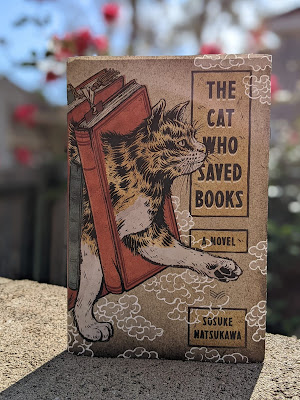
This copy also includes a note on the cover illustration, which is quite interesting. 

©2021 Nancy Horner. All rights reserved. If you are reading this post at a site other than Bookfoolery or its RSS feed, you are reading a stolen feed. Email bookfoolery@gmail.com for written permission to reproduce text or photos.

Thursday, December 09, 2021

Red is My Heart by Antoine Laurain and Le Sonneur


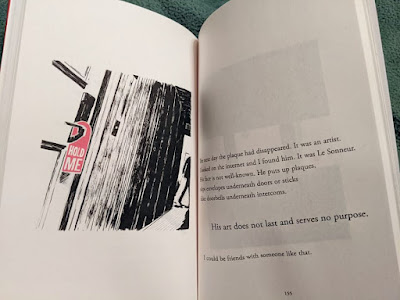
First a note on the cover: I don't know if this is the final cover for the American edition of Red is My Heart but the one I have is so subtle that the words don't stand out (they're impressed rather than printed on the cover). In person, it has a nice look but this cover is what you see at Amazon. I chose this image over a photo of my copy so that it would stand out. 

Red is My Heart by Antoine Laurain and Le Sonneur (illustrator) is a sweet, sad, funny, and ultimately hopeful story about a man who is despondent after his girlfriend leaves him. It's heavily illustrated, so probably novella length.

Each of the illustrations are in black and white with a touch of red. The red is usually distant in some way (but not always), and I presume it represents the loss of a piece of the protagonists heart or the distance, loneliness, and longing that he feels. But, maybe it's less a collaboration than a project written with the thought of Le Sonneur's art (which, you can see from this interior shot, the author describes as serving no purpose). I'd love to know how this book came about.


Highly recommended - I love Antoine Laurain's sense of humor. Red is My Heart is a simple story of a broken heart that appears to be on the mend in the end, but both Laurain's sly wit and the illustrations made Red is My Heart a super fun read that I will undoubtedly return to when I want to read something simple and visual. 

I jumped the gun a bit because I neglected to look at the publication date when I sat down to read Red is My Heart. The current release date is January 18, 2022. It can be pre-ordered. 

My thanks to Meryl Zegarek Public Relations and Gallic Books for the review copy! 

©2021 Nancy Horner. All rights reserved. If you are reading this post at a site other than Bookfoolery or its RSS feed, you are reading a stolen feed. Email bookfoolery@gmail.com for written permission to reproduce text or photos.

Wednesday, September 15, 2021

South of the Border, West of the Sun by Haruki Murakami


I had mixed feelings about South of the Border, West of the Sun by Haruki Murakami. So mixed, in fact, that I couldn't talk myself into rating it at Goodreads. 

South of the Border, West of the Sun is told in first person from the viewpoint of Hajime, an only child who feels out of place until he meets Shimamoto, who is also an only child. They remain playmates and friends for years, till his family moves away and they lose touch. Over the years, Hajime meets (and sleeps with) many women but Shimamoto has a special place in his heart and he even follows a woman who looks like her and has her same limp, at one point. He marries, has two children and his jazz bar becomes a success. He's mostly content. 

Then, Shimamoto reappears in his life, having seen an article about his jazz bar. Hajime is every bit as drawn to her as he was when they were young. She is different, more beautiful, no longer limping, and mysterious. There are questions she won't answer, things he doesn't know about her. Will Hajime stay faithful to his wife? Or, will he leave her for Shimamoto? 

Meh - I still don't feel like I can rate this book. I found it compelling enough to finish and I think that's mostly down to Murakami's writing. He does know how to suck you in. But, Hajime is kind of a yucky person. He's selfish when it comes to women, taking what he wants from them but giving little in return. You can't really root for him. And, Shimamoto's mysteriousness made her feel more like a vague outline of a character than one with color and depth. She was so incomplete that I closed the book unsure whether she was real or a figment of the main character's imagination. 

After a week and the decision that I'm definitely not going to rate the book, what most stands out for me is the feeling I'll forget about it pretty quickly. The one thing I really loved about the book was the use of motifs. But, here I must confess that I didn't know the word "motif" as it relates to literature. I'm probably the last to find out about this but OK. Here's what google told me after I read about the book and the word "motif" came up.

What is a motif in literature? 

Motif is a literary technique that consists of a repeated element that has symbolic significance to a literary work. Sometimes a motif is a recurring image. Other times it's a repeated word, phrase, or topic expressed in language. 

In South of the Border, West of the Sun, there are a large number of words or motifs that are repeated: rain, the color blue, and looking out at a graveyard are a few I recall. I don't always know what various images stand for in literature (so I often end up looking them up — I looked up crows as a metaphor when they appeared in a particular scene, for example). 

This may be simplistic on my part but I'd rather an author show or tell me what he's on about. And, yet, I thought the use of motifs was effective. So, while I didn't love the book, primarily because of Hajime's selfishness, I don't regret having read it. And, good grief, you could spend loads of time reading everyone's analysis of this book.

Some bits of information I found helpful:

The ‘South of the Border’ of the title refers to the popular 1939 song recorded for a film of the same name. As children Hajime and Shimamoto used to listen to a Nat King Cole recording of it (although in reality, Cole never recorded the song). Not knowing it refers to a trip to Mexico, Shimamoto used to wonder about what magical place lay south of the border. “Something beautiful, big and soft”. The ‘West of the Sun’ refers to a form of hysteria Shimamoto says afflicts people living in Siberia, possibly similar to Piblokto, where for no reason they abandon their life in difficult conditions and wander westward, usually dying of exposure.

--from We Need to Talk About Books

And, from Google:

"South of the Border", meaning a life of convention, possibility, and ultimately, disappointment, and "West of the Sun", meaning taking a step beyond reason, and in doing so risking everything [...]

Clearly, I'm going to need to read more Murakami. I've mostly read his short stories and nonfiction. I'll try to tackle one of his longer novels when I can fit it in. 

©2021 Nancy Horner. All rights reserved. If you are reading this post at a site other than Bookfoolery or its RSS feed, you are reading a stolen feed. Email bookfoolery@gmail.com for written permission to reproduce text or photos.

Wednesday, July 14, 2021

Mini reviews: Summer by Edith Wharton, Remo: The Adventure Begins by Murphy and Sapir, and The Days of Abandonment by Elena Ferrante

I don't have a lot to say about any of these, so they get the mini treatment. 

I read Summer by Edith Wharton after Brittanie mentioned it in our online book group and I just happened to spot my copy as I was walking from one room to the next. Thanks, Brittanie!

Summer is kind of difficult to describe but it's about a girl named Charity who works in the library of her small town, lives with a man who took her away from the mountain people out of kindness, and yearns for a more exciting life. 

Brittanie mentioned that the book was considered scandalous at the time it was published but, of course, the mentions of women of ill repute and a neighbor who was forced to go to the Big City for an abortion are only referred to in a vague way. They're obvious and yet obscured by the writing style of the time period. 

Charity, herself, ends up getting into trouble and throughout the book you feel like shaking her. She's aware of the scandal of her friend's sister's pregnancy but naive enough to put her trust in the wrong man. 

I enjoyed Summer but felt like the ending was completely implausible. Still, I'd recommend it. Wharton's writing is stunning. I need to dig through my shelves and see if I can find the other book I know I have by her, The Glimpses of the Moon. I'm not sure if I have any other Whartons but I'll be keeping an eye out. 

Remo: The Adventure Begins by Murphy and Sapir is a companion novel to the 80s movie and I chose to read it after reading Hamnet. Because Hamnet was both melancholy and character-centric, I was in the mood for something plot-driven, pulp-fictiony, even a little stupid. 

Well, I got the stupid part. It actually takes a lot longer to get to the action scenes than I expected. The movie is better, although it's actually pretty bad, too, all "government out to get us so a shadowy organization must be created to kill dangerous people." The authors were imaginative but what they conjured up is ridiculous. 

As to Remo, he's a decent character and I particularly liked the strength of Major Fleming, who was played by Kate Mulgrew in the movie. I just wish the authors had managed to fit in more action. The movie does a good job of portraying the training of Remo Williams and his relationship to his Korean teacher. But, the book portrayal is actually a bit offensive. In hindsight, I doubt I'd have liked the movie as much if I knew early on that the role of the Korean teacher was played by a white guy. 

At any rate, unless you really are in the mood for something terrible, I do not recommend Remo: The Adventure Begins. Save yourself. Read something else. Anything. 

The Days of Abandonment by Elena Ferrante is a stand-alone novel by the author of the Neapolitan series (which I have not yet read). 

When the main character's husband abruptly announces that he's leaving her and walks out the door, she descends into madness and experiences the stages of grief before a tremendous climax leads to acceptance of her new life as a single parent. 

What a crazy novel. I gave it 3.5 stars for excellent craftsmanship and was particularly impressed with the way she built to the climax. I especially liked the scene in which her son is ill and so is the dog and it falls to her young daughter to try to bring down the fever of her big brother because Mom can't cope. I'm going to write a sentence about that favorite scene and the climax for posterity but make the text white so it won't be visible and ruin it for anyone (but you can highlight it if you'd like).

When the dog is poisoned, her son becomes violently ill, and the main character can neither get out of the apartment because of a difficult lock or call out for help because both her cellphone and home phone are non-functional, she finds her daughter putting wet pennies on her son's forehead to cool his fever. 

The biggest problem I had with The Days of Abandonment was that it was just too vulgar for my taste and I had trouble liking the heroine, even when she began to finally started to cope with life as a single mother, so I'm iffy on recommendation. And, yet, you can't help but notice the author's skill and it certainly made me look forward to the Neapolitan series even more. So I don't regret reading it (but it's going into the donation box). 


©2021 Nancy Horner. All rights reserved. If you are reading this post at a site other than Bookfoolery or its RSS feed, you are reading a stolen feed. Email bookfoolery@gmail.com for written permission to reproduce text or photos.

Monday, May 24, 2021

Mini reviews - The Magician's Elephant by Kate DiCamillo, Rose Mellie Rose by Marie Redonnet, The Address by Fiona Davis

I don't have much to say about any of these, and this post will catch me up completely (for now) so it may be quiet in here till I finish something. 

I read The Magician's Elephant by Kate DiCamillo on my iPad (where I have a fully-loaded Kindle app that I barely ever touch) when our power went out a couple weeks ago and I just wanted something light to read while we sat around in the dark. 

The Magician's Elephant is about a boy who lives with a sickly man who has been telling the boy all his life that the boy's entire family is dead and that the old man rescued the child. The boy spends his days being drilled to be a soldier like his father and doing his master's bidding. One day, he goes to market and is drawn into a fortuneteller's tent with the promise of learning about his future. He spends the old man's food money on the prediction, which has to do with following an elephant to find the sister he thought dead. But, there are no elephants in this [fictional] town. 

And, then he hears that an elephant has been conjured by a magician and fallen through the roof of the opera house, onto the lap of a woman who is now permanently injured. The elephant is being held captive and the boy must figure out how to save the elephant so that he can follow it. The magician, the newly-disabled woman, and a few others figure into this story and it ends on a happy note. 

Highly recommended - The Magician's Elephant was exactly the read I needed on the day I opened the file. It's warm, witty, stirring, and full of heart. Kate DiCamillo's middle grade books haven't let me down, yet. 

Rose Mellie Rose by Marie Redonnet is the second book I read while the power was out and it's . . . kind of weird. The third in a triptych, Rose Mellie Rose is a short novel about a 12-year-old girl named Mellie who was left in a grotto as a baby and has been raised by an elderly woman, Rose. When Rose dies, Mellie follows her instructions and heads for the city of Oât, where she registers, gets an ID, and becomes a part of the dying town on a lagoon. 

There's a lengthy explanation by the author about the three novels in the triptych after the story and, I confess, I have no idea what she was trying to say. But, apparently there is flooding and a cemetery in all three books and the flooding somehow relates to the death of 19th Century literature? There's a lot of death, at any rate, the story is a tragedy, and there is some really disturbing sex (TW: could be considered rape but is not portrayed as such) . . . yes, with a 12-year-old. 

Neither recommended or not recommended - I mean . . . ugh, I really did find parts of Rose Mellie Rose disturbing but at the same time it was compelling and I don't regret reading it, although I would not seek out the companion novels (all three are stand-alones with apparently the same theme so it's not necessary to read them in any order if you do read all three). Mostly, I just feel like I'm glad I read it and now I can pass it on. I bought it long, long ago when we had a salvage store that occasionally got book stock from floods, fires, etc., and I was building my home library so I'd buy just about anything that appealed to me. It's a French translation.

The Address by Fiona Davis is a contemporary/historical combo that takes place mostly in the Dakota, the upscale apartment building in New York City where a lot of wealthy, famous people live and outside of which John Lennon was shot. 

Sara Smythe is an Englishwoman who travels from England to work as the manager of the Dakota as it's opening and Bailey, in the 1980s, is an addict fresh out of rehab who is offered the job of redecorating her cousin's apartment in the same building. 

In the past storyline, we know that Sara went mad and killed the architect who employed her. What happened to cause this fit of passion?

In the more contemporary part, Bailey finds clues to what happened in the past that might change her own future. 

Recommended - I liked The Address. It's the first book I've read by Davis and I wasn't quite sure what to expect but it was another one of those, "Ah, just what I needed at this moment" books. It's a light, easy read but with a nice little mystery and I'd been reading a nonfiction without finishing it for over a week so I needed the mental break. As is often the case, I pretty much predicted everything that ended up happening. It took me a while to untangle the possibilities and come up with my own theory, though, so no problem. 

Sara is institutionalized in this story, at one point, and when I got to that part, I recognized the descriptions from Nellie Bly's book about her time in the madhouse. Sure enough, Nellie made an appearance. The Address is a fun read. I will definitely be looking for more by Davis. 

©2021 Nancy Horner. All rights reserved. If you are reading this post at a site other than Bookfoolery or its RSS feed, you are reading a stolen feed. Email bookfoolery@gmail.com for written permission to reproduce text or photos.

Tuesday, May 04, 2021

Before the Coffee Gets Cold by Toshikazu Kawaguchi


A Tokyo basement café that stays cool and comfy all the time, a ghost who occupies a chair except during bathroom breaks, and 4 people who need at least a few moments to visit with someone important to them. In the small café in Before the Coffee Gets Cold by Toshikazu Kawaguchi you can travel through time if you're willing to follow the rules. And, the rules are strict. 

As each of 4 people travel in time for understanding, reassurance, or a glimpse of someone they love, a change takes place but always in the heart of the person who traveled through time. 

What an incredibly satisfying, heart-warming book, absolutely lovely. 

Highly recommended - One of my favorites of the year, so far, I absolutely loved this Japanese time travel (a translation). I honestly don't want to say too much about it because I loved the experience so much. I closed Before the Coffee Gets Cold with happy tears.


©2021 Nancy Horner. All rights reserved. If you are reading this post at a site other than Bookfoolery or its RSS feed, you are reading a stolen feed. Email bookfoolery@gmail.com for written permission to reproduce text or photos.

Monday, March 29, 2021

Sweet Bean Paste by Durian Sukegawa


Sweet Bean Paste by Durian Sukegawa is the story of a cook named Sentaro, an older women named Tokue, and a teenage school girl named Wakana. Sentaro works in a confectionary shop selling dorayaki, a Japanese pancake filled with red bean paste. Sentaro spent a couple years in jail and was offered the job by a man who is now deceased, who paid off Sentaro's debt. Sentaro has been slowly paying him back. The new owner is the previous owner's wife. 

Sentaro has been using pre-made bean paste in the dorayaki he sells when elderly Tokue comes in asking him for a job. Tokue has strangely twisted hands and he's not even sure if she could do a job if he hired her, although he could use the help. But, then she brings him some of her bean paste to taste and he's sold. If she will make the bean paste, sales will go up and he'll be able to pay off his debt to the new owner much faster. 

Tokue is a hard worker and she makes friends with the young schoolgirls who come into the shop very easily. But, then something happens to cause people to stop coming to the store. If he doesn't turn things around, the owner is going to either sell the store or change it to something else entirely. 

Convinced that there is something magical about Tokue's ability to make excellent bean paste, Sentaro has an idea. He will go talk to Tokue at her home. Wakana goes along and while there, they learn the sad history of the people who were forced out of their family homes, never to return to their families. Tokue was one of them. Can Tokue's wisdom help Sentaro? 

Highly recommended - I've got to watch the movie, which appears to be called "Sweet Bean" without the word "paste". I just peeked online, a bit ago. Sweet Bean Paste is a sweet story with a wonderful theme: your worth is not about what you do for a living. Just being alive means you have value. So lovely. 

©2021 Nancy Horner. All rights reserved. If you are reading this post at a site other than Bookfoolery or its RSS feed, you are reading a stolen feed. Email bookfoolery@gmail.com for written permission to reproduce text or photos.

Wednesday, September 16, 2020

Tokyo Ueno Station by Yū Miri


I never carried any photos with me, but I was always surrounded by people, places, and times gone by. And as I retreated into the future, the only thing I could ever see was the past. 

~p. 17

And in the winter, my mother and Setsuko would knit sweaters for everyone in the family. We could only afford cheap yarn and thread so the sweaters quickly developed holes, but the women would repair them neatly.

~p. 37

I confess that I bought Tokyo Ueno Station by Yū Miri (who also goes by Miri Yū) for two completely shallow reasons:

1. I loved the cover
2. It has Tokyo in the title and I've been slowly collecting Japanese titles, particularly if the setting is a place I've visited.

The interesting thing is about buying Tokyo Ueno Station based mostly on the cover is that I saw the train station, the bus, the man in the fancy suit, the runner, the panda . . . and totally overlooked the homeless people lying on the ground, on a pile of possessions, in front of a makeshift hut. But, that's the one of the main settings and the viewpoint of the main character, who is looking back at his life. He's speaking from beyond, now, but his last years were spent in a homeless encampment in the park adjoining a Tokyo train station. And, as you're reading it, you can't help but theorize about how he ended up there.

Kazu was born in Fukushima in 1933. His family lived in poverty and even after marriage he had to travel wherever necessary to earn money. Most of the time, that meant he wasn't home to spend time with his wife and see his children grow. When tragedy struck for the first time, Kazu was shocked to his core and grieved deeply. More tragedy followed and eventually he moved to Tokyo, but why? What happened that led to Kazu's homelessness? And, what are the odd parallels between Kazu's life of struggle and the Imperial family?

I think one of the things that fascinates me the most about Tokyo Ueno Station is that it sounds like it is an utterly depressing story and yet I didn't find it depressing. Yes, Kazu's life appears to fit the words, "Life sucks and then you die." And, yet, there is something about his acceptance of all of the hardship thrown at him and his final passing that I found almost uplifting. At any rate, I didn't find the book depressing at all.

Recommended - I would not read this book when you're already down in the dumps because it might affect other people negatively, but I found Tokyo Ueno Station brilliantly written and engrossing. The story jumps back and forth in time but you don't know till nearly the end (although, when you hear the name "Fukushima" you can assume the final tragedy) what happened to Kazu to drive him to life in a hut made of cardboard and other scraps. It was not exactly what I expected.

What I love best about Tokyo Ueno Station is the way it places you in Kazu's world, so you really get a feel for why that expression about poverty being expensive means. The story about the cheap yarn made me think of the story I recently read about how a wealthy person can afford quality boots that will last years and years but a poor person will have to buy several pairs over the same time period because s/he can afford only a lesser quality that falls apart. In the long run, the person with less money ends up spending more.

You also see how the homeless are overlooked, almost invisible until they become an eyesore and must be tucked out of sight. You get an idea how grief can drive someone to run away from himself and his life. Tokyo Ueno Station is a harsh story but a deeply meaningful one. I'm so glad I bought it on impulse.


©2020 Nancy Horner. All rights reserved. If you are reading this post at a site other than Bookfoolery or its RSS feed, you are reading a stolen feed. Email bookfoolery@gmail.com for written permission to reproduce text or photos.

Wednesday, September 02, 2020

The Readers' Room by Antoine Laurain


In The Readers' Room by Antoine Laurain, Violaine LePage awakens in the hospital to find that she was badly injured in a plane crash, she is missing pieces of her memory, and the author of a bestselling mystery that she published cannot be located. With the Prix Goncourt coming up and Sugar Flowers a likely contender, this is a serious problem that could end her career.

The author of Sugar Flowers has never made an appearance at the publishing company, instead asking for his or her contract (the name of the author could be of either gender) to be sent to a hotel in London. And s/he has stopped responding to emails.

When a police officer shows up at the publishing house to say that she's read Sugar Flowers and the murders described in the book exactly match two murders that she's investigated, then a third person the officer thought connected to the murdered men is killed, Violaine and her employees come under suspicion. Who wrote this wildly bestselling book? Is there a connection between Violaine or any of the other employees and the victims? If so, what is it? And, what do sugar flowers (made by bakers) have to do with their deaths, if anything?

Recommended - I found The Readers' Room captivating and couldn't put it down. The ending was a little disappointing but I enjoyed the book enough that I dashed off to see what else Laurain's written and have added another of his books to my wish list.

I received a copy of The Readers' Room unsolicited in the apparent hope of my unbiased opinion (there ya go) but I didn't keep the publicity material so I'm afraid I have no idea who sent it. Whoever you are, thanks!

Vintage 1954 is the other Laurain title I put on my wish list, if anyone wants to buy me a birthday present. ;)


©2020 Nancy Horner. All rights reserved. If you are reading this post at a site other than Bookfoolery or its RSS feed, you are reading a stolen feed. Email bookfoolery@gmail.com for written permission to reproduce text or photos.

Wednesday, August 26, 2020

A Castle in the Clouds by Kerstin Gier


Confession: I bought A Castle in the Clouds by Kerstin Gier mainly because I liked the cover, particularly the fact that there's a cat on the cover. I almost removed it from my shopping cart but the cat threw me over the edge (and the story sounded fun, anyway).

A Castle in the Clouds is about a German teenage high school dropout named Sophie Spark who works at an aging, upscale hotel in the Swiss Alps as an intern. Not much happens in the first third to half of the book, other than the introduction of a very large cast as the reader gets to know Sophie, beginning with her interaction with an obnoxiously witty 9-year-old regular patron. You see her everyday life and learn about the mysterious "forbidden" cat who manages not to be seen by the bad-tempered one of the two co-owners.

There's a love triangle but it's a little odd. One of the teenage boys is the son of one of the hotel owners (it's a family-run hotel), the other has a grandfather in the jewelry business and a knack for climbing the outer hotel walls and sneaking through windows. Is he a thief? One of the families visiting and planning to attend the annual New Year's Ball is headed by a Russian oligarch who is going incognito. Is the oligarch up to no good?

You know something interesting is going to eventually happen because there's a prologue in which Sophie is covered in blood. But, the book is generally understated, a little everyday, and very fluffy. It's more about Sophie wondering what could be happening and getting it wrong, her odd little quirks like naming the birds that perch on her window ledge, and the two handsome young men circling her. The mystery is weak. I liked it that way, myself.

Highly recommended - I've never read Kerstin Gier and at the time I picked it up, I'd just read something a little too heavy that was getting me down. So, a fluffy read was exactly what I needed. I found A Castle in the Clouds light, a little adventurous, and humorous with a likable heroine. And, I loved the forbidden cat. The mystery is admittedly not that great and that's fine with me, since I'm no longer a big mystery fan. I was hoping for a light read and that's what I got. So, don't go into the reading of A Castle in the Clouds expecting a complex mystery. While it kept me guessing, A Castle in the Clouds is not the kind of book that mystery lovers tend to appreciate. I thought of it more as a love triangle YA with a little excitement on the side. Because A Castle in the Clouds was the perfect book for me at that moment, I gave it 5 stars.

Translated from the German.


©2020 Nancy Horner. All rights reserved. If you are reading this post at a site other than Bookfoolery or its RSS feed, you are reading a stolen feed. Email bookfoolery@gmail.com for written permission to reproduce text or photos.

Tuesday, September 18, 2018

Death of the Snakecatcher by Ak Welsapar


Death of the Snake Catcher by Ak Welsapar is a collection of short stories with several different translators. Author Ak Welsapar is originally from Turkmenistan, a country I knew nothing about until I read the introduction of Death of the Snake Catcher and followed that up with a little online reading. It is one of the "most restricted places on the planet", with media that's entirely government controlled and "absymal" human rights (I'm quoting the intro).

You get a sense of what it's like to live in such a closed, somewhat terrifying regime from some of the stories, although they're not all set in Turkmenistan. The author, after being declared an "enemy of the people", eventually had no choice but to escape and has lived in Sweden for decades. Some stories felt to me like they could happen on my home turf, with perhaps a few minor alterations, and some were a little too foreign for me. At least one made very little sense to me because the traditions and expressions were a little too far from my own understanding. But, the book was worth reading for the few that really made an impact and the introduction left an indelible impression on me, as did my favorite story.

A few of the stories:

"On the Emerald Shore" - A mist envelops the sea and the locals believe it to be the work of the drowned. Several people have recently drowned in the area. One is missing and presumed dead, another has washed ashore. In the nearby bar, people play billiards and discuss the drownings, wondering about how they may have occurred, especially to the most recent victim, who was muscular and fit.

"Love in Lilac" - My personal favorite, the story of a young man named Arslan who spots a "beautiful, fair-skinned girl" sitting amongst the lilacs in a Moscow park. He approaches her awkwardly and eventually they fall in love. But, it's forbidden to interact with foreigners and she's a student from Sweden. After falling for her hard, he is one day removed from class.

He was picked up by the KGB with a sickening lack of ceremony. 

What follows is one of the most intense sections of a short story that I recall reading since the days when I used to read a lot of Richard Matheson's short stories. I don't want to give it away, but it is an understated sort of menacing experience in which the tension ramps up because of what doesn't happen but could -- and Arslan knows it. I've recently seen comments that some Americans are unconcerned about the possibility that we could become an authoritarian regime. This story should make anyone who made such casual remarks have second thoughts.

"One of the Seven is a Scoundrel" - Another menacing story (the tense stories were my absolute favorites). Seven men are returning home in a horse cart from a hard day's work harvesting and talking about how some nearby villagers have been sent to Siberia when their path intersects with that of some soldiers. The soldiers have a quota of men to take to prison but one has escaped, so they need one more. Who will end up being taken away, not for doing anything wrong but to fill a quota? Who will be the scoundrel who turns him in?

Recommended - The title story, "Death of the Snakecatcher" is another favorite. I recommend Death of the Snakecatcher particularly to short story lovers and people who enjoy reading translations. While there were times I felt like I needed some sort of explanation -- a glossary, an introduction to a particular story, etc., to make sense of specific traditions -- the stories that I liked best were so thought-provoking that I had to put the book down to let a story roll around in my head for a day or two. That has always been the sign of a phenomenal short story to me, not being able to get it out of my head until I've given it some thought or wanting to talk to everyone about it.

Two vocabulary words I learned from this book:

Albescent - (adj.) white or tending toward white. From this passage:
On the third day, a mist enveloped the sea. Albescent, rising up off the water, it languidly wrapped around the shore, then the town, little by little covering the entire surroundings. 

~from "The Emerald Shore"


Takyr - (n.) meaning "smooth, even, or bare", is a type of relief occurring in the deserts of Central Asia, similar to a salt flat in the southwestern United States. From this passage:
The sweltering summer heat seemed intolerable to the men lying on the horse cart moving along the dried mud takyr path, some holding their coats and some their sheepskin hats under their elbows.

~from "One of the Seven is a Scoundrel"

©2018 Nancy Horner. All rights reserved. If you are reading this post at a site other than Bookfoolery or its RSS feed, you are reading a stolen feed. Email bookfoolery@gmail.com for written permission to reproduce text or photos.

Friday, November 03, 2017

Blackout by Marc Elsberg


I've recently read two thrillers because I've been in a mood for fast-paced reading and neither disappointed, although Blackout is good but it also is the lesser of the two.

Blackout is a realistic novel about what might happen if the European electrical grid were taken down by saboteurs. Some of the details can be a bit of a yawn but the book is fast-paced and often very exciting.

Lights start going out across Europe. Piero Manzano, a former hacker, is in an automobile accident - one of many that happen across Europe when the traffic lights go out. After attempts to restart the power stations end up bringing up error messages, almost all of Europe is cast into darkness for an extended period. The longer the power is out, the worse things grow. If the power isn't restarted within a certain amount of time, nuclear plants can go into meltdown. Nobody can pump gas so food, medicine, fuel, and other supplies quickly run out, leading to deaths by starvation, freezing, illness, and fire. What can be done?

Manzano is the hero of the book. Shortly after the power goes out and he's injured, he has an idea. He and an elderly neighbor decide to try to contact authorities to explain what he thinks has happened. Meanwhile, you also occasionally get a brief, vague glimpse into the world of the terrorists and the reason for their plan (but only a few paragraphs at a time - Elsberg is quite the tease). As Manzano tries to help uncover the problem and come up with a solution, he also becomes a suspect and befriends a young CNN reporter who just wants a chance to break a big news story.

The author tried to stick as close to reality as possible without providing a road map for potential terrorists as this is a realistic danger, both in Europe and the United States. He guessed at what would happen with the population (with the help of at least one actual study on the possible outcome). If anything, I'd say he was a bit too kind at the outset. Having lived through Hurricane Katrina's aftermath, I can tell you that it doesn't take long at all for people to begin to panic. Fights broke out at the local gas stations in my area (well inland) within days of the hurricane's landfall as people tried to hoard gas for generators and vehicles. The grocery stores only let in a handful of people at a time and wrote transactions down by hand. All perishables were ruined. It took slightly longer for people to become desperate and dangerous in Blackout. But, the author did a great job of describing what happens without power and I found the book a pretty quick and, at times, exciting read.

Recommended - Solid, realistic storyline with plenty of exciting action. While not a favorite thriller, Blackout is, in fact, pretty realistic. And, reality involves a lot of people gathering, having meetings, and getting bogged down in expectations while a few people who are able to think outside the box end up coming up with the answers. In this case, you have a heroic outside-the-box thinker in Manzano, undoubtedly a deliberate rogue type because he needs to be an anti-hero so that he will easily fall suspect. Sometimes that worked for me and sometimes I thought it was just a useful tool that didn't quite fit. At any rate, I found the book pretty gripping. There is a large cast and I had a little difficulty keeping some of the characters distinguished from each other in my mind, at first, but eventually they crystallized a bit and I was able to just enjoy the storyline, even though I didn't always entirely understand the IT details.


©2017 Nancy Horner. All rights reserved. If you are reading this post at a site other than Bookfoolery or its RSS feed, you are reading a stolen feed. Email bookfoolery@gmail.com for written permission to reproduce text or photos.

Wednesday, March 23, 2016

The Heart by Maylis de Kerangal


The tension has very quickly risen at this point on the earth's surface. The plant's leaves seem to tremble, the water in the glasses to ripple; the light in the room seems to grow suddenly brighter, making them blink, and the air to vibrate as if the motor of a centrifuge was slowly turning above their heads. Thomas is the only one to remain completely immobile, to show no emotion. Keeping his gaze steady on their pain-creased faces, ignoring the tremors of their jaws, the shaking of their shoulders, he goes on unflinchingly: The purpose of this interview is to discover and formulate the expression of the dead person's wishes [. . . ]

~from p. 101 of Advance Reader Copy (some changes may have been made to the final print version)

Early on a cold morning in France, three young surfers set out together in an aging van on a jaunt to the shore, dressing in warm gear and catching the waves until they're chilled and numb. Worn and satisfied, they pile back into the van and head home. But, tragedy strikes and one of the young men sustains unsurvivable injuries. When his family is informed, they must make the decision about what is to be done.

While physicians are mobilized in the hope that several transplants will take place and potential organ recipients are notified, the family of a vibrant young man whose life is being sustained only by machines must come to terms with their grief and make a decision in a limited amount of time. Machines can keep his heart pumping but only for a matter of hours, then it will begin to deteriorate and the hope of saving other lives will end.

The Heart by Maylis de Karangal is unexpectedly gripping. I was skeptical when I began reading, thinking it would probably end up being fairly dull, but within the first few pages I was hooked. Not only is the writing beautiful but it's also compelling enough that the pages practically flew, probably because the author did such an excellent job of portraying urgency. It quickly becomes apparent that the clock is ticking and everyone involved in the transplant process is eager for the donation process to be facilitated. It's only toward the end that you get to know the potential recipient of the young man's heart but in that brief space where her life is described, you're rooting for her, knowing that with so little time left, someone else's tragedy may be her last chance to live.

Translated from the French, I was surprised to find The Heart is not the first translation by Sam Taylor that I've read. In both cases, I found the writing was so smoothly handled that I would never have guessed the book was a translation, if not for the fact that it's mentioned on the cover and the book takes place in France. His bio says Taylor is also a published writer and that may make the difference. I've read a number of clunky, confusing translations, at least one so difficult to read that I abandoned it. Clearly, Taylor knows how to stay true to the story and the beauty of its original prose. I was impressed.

Highly recommended - Surprisingly taut, lyrical, engrossing reading. While heartbreaking because you must experience the grief the family is going through, the ending is uplifting and makes the journey worthwhile. I found it particularly interesting that the French system of organ donation requires a person who does not wish to donate to fill out a form refusing automatic donor status, although the surviving family members still may choose not to donate, the opposite to how it's done in the U.S., where you can have the donor option added to your driver's license but if you're not a donor your survivors can still choose to donate viable organs. Also of note is the fact that a French physician who declares someone dead cannot be involved in the surgical process.

Reading The Heart brought back a little of my own frustration with our inability to get my father's organs donated. When my father was declared brain dead, we asked if it would be possible to donate his organs and were told he was too old at 62. The idea of someone else being saved by your loss seems pretty powerful to me. But, it's clearly a very individual choice and I appreciated being walked through the opposite feelings.

©2016 Nancy Horner. All rights reserved. If you are reading this post at a site other than Bookfoolery  or its RSS feed, you are reading a stolen feed. Email bookfoolery@gmail.com for written permission to reproduce text or photos.

Wednesday, July 16, 2014

Twofers: The Scatter Here is Too Great by Bilal Tanweer and In the Sea There Are Crocodiles by Fabio Geda

Twofers = Two for the price of one, aka two mini reviews. 


The Scatter Here is Too Great by Bilal Tanweer
Copyright 2014
Harper (short stories)
Source: HarperCollins 

I'm jumping the gun a bit, here, as The Scatter Here is Too Great doesn't release till mid-August. But, I want to write about it while it's still fresh in my mind.  I took The Scatter Here, etc. with me to New Jersey because it's a book of short stories and I've found that when traveling short stories can be excellent for those stop-and-go moments when you can't sit still long enough to read an entire novel. As it turned out, I had tons of reading time on vacation. My granddog and I had a terrific time reading together.


The stories in The Scatter Here is Too Great are all set in Karachi, Pakistan and they're centered around a deadly bomb blast.  The author tells the same story from a number of completely different perspectives. And, in some ways they are interconnected -- the father of a character whose story you've read early in the book may appear later, telling his own version of the events, for example.

Unfortunately, I found that the biggest problem I had with The Scatter Here is Too Great was in trying to figure out how the characters were connected. I enjoyed the stories, found the setting fascinating, liked the way Karachi was -- yes, I've read the claim that saying so has become a cliché -- a character in and of itself. I did think the setting had a life of its own, so I don't mind sounding a bit cliché. Once I realized that I was trying too hard to figure out those connections, I enjoyed the reading a lot more. In the end, though, because I wasted so much time trying to figure things out instead of just immersing myself in the stories, the book ended up being an average read. 

Recommended but not a favorite - Solid writing, vivid setting but I think the book would have had more impact without any character crossover, which I found bogged down the reading for me. 


In the Sea There Are Crocodiles by Fabio Geda
Copyright 2010
Doubleday (retelling of a true story)
Source: Sent by friend

In the Sea There Are Crocodiles is the retelling of a child's escape (at the age of 10) from his dangerous home country. Even though the story doesn't take place anywhere near the North American continent, given the current immigration crisis along our American/Mexican border, I consider it relevant because of the similarities. A child in danger is taken from Afghanistan to Iran by his mother with the help of a a friend involved in human trafficking. At a mere 10 years of age, he must figure out how to survive and then keep moving from one country to another, seeking a better life until finally he reaches asylum in Italy.

The story of Enaiatollah Akbari is told by an Italian novelist who tried to write the book as it was told to him. Although he admits that the details cannot possibly be perfect because Enaiatollah was young and reconstructing memories will always contain imperfect elements, it doesn't matter. The story has a tremendous impact because it allows the reader to view the unforgiving life of a refugee child as he is abandoned by a mother who loves him too much to even say "goodbye" then moves from job to job and country to country, from Iran to Turkey to Greece then finally Italy. Occasionally beaten, stolen from and "repatriated" to a homeland where he faces almost certain death, In the Sea There Are Crocodiles gives you an idea what it's like to be a child refugee dealing with human traffickers and people who aren't interested in giving a child asylum. 

In the Sea There Are Crocodiles has been translated from Italian to English (translator: Howard Curtis) and I think the translation is done well. There was never a point that I felt like I didn't understand what a particular sentence meant. It's told simplistically but it's a harsh story and not all books are told with lyrical beauty. I disagree with a reviewer who believes the book should be labeled YA merely because of its simple language. One must remember that it was told by a man whose first language is not Italian, written down as close as possible to the way it was related and then translated. Simplistic or not, it's a story whose horrors make it a very adult read. There are humorous and touching moments in addition to hardship, which helps keep the book from being an exhausting downer.

Highly recommended - Especially relevant to Americans as our leaders are in the process of deporting refugees from South and Central America. An eye-opening story of what it's like to escape a life of terror, only to face hardship and deportation. I actually cried with relief when Enaia finally found sanctuary in Italy.

©2014 Nancy Horner. All rights reserved. If you are reading this post at a site other than Bookfoolery  or its RSS feed, you are reading a stolen feed. Email bookfoolery@gmail.com for written permission to reproduce text or photos.

Sunday, July 21, 2013

A few mini reviews - Behind the Scenes at the Museum by K. Atkinson, Well Wished by F. Billingsley and French Leave by Anna Gavalda


All three of the following books are from my personal library.

Kate Atkinson's Behind the Scenes at the Museum tells the story of Ruby Lennox's life from the moment of conception to a time well into her adulthood. But, it's not just about Ruby. Behind the Scenes at the Museum is a family saga that leaps back and forth in time, dashing back to examine how Ruby's family has been fractured by wandering souls and forward to show how the wounds caused by loss and unexplained disappearances, misplaced blame and emotional pain reverberated through several generations.

Behind the Scenes at the Museum is yet another book that does the leapfrogging in time thing, although it's quite different from the historical/contemporary blend with two main characters that's become so common.  Instead, Atkinson leaps from one decade or even century to another and none of the stories are told in a strict timeline sense.  Near the end of the book you find out even the narrator, Ruby, has blocked a critical incident from her memory because it was so painful.

It's tedious wading through detail about one generation of the Lennox family, only to be thrown to another time period and have to reorient yourself to another -- so many characters!  There were several times that I considered closing the book for good because the jumps between time periods were exhausting. And, yet the characterization in Behind the Scenes at the Museum is stunning. When you get to the point that the dots connect, the family members who drifted away are finally explained, the psychic wounds that caused some to be unhappy described you can't help but walk away from the ending thinking Kate Atkinson is one hell of a writer.  

I did, however, get the sense that Atkinson was trying a bit too hard to say, "Look, look how brilliant I am!"  She probably wasn't, but you know how some books come across that way.

Well Wished by Franny Billingsley is a children's fantasy (middle reader).  Nuria lives with her grandfather, whom she calls "the Avy". They live near a beautiful little village with a magical well.  But, wishes made at the village well have to be carefully worded or they can go terribly wrong.  One wish has already caused all but two of the children in the village to disappear.  The Avy has tried to wish the children back and he has forbidden Nuria to ever make a wish.  

Nuria quickly becomes friends with Catty Winter, a child who has been called back by the well.  But, Catty is stuck in a wheelchair after a lengthy illness left her without the use of her legs.  When Catty convinces Nuria to join in on a wish to return her to full health, the wish goes terribly wrong -- and the rules of the well are strict.  A wish can be recanted within a month.  But, if two parties make a wish together, both must agree to undo the wish; and Catty seems unlikely to change her mind.  

The description of Well Wished is a lot more simplistic than the plot. The well itself is a trickster and a series of wishes to undo wishes has created a tangled mess but Nuria is a clever child.  In fact, she's such a witty, inventive child that just reading the dialogue in Well Wished is a delight.  The way everything works out in the end is so brilliant but twisty that at least one adult reviewer at Goodreads said she was confused and couldn't fathom how a child could possibly understand the story.  I can see how someone would have difficulty following the concept.  You have to let go a little and think like a child.  If anything, I think children are more likely to understand the concept in Well Wished than adults.  Well Wished is the third book I've read by Franny Billingsley and it is a wonder.  I've also read and loved Chime and The Folk Keeper.  

French Leave by Anna Gavalda is a short book by the author of one of my long-time favorite short story collections, I Wish Someone Were Waiting for Me Somewhere.  

From Google Books:

Siblings Simon, Garance and Lola flee a dull family wedding to visit brother Vincent, who is working as a guide at a chateau in the heart of the charming Tours countryside.  

Sounds great, but unfortunately the bulk of French Leave describes the drive to the wedding and the escape portion of the book is deeply disappointing.  After some jumpy but very entertaining set-up with great interaction and Garance's reflection on a wild and crazy youth, not much actually happens when the siblings finally gather.  When Simon, Garance and Lola first encounter Vincent, though, it's pretty funny and I think the fact that not much happens is probably the point of French Leave.  Garance has happy memories but she and her siblings are simply not the same people they used to be; adulthood has changed them too much and even happy-go-lucky Garance, the narrator, realizes it's time for her to move on.

Well Wished is my favorite of these three books and the one I'd most highly recommend.  Fantasy is a genre I seldom read because the elaborate worlds and names in many fantasies overwhelm me but so far I have loved everything I've read by Franny Billingsley, although it takes a while before the pictures she paints become clear.  

Behind the Scenes at the Museum has such depth of character and setting that it can become tiresome but in the end it's quite an amazing read so I also recommend it but I'd save it for a time when you're feeling patient and willing to wade through a lot of detail.  Between the characterization and the bouncing back and forth in time, it's a frustrating book but when the pieces start to fall together it's pretty spectacular to look back and realize just what the author has accomplished.

French Leave is okay; I recommend it, but hesitantly.  Too much build-up that leads to nothing, in my humble opinion, although I don't regret the time spent reading.  I liked the first 2/3 or so.  It's unfortunate that the story petered out once the siblings gathered together.  Even if the point is that they've changed, the last portion is such a huge let-down that it colors the entire reading experience.

Wish me luck.  I'm going to do my level best to finish catching up on reviews, this week.  My goal will be to keep things short and incisive.  I am laughing at myself, already. 

©2013 Nancy Horner. All rights reserved. If you are reading this post at a site other than Bookfoolery  or its RSS feed, you are reading a stolen feed. Email bookfoolery@gmail.com for written permission to reproduce text or photos.

Tuesday, September 18, 2012

The Lost Button by Irene Rozdobudko


Book Description:

When young screenwriter Denys has a chance encounter with the gorgeous but older Liza at a vacation resort in the Carpathian mountains in the Seventies, he is immediately captured to the point of obsession. Moved to do everything in his power to be with her, he pays his way into a tour group during which Liza and Denys become "lost" together. But, their time alone is limited. Liza has a daughter and a life of her own. She has no real interest in Denys and is angered when he later shows up in her classroom.

Liza goes on with her life after they part. But, Denys is unable to let go of their single night together in the woods, even after decades have passed; and, his entire life revolves around his obsession. When he makes an impulsive decision that could change everything for the better, Denys is blinded to what is good and real in his life . . . until it's gone. Suddenly aware of what he had, Denys goes in search of the true love of his life. But, is it too late?

The Lost Button by Irene Rozdobudko is yet another book that I read around 2 weeks ago but have no problem remembering. Translated from the Ukranian, there are some turns of phrase that I found a little odd and I thought the book began rather slowly. In fact, I wasn't sure I'd complete it at all because Denys's obsession made for pretty dull and annoying reading (my opinion). And, then suddenly it became unbearable to put down. What happened?

The turning point in The Lost Button takes place when the reader becomes aware that Denys has lost the best thing in his life and after two years of searching has come up empty-handed. There are some complications that I think are best left as a surprise, although I will tell you that the missing person is his wife and her name is Lika.

After we learn about his search, the book switches from Denys's point of view to Lika's. We learn about how Lika reacted to betrayal, psychologically, where she went and what became of her. In the end, everything is thoroughly wrapped up in a very satisfying way.

Highly Recommended - The Lost Button is quite a fascinating book because it goes from a tale of obsession to a story about a man who simply can't see the good in his life, then it becomes a mystery about a missing person and finally ends with a psychological analysis of how a woman reacted to betrayal and went missing. It is utterly fascinating and I loved it, even if the obsession part nearly made me pull my hair out. I guess obsession by its very nature tends to be repetitive. That part was hard to get through but I would read The Lost Button again, now that I know how it ends. I absolutely loved Lika and found her story the most engrossing part of the book.

The Lost Button is the first of three translations I've gotten from Glagoslav Publications. I'm really excited to see how the other two turn out.

Speaking of which . . .

I've only managed to finish a whopping 4 books, so far, this month. This may possibly be the worst reading month I've had in 6 1/2 years of blogging! But, I'm actually just trying to roll with it. If I'm too tired to read (unpacking is dreary and exhausting), I sometimes nap, go to bed early or find something other than reading that occupies my mind. I've been having a lot of fun with Fat Mum Slim's September photo-a-day challenge. While I haven't managed to grab the camera every day, I love the fact that it's making me think about photography subjects that wouldn't occur to me, otherwise.

And, another side benefit of the challenge is that I have found a wonderful online photo editor that has effects very similar to those of Instagram. Since I don't have a smart phone, I've been a little envious of those Instagram effects, but the Pixlr-o-matic is easy as pie and has loads of great effects. Here's one of my favorite non-challenge photos, gussied up with Pixlr effects:

I've been asked to share my challenge photos at the end of the month. Some of them are pretty dull, but I'll share. I love looking at everyone else's photos; that's what got me started.

Tomorrow is F2F meeting day. Wahoo! I can't wait! We read two books, this month: A Moveable Feast by Ernest Hemingway and The Paris Wife by Paula McLain. I've continued to feed my new Hemingway obsession by indulging in Hemingway's Girl by Erika Robuck. I hope to finish it by 2013 [<----comment on my pathetic current reading speed]. I may be reading slowly, but I'm having fun when I do pick up a book.

Have you read anything fabulous, lately?


©2012 Nancy Horner. All rights reserved. If you are reading this post at a site other than Bookfoolery and Babble or its RSS feed, you are reading a stolen feed. Email bookfoolery@gmail.com for written permission to reproduce text or photos.
Sunday, July 08, 2012

Kaytek the Wizard by Janusz Korczak

Kaytek the Wizard by Janusz Korczak
Copyright 1933/2012
Penlight Publications - Fantasy/Translation
Translated by Antonia Lloyd-Jones
272 pp, incl. Translator's Afterword and References
Wikipedia entry on Janusz Korczak (Wow, what an amazing man)

Kaytek the Wizard is a fantasy novel about a little boy (about age 10, as I recall) who desires to become a wizard but when he succeeds at becoming a wizard, he has trouble controlling his impulses and causes loads of trouble.

Kaytek is a precocious Polish boy. He taught himself to read and loves books but he's a little odd and doesn't fit in at school. Kaytek decides he wants to be a wizard and practices making things happen by saying, "I want, I demand . . . [whatever he wants]." He's a bit of a brat so he plays a lot of pranks and causes trouble. When he tries to do good, he finds that he's misunderstood (often blamed for trouble caused by others). Eventually, he is driven from his home in Warsaw. He cares deeply for his family so when he travels the world, he leaves behind a duplicate of himself so his parents won't be worried.

As he travels the world, Kaytek's ego is fed but his soul is not. He finds that what he loves more than anything is his home and family. He desires to do good but plans and follow-through have a rough time getting together. Will Kaytek ever learn how to control his impulses and restrain his powers?

What I liked about Kaytek the Wizard:

Kaytek the Wizard is very different from today's fantasy novels about wizards, in spite of that Harry-Potterish cover. He lacks the advantage of Harry Potter in that there is no school for wizards, nobody to tell him right from wrong and help him to learn self-control, although occasionally he'll get a mysterious invisible shove in one direction or the other, indicating that there are other wizards keeping an eye on him.

I enjoyed Kaytek the Wizard as much for learning about how children's literature has changed and reading a translation (both learning experiences) as for the story itself, although the book easily hooked me and kept me reading to find out what would happen and whether or not Kaytek would ever stop playing pranks and gain control over his powers.

What I disliked about Kaytek the Wizard:

One distressing oddity about the dialogue is that people are very rude throughout the book (including the hero). They don't just say, "Go away kid," if, for example, the obviously-impoverished Kaytek tries to eat in a fancy restaurant. They say, "Go away, you brat," or "Go away, you pig." There always seems to be an insult thrown in. There are a lot of blow-off responses akin to our current, "Whatever," as well. I don't know if that was common in Poland in 1933 or just a way of showing how difficult it was to be a poor child, as well as how temperamental Kaytek was. It's uncomfortable, in other words, but possibly with a purpose as the author ran an orphanage and the children likely experienced prejudice and rudeness.

Kaytek tends to like to get back at people who give him a hard time and doing so just adds to his trouble. At times, I did find him frustrating but again . . . I think the author was writing for his children and those few things that disturbed me probably were meant to be relatable to his audience.

A small warning:

Kaytek the Wizard is unfinished. It was apparently published in serial form. The author read it to his orphans (he ran an orphanage) and crossed out things they found too frightening but didn't make changes apart from removing the frightening parts because the book was already in pre-publication and he didn't have time or ability to fix those problems. So, there are big gaps where you have no idea what happened in Chapter 12 (I think it's 12) and then shortly after that, the the story just stops. I knew the book was incomplete so that part didn't bother me, but I didn't care for the unexpected gaps.

However, the book was originally published in 1933 and the original "scary" parts that were removed no longer exist in any form. It's my understanding that those portions that frightened the children had not yet been removed when Kaytek was published in serial form, but since they no longer exist there's no going back to find them.

The bottom line:

Recommended. A fascinating Polish fantasy that will appeal to many ages. Like reading a book and comparing it to the movie or reading a novel and comparing it to the script, it's fun to read Kaytek the Wizard to compare it to modern fantasy. Amazingly, in spite of its missing pieces, you'll see if you read about Kaytek the Wizard at Wikipedia that the book was immensely popular in its day and has been made into a movie several times. There's a lot that happens; some bits are funny, some horrifying. Kaytek the Wizard is definitely an adventurous story and, in the end, I closed the book satisfied.

About the author:

Janusz Korczak died with his orphans in Treblinka concentration camp. I think that was part of the reason I picked up the book and immediately began reading. I was curious about the author, who was well-known in his time, and how fantasy in 1930s Poland would read by comparison with today's fantasy. I advise reading it for historical context, but don't expect Harry Potter. Kaytek is adventurous but quite different. Footnotes and notes by the translator help the book to make sense and to give it added interest.

Cover thoughts:

I love the cover. It's a real grabber, very pretty and appears to fit the time and place. There's a castle in Warsaw (or was), there were trams and Kaytek does actually fly at some point in the book. The colors and the image of a flying Kaytek are definitely eye-catching!

Oops . . .

Anyone notice this post was up and then disappeared? I was trying to make some changes whilst eating a Haagen Dazs ice cream bar and Isabel attempted to help -- with the eating of the ice cream bar, that is. She ended up helping all the way across the keyboard and I had a slight fiasco to repair. Someday, I'll have to get a video of Izzy trying to get to my food. It's hilarious. She is one persistent little fur gal!

©2012 Nancy Horner. All rights reserved. If you are reading this post at a site other than Bookfoolery and Babble or its RSS feed, you are reading a stolen feed. Email bookfoolery@gmail.com for written permission to reproduce text or photos.