
©2022 Nancy Horner. All rights reserved. If you are reading this post at a site other than Bookfoolery or its RSS feed, you are reading a stolen feed. Email bookfoolery@gmail.com for written permission to reproduce text or photos.
©2022 Nancy Horner. All rights reserved. If you are reading this post at a site other than Bookfoolery or its RSS feed, you are reading a stolen feed. Email bookfoolery@gmail.com for written permission to reproduce text or photos.

©2022 Nancy Horner. All rights reserved. If you are reading this post at a site other than Bookfoolery or its RSS feed, you are reading a stolen feed. Email bookfoolery@gmail.com for written permission to reproduce text or photos.
I reviewed all of the books I read in January so I've just linked to the full reviews. This photo is a little hard to see because I can't lighten it without washing out the image of Unspeakable, but you should be able to click to enlarge it. January was a very good month with an eclectic mix of children's books (one of which was by a high school friend), a classic, a feminist work, some nonfiction including books about art, and one book from a banned list.

January:
©2022 Nancy Horner. All rights reserved. If you are reading this post at a site other than Bookfoolery or its RSS feed, you are reading a stolen feed. Email bookfoolery@gmail.com for written permission to reproduce text or photos.

Recent arrivals (clockwise from left):
OK, yes, I broke my book-buying ban, again. But, I'm back on the proverbial horse.
Books finished since last Malarkey:
Currently reading:
I have some other bookmarks in books but this is the only one I'm currently reading. I started Sisters of Night and Fog and realized I needed to set it aside briefly but plan to read it next. I can't recall why; it's already shaping up to be an excellent read but perhaps it was too heavy for a day in which I was sobbing harder than usual over the bombings. I'll start over from the beginning when I read it, probably tomorrow.
Black Brother, Black Brother is going to be a quick read. The main character is a 7th grader so I'm not exactly sure how to classify it. 7th grade is a bit too old for middle grade, but it doesn't quite feel like a YA, either. Maybe YA Lite. Regardless, I'm enjoying it for the way the main character has chosen to stand up for himself by challenging himself physically rather than lashing out at anyone.
Posts since last Malarkey:
In other news (aka, "Where ya been?"):
Last week was one of those weeks that I tried to write a review and stared at the screen for hours. That was Monday. On Tuesday, I sat down to try again and found myself still unable to write. So, I walked away from the computer for a week. I've periodically checked email but just realized that I haven't even done that for at least 3 days. So, that's why there were no blog posts, last week, not even a Fiona Friday. In fact, I might have put up a Fiona Friday photo if I hadn't been hauling a cat to the vet. Isabel is still on antibiotics after a month, still twitching, but we haven't done follow-up blood work, yet, or further testing. Two more weeks till her next visit (approximately — since going to the vet means I have to catch her and she is too clever for her own good).
I'm on Season 3 of Chicago Fire. I don't know why that show is able to serve as my escapist bolt hole, but it is. When the news is unbearable, I turn on another episode of Chicago Fire. My husband can't bear to watch it. "It's so stupid," he says. To that, I have to say . . . well, yeah. Maybe that's why it's so great for escapism. I've noticed something interesting about the show that I never noticed when watching it every week or so (I'm not good at tuning in at the right time for anything, unfortunately, so I've never seen it regularly for an entire season). They have a tendency to run a storyline for a few episodes and then just drop it with no mention ever again. For example, Shay decided she wanted to have a baby, talked her dad into paying for in-vitro treatment, and went through with it. That took several episodes. Then, she found it out didn't take, was envious of the pregnant girlfriend of her best buddy for a short time and . . . nothing. It was never again mentioned. That happens a lot and once you've noticed, it's hard not to keep a running list of all the abandoned storylines, but I don't care. It's a bit of a soap opera, typically, and while it'll never quite be the joyful viewing that Emergency! was, I still love it.
I'm also on the third season of Being Erica and it's taken an unusual turn, this season. Otherwise, it's all been news of Ukraine and I confess that there have been only a couple of news reports that didn't have me in tears. I've read comments to that effect from other people on social media, along with the fact that people feel similarly helpless watching an entire country being heartlessly bombed. At the same time, my admiration for Ukrainians is unbounded. What an amazingly strong, resilient, hopeful people. I want to be as tough as a Ukrainian. But, mostly, I want Putin defeated so they can go home in peace and rebuild their country.
©2022 Nancy Horner. All rights reserved. If you are reading this post at a site other than Bookfoolery or its RSS feed, you are reading a stolen feed. Email bookfoolery@gmail.com for written permission to reproduce text or photos.

©2022 Nancy Horner. All rights reserved. If you are reading this post at a site other than Bookfoolery or its RSS feed, you are reading a stolen feed. Email bookfoolery@gmail.com for written permission to reproduce text or photos.
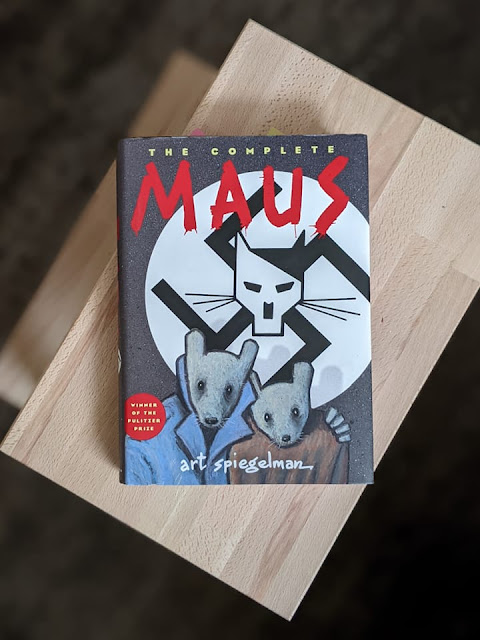
I bought a copy of The Complete Maus by Art Spiegelman (both the Pulitzer-winning original and the follow-up in one volume) after reading about Maus's removal from a curriculum in Tennessee. I'm sure you've all heard about that if you're in the US. I've had it on my wishlist for years and at one point actually owned a copy of the original with a cover that was falling off but got rid of it without reading it during one of my book purges. At the time, I didn't know what it was about; I'd bought it used on a whim when I'd never read any graphic novels or biographies, probably out of curiosity. Then, I didn't get around to reading it.
For those who don't know, Maus I: A Survivor's Tale is a graphic memoir about author and artist Art Spiegelman's parents' experiences leading up to and during WWII and the author's difficult relationship with his father. Art Spiegelman's father was a Polish Jew. Maus I first tells the story of how his parents met, married, and started a family as Hitler was coming into power. During the early years of the war, Art's parents either managed to find jobs, hide, or escape arrest numerous times but had many harrowing close calls. The book goes back and forth between Vladek Spiegelman's experiences and Art's determined effort to get the full story of what happened to his family, including a brother who died during the war, out of his father and try to locate his mother's diaries.
The second book, Maus II, describes his father's experiences in a concentration camp after he and his wife were imprisoned and separated. Again, it goes back and forth in time as the author deals with his difficult father and gradually learns the complete story.
I chose to buy The Complete Maus so I could judge its merits for myself after reading that the Tennessee school board members had complained about nudity, violence, and profanity in the book. My questions were, "How much nudity and profanity are there in the book(s)? Is anything portrayed genuinely offensive or is the storyline important enough to negate any negative aspects?"
First of all, you must know that we're talking about people portrayed as mice (Jews), cats (Nazis), and other animals (pigs were, I think, Poles who were not Jewish, but I'm not certain), except when he portrays his mother's suicide. In that case, he reverted to human images and showed a partial image of his mother's naked body in the bathtub, where she took her life. I counted a total of 7 instances in which profanity was used, all of which are words heard regularly on TV. When the Jews were forced to stand around naked, you do see tiny little man parts on the mouse bodies. And, yes, there are images of legs and feet when Nazis hanged Jews, either as punishment or for sport. All of this is less offensive than the factual horror of what the Nazis did, of course. Who cares about a few bad words and a little nudity when Maus has, as teachers say, told the historical truth of Nazi cruelty effectively?
Highly recommended - There is nothing in The Complete Maus that kids today haven't seen when it comes to the items school board members in Tennessee found offensive, and Maus is an important book, one that not only describes the Holocaust and its horrors but also portrays a difficult relationship between father and son that likely has made a lot of people with equally difficult relationships feel a little less alone. Suicide is a third topic that is addressed, although only marginally as his father describes his mother's battle with recurring depression that first began as postpartum depression.
©2022 Nancy Horner. All rights reserved. If you are reading this post at a site other than Bookfoolery or its RSS feed, you are reading a stolen feed. Email bookfoolery@gmail.com for written permission to reproduce text or photos.
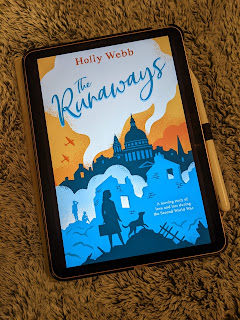
Molly is already upset about her friends leaving when she finds out her mum is going to have the dog and cat put to sleep in preparation for possible bombing. So she packs up, takes the animals, and runs away.
The cat gets out of her basket and runs back home (which naturally gave the cat lover in me anxiety) but Molly continues on with the dog and eventually comes across two children who are also runaways but from an abusive home. The three travel together until they find a place to settle. But, even that may not end up well.
Recommended - I thought The Runaways was a very good story, although the writing was occasionally a bit awkward. The occasional awkward sentence, though, certainly wasn't enough to stop the momentum. I felt like you really got a feel for the hunger, the dirt, the grief, and the general horror of war in The Runaways and I'll be watching for more by Holly Webb.
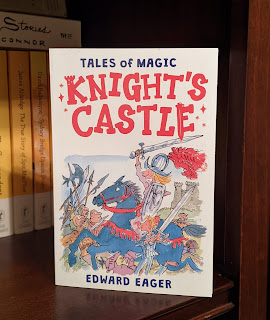
After I added the book to my wish list, I threw away the interview in which Knight's Castle was mentioned, so I have no idea who recommended it but she said she'd been waiting for it to have it's time in the sun as she thought it was better than Harry Potter. While I'm not a huge fan of Harry Potter, I tend to disagree, but I still enjoyed Knight's Castle.
Knight's Castle is the story of a boy who has a collection of toy soldiers that have been passed down through his family. The oldest one is in terrible shape but when the boy closes his hand around it and makes a wish, he's transported back in time and the way he's positioned the toy soldiers around a play castle is how they are when he materializes in this magical world and the toys become human.
There's a whole backstory with the boy, his sister, and two cousins. The boy and his sister end up at their cousins' house because something's wrong with their father and he must urgently go to the hospital.The boy is originally transported through time when he makes his wish and then the other children eventually begin to travel back in time with him. But, his wish can't come true until he proves himself worthy. And, he's running out of time.
Recommended - While I wouldn't call Knight's Castle a favorite, I enjoyed it enough to wish I had the entire series to read. I always enjoy time travel and there's a silliness to the book that tickled me. When the soldier's talk, it's like they're trying to speak as if they live in the Middle Ages but they don't quite know how, so it's a bit gibberish and quite funny. I can definitely see how this story would have left an impression on a child.
©2022 Nancy Horner. All rights reserved. If you are reading this post at a site other than Bookfoolery or its RSS feed, you are reading a stolen feed. Email bookfoolery@gmail.com for written permission to reproduce text or photos.

Recent arrivals (top to bottom):
Not pictured:


©2022 Nancy Horner. All rights reserved. If you are reading this post at a site other than Bookfoolery or its RSS feed, you are reading a stolen feed. Email bookfoolery@gmail.com for written permission to reproduce text or photos.

©2022 Nancy Horner. All rights reserved. If you are reading this post at a site other than Bookfoolery or its RSS feed, you are reading a stolen feed. Email bookfoolery@gmail.com for written permission to reproduce text or photos.

The problem is that today, the religious right has hijacked the conversation about how God talks to people. The language of white evangelicalism, particularly the politicized American version, rooted in its history of Calvinistic ideas of sin and predestination, emphasizes a person hearing Jesus or God speak to them not for the good of the community or the salvation of humankind like those mad women saints did, but for selfish, power-driven, and dangerous reasons.
The faith of prosperity-gospel preachers, gun-rights advocates making rosaries out of bullets, and "pro-life" men who assassinate doctors who perform abortions or plant bombs in clinics is, for many of us, what really feels like madness. Watching the increasingly tightly bound ties between nationalism and religion, white supremacy and religion, and homophobia/transphobia and religion and the stripping away of the health care mentally ill people rely on is like witnessing a collective episode of mental illness in light of what the gospels actually preach. If the purpose of religion is to make us better people, more concerned with others, and participants in the liberation of all humanity, the religious right has foresworn belief in the opposite.
The hatred, suspicion, and fear of visionary women is real, too, including in the Catholic Church, which has transformed its wild and untamable female saints into squeaky-clean, obedient, silent enigmas bereft of personality and representative of not much more than purity and piety. It is easier for religious or political institutions to point the finger and dismiss a woman as "crazy" than it is to unpack the overlapping social, cultural, and religious forces that exacerbate so many women's mental health issues in the first place. If those saints were just more crazy women littered throughout history, they're also easily erased.
~pp. 62-63 of The Defiant Middle
Here's why I bought The Defiant Middle by Kaya Oakes, a description included in a review I read:
For every woman, from the young to those in midlife and beyond, who has ever been told, You can't and thought, Oh, I definitely will!--this book is for you.
That makes The Defiant Middle sound like it might be a book of positive thinking for women and the above quote shows that it's not that at all, although you may come out of the reading feeling like you're ready to grab your sword and take on the world and its ridiculous expectations. Author Kaya Oakes talks about how patriarchal society has influenced everything from the words in the Bible to the societal pillars for how women should behave, as well as how women through the ages have been punished for simply being who and what they are. The second paragraph from the publisher's description gives you a better feel for it:
Women are expected to be many things. They should be young enough, but not too young; old enough, but not too old; creative, but not crazy; passionate, but not angry. They should be fertile and feminine and self-reliant, not barren or butch or solitary. Women, in other words, are caught between social expectations and a much more complicated reality.
The author weaves her personal history as a Catholic and her knowledge of saints into the narrative about how women have been suppressed, notable women have been erased from history, and unique women have been treated as if they're nuts or, worse, heretics.
Unfortunately, while I recall the author talking a lot about the conflicting societal expectations for women, it's been a bit too long since I read it to go into any detail beyond that of the publicity material. I do recall that it all made sense to me and made me steam. And, when I closed the book I immediately thought, "I'm going to need to reread this."
Highly recommended - A solid read that describes womanhood and the challenges of being female in a patriarchal society through a spiritual lens. Excellent and definitely discussion-worthy.
©2022 Nancy Horner. All rights reserved. If you are reading this post at a site other than Bookfoolery or its RSS feed, you are reading a stolen feed. Email bookfoolery@gmail.com for written permission to reproduce text or photos.

©2022 Nancy Horner. All rights reserved. If you are reading this post at a site other than Bookfoolery or its RSS feed, you are reading a stolen feed. Email bookfoolery@gmail.com for written permission to reproduce text or photos.
Jefferson also authored the Virginia Statue for Religious Freedom, upon which the First Amendment would be based. That law, along with the University of Virginia and the Declaration of Independence, were the only achievements he wanted inscribed on his gravestone. The statute guaranteed religious freedom by guaranteeing a secular government. In the statute, Jefferson skewered "the impious presumption of legislators and rulers, civil as well as ecclesiastical, who being themselves but fallible and uninspired men, have assumed dominion over the faith of others, setting up their own opinions and modes of thinking as the only true and infallible, and as such endeavoring to impose them on others."
~p. 36 of The Founding Myth
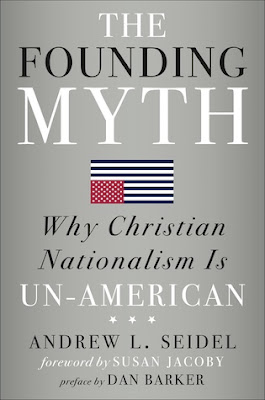
The Founding Myth: Why Christian Nationalism is Un-American by Andrew L. Seidel is about the separation of church and state, how and why the "founding fathers" of the United States chose to create this wall of separation, and what specifically they said about religion that indicated their personal beliefs.
If you're a Christian, as I am, you'll struggle with certain opinions of the atheist author of The Founding Myth. He can be pretty strident when describing the negatives of religion. But, while he may get certain details wrong from our perspective, the bottom line is that the historical references and quotes lay out his assertion that the US was not founded as a Christian nation in a logical, detailed way.
Seidel also asserts that the wall of separation between church and state makes both religious groups and the government stronger. I agree with him on that, but if the idea rubs you the wrong way, all the more reason to explore why he makes such a declaration.
Highly recommended - I have always been a strong believer in the separation of church and state and the author of The Founding Myth does an excellent job of explaining why it exists and backing that up with historical references. As to his thoughts about Christianity, while there were some minor issues with some of his assertions about it, I like having my beliefs challenged and I can't deny that he makes a lot of excellent points about how Christianity has been used as a cudgel, whether to cause the submission of women or justify violence against enemies. Christianity has a terrible, bloody history, when you get right down to it. We see, in fact, the justification of gun ownership and use by Christians using a single, out-of-context Bible quote, even today.
There are a lot more quotes I considered using for this review as this is my most marked-up book, so far in 2022. But, the book is so worth reading that I'd rather just encourage everyone to read it, instead.
©2022 Nancy Horner. All rights reserved. If you are reading this post at a site other than Bookfoolery or its RSS feed, you are reading a stolen feed. Email bookfoolery@gmail.com for written permission to reproduce text or photos.

©2022 Nancy Horner. All rights reserved. If you are reading this post at a site other than Bookfoolery or its RSS feed, you are reading a stolen feed. Email bookfoolery@gmail.com for written permission to reproduce text or photos.
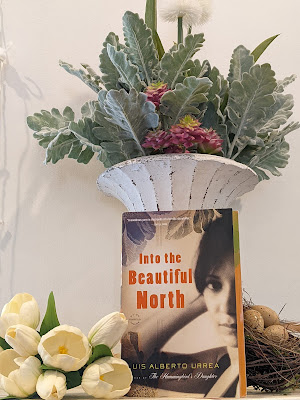
In Into the Beautiful North by Luis Alberto Urrea, Nayeli's village in Mexico, Tres Camarones, has been invaded by dangerous drugs runners/bandidos but almost all of the men have gone to the United States to find work. Her father has been gone for years without sending money or even a postcard. When Nayeli realizes there is nobody around to save them, she's inspired by the movie, The Magnificent Seven. She and her friends will go to America to bring home her own Magnificent Seven to drive the bandidos away.
Highly recommended - A marvelous read that treats the "illegal" characters like the humans they are, with joys and sorrows like the rest of us. Nayeli is an especially strong character but a believable one, as are her friends, flaws and all. I was expecting the usual, harrowing border crossing adventure and there's plenty of that. What I didn't expect was the humor. Mexicans complaining that they need a wall on their Southern border. Border Patrolmen who put illegals on the bus back to Tijuana and, after asking, "Will you cross over again?" and being told yes, say "See you next week!" Just an all-around fabulous read, respectful, surprising, and hilarious.
I don't own any other books by Luis Alberto Urrea, unfortunately, but now I want to read his entire backlist. I love his sense of humor.
©2022 Nancy Horner. All rights reserved. If you are reading this post at a site other than Bookfoolery or its RSS feed, you are reading a stolen feed. Email bookfoolery@gmail.com for written permission to reproduce text or photos.
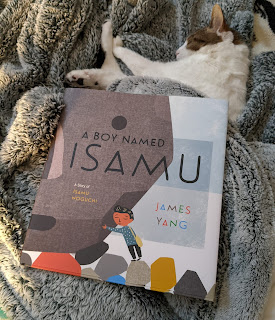
The illustrations are fabulous. I'm a fan of James's art but I think he really knocked it out of the park in A Boy Named Isamu. And, I loved the way he portrayed how an artist sees and thinks. There's a nice bio of Isamu Noguchi in the back of the book.
Highly recommended - I loved A Boy Named Isamu so much that I read it, recorded it in my reading calendar, and then read it again. As I said elsewhere . . . forget the grandkids, this one's for me. But, I'm sure the grandchildren would appreciate it, as well.
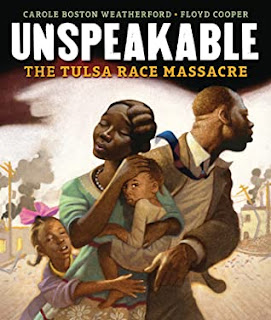
Brief note: My husband and I grew up in Oklahoma and neither of us ever heard of this particular historical event, although Hubby says his friend told a story of his grandfather hiding a Black man in the 1920s and he's pretty sure it was during what has elsewhere been called the "Tulsa Race Riot" (a name which, this author notes, places blame on the victims).
Unspeakable tells the true story of the Tulsa Race Massacre and places the blame squarely where it belongs, on the people of that time period who murdered, looted, and burned a prosperous black community to the ground. It's well written, appears well researched, and the illustrations are marvelous. It ends with a photo of the burned remains of Tulsa's Greenwood district. As an Oklahoman who didn't hear about this violent travesty until a few years ago, I'm glad to see it talked about.
Highly recommended - The hardback was sold out everywhere when I looked this book up, so I bought the e-book and the electronic version is perfect. There were no issues at all with the images. This story was suppressed for far too long and I can't imagine why anyone would desire to ban it other than a continued desire to suppress the truth. It's told in a very positive way and the illustrations are just stunning.
©2022 Nancy Horner. All rights reserved. If you are reading this post at a site other than Bookfoolery or its RSS feed, you are reading a stolen feed. Email bookfoolery@gmail.com for written permission to reproduce text or photos.

Recent arrivals (above):

And, one pile from my break from the book-buying ban (above, top to bottom):
Books finished since last Malarkey:
Currently reading:
Posts since last Malarkey:
Last week was obviously one of those weeks that I didn't feel like writing blog posts. Hopefully, this week will be a better one because I am way the heck behind on reviewing. Whatever, I'll catch up.
In other news:

I don't know if this image can be clicked on to enlarge, but here's everything we've watched lately, or are in the process of watching (for the most part -- I just realized I missed one). Movies we've watched are The Map of Tiny Perfect Things, which I may have already mentioned, Charade, and My Man Godfrey. All were great. We were recently in a mood for older, classic movies, hence Charade and My Man Godfrey. I only occasionally watch an episode of Blake's 7 but I'm enjoying it. And, I've just started watching Station Eleven. I have not read the book but do have an electronic copy of it. I've also been watching Chicago Fire, Season 1. It's been a favorite for years but I am so not a TV person that I keep forgetting to tune in, so I decided to see if it would be possible to stream the entire series from the beginning. Thank you, Peacock! The one show I'm watching almost daily that I forgot to add to my collage is Being Erica, which I usually watch while eating lunch.
It took a while but finally, after a couple of months during which had to dismantle my art space and then clear a space because it had become buried in clutter, I'm back to doing some artwork. Currently, I'm working on a tutorial of "happy houses" and I got the cover of a cat art journal finished, so now I need to start on the interior. I've never done art journaling and I fear I'm a bit too precious about it so I'll be working on trying to loosen up and just use it as a practice space.
©2022 Nancy Horner. All rights reserved. If you are reading this post at a site other than Bookfoolery or its RSS feed, you are reading a stolen feed. Email bookfoolery@gmail.com for written permission to reproduce text or photos.

This photo has a story. I had a sleepless night in which the cat contributed to the challenge, so at about 2AM, I decided to just document all that climbing around that Isabel was doing. Here, she's balanced on the edge of a bedside table drawer. I have photos of her climbing across my legs, walking across the drawer from various angles, close-ups, and one hilarious photo of her tail flopped across my face. It was a hell of a night. The next night was a normal one, thank goodness.
For those who aren't on my Instagram, Isabel had some bad blood results and is currently on antibiotics. We're hoping the problem is just a bad infection, not something worse. If you've been around a very long time, you might remember our Sunshine, who is still in the sidebar. Sunshine was the same age both kitties are now when she died of cancer. And, recently both cats have come up with their own health challenges. Fiona's hyperthyroidism is under control with medication. Now, we just have to hope Isabel's problem will be fixed by antibiotics. Any prayers or good vibes are welcome. I'll be back to regular posting with next week's Monday Malarkey.
©2022 Nancy Horner. All rights reserved. If you are reading this post at a site other than Bookfoolery or its RSS feed, you are reading a stolen feed. Email bookfoolery@gmail.com for written permission to reproduce text or photos.

©2022 Nancy Horner. All rights reserved. If you are reading this post at a site other than Bookfoolery or its RSS feed, you are reading a stolen feed. Email bookfoolery@gmail.com for written permission to reproduce text or photos.
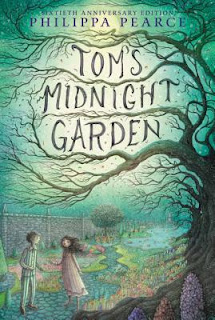
Tom's brother has the measles and to try to prevent Tom from getting them as well, he's hustled off to his childless aunt and uncle's home, a flat in a large house that's been divided. Tom is disappointed because he was looking forward to spending the school holidays playing in the garden with his brother. But, when the grandfather clock downstairs strikes 13, Tom is curious and he can't sleep, anyway, so he goes to peer out the back door, where he's been told there's a small parking area and a garbage bin but little else.
When Tom opens the door, instead he finds a large walled garden with plenty of room to explore and trees to climb. He finds that he's invisible to most of the people in the garden but there's a little girl who can see and speak to him. She thinks he's a ghost but that doesn't faze her; they become playmates. Each night, Tom sneaks out the door to the garden and plays in another time. Where and when does this garden exist? Is Tom's playmate the ghost of someone who used to live in the house?
Highly recommended - I can see why this book is a classic. It's beautifully written, mysterious, and absolutely sweeps you away to a magical time when nature was an endless playground. I loved every minute and was happy that the book ended exactly as I hoped it would.
I also found it quite interesting how a child's dangerous illness was handled in an earlier time (guessing his aunt and uncle had already had the illness?). Tom's Midnight Garden was published in 1958, undoubtedly pre-vaccine. His brother is ill for weeks, which fits my own experience as my vaccination didn't "take" and I was one of the rare children of my era who had the measles after being vaccinated.
Another book I'll hang onto for a potential reread and hopefully one that I can share with my grandchildren, someday.
©2022 Nancy Horner. All rights reserved. If you are reading this post at a site other than Bookfoolery or its RSS feed, you are reading a stolen feed. Email bookfoolery@gmail.com for written permission to reproduce text or photos.
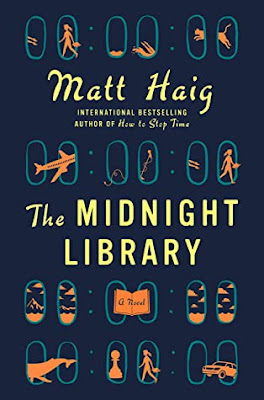
I read The Midnight Library primarily because I needed an upper and Matt Haig's books are pretty much guaranteed to be uplifting in some way. Bingo. Definitely a book that gives you hope.
The heroine in The Midnight Library has problems that she can't see her way out of. Nora Seed's lost her parents, her brother seldom speaks to her, her cat has died, and she's just lost her job. She can't find any reason to go on and decides to end it all but instead finds herself in a library, where she's told that she's between life and death by the woman who actually used to be her school librarian and helped her get through another rough time in her life. In this library, Nora can choose to relive her life if she'd made different decisions, large or small. All of them exist parallel to each other (so, it's a metaverse book). If she finds a life she prefers, she can stay. But, even the smallest thing that doesn't feel right will send her right back to the library.
At first, Nora relives changes to the most obvious regrets in her life. But, eventually Nora finds out that she can try things that are a bit outlandish. However, she doesn't have forever because it's possible that back in her known world, the body she tried to kill may die. If the clock in the library hits midnight, it's all over. Will she be able to find her perfect life and keep living it?
Highly recommended - The Midnight Library gets some pretty polarized reviews and I can see both sides but the bottom line, for me, was that I couldn't put it down and it makes a nice point about life being imperfect but worth living. It's schmaltzy, but I loved it. I gave it 5 stars. Having said that, the ending wasn't what I'd hoped for and I think Haig got the same theme across better in The Humans. But, his writing is clever and compelling and I can actually visualize myself rereading The Midnight Library in the future, when I need an upper again.
©2022 Nancy Horner. All rights reserved. If you are reading this post at a site other than Bookfoolery or its RSS feed, you are reading a stolen feed. Email bookfoolery@gmail.com for written permission to reproduce text or photos.
